 |
 LHS Episode #238: Open Research Institute Deep Dive
 24 July 2018 | by
  Welcome to Episode 238 of Linux in the Ham Shack. This time around we have an in-depth interview with Steve, AI4QR, and Michelle, W5NYV about Ubuntu Hams and the Open Research Institute. Discussion revolves around the two organizations, their focuses, directions, resources and active projects. Thanks so much to our guests and we hope you enjoy the program.
73 de The LHS Crew
Russ Woodman, K5TUX, co-hosts the Linux in the Ham Shack podcast which is available for download in both MP3 and OGG audio format. Contact him at [email protected].
Weekly Propagation Summary – 2018 Jul 23 16:10 UTC
Here is this week’s space weather and geophysical report, issued 2018 Jul 23 0031 UTC.
Highlights of Solar and Geomagnetic Activity 16 – 22 July 2018
Solar activity was very low throughout the period. Region 2716 (N16, L=199, class/area=Axx/10 on 21 Jul) was briefly the sole active region with sunspots, but was largely unproductive. No Earth-directed CMEs were observed this period.
No proton events were observed at geosynchronous orbit.
The greater than 2 MeV electron flux at geosynchronous orbit reached moderate levels on 22 Jul with normal levels observed through the rest of the period.
Geomagnetic field activity was quiet to unsettled on 16-17, 20-21 Jul with generally quiet conditions observed throughout the remainder of the period. The activity on 20-21 Jul was associated with the weak influence of a positive polarity coronal hole high speed stream.
Forecast of Solar and Geomagnetic Activity 23 July – 18 August 2018
Solar activity is expected to be very low throughout the outlook period.
No proton events are expected at geosynchronous orbit.
The greater than 2 MeV electron flux at geosynchronous orbit is expected to reach high levels on 23-31 Jul and moderate levels are expected on 01-11, and 18 Aug. Normal levels are expected throughout the remainder of the outlook period.
Geomagnetic field activity is likely to reach G1 (Minor) geomagnetic storm levels on 24 Jul due to the influence of a negative polarity coronal hole high speed stream. Active conditions are expected on 23, 25 Jul and 17 Aug due to the influence of multiple, recurrent coronal hole high speed streams. Quiet and quiet to unsettled conditions are expected throughout the remainder of the outlook period.
Don’t forget to visit our live space weather and radio propagation web site, at: http://SunSpotWatch.com/
Live Aurora mapping is at http://aurora.sunspotwatch.com/
If you are on Twitter, please follow these two users: 1. https://Twitter.com/NW7US 2. https://Twitter.com/hfradiospacewx
– – – – – – – – – – – – –
Be sure to subscribe to our space weather and propagation email group, on Groups.io
https://groups.io/g/propagation-and-space-weather
Spread the word!
– – – – – – – – – – – – –
Links of interest:
+ Amazon space weather books: http://g.nw7us.us/fbssw-aSWSC
+ https://Twitter.com/NW7US
+ https://Twitter.com/hfradiospacewx
Space Weather and Ham Radio YouTube Channel News:
I am working on launching a YouTube channel overhaul, that includes series of videos about space weather, radio signal propagation, and more.
Additionally, I am working on improving the educational efforts via the email, Facebook, YouTube, Tumblr, and other activities.
You can help!
Please consider becoming a Patron of these space weather and radio communications services, beginning with the YouTube channel:
https://www.patreon.com/NW7US
The YouTube channel:
https://YouTube.com/NW7US
..
Visit, subscribe: NW7US Radio Communications and Propagation YouTube Channel
ICQ Podcast Episode 272 – World Radio Team Championship 2018 Review
In this episode, Martin M1MRB is joined by Leslie Butterfield G0CIB, Edmund Spicer M0MNG, and Matthew Nassau M0NJX to discuss the latest Amateur / Ham Radio news. Colin M6BOY rounds up the news in brief, and this episode’s feature World Radio Team Championship 2018 Review.
ICQ AMATEUR/HAM RADIO PODCAST DONORS
We would like to thank our monthly and annual subscription donors for keeping the podcast advert free. To donate, please visit - http://www.icqpodcast.com/donate
- Sibling Radio Hams Assist in Road Race
- 96% Pass Rate in Cuban Amateur Radio Exam
- JOTA JOTI 2018 Registration Open
- UK SW Radio Listenership Continues Steep Decline
- 88 MHz Trans-Atlantic Signals Heard in Ireland
- Ham Radio Technology Used in Thailand Cave Rescue
- Google Map API Changes Affect Amateur Radio Sites
- Kenwood TS-890S Pricing Announced
Colin Butler, M6BOY, is the host of the ICQ Podcast, a weekly radio show about Amateur Radio. Contact him at [email protected].
6m … Where’d The Magic Go?

This summer's 6m sporadic-E (Es) DX season is now well past the half-way mark and things have been different ... a lot different. For me, the past 40 plus summers of activity on the magic band have always been interesting, if not down right exciting ... particularly when the band opens to Europe from the west coast.
These usually very short-lived paths have been my main interest for the past several years and the bread and butter mode is normally a fast CW exchange, usually taking less than 20 seconds before signals would vanish, as the always quirky west coast path to Europe would jump to another region. But this has all changed dramatically.
I have seen many strong openings involving loud FT8 signals from various parts of North America but when tuning down to the CW/SSB section of the band, found nothing but ghostly silence! Gone are the familiar voices of friends met every summer for decades or the recognition of an old friend's fist on CW ... for me personally, most of the magic was missing this summer. I wonder if this is all part of the natural evolution of amateur radio or does the FT8 revolution signal the long term fate for many of the older conventional modes?
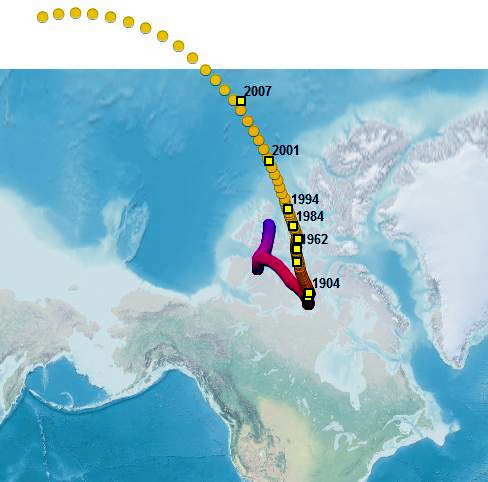 |
| Track the pole's movement here. |
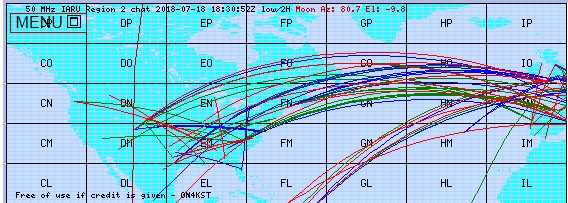 |
| July 18th courtesy: http://www.on4kst.org/chat/index.php |
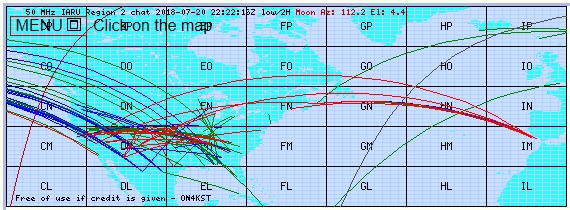 |
| July 20th courtesy: http://www.on4kst.org/chat/index.php |

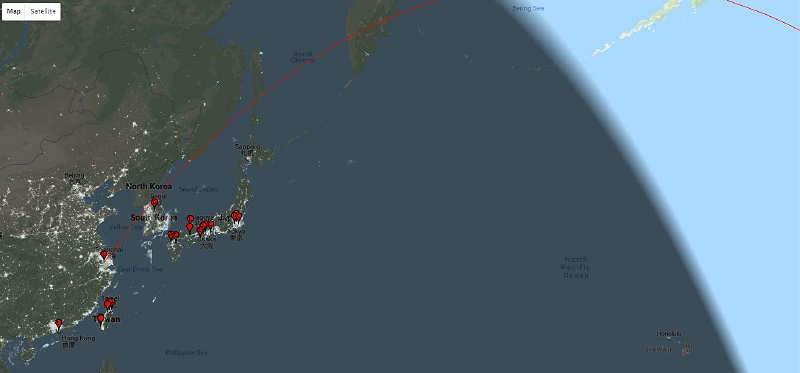 |
| Overnight decodes July 8-9 |
BM6GJL PL02
HL1BRU PM37
HL2IFR PM37
BG4QNE PM01
VR2VAZ OL72
BV2FB PL05
BV6CC PL03
BV1EK PL05
BM3GFU PL04
Thanks to Paul, K7CW, for doggedly sorting through my all-night decode file which may be viewed in full here.
With just a couple of weeks left in the normal Es season, it will be interesting to see if FT8's extra few db will extend it longer than usual!
Steve McDonald, VE7SL, is a regular contributor to AmateurRadio.com and writes from British Columbia, Canada. Contact him at [email protected].
Initial setup of SunSDR2 Pro

The only (as far as I know) software this radio will work with is ExpertSDR software. Having said that I am very happy with the software and questions I have asked on the forum has been answered very promptly. It runs very smoothly on my PC and the waterfall looks great! The next post I will be looking at the ExpertSDR software.
Mike Weir, VE9KK, is a regular contributor to AmateurRadio.com and writes from New Brunswick, Canada. Contact him at [email protected].
Operating Tips for VHF SOTA
 Here are some operating tips that I have found useful when doing Summits On The Air (SOTA) on VHF. I’ve been using VHF and higher frequencies for SOTA exclusively and have activated over 100 summits in Colorado (and other states such as California, Wyoming, New Mexico, North Carolina and Tennessee.)
The challenge with VHF and higher is that the radio range is limited compared with HF. (It really does help to bounce those signals off the ionosphere.) VHF propagation will vary depending on a lot of factors but for SOTA activations our range is typically 50 to 100 miles. In the backcountry of Colorado, a 50 mile radius may not include very many active radio amateurs, so you may come up short in terms of radio contacts.
First, take a look my blog posting about the basics: How To Do a VHF SOTA Activation
Next, here are some additional tips to having a successful activation:
Send Invitations
Get the word out to people that may be within range. I try to keep track of who I’ve worked in the past or know to be in a particular area and let them know when I’ll be activating. In some cases, I’ll go ahead and make a specific sked with a station. That is, we’ll meet on a particular frequency at a particular time, perhaps on CW or SSB for maximum weak signal performance.
Create an Alert and then Spot yourself on the sotawatch.org web page (using smartphone app).
Make Your Call
By the rules, SOTA contacts are always simplex, so on 2 meters the place to try is usually 146.52 MHz, the National Simplex Calling Frequency. (Some areas have established other 2m simplex frequencies to use for SOTA, so inquire locally.) This is the place to try calling.
Who are you going to find there? Hard to say. SOTA chasers will often listen to “five two”…that’s where they find SOTA activators. Also, there are radio hams that just like to hang out on 52…they like 2m fm operating but they don’t like repeaters so they listen here. You will also find that many mobile stations monitor 146.52 as they drive through rural areas. Basically, they are listening for anyone around but aren’t flipping from repeater to repeater as they change location. I’ll often hear 4WD enthusiasts, hikers, boaters, campers, etc. using Five Two.
Make It Sound Good
Realize that not everyone knows about SOTA so they may not know what the heck you are doing. Make a call such as this: “CQ CQ this is Kilo Zero November Romeo operating from Pikes Peak – Summits On The Air – anyone around?” Or “CQ 2 meters this is K0NR on Pikes Peak – Summits On The Air.”
Do a little bit of “selling” when you make your call. Sound like you are having fun.
Be Patient
Be patient. Sometimes it just takes time to accumulate your 4 QSOs to qualify for activator points. The few times I have been skunked on QSOs were when I did not have enough time, usually because storms were moving in. Keep calling every few minutes, taking a break once in a while to enjoy the view.
Try Other Frequencies
You may want to try other simplex frequencies, so know the band plan for the area you are activating in. Another trick is to get on a local 2m repeater and ask for someone to move over to simplex to work you. I have not had to do this very often but it does work. Have some of the local repeaters programmed into your radio.
Improve Your Station
Hopefully by now you know that using an HT with a rubber duck antenna is a bad idea. Get at least a half-wave vertical or roll-up j-pole antenna. Better yet, get a small yagi antenna to add 5 or 6 dB to your signal. It can make a big difference on who you can work. I’ve even started carrying a small 2m/70cm transceiver to get my 2m transmit power up to 30W.
Another angle is to use SSB and CW, which are much better for weak signal performance (compared to FM). This sets you up to work the serious VHF stations which tend to use these modes and have large high-gain antennas (horizontally polarized).
73, Bob K0NR
The post Operating Tips for VHF SOTA appeared first on The KØNR Radio Site.
Bob Witte, KØNR, is a regular contributor to AmateurRadio.com and writes from Colorado, USA. Contact him at [email protected].
LHS Episode #237: The Weekender XIII
 Welcome to the weekend! In this episode of Linux in the Ham Shack, your hosts discuss good food, good fun, good friends and some wonderful things to do and try on the next couple of weekends. Thank you so much for tuning in and we hope you're enjoying our show. Please leave us feedback and tell us how we're doing.
Cheers and 73 de The LHS Crew
Russ Woodman, K5TUX, co-hosts the Linux in the Ham Shack podcast which is available for download in both MP3 and OGG audio format. Contact him at [email protected].
 Ham Radio Deluxe |
 W5SWL Electronics |
 Ham Radio Prep |
 KB3IFH QSL Cards  Hip Ham Shirts  HamRadioAuctions HamRadioAuctions Reliance Antennas Reliance Antennas Enigma Shop Enigma Shop |  morseDX  Ni4L Antennas  R&L Electronics R&L Electronics antennas.us antennas.us QRV QRV |
- Matt W1MST, Managing Editor
