 |
 Hunting For NDBs In CLE 235
 20 August 2018 | by
  |
| BF-362 courtesy: Steven M O'Kelley |
This coming weekend will see another monthly CLE challenge. This time the hunting grounds will be 350.0 - 369.9 kHz.
For those unfamiliar with this monthly activity, a 'CLE' is a 'Co-ordinated Listening Event', as NDB DXers around the world focus their listening time on one small slice of the NDB spectrum.
A really good challenge in this one is to hear BF-362, located in Seattle, Washington. I suspect that it's a 25-watter but is rarely logged outside of the Pacific Northwest region. If you are east of Montana and can hear it, your system is working well!
Listen for BF's upper-sideband CW identifier (with your receiver in the CW mode) on 363.030 kHz while its lower-sideband can be heard on 360.943 kHz.
Although we are getting ever-closer to the fall DX season, lightning storms may yet be a problem, but at this time of the year we may get a lucky few quiet nights like this one in mid-June.
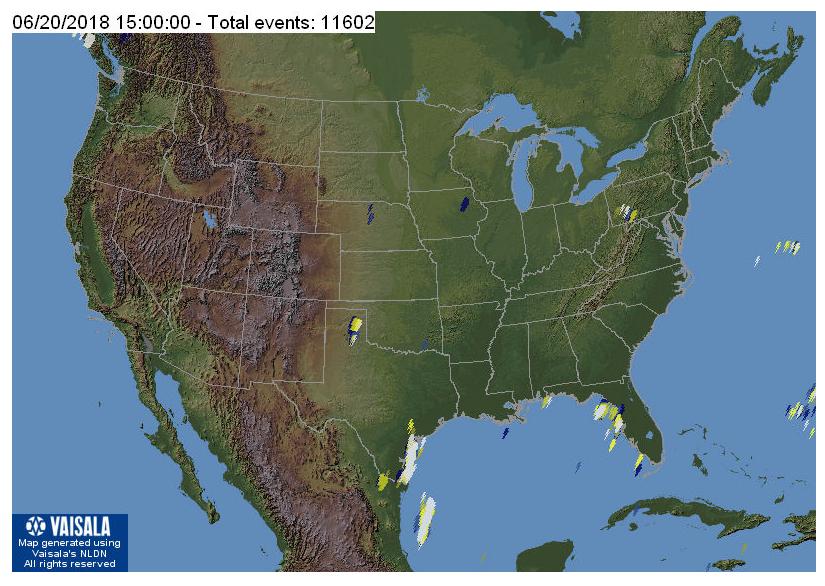 |
| courtesy: http://thunderstorm.vaisala.com/explorer.html |
If you are interested in building a system for the new (U.S.) 630m band, the CLE will give you the chance to test out your MF receiving capabilities and compare against what others in your area might be hearing.
When tuning for NDBs, put your receiver in the CW mode and listen for the NDB's CW identifier, repeated every few seconds. Listen for U.S. NDB identifiers approximately 1 kHz higher or lower than the published transmitted frequency since these beacons are modulated with a 1020 Hz tone approximately.
For example, 'AA' near Fargo, ND, transmits on 365 kHz and its upper sideband CW identifier is tuned at 366.025 kHz while its lower sideband CW ident can be tuned at 363.946 kHz. Its USB tone is actually 1025 Hz while its LSB tone is 1054 Hz.
Often, one sideband will be much stronger than the other so if you don't hear the first one, try listening on the other sideband.
Canadian NDBs normally have an USB tone only, usually very close to 400 Hz. They also have a long dash (keydown) following the CW identifier.
All NDBs heard in North America will be listed in the RNA database (updated daily) while those heard in Europe may be found in the REU database. Beacons heard outside of these regions will be found in the RWW database.
From CLE organizer Brian Keyte, G3SIA, comes the details:
Hello all
Here are the full details for this weekend's co-ordinated listening event.
It is open to everyone including CLE new-comers:
Days: Friday 24 August - Monday 27 August
Times: Start and end at midday, your LOCAL time
Range: 350.0 - 369.9 kHz
This range is a busy one, usually giving us a high number of NDBs heard.
We last concentrated on these frequencies during CLE219 in May 2017.
Wherever you are, please join us and log the NDBs that you can positively
identify that are listed in this busy frequency range (it includes 350.0 kHz
but not 370 kHz) plus any UNIDs that you come across there.
Send your CLE log to the List, preferably as a plain text email
(not in an attachment) with "CLE235 - FINAL Logs" at the start of its
subject line.
Please show on EVERY LINE of your log:
# The date ( e.g. 2018-08-24 or just the day no. 24 ) and UTC
(the day changes at 00:00 UTC).
# kHz (the beacon's nominal published frequency, if you know it)
# The Call Ident.
Show those main items FIRST on each line, before other optional details
such as Location, Distance, Offsets, Cycle time, etc.
If you send any incomplete logs to the List during the event, please also
send your 'FINAL', complete one.
Please always make your log interesting to everyone by showing your
own location and brief details of the receiver and aerial(s), etc., that
you were using.
We will send the usual 'Any More Logs?' email so that you can check that your log has been found OK.
You can check on all CLE-related information from the CLE Page
http://www.ndblist.info/cle.htm
It includes a link to seeklists for the Event from the Rxx Database.
Good listening
Brian
----------------------------------------------------------
From: Brian Keyte G3SIA ndbcle'at'gmail.com
Location: Surrey, SE England (CLE coordinator)
----------------------------------------------------------
(REMINDER: You could use any one remote receiver for your loggings,
stating the location and owner - with their permission if required.
A remote listener may NOT also use another receiver, whether local
or remote, to obtain further loggings for the same CLE).
-------------------------------------------------------------------
- determine, worldwide, which beacons are actually in service and on-the-air so the online database can be kept up-to-date
- determine, worldwide, which beacons are out-of-service or have gone silent since the last CLE covering this range
- will indicate the state of propagation conditions at the various participant locations
- will give you an indication of how well your LF/MF receiving system is working
- give participants a fun yet challenging activity to keep their listening skills honed
The Yahoo ndblist Group has been moved to Groups.io and The NDB List Group will now be found there! The very active group is a great place to learn more about the 'Art of NDB DXing' or to meet other listeners in your region. There is a lot of good information available there and new members are always very welcome. As well, you can follow the results of other CLE participants from night to night as propagation is always an active topic of discussion.
You need not be an NDB List member to participate in the CLEs and all reports, no matter how small, are of much value to the organizers.
Remember - 'First-time' logs are always VERY welcome!
Reports may be sent to the NDB List Group or e-mailed to CLE co-ordinator, Brian Keyte (G3SIA), whose address appears above. If you are a member of the group, all final results will also be e-mailed and posted there.
Please ... give the CLE a try ... then let us know what NDB's can be heard from your location! Your report can then be added to the worldwide database to help keep it up-to-date.
Have fun and good hunting!
Steve McDonald, VE7SL, is a regular contributor to AmateurRadio.com and writes from British Columbia, Canada. Contact him at [email protected].
Weekly Propagation Summary – 2018 Aug 20 16:10 UTC
Here is this week’s space weather and geophysical report, issued 2018 Aug 20 0445 UTC.
Highlights of Solar and Geomagnetic Activity 13 – 19 August 2018
Solar activity was very low. Two small regions developed on the visible disk this period. Region 2718 (S07, L=191, class/area Hrx/020 on 17 Aug) developed on 14 Aug and decayed to plage by 19 Aug. Region 2719 (S06, L=133, class/area Bxo/010 on 19 Aug) developed in the SE quadrant on 19 Aug. No significant flare events occurred from either region. Other activity included a filament eruption centered near S11W04 observed lifting off the solar disk at approximately 19/0538 UTC. An associated coronal mass ejection was observed off the SW limb in SOHO/LASCO C2 imagery at 19/0812 UTC. WSA/Enlil modelling of the event suggested the ejecta was primarily directed westward of the Sun-Earth line and is not expected to cause any significant effects.
No proton events were observed at geosynchronous orbit.
The greater than 2 MeV electron flux at geosynchronous orbit was at normal levels on 13-15 Aug, moderate levels on 16-17 Aug, and at high levels on 18-19 Aug. The largest flux of the period was 18,287 pfu observed at 19/1800 UTC.
Geomagnetic field activity ranged from quiet to active levels over the period. Solar wind speed was at nominal levels at the beginning of the period with solar wind speed ranging from 310-430 km/s while total field was between 1-4 nT. The geomagnetic field was quiet on 13-14 Aug. By 15 Aug, solar wind speed increased to approximately 450-500 km/s with total field increasing to a maximum of 14 nT by 16/1005 UTC as a positive polarity coronal hole high speed stream (CH HSS) moved into geoeffective position. A further increase in solar wind speed to near 570 km/s was observed late on 17 Aug before slowly receding to nominal levels by midday on 19 Aug. The geomagnetic field responded with quiet to active levels on 15-18 Aug. By late on 19 Aug, total field increase again to 12 nT along with an increase in solar wind to near 550 km/s as a negative polarity CH HSS was becoming geoeffective. However, only quiet levels were observed on 19 Aug.
Forecast of Solar and Geomagnetic Activity 20 August – 15 September 2018
Solar activity is expected to continue at very low levels.
No proton events are expected at geosynchronous orbit.
The greater than 2 MeV electron flux at geosynchronous orbit is expected to reach high levels on 22-27 Aug and again on 13-15 Sep due to CH HSS influence.
Geomagnetic field activity is expected to be unsettled to active levels on 20-25 Aug, 03-04 Sep, 07 Sep, and 11-15 Sep with a chance for G1 (Minor) geomagnetic storm levels on 20-21 Aug due to recurrent CH HSS activity.
Don’t forget to visit our live space weather and radio propagation web site, at: http://SunSpotWatch.com/
Live Aurora mapping is at http://aurora.sunspotwatch.com/
If you are on Twitter, please follow these two users: 1. https://Twitter.com/NW7US 2. https://Twitter.com/hfradiospacewx
– – – – – – – – – – – – –
Be sure to subscribe to our space weather and propagation email group, on Groups.io
https://groups.io/g/propagation-and-space-weather
Spread the word!
– – – – – – – – – – – – –
Links of interest:
+ Amazon space weather books: http://g.nw7us.us/fbssw-aSWSC
+ https://Twitter.com/NW7US
+ https://Twitter.com/hfradiospacewx
Space Weather and Ham Radio YouTube Channel News:
I am working on launching a YouTube channel overhaul, that includes series of videos about space weather, radio signal propagation, and more.
Additionally, I am working on improving the educational efforts via the email, Facebook, YouTube, Tumblr, and other activities.
You can help!
Please consider becoming a Patron of these space weather and radio communications services, beginning with the YouTube channel:
https://www.patreon.com/NW7US
The YouTube channel:
https://YouTube.com/NW7US
..
Visit, subscribe: NW7US Radio Communications and Propagation YouTube Channel
ICQ Podcast Episode 274 – PiStar – 12 months On
In this episode, Martin M1MRB is joined by Chris Howard M0TCH, Dan Romanchik KB6NU, Ed Durrant DD5LP and Frank Howell K4FMH to discuss the latest Amateur / Ham Radio news. Colin M6BOY rounds up the news in brief, and this episode’s feature is Austrian Innovation and US Book Review.
ICQ AMATEUR/HAM RADIO PODCAST DONORS
We would like to thank Charles Riley (G4JQX) and our monthly and annual subscription donors for keeping the podcast advert free. To donate, please visit - http://www.icqpodcast.com/donate
- FCC Action Against Illegally Marketed HT's
- Prohibiting Illegal Use of Two Way Radios in New Zealand
- Ofcom Release UK Amateur Ham Radio Callsign Figures
- VOACAP Propagation Prediction Wheel Returns
- Key Triathlon Role for Amateur Radio Operators
- BIRDS-2 CubeSats to Deployed
- 83% support 50 Watt Australian Foundation Power
- Paraguay Joins 60m
Colin Butler, M6BOY, is the host of the ICQ Podcast, a weekly radio show about Amateur Radio. Contact him at [email protected].
Amateur Radio Weekly – Issue 215

FT8 QSO Mode
No character type restrictions, 23 characters per 15 second transmit period.
KN4CRD
ARRL annual report highlights membership problems
Membership is forecast to continue to decline in 2018 (2% loss is forecast).
KB6NU
New FCC Part 95 rules
Additional FRS channels and increased power on certain FRS channels from 0.5 W to 2 W.
ARRL
AREDN mesh network progress
We have been working on bringing up an AREDN mesh network at ARRL HQ and here at AA6E.
AA6E
Nunavut operation
Active from Iqaluit, Nunavut as VY0BRR using all modes and all bands except 160.
Southgate
How much battery do you really need?
There are some basic battery concepts that will help you sort through this confusing topic.
Off Grid Ham
Breaking ground
With building permit in hand, it’s finally time to get my vertical… vertical again!
W0EA
SDR-Remote: A physical tuning and control knob for SDR#
This is a physical tuning knob that connects to your PC, and can be used with programs like SDR#.
RTL-SDR.com
Screwdriver antenna experiences
Even on a compact SUV.
Surrey Amateur Radio Club
Video
More on the J-pole Antenna
A close look at how the J-pole antenna works with special attention to how it’s fed.
David Casler
How to decode 433Mhz low power devices
Here we take a look at decoding some of the micro transmissions from Low Power Devices on the 433Mhz band using RTL433 software for Linux and Windows.
Tech Minds
Get Amateur Radio Weekly in your inbox.
Sign-up here
Amateur Radio Weekly is curated by Cale Mooth K4HCK. Sign up free to receive ham radio's most relevant news, projects, technology and events by e-mail each week at http://www.hamweekly.com.
AmateurLogic 120: Raspberry Pi for PC & Mac
AmateurLogic.TV Episode 120 is now available for download.
George installs Raspberry Pi Desktop for PC and Mac.
Tommy visits John Amodeo on the new set of Tim Allen’s Last Man Standing. Watch it come together.
Emile shows the long awaited, multifunction, PiClock.
October will be ALTV’s 13th Anniversary. We are celebrating with another contest. Get all the details here.
1:21:16
George Thomas, W5JDX, is co-host of AmateurLogic.TV, an original amateur radio video program hosted by George Thomas (W5JDX), Tommy Martin (N5ZNO), Peter Berrett (VK3PB), and Emile Diodene (KE5QKR). Contact him at [email protected].
MiniTiouner DATV Receiver built
The build was straightforward and there are some instructions by Mike G0MJW but only really referenced them for the commissioning stage, checking voltages etc. I was pleasantly surprised to see a large degree of protection on the board, fuses both filament and poly-fuse, reverse protection and zener diodes in the circuit.
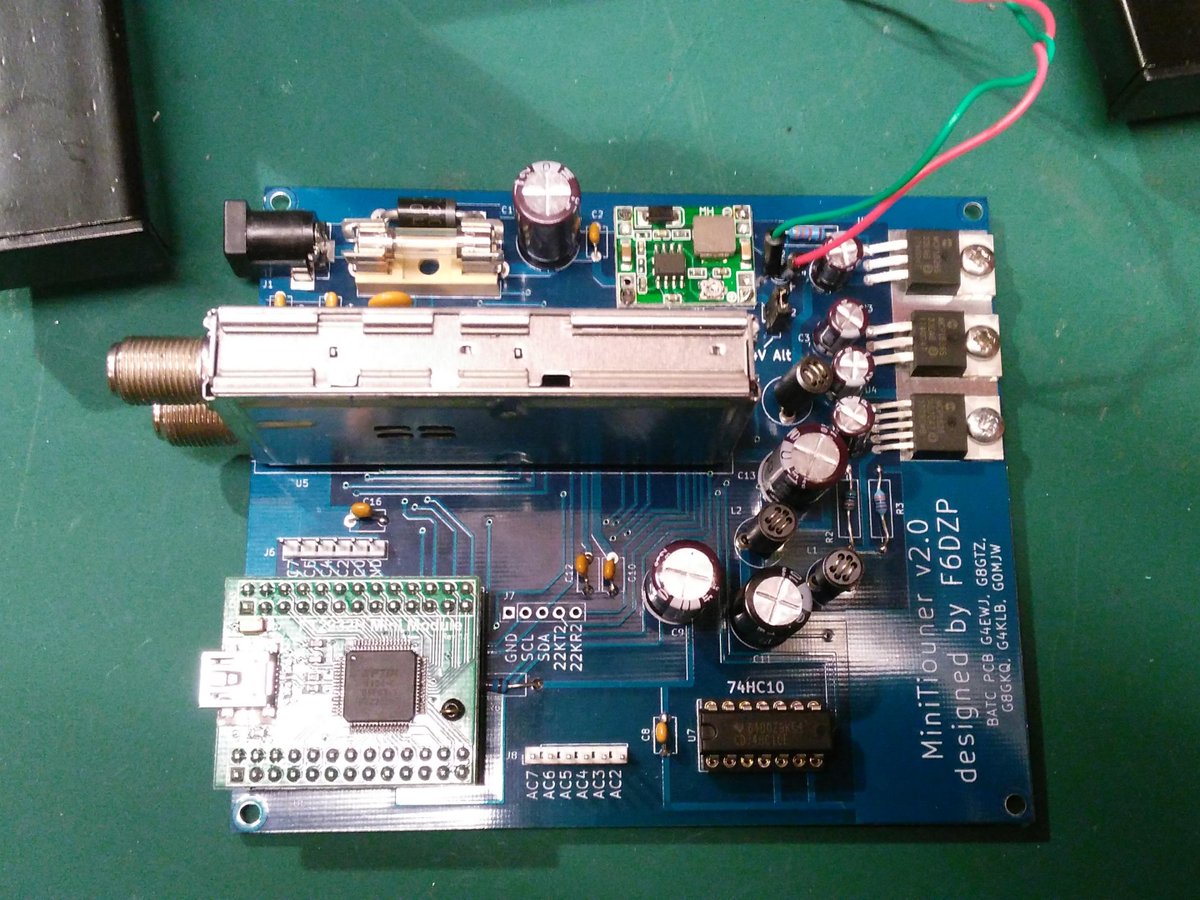
The MiniTiouner uses free to download DVB-S receive and analysis software called "Minitioune" written by F6DZP. The Software is hosted on the VivaDATV forum. So I registered and downloaded the software.
V8.0 of the software requires a pull-down resistor adding to the USB module to identify the type of board, so that was added (not pictured).
Power was connected and then plugged the USB lead into the PC (Windows 7 32bit) and it went off and installed drivers. The documentation said I should see two USB controllers, but I was seeing four?
There are several test programs included in the software package to test drivers and board and they were showing errors.
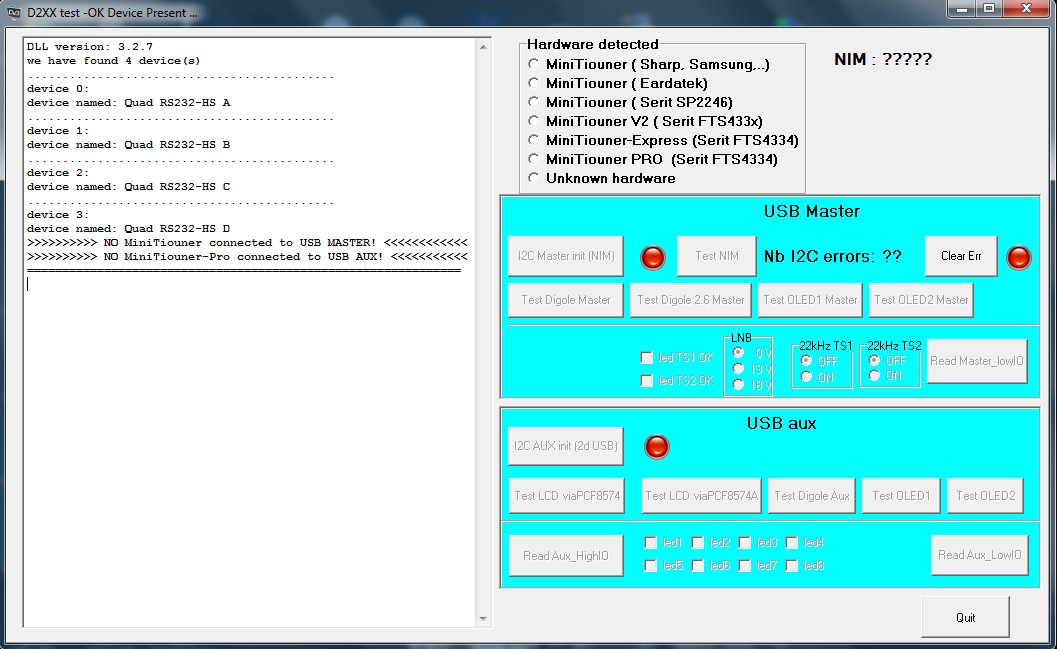

The PC I was using has had no end of serial USB devices plugged in and out over time so suspecting another Microsoft Windows "disappearing up its own backside" driver issue I tried it on another more vanilla machine but had the same problem.
This seemed to point to the USB interface (an FTDI FT2232H Mini Module) perhaps it wasn't programmed? So I downloaded the FTProg utility from FTDI but instead of seeing a FT2232H was showing it as a FT4232H device.
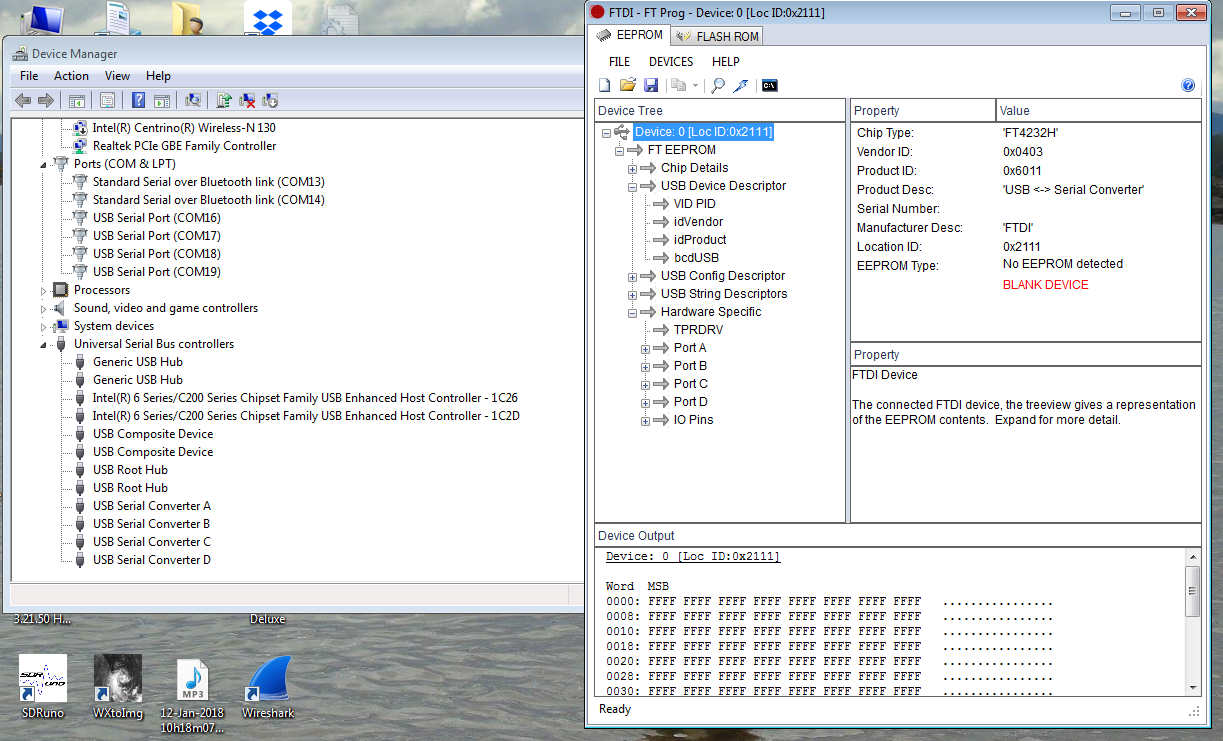
Doing a Google found a reference to the same problem. I downloaded the data-sheet and checking with a meter I could see pins CN2-5 and CN2-11(VIO) on the module didn't have 3.3V for some reason and as the post said if the VIO pin is missing 3.3V it defaults to a FT4232H. In the end I checked my soldering (no fault found) I removed the module from the socket to examine it and after re-seating it the board sprang to life so seems it was just a bad connection.
Eager to test I set up the ADALM-PLUTO SDR running DATVExpress as I'd done previously with the commercial set-top satellite receiver and we had a picture! It was time for a cup of tea!

Now it was working all that was left was to put it in a box.

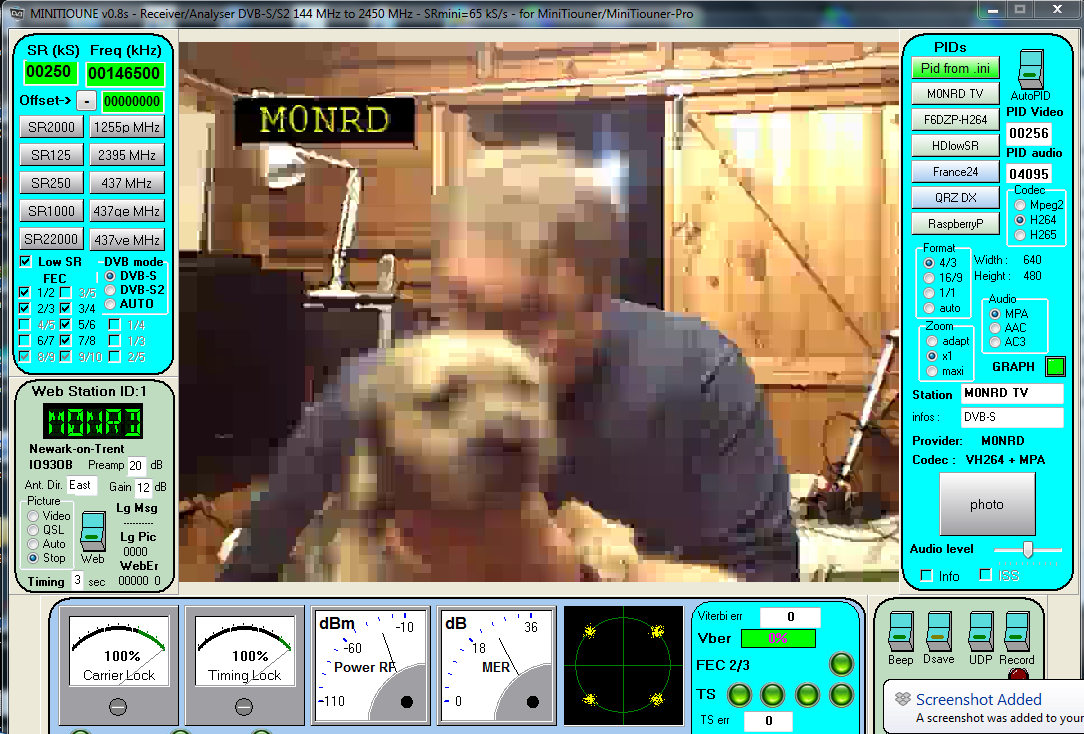
I have only had a brief play with the software since the weekend but was interested to see if I could receive some RB-TV (Reduced bandwidth) So I set the Pluto and DATVExpress to transmit on 146.500MHz using a low symbol rate (250 Ksymbols/s) and it worked! Bertie was wriggling a bit too much for a clear picture but I had now actually used my 146-147MHz NoV. Now just got to learn and understand the various modulations and settings.
I was able to try out another piece of software, the Spectrum Analyser from Steve Andrew for the SDRPlay. It turns the SDR receiver into a handy spectrum analyser with 10MHz bandwidth from 1kHz upto 2GHz and was able to check the output of the Pluto.
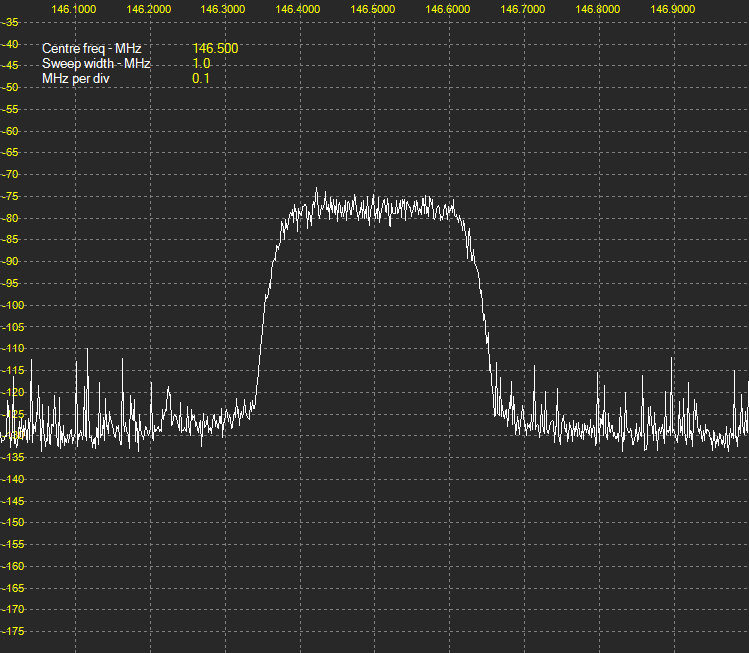
This wasn't a proper test setup by any means, the SDRPlay was still connected to the dual-band collinear outside the shack so the noise is the usual hash I see, but the Pluto was putting out a decent waveform, it did help putting on a proper resonant antenna (a spare mobile magmount) rather than the tiny one supplied.
I plan to do a bit more with the 5.6GHz FPV stuff before the weekend having took delivery of some nice grid antennas and hope to get out to try a contact or some tests with members of SKARS 73
Andrew Garratt, MØNRD, is a regular contributor to AmateurRadio.com and writes from East Midlands, England. Contact him at [email protected].
LHS Episode #241: The Dark Side of Open Source
 Welcome to Episode 241 of Linux in the Ham Shack. In this episode, the hosts discuss emcomm in Indonesia, the UN radio club, amateur radio license changes in Norway, open source software in automobiles and medical fields, becoming an APRS weather alert station an another dive into the Github bins. Thank you for listening! If you aren't supporting us yet, please consider clicking on the sponsored ads, picking up some merch or subscribing via Patreon. Every little bit helps us keep the show going.
73 de The LHS Crew
Russ Woodman, K5TUX, co-hosts the Linux in the Ham Shack podcast which is available for download in both MP3 and OGG audio format. Contact him at [email protected].
 Ham Radio Deluxe |
 W5SWL Electronics |
 Ham Radio Prep |
 KB3IFH QSL Cards  Hip Ham Shirts  HamRadioAuctions HamRadioAuctions Reliance Antennas Reliance Antennas Enigma Shop Enigma Shop |  morseDX  Ni4L Antennas  R&L Electronics R&L Electronics antennas.us antennas.us QRV QRV |
- Matt W1MST, Managing Editor
