 |
 Ham College 49
 3 February 2019 | by
 Ham College episode 49 is now available for download.
General Amateur Radio Exam part 20. More on modulation. Coaxial cable loss explored.
1:07:03
George Thomas, W5JDX, is co-host of AmateurLogic.TV, an original amateur radio video program hosted by George Thomas (W5JDX), Tommy Martin (N5ZNO), Peter Berrett (VK3PB), and Emile Diodene (KE5QKR). Contact him at [email protected].
ICQ Podcast Episode 286 – Peanut the D-Star App
In this episode, Martin M1MRB is joined by Leslie Butterfield G0CIB, Edmund Spicer M0MNG and Ed Durrant DD5LP to discuss the latest Amateur / Ham Radio news. Colin M6BOY rounds up the news in brief and this episode’s feature is Peanut the Dstar App.
ICQ AMATEUR/HAM RADIO PODCAST DONORS
We would like to thank Keith Schlottman (KR7RK) and Richard Perzyna (G8ITB) along with our monthly and annual subscription donors for keeping the podcast advert free. To donate, please visit - http://www.icqpodcast.com/donate
- Student Promotes Ham Radio
- Bloomington South School on the Air
- Public Consultation on Electromagnetic Field Regulations
- PocketRxTx v3 Released
- Geoffrey Starks Sworn in as FCC Commissioner
- Nominate for CWops Award
Colin Butler, M6BOY, is the host of the ICQ Podcast, a weekly radio show about Amateur Radio. Contact him at [email protected].
LHS Episode #269: The Weekender XXIII

Welcome to our latest edition of The Weekender. In this episode, the hosts discuss the usual blend of hedonism mixed with some upcoming amateur radio contests and special event stations, interesting Linux distributions, open-source events and news, interesting discussion and much more. Thank you for being a listener. We appreciate each and every one of you!
73 de The LHS Crew
Russ Woodman, K5TUX, co-hosts the Linux in the Ham Shack podcast which is available for download in both MP3 and OGG audio format. Contact him at [email protected].
CLE240 Results
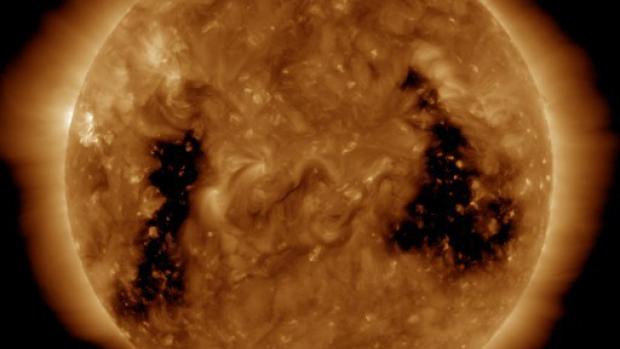 |
| courtesy: NOAA |
Last weekend’s CLE240 saw mediocre propagation for North America and European listeners alike.
It seems that our monthly CLE schedule continues to be synced with the Sun’s monthly rotational period that has been regularly lining us up with the same massive coronal hole, elevating earth-directed solar wind speeds now for several months.
Several CLE participants in the USA commented on the lack of any propagation into BC, further fueling my long-held belief that BC seems particularly sensitive to any geomagnetic activity in the auroral zone to our north. The auroral activity always seems to dip further to the south here for some anomalous reason, as listeners just a few hundred miles to the south or southeast see far less absorption than is observed here.
With a few exceptions, the main effect of these conditions is to largely kill the normal east-west propagation path and just allow single-hop signals from the south or the SE/NW to dominate. Typically, the path to the Pacific is not affected and can often be enhanced.
As a side observation, this past weekend was also the CQWW 160m DX contest and, as one left-coaster commented, conditions were the “worst seen in 10 years”. One would expect to see much better conditions and a much quieter Sun at this point in the solar cycle!
With fingers crossed for better propagation during the next CLE, here is what was logged over the three-night listening event from my location here in BC’s Southern Gulf Islands using a Perseus SDR and an Inverted-L antenna resonated to 400 kHz:
26 05:00 385 QV Yorkton, SK, CAN
26 07:00 385 OCC Yakutat, ALS
26 09:00 385 MR Pacific Grove, CA, USA
26 09:00 385 EHM Cape Newenham, ALS
27 07:00 385 CPZ Chaparrosa Ranch, TX, USA
26 07:00 386 SYF St. Francis, KS, USA
26 09:00 386 HAU Helena, MT, USA
26 06:00 388 OK Preston, OK, USA
26 07:00 388 MM Fort Mc Murray, AB, CAN
26 07:00 388 JW Pigeon, AB, CAN
26 06:00 388 CDX Somerset, KY, USA
26 06:00 389 YWB Kelowna, BC, CAN
26 04:00 389 TW Twin Falls, ID, USA
26 07:00 389 CSB Cambridge, NE, USA
26 07:00 390 HBT Sand Point, ALS
26 11:00 390 AES Northway, ALS
26 04:00 391 TK Telkwa, BC, CAN
26 11:00 391 GXD Nacogdoches, TX, USA
26 07:00 391 EEF Sisters Island, ALS
26 06:00 391 DDP Dorado, PTR
26 09:00 392 ZFN Tulita, NT, CAN
26 05:00 392 PNA Wenz, WY, USA
26 05:00 392 ML Charlevoix, QC, CAN
26 08:00 392 FMZ Fairmont, NE, USA
26 10:00 393 UKS Kosrae, FSM
26 04:00 394 RWO Kodiak, ALS
26 07:00 394 DQ Dawson Creek, BC, CAN
26 07:00 395 YL Lynn Lake, MB, CAN
26 04:00 395 ULS Ulysses, KS, USA
26 07:00 395 5V Drumheller, AB, CAN
26 07:00 396 YPH Inukjuak, QC, CAN
26 05:00 396 CRS Corsicana, TX, USA
26 05:00 396 CMJ Ketchikan, ALS
26 07:00 397 ZSS Saskatoon, SK, CAN
27 12:00 397 SB San Bernardino, CA, USA
26 10:00 398 YOD Cold Lake, AB, CAN
26 06:00 398 3D Cumberland House, SK, CAN
26 11:00 399 ZHD Dryden, ON, CAN
26 11:00 399 SRI Pribilof, ALS
A summary of results for all participants can be found here, at the ndblist info site.
Steve McDonald, VE7SL, is a regular contributor to AmateurRadio.com and writes from British Columbia, Canada. Contact him at [email protected].
LHS Episode #268: Getting the AX

Welcome to the 268th episode of Linux in the Ham Shack! In this episode, we discuss several amateur radio, Open Source and Linux in the Ham Shack-y topics. Those include a special call sign prefix for Australia, the Amateur Radio Parity Act (again), vulnerabilities in APT, API vs. IP, PJON, Pat and so much more. Thank you for tuning in. We love you all.
73 de The LHS Crew
Russ Woodman, K5TUX, co-hosts the Linux in the Ham Shack podcast which is available for download in both MP3 and OGG audio format. Contact him at [email protected].
Slimming down
This post builds on the RPi Zero W Cloudlog installation that I did in December with a RPi 3 that was destined to be used in the shack for something. I have long used a laptop to do most of the heavy lifting but have moved most of the clever stuff on to individual machines. The line up is growing but is a bit all over the place. I have….
- A RPi3 as a VHF SatNOGS station that runs nicely but needs a proper home (antenna ia indoors and a lash up)
- A RPi3 as a UHF SatNOGS station that is subject to loads of noise at the moment which needs a cure. It also needs a better home
- A RPi2 as a Flight Radar receiver
A spare RPi3 that was used as a media player in the lounge. Now redundant really as tech has moved on. This needed a new function. So I thought I would bring it into service as a shack server. Trouble is I have no expereince of servers and even the word makes me quiver. I tend to smile, nod politely (It’s a British thing) then retreat carefully to avoid uncomfortable conversation. Anyway it’s time to take the plunge a bit further. I have after all mastered the Cloudlog thing.
What distribution?
Normally I would run straight to Rasbian, but this time I made a detour through to DietPi. It’s a ligh tweight distribution that supports a few bits of software that are simple to install and configure. Perfect for the lazy, like me. The game is pretty much the same s every Raspberry Pi installation. Find a suitable SD card, burn the image to it and start the machine up. For this the recommendation is to hook up a screen and keyboard for the first bit until it’s all running then you can use SSH or whichever is your preferred method for getting into the machine once it is up and running.
What software?
Well Cloudlog for a start. That needed the webserver reinstalling. Guess what? DietPi had one. check the box and that gets installed. Then it was a simple fact of getting Cloudlog reinstalled. Job done and it took a lot less time this go. (need to find a log for this).
Next up was Pi-hole. I’m ok with a bit of advertising, people have got to make a living I suppose but I feel like I’m  swimming in a sea of bollocks (figuratively of course, I couldn’t really visualise this literally and don’t want too). Pi-hole claims to reduce the adverts to a more normal level and stops my browser looking like a version of the $1m dollar website (if you can remember that). Something has got to change. Installation was again more simple that you might imagine. Check the box and let the installer do its thing. As I had no idea what I was doing I used the default installation but made the error of not pointing my DNS server to the installation in my router settings. Don’t forget to do that otherwise it won’t do a thing.
There is a nice dashboard that gets filled with clever stuff. Bottom line is that there are already fewer ads on all my devices. Ace!

So what happens now?
Not much really. If you would like to have a go with a really lightweight distro for your raspberry pi (or other sbc – they support all sorts) then give it a go. The easy installation of software make a big difference for dullards like me and avoids time wasting.
I have thought about plugin in a RTL-SDR as a server but don’t really have a need at the moment. Perhaps something for the PiKon telescope now that I have got the lens. We’ll see how the thing goes. One thing I would like is a really simlpe website that does one thing on a button press, but that is a whole new game and perhaps another post.
I’m going to start planning my SOTA activations now 
Alex Hill, G7KSE, is a regular contributor to AmateurRadio.com and writes from Cumbria, UK. Contact him at [email protected].
Amateur Radio Weekly – Issue 228

SSTV from International Space Station
The Inter-MAI amateur radio Slow Scan Television experiment in the Russian Service Module of the International Space Station is scheduled to be activated Jan 30 – Feb 1 on 145.800 MHz FM.
AMSAT UK
Will opaqueness kill Brandmeister?
In response to the ill-advised Brandmeister ban on the DV4mini devices by Corey Dean (N3FE), I approached some of the key personnel behind the Brandmeister DMR system.
K2DLS
ARRL to re-examine Parity Act
The organization needs to “review, re-examine, and reappraise ARRL’s regulatory and legislative policy with regard to private land use restrictions.”
ARRL
The 1859 Carrington Event
The Carrington Event of 1859 was a glimpse of what our star is capable of under the right circumstances, the implications of which are sobering indeed given the web of delicate connections we’ve woven around and above the planet.
Hack A Day
QRP FT8 Operating Tips
A few tips on making the most out of FT8, especially when operating QRP.
N0SPN
Industrial machines easily hacked with Software Defined Radios
Take control of building cranes, excavators, scrapers and other large industrial machines with a simple bladeRF software defined radio.
RTL-SDR.com
The Knitted Radio
The Knitted Radio is an installation piece that manifests how to knit a sweater that is also an FM radio transmitter.
Irene Posch
Video
Breaking the bandwidth barrier with your oscilloscope
What if you don’t care about getting an accurate representation? What can you do?
Keysight Labs
Quartzfest Jan 19, 2019
No other gathering in the world brings together so much hands-on demos and innovation in mobile systems.
K7AGE
Introduction to the IC-9700
We have been fortunate to have had an engineering sample of the IC-9700 VHF/UHF Base Station Amateur SDR Transceiver.
Icom
Get Amateur Radio Weekly in your inbox.
Sign-up here
Amateur Radio Weekly is curated by Cale Mooth K4HCK. Sign up free to receive ham radio's most relevant news, projects, technology and events by e-mail each week at http://www.hamweekly.com.
 Ham Radio Deluxe |
 W5SWL Electronics |
 Ham Radio Prep |
 KB3IFH QSL Cards  Hip Ham Shirts  HamRadioAuctions HamRadioAuctions Reliance Antennas Reliance Antennas Enigma Shop Enigma Shop |  morseDX  Ni4L Antennas  R&L Electronics R&L Electronics antennas.us antennas.us QRV QRV |
- Matt W1MST, Managing Editor
