 |
 Hunting For NDBs In CLE241
 19 February 2019 | by
 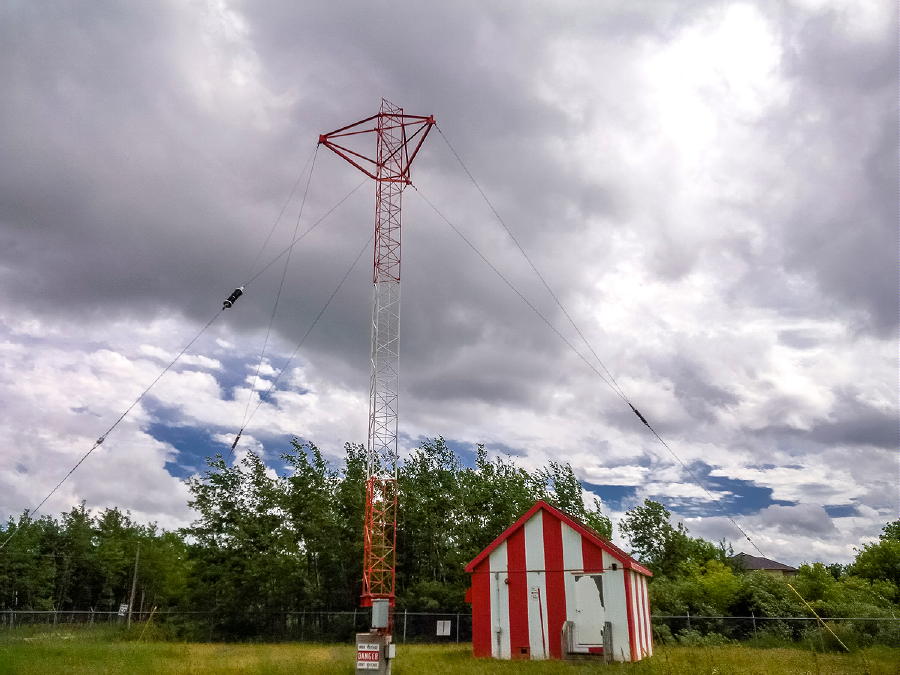 |
| ZWW - 215 courtesy: VE3GOP |
For those unfamiliar with this monthly activity, a 'CLE' is a 'Co-ordinated Listening Event', as NDB DXers around the world focus their listening time on one small slice of the NDB spectrum.
Never tried the CLE? If you've ever been wondering what can be heard 'below' the broadcast band, this weekend would be a great time to give a listen and enter your first CLE!
A nice challenge in this one is to hear 'ZWW' on 215 kHz located near Winnipeg, Manitoba. It's a 25-watter and is well-heard throughout North America. Listen for its CW identifier on 215.388 kHz (repeated every 10 seconds), with your receiver in the CW mode .
MF propagation this week has been good and signals in this frequency range should be propagating well if things stay undisturbed for the weekend.
When tuning for NDBs, put your receiver in the CW mode and listen for the NDB's CW identifier, repeated every few seconds. Listen for U.S. NDB identifiers approximately 1 kHz higher or lower than the published transmitted frequency since these beacons are modulated with a 1020 Hz tone approximately.
For example, 'AA' near Fargo, ND, transmits on 365 kHz and its upper sideband CW identifier is tuned at 366.025 kHz while its lower sideband CW ident can be tuned at 363.946 kHz. Its USB tone is actually 1025 Hz while its LSB tone is 1054 Hz.
Often, one sideband will be much stronger than the other so if you don't hear the first one, try listening on the other sideband.
Canadian NDBs normally have an USB tone only, usually very close to 400 Hz. They also have a long dash (keydown) following the CW identifier.
All NDBs heard in North America will be listed in the RNA database (updated daily) while those heard in Europe may be found in the REU database. Beacons heard outside of these regions will be found in the RWW database.
From CLE organizer Brian Keyte, G3SIA, come details via the The NDB List Group:
Hello all,
Our 241st Co-ordinated Listening Event is next weekend.
Do join in if you can. First-time CLE logs will also be very welcome.
Days: Fri. 22 Feb. - Mon. 25 Feb., Midday-Midday, your local time
Frequencies: NDBs from 190 - 239.9 kHz
PLUS: Normal NDBs with carriers on 'half-way' frequencies ‘nnn.5 kHz’
(from 190.5 - 999.5 kHz)
Both halves are for everyone to try.
Away from Europe many of the frequencies below 240 kHz are busy with
NDBs. In Europe there are very few, but some DX ones might be heard
from North America and maybe from a few other places.
The normal NDBs which have carriers on the 'half-way' frequencies
e.g. 267.5 OPW, 333.5 VOG, 370.5 LB, 390.5 ITR, 433.5 HEN (not DGPS)
are scattered across Europe but there are very few of them elsewhere.
'Hot spots' are ENG and ITA.
These half-frequencies usually give comfortable QRM-free listening
and probably some good catches as a result.
America has only one or two (e.g. 381.5 SJX in MI) but East and West
coasters might hear some DX ones.
We last used these 'rules' for CLE225 in November 2017.
Please look out for the Final Details about two days before the CLE.
73
Brian
----------------------------------------------------------------------------
From: Brian Keyte G3SIA ndbcle'at'gmail.com
Location: Surrey, SE England CLE Coordinator)
----------------------------------------------------------------------------
- determine, worldwide, which beacons are actually in service and on-the-air so the online database can be kept up-to-date
- determine, worldwide, which beacons are out-of-service or have gone silent since the last CLE covering this range
- will indicate the state of propagation conditions at the various participant locations
- will give you an indication of how well your LF/MF receiving system is working
- give participants a fun yet challenging activity to keep their listening skills honed
The NDB List Group is a great place to learn more about the 'Art of NDB DXing' or to meet other listeners in your region. There is a lot of good information available there and new members are always very welcome. As well, you can follow the results of other CLE participants from night to night as propagation is always an active topic of discussion.
You need not be an NDB List member to participate in the CLEs and all reports, no matter how small, are of much value to the organizers.
Remember - 'First-time' logs are always VERY welcome!
Reports may be sent to the NDB List Group or e-mailed to CLE co-ordinator, Brian Keyte (G3SIA), whose address appears above. If you are a member of the group, all final results will also be e-mailed and posted there.
Please ... give the CLE a try ... then let us know what NDB's can be heard from your location! Your report can then be added to the worldwide database to help keep it up-to-date.
Have fun and good hunting!
Steve McDonald, VE7SL, is a regular contributor to AmateurRadio.com and writes from British Columbia, Canada. Contact him at [email protected].
ARRL DX CW 2019 in the books
 |
| The setup |
As for the contest I was running 60 watts (not sure of reason for the 60 watt number) and my antenna is the MFJ 1788 mag loop. I am in a condo so it’s a balcony antenna about 180 feet up facing south east. The software was N1MM+ and MRP40 CW decoder for the super fast fisted contesters. On Sunday the winds for some reason really picked up and my MFJ loop was moving around the balcony. I shut the radio down and took it in I would rather save the antenna from damage than taking a chance on getting more contacts.
I made only 25 contact and a score of 1575 BUT my intention was not to blow the doors off with a great score. Instead after I made contact with a station I would look them up on QRZ.COM and read about either the individual or the contest station. Over all the limited time I was in the contest I had a blast and was very please with the Icom 7610 and the ability of my balcony mounted Mag loop antenna.
Mike Weir, VE9KK, is a regular contributor to AmateurRadio.com and writes from New Brunswick, Canada. Contact him at [email protected].
VE3WDM's QRPower BLOG 2019-02-17 17:03:00
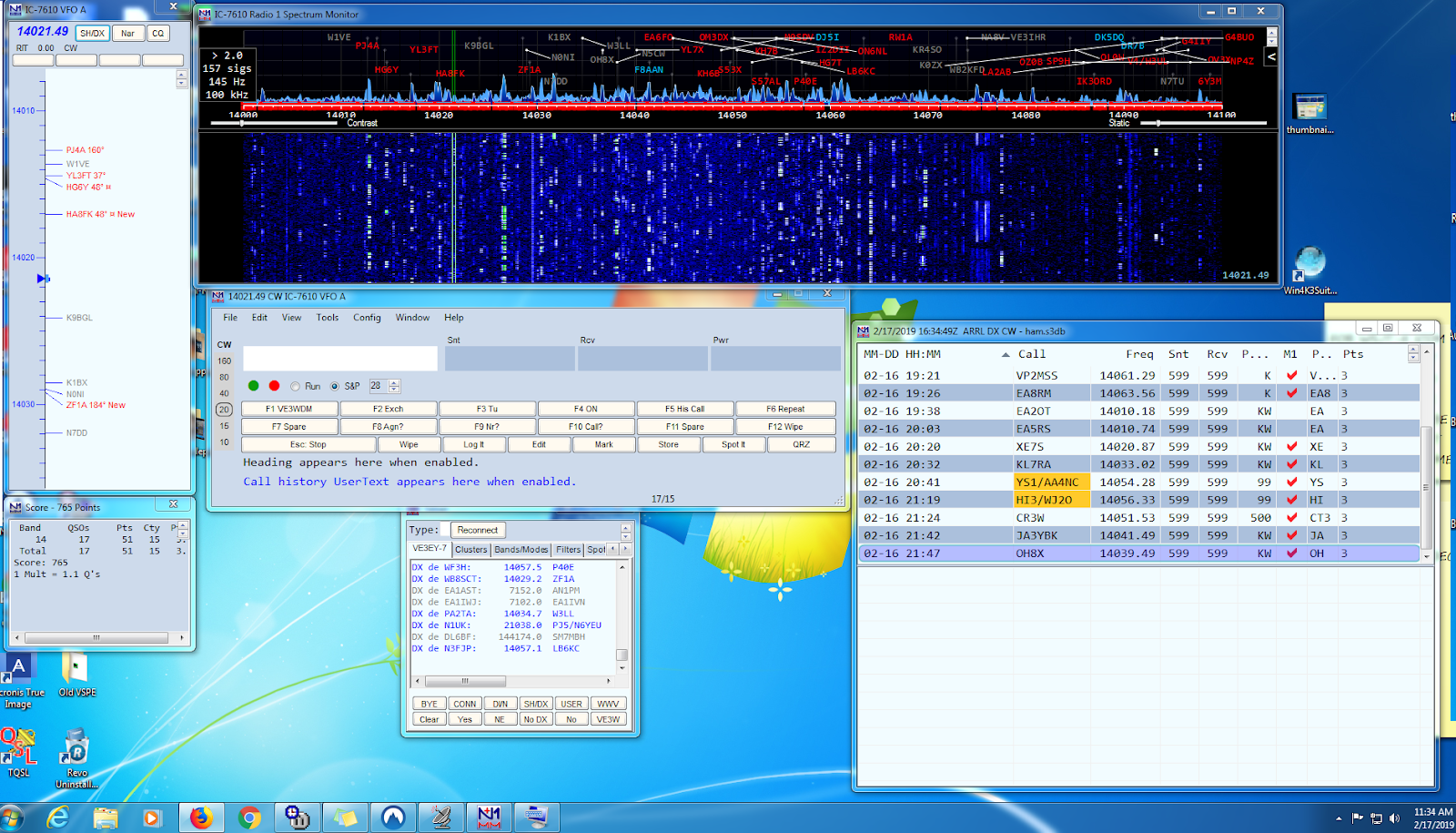
I will see if the propagation gods are smiling down on me today as I give the contest another go this afternoon.
Mike Weir, VE9KK, is a regular contributor to AmateurRadio.com and writes from New Brunswick, Canada. Contact him at [email protected].
ICQ Podcast Episode 287 – 50 years of Worked All Britain
In this episode, Martin M1MRB is joined by Chris Howard M0TCH, Martin Rothwell M0SGL, Dan Romanchik KB6NU and Frank Howell K4FMH to discuss the latest Amateur / Ham Radio news. Colin M6BOY rounds up the news in brief and this episode’s feature is 50 years of Worked All Britain.
ICQ AMATEUR/HAM RADIO PODCAST DONORS
We would like to thank Robert Giesel (KE5VLI) along with our monthly and annual subscription donors for keeping the podcast advert free. To donate, please visit - http://www.icqpodcast.com/donate
- Ham Radio License in a Day
- Qatar OSCAR-100 Web Receiver Live
- Supporting Innovation through Wireless Technology
- Two Milestones in Distance Learning
- Electronics Notes Opens a Ham Radio Store
- Reflecting on 50 years in the Radio Business
- Reshaping ARRL Objectives
- US Navy Explores Amateur Radio as a Training Adjunct
- RSGB Company Secretary Vacancy
- US Amateur Radio Population Grows Slightly in 2018
Colin Butler, M6BOY, is the host of the ICQ Podcast, a weekly radio show about Amateur Radio. Contact him at [email protected].
AmateurLogic 127: Winter Projects
AmateurLogic.TV Episode 127 is now available for download.
Emile and the Ozone ARC participate in Winter Field Day. Winter is the perfect time to catch up on projects. Tommy shows how to update the firmware of a DVMega. After six years, George revisits Echolink on the Raspberry Pi. SVXlink part-1. Plus your viewer email.
1:11:25
George Thomas, W5JDX, is co-host of AmateurLogic.TV, an original amateur radio video program hosted by George Thomas (W5JDX), Tommy Martin (N5ZNO), Peter Berrett (VK3PB), and Emile Diodene (KE5QKR). Contact him at [email protected].
LHS Episode #272: The Weekender XXIV
Good grief! It's the latest edition of the Weekender! In this episode, the hosts put together a list of amateur radio contests and special events, upcoming open source conferences and a hefty does of hedonism that blends together and goes down like a luxurious sippin' whiskey. Thank you for tuning in and we hope you have an amazing upcoming fortnight.
73 de The LHS Crew
Russ Woodman, K5TUX, co-hosts the Linux in the Ham Shack podcast which is available for download in both MP3 and OGG audio format. Contact him at [email protected].
SOTA News: Joyce/K0JJW Is Half a Goat
Recently, my SOTA Activating Partner and Spousal Unit Joyce/K0JJW racked up more than 500 activating points for Summits On The Air (SOTA). This is halfway towards the coveted Mountain Goat award, so naturally this is referred to as Half Mountain Goat. Steve/WG0AT noticed this achievement and created this certificate for her.

She has activated 108 summits in 13 different associations (including HB Switzerland). All radio contacts have been on the VHF/UHF bands. She really likes it when another woman gets on the air with her, which she calls F2F (Female-to-Female) radio contact.
Congratulations, Joyce!
73 Bob K0NR
The post SOTA News: Joyce/K0JJW Is Half a Goat appeared first on The KØNR Radio Site.
Bob Witte, KØNR, is a regular contributor to AmateurRadio.com and writes from Colorado, USA. Contact him at [email protected].
 Ham Radio Deluxe |
 W5SWL Electronics |
 Ham Radio Prep |
 KB3IFH QSL Cards  Hip Ham Shirts  HamRadioAuctions HamRadioAuctions Reliance Antennas Reliance Antennas Enigma Shop Enigma Shop |  morseDX  Ni4L Antennas  R&L Electronics R&L Electronics antennas.us antennas.us QRV QRV |
- Matt W1MST, Managing Editor
