 |
 Radcom didn’t show?
 30 March 2019 | by
 Over the last few years I have started to lose magazines I subscribe to that are delivered by Royal Mail.
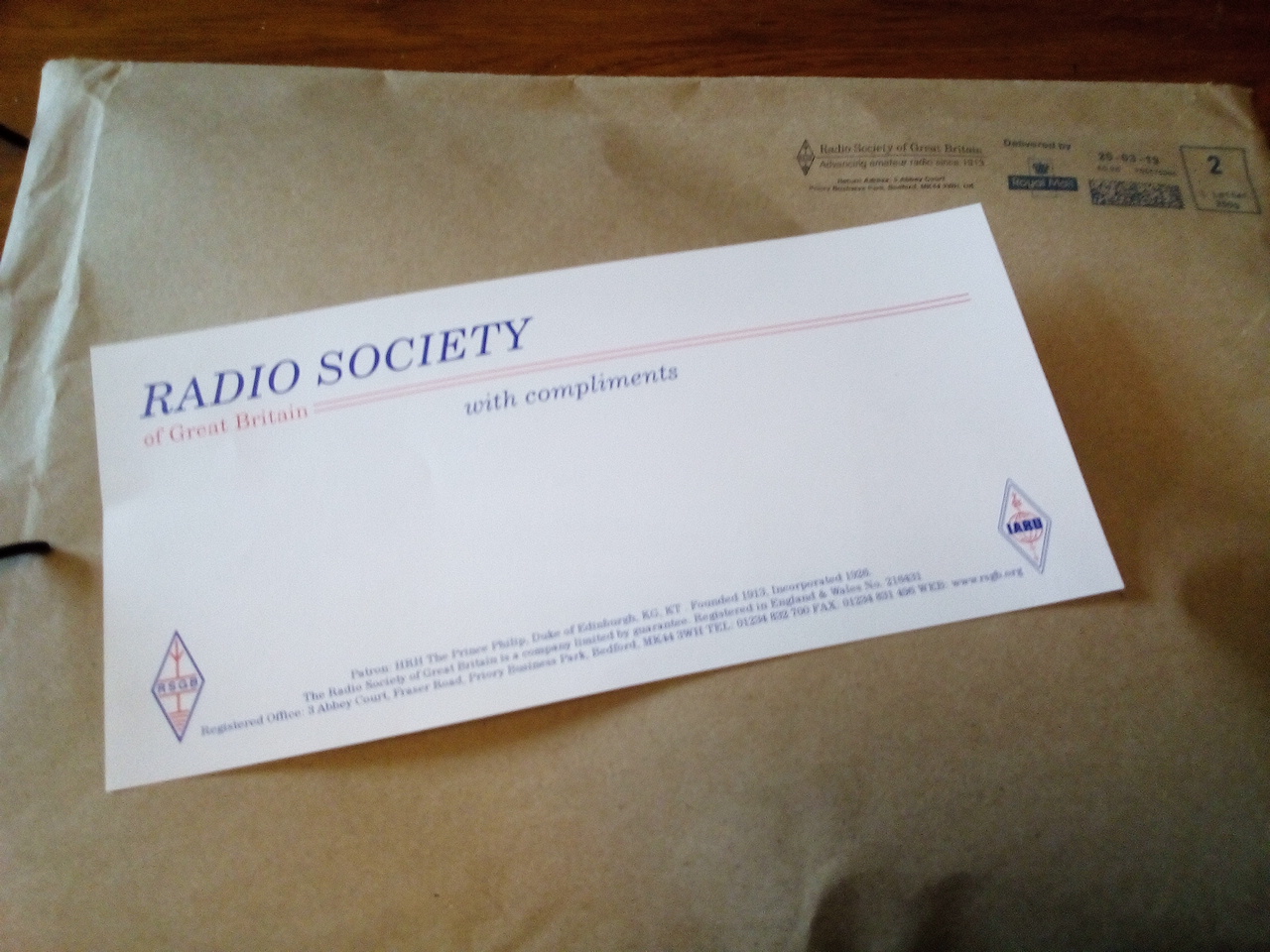
This month it was Radcom's turn, the April edition didn't show it's face. At least a week had gone by after despatch to the membership. One has to be on the ball, it would be easy for the month to pass and the next month to roll in and the copy might not be missed if I was busy. I seem to remember it was about this time last year that Radcom had gone missing, the year before that it was QST, do I have someone snaffling my post?
Anyway a quick call to the RSGB office and there was one sent out in a plain brown envelope very quick! But I had missed the window of opportunity for persusing members ads, which you have to be quick if one is on the lookout for a bargain.
Steve, G1KQH, is a regular contributor to AmateurRadio.com and writes from England. Contact him at [email protected].
Amateur Radio Weekly – Issue 235

Last chance: 2019 State of the Hobby Survey
This benchmark can help us determine what is working and what is not in the ham radio community. This can involve participation, recruitment, mentoring and licensing. It can also help identify new and emerging trends in amateur radio. Please take a few minutes to complete the survey and share with others in the hobby.
N8RMA
ISS SSTV transmissions April 1-2
Cosmonauts on the International Space Station will again be transmitting SSTV images, April 1-2, on 145.800 MHz FM as part of the Inter-MAI-75 experiment.
AMSAT UK
FCC considers changes to Amateur Radio Licensing
The FCC has invited public comments on two proposals to change the licensing requirements for amateur radio operators.
K0NR
Bryan Broadcasting Asks FCC to Allow All-Digital AM
Permitting such modernization would “give AM broadcasters a needed innovative tool with which to compete” without harming others in the spectrum ecosystem.
Radio World
6 meter amplifier — testing and setup
I’ve added a TE Systems 0510G 6 meter amplifier set up for 10 watts in and 170 watts out.
K5ND
ARES helps Iowa water utility resolve RFI issue
After a process of elimination, the ARES volunteers pinpointed the interfering signal.
ARRL
How to get into DMR without a radio
It begins by acquiring a special USB Dongle that contains an analog to digital and digital to analog IC chip.
Southgate
Making a 1940s radio digital with nixies
The rest of the build consists of fixing up an old radio and gluing the veneer down again with modern glues that will last another seventy years.
Hack A Day
Video
Volunteer first responders use CB Radio
Volunteers at Imperial Dam Long Term Visitor Area in California use CB Radio as communications method.
YouTube
Get Amateur Radio Weekly in your inbox.
Sign-up here
Amateur Radio Weekly is curated by Cale Mooth K4HCK. Sign up free to receive ham radio's most relevant news, projects, technology and events by e-mail each week at http://www.hamweekly.com.
LHS Episode #278: The Weekender XXVI
It's time once again for The Weekender. This is our bi-weekly departure into the world of amateur radio contests, open source conventions, special events, listener challenges, hedonism and just plain fun. Thanks for listening and, if you happen to get a chance, feel free to call us or e-mail and send us some feedback. Tell us how we're doing. We'd love to hear from you.
73 de The LHS Crew
Russ Woodman, K5TUX, co-hosts the Linux in the Ham Shack podcast which is available for download in both MP3 and OGG audio format. Contact him at [email protected].
Ham-flavored STEM, the ISS Calling CQ, and Grounding
 Stories you’ll find in our April, 2019 edition:
TSM Reviews: Uniden SDS100 Base/mobile Scanner
By Larry Van Horn N5FPW
On the heels of the release of the SDS100 handheld scanner in the first quarter of 2018, Uniden announced the release of the SDS200 base/mobile scanner in January 2019. Like the SDS100, the SDS200 is a True I/Q™ scanner, that incorporates software defined radio technology to provide improved digital performance in even the most challenging RF environments.
What sets the SDS100/200 series scanners apart from any others in the marketplace is their ability to handle simulcast reception issues while monitoring certain P25 trunk radio systems. Larry takes a look at this talented scanner in part two of “The Good, the Bad and the Ugly.”
Bringing Ham Flavored STEM into the Classroom
By Martha Muir W4MSA
Members of the North Fulton Amateur Radio League (NFARL) spent a week working with some seventh and eighth grade students at Mill Springs Academy in Alpharetta, Georgia, teaching them some fundamental concepts of electronics with direct applications related to amateur radio. This is part of a program at Mill Springs called Winter Learning, where students get to take a weeklong seminar on a specialty topic. This specialty topic, “Electricity is Magnetic!” was organized by NFARL members, Chuck Catledge AE4CW and Jim Stafford W4QO. Martha tells us what happens when Science Technology Engineering and Mathematics meets amateur radio in the classroom.
Portable Airband Transceiver Overview
By Cory GB Sickles WA3UVV
The VHF spectrum is full of FM analog and various forms of digital voice and data communications, but also found there are communications based on a technology that goes back a century and then some—AM or Amplitude Modulation. This is the type of signaling shared by commercial and general aviation pilots, as well as the men and women on the ground that communicate with them to keep everyone safe and moving efficiently. If you live near an airport of any size you may have wondered about listening in. Cory takes a look at listening to this small but important slice of the spectrum.
Othernet’s Free Satellite Service Continues to Evolve
By Kenneth Barbi
The free one-way digital satellite service, known as Othernet, has been evolving since its debut in 2017. Othernet had operated first on Ku-band and then on L-band, and though coverage was worldwide, the cost was astronomical, and the throughput was limited to 20 MB per day. By reconfiguring their operation back to Ku-band, costs came down and throughput increased to more than 1 GB per day. But the change required different hardware. Kenneth updates the latest on this non-profit information service.
Scanning America
Dan Veeneman
TETRA System; FCC Actions; Clark County, Ohio
Federal Wavelengths
By Chris Parris
Federal Radios Fading Away?
Milcom Monitoring
By Larry Van Horn N5FPW
Monitoring the Pakistan-India Navies
Utility Planet
By Hugh Stegman
North Korean “Numbers” Messages Continue
Shortwave Utility Logs
By Mike Chace-Ortiz and Hugh Stegman
VHF and Above
By Joe Lynch N6CL
ISS Astronauts are Calling CQ Students
Digitally Speaking
By Cory GB Sickles WA3UVV
Split P Soup
Amateur Radio Insights
By Kirk Kleinschmidt NT0Z
Down to the Wire
Radio 101
By Ken Reitz KS4ZR
ATSC3, 4K and 5G: What Next?
Radio Propagation
By Tomas Hood NW7US
A New Cycle is Born
The World of Shortwave Listening
By Rob Wagner VK3BVW
Hunting Shortwave Schedule Changes
The Shortwave Listener
By Fred Waterer
Slovakia on Shortwave, RNZI, Plus BBC Programming this Month
Maritime Monitoring
By Ron Walsh VE3GO
Winter Winds, Spring Melt and Radio
Adventures in Radio Restoration
By Rich Post KB8TAD
Still a Thrill: The National SW3 “Thrill Box”
Antenna Connections
By Dan Farber AC0LW
Well Grounded: A Down to Earth Station
The Spectrum Monitor is available in PDF format which can be read on any desktop, laptop, iPad®, Kindle® Fire, or other device capable of opening a PDF file. Annual subscription is $24. Individual monthly issues are available for $3 each.
Ken Reitz, KS4ZR, is publisher and managing editor of The Spectrum Monitor. Contact him at [email protected].
LHS Episode #277: Nano Nano

Hello and welcome to the latest short-format episode of Linux in the Ham Shack. In this episode, the hosts discuss improvements to the Nano editor, Indian satellites with amateur radio payloads, Puerto Rico bracing for a year of emcomm, add-on applications for WSJT-X, network time protocol (NTP) and much more. Thank you for listening and supporting our program!
73 de The LHS Crew
Russ Woodman, K5TUX, co-hosts the Linux in the Ham Shack podcast which is available for download in both MP3 and OGG audio format. Contact him at [email protected].
Building A Jones Push-Pull Oscillator
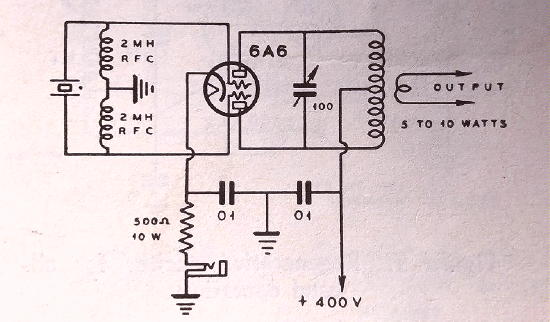
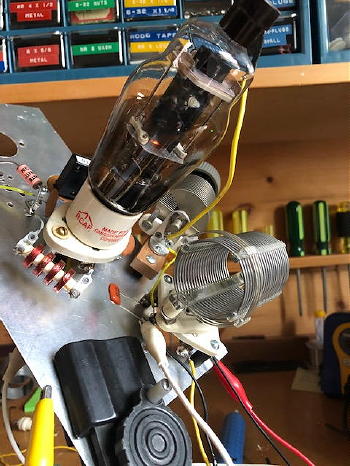
Just as my shelf space for new projects keeps expanding (and quickly running out!), so does my main web site, "The VE7SL Radio Notebook". I have just added a new page to the site describing the construction of my newly-completed Jones Power-Oscillator using a pair of 6L6s.
If you might be thinking of building a 'Jones', you may find something helpful or perhaps find inspiration for a new project. The new page may be found here.
I'm presently building the final version of my RK-39 crystal power-oscillator ... but I have no idea where I 'll put it when finished!
Steve McDonald, VE7SL, is a regular contributor to AmateurRadio.com and writes from British Columbia, Canada. Contact him at [email protected].
FCC Considers Changes to Amateur Radio Licensing
The FCC has invited public comments on two proposals to change the licensing requirements for amateur radio operators. Both of these proposals are aimed at attracting and retaining new amateur radio licensees.
Tyro
The first one is the “Tyro” license proposal from Gary/AD0WU that creates a new license class with minimal licensing requirements and operating privileges on the 70 cm band. See the complete proposal on the FCC website.
I find this proposal severely flawed with way too many details that would need to be written into Part 97. For example, the proposal establishes 99 specific repeater/simplex channels in the 430 MHz portion of the band. Oh, and the repeaters use a non-standard 9 MHz offset. There’s lots more in the proposal that make it a non-starter.
Still there is a nugget of an idea in here: a GMRS-like entry-level amateur radio license that is super easy to get. This could be an easy-peasy gateway into ham radio for kids, spouses and family members. However, I expect the FCC to just dismiss this petition without serious consideration.
Enhanced Technician
The second proposal is from the ARRL (see this ARRL news item):
The FCC has invited public comments on ARRL’s 2018 Petition for Rule Making, now designated as RM-11828, which asks the FCC to expand HF privileges for Technician licensees to include limited phone privileges on 75, 40, and 15 meters, plus RTTY and digital mode privileges on 80, 40, 15, and 10 meters.
The proposal would “add limited High Frequency (HF) data and telephony privileges to those currently available to Technician Class Amateur licensees.” The objective is to sweeten the Technician privileges to both attract new licensees and to retain existing Technicians (and maybe get them interested in moving up to General). There is an assumption/belief/hope that providing some HF telephony and digital privileges will accomplish these goals.
I am disappointed in the lack of data-driven analysis in support of this proposal. The ARRL filing claims that they “studied the comparable entry level license class operating privileges of other countries” but provided no data. There are different licensing schemes around the world…maybe we should compare and learn something from them. The data they did provide was survey data of ARRL members…which is really just an opinion poll: what do you think we should do with the licensing structure? This is not a great way to create public policy.
What’s the Objective?
Let’s start with the objective, which the ARRL petition says is “developing improved operating capabilities, increasing emergency communications participation, improving technical self-training, and increasing growth overall in the Amateur Radio Service.” I think this is a reasonable goal.
For some reason, every time there is a concern about improving and growing amateur radio, the proposed solution is a change in the licensing structure (usually to make it easier to obtain operating privileges). If the only tool you have is a hammer, everything looks like a nail. While the licensing structure should be improved over time, it should not be the first (or only) tool to apply. The ARRL needs to take a much more strategic approach to working towards the objective. Fortunately, I see positive signs they are moving in the right direction. See ARRL CEO Howard/WB2ITX Speaks.
Back To Licensing
There is a worthy idea in the ARRL proposal:
Change the entry level license (Technician) to provide a taste of HF phone and digital privileges, so it attracts more people to the hobby AND get them more deeply engaged. This might actually work.
I am not an unbiased observer because I have plenty of fun playing around with radios on frequencies above 50 MHz. I originally thought I would be a Technician for life but gradually got pulled into the fun below 30 MHz. So part of my brain says “Technicians just need to figure out how to have fun on VHF/UHF.” There is a lot to be said for having the entry level license be focused on VHF/UHF to learn basic radio operating. HF can come later.
Another part of my brain sees the excitement and growing popularity of the WSJT-X digital modes, especially FT8. Why do Technicians get to use CW on some of the HF bands but not other digital modes? That seems kind of silly in the year 2019. And making HF contacts with other states and countries on SSB is lots of fun, too.
Another question to ask is “what harm could be done by this proposal?” We could see a lot more activity in the portions of the HF bands Technicians are given. Maybe so much that those subbands get overrun with signals…seems like a potential problem. Some people have argued that giving Technicians these HF privileges will cause them to not upgrade to General. That seems like a low risk…if they get hooked on HF operating, they will upgrade to get access to additional spectrum.
There are really two assumptions in play here:
- Attract Assumption: More people will be attracted to ham radio due to the expanded Technician HF privileges.
- Retain Assumption: That Technicians will be more engaged in ham radio activity due to the expanded HF privileges (perhaps upgrading to higher license classes).
The distribution of US amateur radio licenses is roughly Amateur Extra (20%), General (23%) and Technician (50%), the remaining 7% are Novice and Advanced. So roughly half of US radio amateurs have decided to get their “VHF oriented” license while the other half have gone on to get an “HF privileged” license. Frankly, I don’t see the General license exam as a big barrier…I see people studying for it in our license classes and 90% of them are successful on the exam. But the exam is yet another thing to do, so it does represent an obstacle to overcome, just not a big one. What I do see them struggling with actually getting on the air with HF. See Getting On HF: The Fiddle Factor. Easier licensing is not going to address that problem.
Who Wants HF?
A lot of Technicians are just fine with the operating privileges they have. I even noted some Tech’s complaining they are tired of OF hams telling them they need to fall in love with HF. Interesting. I don’t have reliable data on what Technicians think but I see several types of Technicians that are quite happy with their existing privileges:
- Family/Friend Communicators – these folks are not hard core radio amateurs but they got their license to communicate with friends and family.
- Outdoor Enthusiasts – these folks use ham radio to augment their outdoor activities: hiking, biking, offroad driving, camping, fishing, etc.
- Emcomm and Public Service Volunteers – these hams are involved in local emergency response, support of served agencies (Red Cross, Salvation Army, etc.) or providing communications support for marathons, parades, charity walks, etc.
- Technical Experimenters – many radio amateurs are into experimenting with technology and the bands above 50 MHz offer a lot of opportunity for that.
I don’t know what percentage of Technicians are unconcerned about HF privileges but it is significant (half of them? perhaps more?) Providing HF privileges to this group will not have much of an effect. It seems like the ARRL should have data on this before serving up a proposal to change the licensing structure.
My Thoughts
What do I think? I think this proposal most likely will not make a significant difference with regard to attracting and retaining new radio hams. Something else is needed to do that, such as effective training programs, strong local clubs and mentors available to help newbies get started and build skills.
But it might just work. Maybe HF is the bright shiny object that will motivate people to pursue amateur radio.
So count me as agnostic on this proposal. I won’t be filing comments with the FCC. What do you think?
73 Bob K0NR
The post FCC Considers Changes to Amateur Radio Licensing appeared first on The KØNR Radio Site.
Bob Witte, KØNR, is a regular contributor to AmateurRadio.com and writes from Colorado, USA. Contact him at [email protected].
 Ham Radio Deluxe |
 W5SWL Electronics |
 Ham Radio Prep |
 KB3IFH QSL Cards  Hip Ham Shirts  HamRadioAuctions HamRadioAuctions Reliance Antennas Reliance Antennas Enigma Shop Enigma Shop |  morseDX  Ni4L Antennas  R&L Electronics R&L Electronics antennas.us antennas.us QRV QRV |
- Matt W1MST, Managing Editor
