 |
 Benchduino: It’s Gonna Be BIG, for Builders
 11 May 2019 | by
Far more than will admit, amateur electronic builders tend to have a prototype that looks more like a Rube Goldberg cartoon than something designed by Hewlett Packard (when they were building). Me, too. There’s just a lot of wires, connectors, rigged-up jigs, and so forth when you’re trying to get a circuit to work like it’s ‘sposed to. And, put a microcprocessor or small PC board into the mix, aye yai yai!
There are breadboards, even sophisticated ones, that help with this. And, there are design boards to facilitate with some PIC development as well as ones that help with Arduino or Raspberry Pi projects. That’s good. But I’ve seen nothing like a workbench platform for most all of these with hardware and software hooks to keep Rube Goldberg in Collier’s Magazine. Until now.
George Zafiropoulos KJ6VU of the Ham Radio Workbench Podcast team has put together what he calls the Benchduino. George has an Internet group on the project at Groups.io here. You can follow the beta development there by joining. But you can get more meat on the bones by listening to a recent episode of the HRW podcast on the Benchduino. If you build using microprocessors, you will not be disappointed.
This product will be BIG for builders. You can download the interim documentation file here. Here’s what it looks like, taken from the website page. There are multiple add-on boards to connect to Arduino Mega, Raspberry Pi Zero, PIC – 40 pin 18F series processor, Adafruit Feather, Xbee data radio socket (built-in). George has pre-loaded shopping carts for necessary parts at Digi-Key for various boards. To channel the comedian Martin Short: I must say, I must say!

Taken from the HRW website page:
The BenchDuino is a development platform for building projects based on the Arduino, Raspberry Pi and PIC microcontrollers. The platform defines a common foot print for processor and expansion boards to make it easy to expand the functionality of the system. The BenchDuino motherboard includes many commonly used peripherals which can be connected to the CPU pins with jumper wires or plug in shunts. The BenchDuino is an open platform and we encourage the development of plug-in CPU and expansion boards.
https://www.hamradioworkbench.com/benchduino.html
Now, this is quite dramatic for prototype development using various microprocessor boards. But the pièce de résistance, IMHO, comes via the header on the top edge of the Benchduino as shown in the photograph above. Need several pieces of test equipment, including a logic analyzer, to check out whether your code makes the light blink (or whatever)? Use the Analog Discovery 2 USB-based test workbench directly connected to the Benchduino! I love mine, including the latest add-on Impedance Measurement Board (~$20). The HRW Podcast has a $100 off discount code for the AD2 product through their website which takes you to Digilent.
So, in brief, your project doesn’t have to be a Rube Goldberg cartoon that you’d just not like your builder buddies to see before it’s completed. Your project may not get Bob’s Your Uncle status upon first execution, but it will likely be Bob’s Cousin with the Benchduino and the Analog Discovery 2. The latter has multi-platform free software for the hardware which makes it a Swiss Army Knife of test equipment.
I’m buying my Benchduino boards from the Ham Radio Workbench booth at Hamvention this year. George is giving a Forum talk / demo on the Benchduino too. (Digilent will also be at Xenia with the HRW discount. Get the Impedance Analyzer Board while you’re at it.) Let George know you’re coming via Twitter: @kj6vu
Frank Howell, K4FMH, is a regular contributor to AmateurRadio.com and writes from Mississippi, USA. Contact him at [email protected].
From Sea to Summit on CW
I've enjoyed the IOTA program for 25 years. It took me 16 years to get to #1 DXCC, but I'm still working new ones in IOTA. There are 1200+ island groups so it takes a while. I've also enjoyed IOTA Expeditioning over the years including islands in Australia, Nicaragua, Labrador, Alaska and numerous islands in the Gulf of Mexico. My last expedition was in 2017 and I was getting the itch to go out again.
I live about 3 hours from the Gulf of Mexico and had been thinking about a trip to North Padre Island, (NA-092), on the Texas coast to have a fun couple of days operating portable and enjoying the National Seashore there. I was convinced that while NA-092 was not rare in the states, the RV Ham crowd has satisfied that demand, but that it would be needed in Europe and Asia. To convince myself that I needed to take the radio gear on the trip, I put out a query on the IOTA Chaser reflector to gauge interest. I was a bit surprised at the many long time IOTA Chasers in Europe and Asia who needed it. So, my hunch was confirmed.
So I put my operating plan together. My station would consist of:
K3 Transceiver
KPA500 Amplifier
KAT500 Tuner
30 ft MFJ push up pole
MFJ 2980 Feather Lite Vertical
Begali Stradivarius Paddle
N1MM+
Winkey
Since Padre Island is a barrier island it is connected to the mainland by a bridge, so no boat necessary on this trip. I have a tear-drop camping trailer that is a king-size bed on wheels with a kitchen in the back which would be sleeping quarters and a 6 person tent which would be the operating HQ. My XYL, Cris, accompanied me on the trip and was gracious enough tolerate my operating. Below is a picture of the operating location.
 |
| AD5A/p on North Padre Island |
I was very pleased with the results of the operation. I provided a new island to many EU and Asian Chasers and the station performed well. I was very pleased with the performance of the Feather Lite vertical. The antenna has a very small foot print, which in a campground is essential, and I experienced good TX/RX results with it, of course a vertical over salt water works extremely well and this was confirmed once again. During the first Asian sunset, 3:30 am for me, I had to go split for about an hour to handle the pile-up. I finished with 633 QSO's with ~40 countries, 427 of the QSO's were on 40m.
But this is only half the story. We arrived on Padre Island on a Monday afternoon and departed on Wednesday morning.
On Friday, we had to catch a flight to Albuquerque, NM and drive to our second QTH in Santa Fe, NM. One of my favorite things to do in Santa Fe is to do activations for the Summits on the Air (SOTA) program. In Santa Fe we have a team we call the Three Amigos, consisting of Fred, KT5X, John, K1JD and myself. We are all Mountain Goats within the SOTA program, (1,000 activation points required) and our likeness was captured by a female artist, the subject of another blog. But here is our portrait, notice the belt buckles if you can see them:
 |
| Tres Amigos de SOTA |
Upon arrival in Santa Fe, I made contact with John, K1JD (KT5X as out of town) and we decided to activate El Cerro de la Consena or W5N/SI-020 which had an elevation of 6,923 ft. This mountain has lots of loose rock and cactus.
Planning for a SOTA activation is much simpler than an IOTA expedition, but you will need to be self propelled. This hike is ~6.5 mile round-trip. My station consisted of a KX-2, a 3 band trapped EFHW made of 28 ga. wire, an 81 to 1 transformer and a 20 ft. collapsible fiberglass pole. The paddle I use is the Elecraft paddle made for the KX2 I made 28 QSO's on this activation and found these:
 |
| Hopi Petroglyphs |
 |
| AD5A Shack at 9,420 ft |
So in the span of a week I had gone from Sea Level to Mountain Summits operating CW and enjoying the magic of our hobby. There is adventure in ham radio, and many ways to get out and make QSO's. If you can't make QSO's at home, go to where the QSO's are, the seas and summits.
Mike Crownover, AD5A, is a regular contributor to AmateurRadio.com and writes from Texas, USA. Contact him at [email protected].
On t’fells
Whilst the weather may not have been as warm as last year at this time it has been a very dry few weeks so I have taken the time to get out on the fells and do a few SOTA activations. Nothing too demanding but the local ones around Wasdale and a visit to Keswick.
Keswick can offer a few things. Skiddaw and Blencathra are the two in the frame today. It also offers swarms of people in expensive technical clothing wandering round the town and people on the fells in flip flops. Skiddaw is popular as you can walk from the town. Both of these walks were up and back the same way. A bit dull I know but they can both be very busy if you leave it past about 9am

Both of these walks I had Angus (the dog by the way) with me to keep me company / attempt to pinch other peoples sandwiches. They are nice enough walks but can be a bit busy so if it is solitude you’re after avoid these. There were kids playing in the remains of the snow on the steep slopes in bare feet!

Next up was a trip to Wasdale. Well to be specific it was Mosedale in Wasdale to start with but Pillar and Kirk Fell were the targets. The route take you up black sail and is quiet. You can go up the very steep slope to the left to Pillar but it’s hard going and not as quick as you might think. Pillar is a lovely spot, great views across Ennerdale and Wasdale and on a good day over to Keswick and out towards Penrith. We had a small refusal from Angus at the top of Kirk Fell, where the red splodge is. There is a steep slippery section with some 2+m bits of scramble. He couldn’t get up so we turned round and went round Boat How. Much gentler and less likely to involve Mountain Rescue.


Lastly in this section was Great Gable and Scafell Pike. I’ve not been up Great Gable for a couple of years and it was nice to go up via Sty Head tarn and then up to the war memorial on the summit. It started to snow on the top and was still snow just a few hundred meters from the tarn. Carry straight on and that takes you along the corridor route up Scafell Pike. Quieter and less eroded. There are alwways a few odd sights up on the summit, from people who look like they are going to collaspe through to runners bagging the summit. Best to use the small remains of the hut just below the summit on the south side for activations.

The summits were cold that day and the valley reasonably warm and free from wind, there were some very cold looking people on the summit and at least one dipstick who forgot a patch lead, so no hf activation for me!

I’ve not been over to Helvellyn so that might be next on the list list for this year. Plenty of time to get out and about if the weather stays like this. There were a few dried up tarns and I wonder if this is a result of last summer when it was nearly 30c in Wasdale.
The total so far for SOTA is 198 points. A long way off mountain goat but enjoying the time on the fells all the same.
Alex Hill, G7KSE, is a regular contributor to AmateurRadio.com and writes from Cumbria, UK. Contact him at [email protected].
LHS Episode #284: The Weekender XXVIII

It's time once again for The Weekender. This is our bi-weekly departure into the world of amateur radio contests, open source conventions, special events, listener challenges, hedonism and just plain fun. Thanks for listening and, if you happen to get a chance, feel free to call us or e-mail and send us some feedback. Tell us how we're doing. We'd love to hear from you.
73 de The LHS Crew
Russ Woodman, K5TUX, co-hosts the Linux in the Ham Shack podcast which is available for download in both MP3 and OGG audio format. Contact him at [email protected].
A new “touch” paddle for the shack.
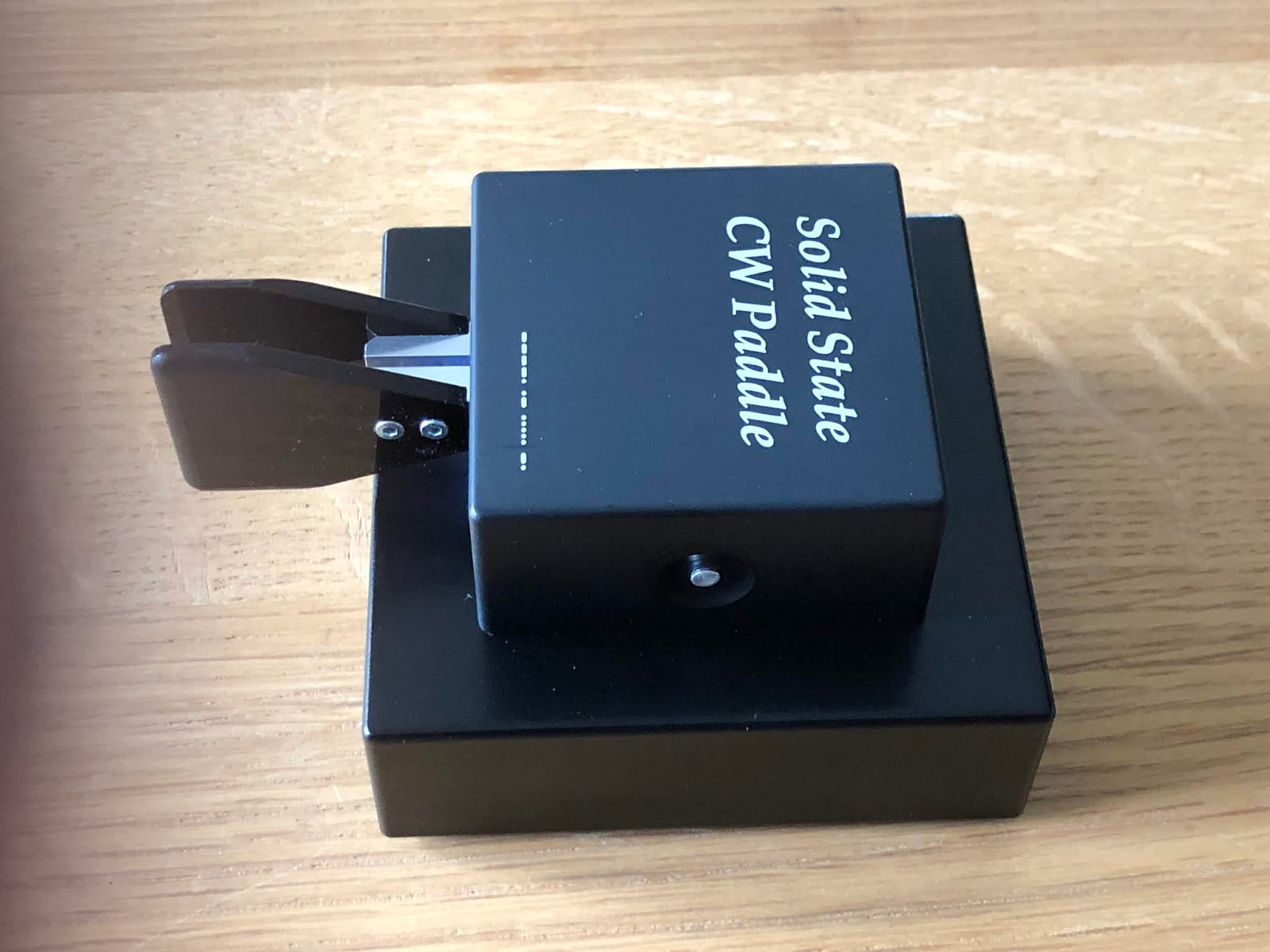
- No moving parts to ware or make a clicking noise.
- You just turn it off when not in use so no accidental dit's or dahs sent when inadvertently touching the paddle.
- There is not maintenance (other than changing the batteries) no periodic mechanical adjustments.
- If you have owned a iambic key there really is no learning curve just turn in on and away you go.
The only adjustment that you may want to do is adjust the touch sensitivity with the key factory set at 10 grams and adjustable to 50 grams in 5 gram steps. Seeing this is a touch paddle depending on your "touch" you may want to increase or decrease the sensitivity. I seemed to be happy with were it was factory set to at 10 grams.
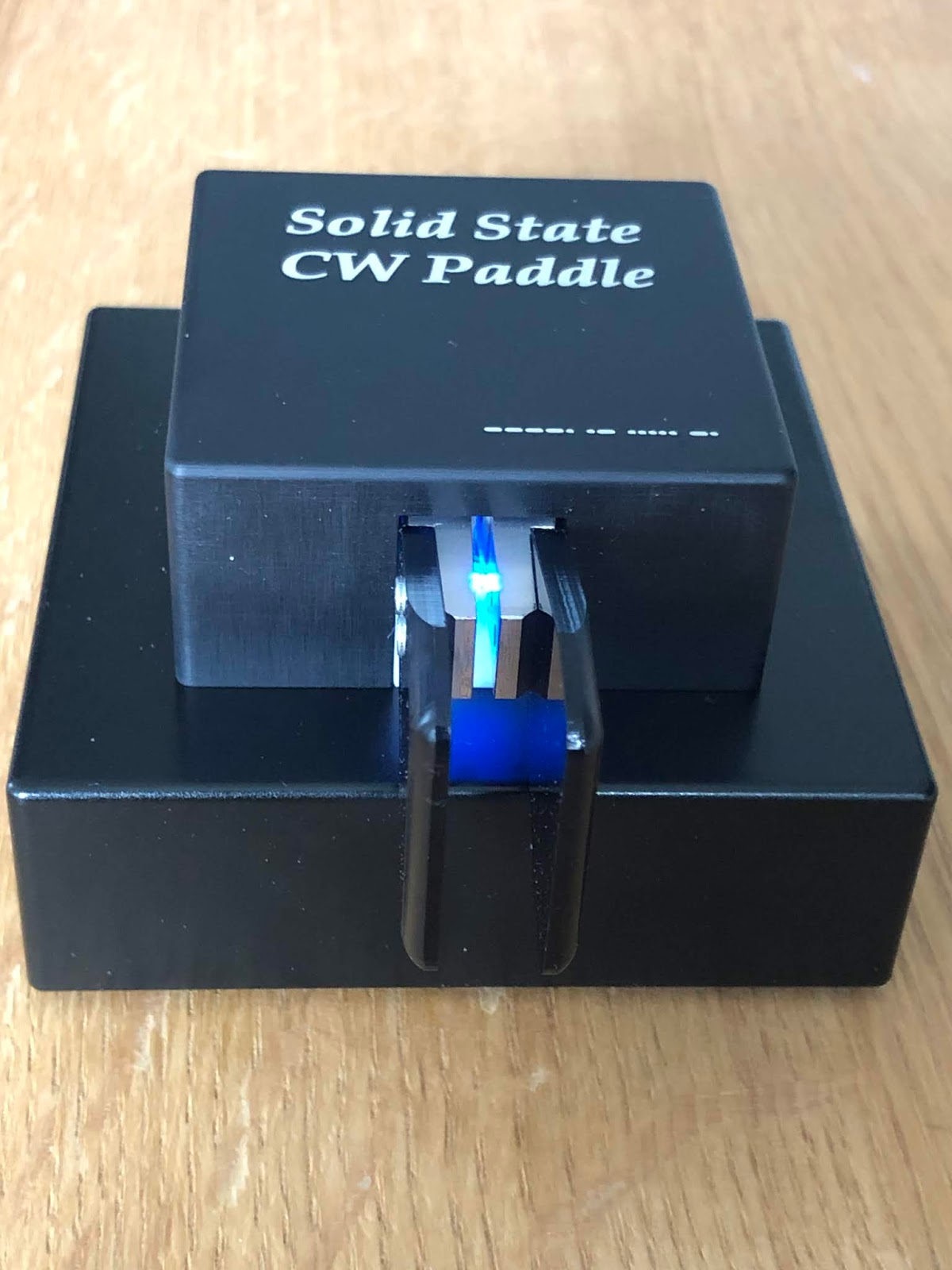
The only other menu change you can do is place the keyer in contest mode and what this means is the keyer will not time out and turn off on you. Normally If you forget to turn the paddle off it will do so after 40 minutes of non operation.
To enter contest mode make sure the key is off then push and hold the on button until the LED flashes then release the button. So in a nut shell to adjust the key paddle touch sensitivity start with the key turned on and hold the power button. To put the key in contest mode (meaning it will not turn off on it's own) start with the key off and hold the power button.
The key is very well made and the base is 1.8 kilo's so it's not going anywhere on your desk as you use it.
The last item I wanted to mention was yes it does take batteries (2 AAA) according to Neno's instructions the battery life should be up to 800 operating hours. The blue LED which is on during operation will indicate low battery life when it gets dim. So you do have an indication when its time to change out the batteries. Finally the paddle is warrantied for 24 months from date of purchase.

Mike Weir, VE9KK, is a regular contributor to AmateurRadio.com and writes from New Brunswick, Canada. Contact him at [email protected].
Hams prepare for 2019 Scout Pacific Jamboree at Camp Barnard
 I wanted to share that I will once again be running a Ham Radio Station at the BC/Yukon Pacific Scout Jamboree being held July 6 – 13 at Camp Barnard in Sooke BC Canada, a 250 acre scout camp on Young Lake.
I ran this same station in 2015 and of the 3,000 scouts attending the Jamboree, some 350 of them came to our Ham Radio Station to earn a Ham Radio badge at Camp Barnard.
 We anticipate the same number of scouts, (i.e. boys and girls aged 11 – 14 years old), to attend this year’s Jamboree and a similar number, (350 – 400) to visit our station to earn a badge. Our club call sign is VE7SHR (i.e. for Scout Ham Radio).
A Scout Pacific (BC / Yukon) Jamboree like other Jamborees are held every 4 years. In 2015 it was the first Jamboree at Camp Barnard in many years and cost over a million dollars to put on with improvements and additions to roads, water and power lines, added washroom facilities, dock extension, food deliveries, fire, police and medical preparations, (i.e. we have an onsite hospital set up), etc. etc. and requires hundreds of volunteers.
Having just earned my VA7RTB Ham Radio Certification in early 2015, along with the Camp Ranger Willy Burrows VE7WRB, and with the 2015 Pacific Scout Jamboree only months away, we decided to try our hand at running a Ham Radio Station. Help from a much more experienced advanced Ham, Chris Carr VE7BAC, from BC’s mainland didn’t hurt either!
As a volunteer organization and little money however, we put the word out to the local Ham community for the donation of any used / unwanted Ham Radio equipment. We were overwhelmed with the response with donations of radios, towers, antennas, coaxial cables, power supplies etc. etc. We also were given permission to share the archery room to create a permanent Ham Shack as seen in the pictures below which needed some extensive renovations to accommodate us.
 Although a lot of the equipment donated was outdated or not working, there were some very usable pieces, plus the donations that Chris brought over from his scrounging over on the mainland, made our shack operational. One bonus was being able to purchase a brand new Yaesu FT-8800 from the Jamboree fund for our permanent shack.
So, with a 20’ X 20’ rented army tent, we set up our Ham Shack and waited for all 3000 youth to arrive, but not sure how much interest our station would actually generate. Well, we didn’t have to wait long, as scouts, (i.e. boys and girls aged, 11 – 14), seemed to gravitate to us and were keen to earn a “generic” Ham Radio badge. Being located next to the badge trading station didn’t hurt either. We were however, in fact blown away by the interest and enthusiasm of the youth. Originally we had them complete six activities to earn a badge, however as we were quickly running out of badges, we upped the requirements to completing 9 activities, and still we ran out of badges in the end.
As an example of the positive responses we got, Chris said that we had more youth attend our station on day one, than attended the week long Ham Station a year earlier at the “Canadian Jamboree” that was host to 2 & 1/2 times as many scouting youth as our provincial Jamboree. It was also great to have the youth make HF contact with other Hams in Alaska, Russia, the Virgin Islands, a weather ship at sea and even Disneyland.
Other events at the 2015 Pacific Jamboree included, canoeing, rock climbing, an overnight hike, scuba diving, visiting the town of Sooke, log rolling, a variety of arts and crafts, robotics, swimming, log pole climbing and ax throwing, to mention a few.
So, with the 2015 Pacific Jamboree over, we immediately set our sights on planning for 2019. We continued to try and improve our equipment, designed a more Ham Radio specific badge, (as seen in the email below), and looked at some new activities to involve the youth in such as Morse Code keying, and having them look up available Call Signs. We have also, as in the last Jamboree, invited local Hams to either come out and assist us, or at least call in to our station on their radios. We are also negotiating with another Ham to borrow his 30’ Ham Radio trailer to be present on site at the Jamboree.
We are also looking at setting up a second Ham Shack location on site as it is a larger space and can accommodate bigger groups throughout the year. (We haven’t determined yet exactly which frequencies we will be monitoring but that will come.)
 So what’s next? We have already heard that the Francophone Scouts are scheduled to hold their Jamboree at Camp Barnard in 2020,as well as the Girl Guides holding there SOAR Jamboree there that same year. Again, some 3,000 Girl Guides are planning to attend. Plans are in the works for both of these events, for us to offer a Ham Radio Station. We also plan to participate in the “Scout Jamboree On The Air” (JOTA), held every October, and we do smaller presentations to Beaver, Cub and Scout groups throughout the year when asked.
Ron Bilinsky, VA7RTB, is a special contributor to AmateurRadio.com and writes from British Columbia, Canada.
LHS Episode #283: The Dr. Bill Show

Welcome to Episode 283 of Linux in the Ham Shack. In this short topic episode, the discuss the new weak signal mode FT4, amateur radio at the World Scout Jamboree, the Northwest Linuxfest, Fedora Core 30 and much more. Thank you for listening and hope to see everyone at Hamvention 2019!
73 de The LHS Crew
Russ Woodman, K5TUX, co-hosts the Linux in the Ham Shack podcast which is available for download in both MP3 and OGG audio format. Contact him at [email protected].
 Ham Radio Deluxe |
 W5SWL Electronics |
 Ham Radio Prep |
 KB3IFH QSL Cards  Hip Ham Shirts  HamRadioAuctions HamRadioAuctions Reliance Antennas Reliance Antennas Enigma Shop Enigma Shop |  morseDX  Ni4L Antennas  R&L Electronics R&L Electronics antennas.us antennas.us Ears to Our World Ears to Our World |
- Matt W1MST, Managing Editor
