 |
 LHS Episode #285: Hamvention 2019 Day One
 18 May 2019 | by
Thank you for tuning in to Episode 285 of Linux in the Ham Shack. In this episode we wrap up our experiences with day one of the 2019 Hamvention in Xenia, Ohio. We would sincerely like to thank our supports who got us here and for everyone who has visited us in our booth at the show. We hope to see everyone before we leave town on Sunday.
73 de The LHS Crew
Russ Woodman, K5TUX, co-hosts the Linux in the Ham Shack podcast which is available for download in both MP3 and OGG audio format. Contact him at [email protected].
Well the news is out!
Mike Weir, VE9KK, is a regular contributor to AmateurRadio.com and writes from New Brunswick, Canada. Contact him at [email protected].
How Low Can They Go!
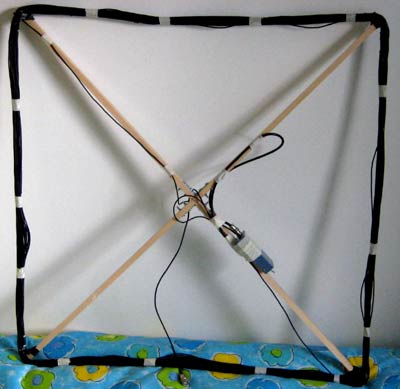 |
| courtesy: Roger, G3XBM |
For the past few years several amateurs in Europe and along the east coast of North America have been experimenting on the ‘dreamers band’, 8.7 - 9.1 kHz.
Some rather surprising distances have been covered on these frequencies in spite of the dreadfully poor efficiencies realized with backyard antenna systems.
Previous 'earth-mode' backyard experiments on VLF by Roger, G3XBM, are well documented on his website along with details on his simple homebrew gear used to send signals across town using the earth. Following Roger's steady progression via his previous blog spots makes for fascinating reading ... there is some really great stuff here making it difficult to not jump in and take the plunge yourself.
This experimental field presents the ideal opportunity for a couple (or several) local amateurs to work together at exchanging signals on these low frequencies with simple home built equipment.
A major contributor to the present state of the ‘VLF / ULF amateur art’ is Stefan, DK7FC and a posting this week to the old RSGB's (blacksheep) LF reflector makes some of his earlier work pale by comparison as he announced the reception of his 270Hz signal (the 1110km band!) at a distance of 177 km!
Just a note from a recent experiment at 270.1 Hz.
On Sunday morning, 2019-05-12_10:34,+150m, I've done a carrier transmission on my ground loop antenna again. I did not expect more than, hopefully, a detectable spectrum peak in 57.6 km distance, i.e. at my tree site. The tree receiver site was listening and recording data using vlf-rx tools.
One E field antenna and two orthogonal loops were listening. The loops have been improved recently! They consist out of a single circular turn of 1.2 m diameter using 10mm diameter copper tube (about 25 mm^2). It is a closed loop, non-resonated, with an impedance matching transformer. This transformer previously had 1:100 turns. Now it (they) has 2:240 turns, i.e. two turns primary (out of 14mm^2, AWG6). This improved the sensitivity below 2 kHz significantly ( abt. 4...5 dB).
Furthermore the TX antenna length and angle has been improved, resulting in about +3 dB more signal strength on the RX site!
In a previous experiment at 270.1 Hz, some month ago, there was no result at all, not the weakest trace, despite excessive tweaking of all parameters. So the question was, will the improvements result in a detectable signal now?
Several things went wrong in that experiment. I forgot a bag containing important equipment such as the power supply for the netbook that generates the carrier signal. Also the output power was not as high as planned, just about 380 W, giving 2.2 A antenna current (I measured 64.7 V at 1 A DC). Anyway i managed to improvise so the experiment was started, but with some hours of delay which meant i higher QRN background level. Then, on the WLAN link to the tree, there were several interruptions of the stream (i'll move to 5 GHz very soon!). I even got some QRM from my battery charger for some short time periods (forgot to disable the charger remotely). So there were several factors that could have been improved or avoided. And the middle of May is not the ideal time anyway.
Well, 270.1 Hz, that's the 1110 km band! The far field begins at 177 km distance, i.e. i am clearly in the near field here. Thus, from a 'magnetic' TX antenna, we would expect that the signal is mainly detectable on the H field, i.e. the loop antennas.
The first interesting results is that this expectation is actually confirmed. There is nothing detectable on the E field but the carrier S/N in the H fields is close to 10 dB in the first run. Mixing the H fields and tweaking the filters rises the carrier S/N to 10.7 dB, see attachment.
So far not really an undoubtedly detection but it is a candidate for optimism! With a few less problems during the experiment there is a chance for 14 dB SNR. Also, there is quite much sideband QRM around 300 Hz which makes 270 Hz a bit harder to work on.
73, Stefan
Steve McDonald, VE7SL, is a regular contributor to AmateurRadio.com and writes from British Columbia, Canada. Contact him at [email protected].
Weekly Propagation Summary – 2019 May 13 16:10 UTC
Here is this week’s space weather and geophysical report, issued 2019 May 13 0226 UTC.
Highlights of Solar and Geomagnetic Activity 06 – 12 May 2019
Solar activity was at low levels on 06, 07, and 09 May due to C-class flare activity from Region 2740 (N08, L=307 class/area Dho/280 on 05 May. The largest of the flares was a C9.9/1N at 06/0510 UTC. Mutliple eruptions were observed in coronagraph imagery, but only the halo CME from 06 May was geoeffective. The assymetric halo CME was first observed in SOHO LASCO C2 imagery at 06/2348 UTC. Additionally, a partial halo CME was first observed in LASCO C2 imagery at 12/2036 UTC and is determined to be Earth-directed and arrive at Earth on 17 May. Solar activity was at very low levels for the remainder of the summary period.
No proton events were observed at geosynchronous orbit.
The greater than 2 MeV electron flux at geosynchronous orbit reached high levels on 07, 11, and 12 May. Normal to moderate levels were observed throughout the remainder of the period.
Geomagnetic field activity reached active to G1 (Minor) storm levels on 11 May due to the arrival of a CME from 06 May. Impact was first observed by the DSCOVR spacecraft at 10/1655 UTC. Total reached a peak of 12 nT and Bz reached a maximum southward deflection of -11 nT. Solar wind averaged near 350 km/s throughout tranient passage. G1 (Minor) storm levels were observed during the 11/00-03 UTC synoptic period, with several active periods during the remainder of the UT day. Quiet to unsettled levels were observed for the remainder of the period.
Forecast of Solar and Geomagnetic Activity 13 May – 08 June 2019
Solar activity is expected to be at very low levels, with a slight chance of C-class flares throughout the period.
No proton events are expected at geosynchronous orbit.
The greater than 2 MeV electron flux at geosynchronous orbit is expected to be at moderate to high levels on 13-23 May, and 29 May – 08 June. Normal to moderate levels are expected on 24-28 May.
Geomagnetic field activity is expected to reach G1 (Minor) storm levels on 15 and 17 May due to CME arrival. Active conditions are expected on 29 May due to the influence of a recurrent coronal hole high speed stream. Quiet to unsettled conditions are expected for the remainder of the period.
Don’t forget to visit our live space weather and radio propagation web site, at: http://SunSpotWatch.com/
Live Aurora mapping is at http://aurora.sunspotwatch.com/
If you are on Twitter, please follow these two users: 1. https://Twitter.com/NW7US 2. https://Twitter.com/hfradiospacewx
– – – – – – – – – – – – –
Be sure to subscribe to our space weather and propagation email group, on Groups.io
https://groups.io/g/propagation-and-space-weather
Spread the word!
– – – – – – – – – – – – –
Links of interest:
+ Amazon space weather books: http://g.nw7us.us/fbssw-aSWSC
+ https://Twitter.com/NW7US
+ https://Twitter.com/hfradiospacewx
Space Weather and Ham Radio YouTube Channel News:
I am working on launching a YouTube channel overhaul, that includes series of videos about space weather, radio signal propagation, and more.
Additionally, I am working on improving the educational efforts via the email, Facebook, YouTube, Tumblr, and other activities.
You can help!
Please consider becoming a Patron of these space weather and radio communications services, beginning with the YouTube channel:
https://www.patreon.com/NW7US
The YouTube channel:
https://YouTube.com/NW7US
..
Visit, subscribe: NW7US Radio Communications and Propagation YouTube Channel
AmateurLogic 130: Echolink Pi is Back
AmateurLogic.TV Episode 130 is now available for download.
George completes the 2019 Echolink Pi/SVXlink project. Tommy discovers an interesting new online SDR. Mike, VE3MIC joins us with a really cool BlueDV-AMBE server project. Plus another Foreign Food taste test, courtesy of Kevin Mitchell, ZL1KFM.
1:23:36
George Thomas, W5JDX, is co-host of AmateurLogic.TV, an original amateur radio video program hosted by George Thomas (W5JDX), Tommy Martin (N5ZNO), Peter Berrett (VK3PB), and Emile Diodene (KE5QKR). Contact him at [email protected].
ICQ Podcast Episode 293 – WOLFWave Audio Processor
In this episode, Martin M1MRB is joined by Chris Howard M0TCH, Martin Rothwell M0SGL, Frank Howell K4FMH and Dan Romanick KB6NU to discuss the latest Amateur / Ham Radio news. Colin M6BOY rounds up the news in brief and this episode’s feature is the WOLFWave Audio Processor by Martin Butler M1MRB.
ICQ AMATEUR/HAM RADIO PODCAST DONORS
We would like to thank Chuck Chivers (VE3VSA) and Bill Hester (N0LAJ) and our monthly and annual subscription donors for keeping the podcast advert free. To donate, please visit - http://www.icqpodcast.com/donate
- Amateur Radio Club Lends a Hand to Firefighters - Arduino and RF from kHz to 1 GHz - RM-11828 Technician Enhancement - Update - First on-air test of FreeDV 2020 - Radio Experiments by Colonel Dennis EI2B - Dayton Hamvention Providing Information Radio Station on 1620 AM
Colin Butler, M6BOY, is the host of the ICQ Podcast, a weekly radio show about Amateur Radio. Contact him at [email protected].
Benchduino: It’s Gonna Be BIG, for Builders

Far more than will admit, amateur electronic builders tend to have a prototype that looks more like a Rube Goldberg cartoon than something designed by Hewlett Packard (when they were building). Me, too. There’s just a lot of wires, connectors, rigged-up jigs, and so forth when you’re trying to get a circuit to work like it’s ‘sposed to. And, put a microcprocessor or small PC board into the mix, aye yai yai!
There are breadboards, even sophisticated ones, that help with this. And, there are design boards to facilitate with some PIC development as well as ones that help with Arduino or Raspberry Pi projects. That’s good. But I’ve seen nothing like a workbench platform for most all of these with hardware and software hooks to keep Rube Goldberg in Collier’s Magazine. Until now.
George Zafiropoulos KJ6VU of the Ham Radio Workbench Podcast team has put together what he calls the Benchduino. George has an Internet group on the project at Groups.io here. You can follow the beta development there by joining. But you can get more meat on the bones by listening to a recent episode of the HRW podcast on the Benchduino. If you build using microprocessors, you will not be disappointed.
This product will be BIG for builders. You can download the interim documentation file here. Here’s what it looks like, taken from the website page. There are multiple add-on boards to connect to Arduino Mega, Raspberry Pi Zero, PIC – 40 pin 18F series processor, Adafruit Feather, Xbee data radio socket (built-in). George has pre-loaded shopping carts for necessary parts at Digi-Key for various boards. To channel the comedian Martin Short: I must say, I must say!

Taken from the HRW website page:
The BenchDuino is a development platform for building projects based on the Arduino, Raspberry Pi and PIC microcontrollers. The platform defines a common foot print for processor and expansion boards to make it easy to expand the functionality of the system. The BenchDuino motherboard includes many commonly used peripherals which can be connected to the CPU pins with jumper wires or plug in shunts. The BenchDuino is an open platform and we encourage the development of plug-in CPU and expansion boards.
https://www.hamradioworkbench.com/benchduino.html
Now, this is quite dramatic for prototype development using various microprocessor boards. But the pièce de résistance, IMHO, comes via the header on the top edge of the Benchduino as shown in the photograph above. Need several pieces of test equipment, including a logic analyzer, to check out whether your code makes the light blink (or whatever)? Use the Analog Discovery 2 USB-based test workbench directly connected to the Benchduino! I love mine, including the latest add-on Impedance Measurement Board (~$20). The HRW Podcast has a $100 off discount code for the AD2 product through their website which takes you to Digilent.
So, in brief, your project doesn’t have to be a Rube Goldberg cartoon that you’d just not like your builder buddies to see before it’s completed. Your project may not get Bob’s Your Uncle status upon first execution, but it will likely be Bob’s Cousin with the Benchduino and the Analog Discovery 2. The latter has multi-platform free software for the hardware which makes it a Swiss Army Knife of test equipment.
I’m buying my Benchduino boards from the Ham Radio Workbench booth at Hamvention this year. George is giving a Forum talk / demo on the Benchduino too. (Digilent will also be at Xenia with the HRW discount. Get the Impedance Analyzer Board while you’re at it.) Let George know you’re coming via Twitter: @kj6vu
Frank Howell, K4FMH, is a regular contributor to AmateurRadio.com and writes from Mississippi, USA. Contact him at [email protected].
 Ham Radio Deluxe |
 W5SWL Electronics |
 Ham Radio Prep |
 KB3IFH QSL Cards  Hip Ham Shirts  HamRadioAuctions HamRadioAuctions Reliance Antennas Reliance Antennas Enigma Shop Enigma Shop |  morseDX  Ni4L Antennas  R&L Electronics R&L Electronics antennas.us antennas.us Ears to Our World Ears to Our World |
- Matt W1MST, Managing Editor
