 |
 Weekly Propagation Summary – 2019 Jul 01 16:10 UTC
 1 July 2019 | by
Here is this week’s space weather and geophysical report, issued 2019 Jul 01 0141 UTC.
Highlights of Solar and Geomagnetic Activity 24 – 30 June 2019
Solar activity was at very low levels. Regions 2742 (N04, L=092, class/area Axx/010 on 24 Jun) and 2743 (N03, L=111. class/area Axx/010 on 24 Jun) were quiet and stable. No Earth-directed CMEs were observed in available imagery.
No proton events were observed at geosynchronous orbit.
The greater than 2 MeV electron flux at geosynchronous orbit was at normal levels.
Geomagnetic field activity was at quiet levels with an isolated unsettled period observed early on 30 Jun. Solar wind parameters were at mostly nominal levels throughout the period. A peak wind speed of 418 km/s was observed at 26/1805 UTC. Bt and Bz parameters were at mostly nominal levels.
Forecast of Solar and Geomagnetic Activity 01 July – 27 July 2019
Solar activity is expected to be at very low levels throughout the outlook period.
No proton events are expected at geosynchronous orbit.
The greater than 2 MeV electron flux at geosynchronous orbit is expected to be at normal to isolated moderate levels throughout the period.
Geomagnetic field activity is expected to reach isolated unsettled levels on 06 Jul and 10-11 Jul due to recurrent CH HSS influence. Mostly quiet conditions are expected for the remainder of the outlook period.
Don’t forget to visit our live space weather and radio propagation web site, at: http://SunSpotWatch.com/
Live Aurora mapping is at http://aurora.sunspotwatch.com/
If you are on Twitter, please follow these two users: 1. https://Twitter.com/NW7US 2. https://Twitter.com/hfradiospacewx
– – – – – – – – – – – – –
Be sure to subscribe to our space weather and propagation email group, on Groups.io
https://groups.io/g/propagation-and-space-weather
Spread the word!
– – – – – – – – – – – – –
Links of interest:
+ Amazon space weather books: http://g.nw7us.us/fbssw-aSWSC
+ https://Twitter.com/NW7US
+ https://Twitter.com/hfradiospacewx
Space Weather and Ham Radio YouTube Channel News:
I am working on launching a YouTube channel overhaul, that includes series of videos about space weather, radio signal propagation, and more.
Additionally, I am working on improving the educational efforts via the email, Facebook, YouTube, Tumblr, and other activities.
You can help!
Please consider becoming a Patron of these space weather and radio communications services, beginning with the YouTube channel:
https://www.patreon.com/NW7US
The YouTube channel:
https://YouTube.com/NW7US
..
Visit, subscribe: NW7US Radio Communications and Propagation YouTube Channel
Building A ’37-Style ‘RK-39’ Crystal Power Oscillator
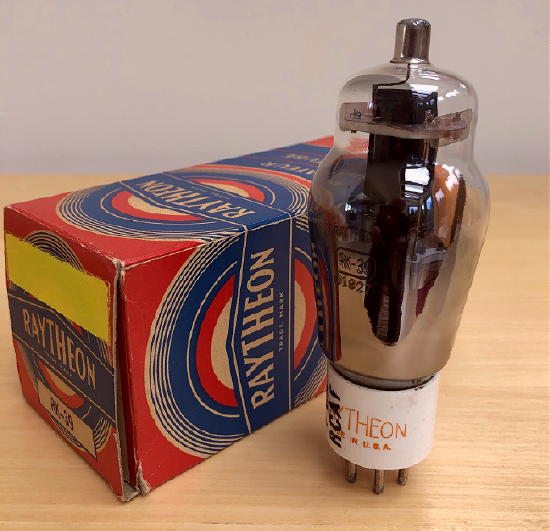
When I completed my ‘Jones 6L6 Push-Pull Oscillator’ project in the spring, I made a start on a new ‘spring-summer radio project’ which was to be based on some 1937 RK-39 tubes that had been gathering dust here for many years.
With an unusually sunny and warm spring, I soon found that my radio-bench time was being hi-jacked with a lot of outside yard work and getting all of next winter’s firewood split and stacked away before the really hot weather arrived.
I found myself working on the project in tiny bites, sometimes not making any progress at all during the passage of a week. Headway was also tempered by the fact that I’ll often deliberate for several days over the placement of a single component or the selection of one component over another. I find this slow pace and decision ‘pondering’ during the design phase of any project to be most enjoyable as it gets my old brain working more than normal, on things that really interest me.
I’m happy to report that my latest project is now complete and fully operational and ready for operation!
As usual, I have written and published a web page fully describing the project and some of the background details of the building process.
My ‘Building A ‘37-Style ‘RK-39’ Crystal Power-Oscillator' page can be found here.
Hopefully we can have a CW QSO with it in the near future!
Steve McDonald, VE7SL, is a regular contributor to AmateurRadio.com and writes from British Columbia, Canada. Contact him at [email protected].
Summits On The Air VHF Mountain Goat
 My Summits On The Air (SOTA) activation of Pikes Peak (W0C/FR-004) on June 20th qualified me for Mountain Goat, using only the VHF/UHF bands. Mountain Goat requires 1000 activation points using the SOTA activation point system.

I’ve been working toward this goal for quite a while. I was doing mountaintop VHF activations before SOTA was even a thing. The first contact in my SOTA log is from Mount Antero in August 2011 but I started cranking up the SOTA activations in 2013 and later. I chose Pikes Peak for my qualifying Mountain Goat activation because its always been a special summit for me: I see it almost every morning (weather permitting) from my house in Monument. It is America’s Mountain, reaching to over 14k feet in elevation, standing tall west of Colorado Springs.

Most people have to wait for the mail to receive their SOTA Mountain Goat certificate. However, Steve/WG0AT created a custom award certificate that Joyce presented to me on the summit of Pikes Peak.

Some statistics from my SOTA log: I made 1557 radio contacts during 164 activations. Some of these activations were repeats of the same summit and I activated 96 unique summits. On 9 of those activations, I failed to complete the minimum of 4 radio contacts required to receive points; so I “got skunked” on those summits (zero points).
The majority of these summits were in Colorado, but I also did some operating from California, South Dakota, New Mexico, Wyoming, Utah, Oklahoma, Nebraska, Tennessee, North Carolina, Georgia, Arkansas, Texas and (last but not least) Switzerland. Almost all of them with my awesome wife and hiking partner, Joyce/K0JJW. Take a look at the various SOTA postings on my blog for trip reports and operating tips.
Chasers
Any SOTA activator will tell you that nothing happens without chasers being there to make radio contacts. Chasers are always important but even more important for VHF due to the limited range. The list below shows my top chasers. Some of these folks are active SOTA enthusiasts but many of them are just friendly folks on the radio helping me achieve this goal. You’ll see that my #1 chaser is Joyce/K0JJW, who usually worked me on multiple bands after leaving the summit.
Thank you, Chasers, for your support!
 Many people underestimate what is possible on the VHF/UHF bands, even under normal conditions. I’ve been trying to educate folks on what is possible with VHF from high locations. See The Myth of VHF Line of Sight. Beefing up your station with a directional antenna and a little bit of power can make a big difference, even when just using FM. My best DX using VHF on a SOTA activation is a 2m CW contact from Capulin Mountain with W9RM near Olathe, CO for a distance of 257 miles.
The Summits On The Air program is a fantastic way to enjoy the outdoors while having fun with ham radio. Thanks to everyone that helped me reach my goal of VHF Mountain Goat.
73 Bob K0NR
The post Summits On The Air VHF Mountain Goat appeared first on The KØNR Radio Site.
Bob Witte, KØNR, is a regular contributor to AmateurRadio.com and writes from Colorado, USA. Contact him at [email protected].
Ham College 54
Ham College episode 54 is now available for download.
General Amateur Radio Exam part 25. Logic Gates, more Ohm’s Law, Connectors.
01:11:19
George Thomas, W5JDX, is co-host of AmateurLogic.TV, an original amateur radio video program hosted by George Thomas (W5JDX), Tommy Martin (N5ZNO), Peter Berrett (VK3PB), and Emile Diodene (KE5QKR). Contact him at [email protected].
Sometimes technology can drive you back to old school
I have read many ebooks in the past and one great option is there can be links added that send you to a site for further detailed reading on a particular point. It's also nice to not have to remember the book when you are out and about an ebook can be viewed on your PC, Ipad and phone as well. For the first time I found a major limitation with my kindle ebook. The Icom guide book had many references where you were asked to return to a particular page. I had never noticed in the past but my kindle version of the book the page numbers were very odd. I guess the wording of page numbers is incorrect as kindle show a percent or a location. The location number is on the thousands! When the author asks you to return to page 55 it is next to impossible to find it and can get very frustrating. In this book in particular you are directed by page number to either move back or forward for further reading. It was really getting to me that I went back to Amazon and purchased the paperback and it was delivered the other day. It goes to show you that sometimes that technology has limitations and going back to the old school still works.
Mike Weir, VE9KK, is a regular contributor to AmateurRadio.com and writes from New Brunswick, Canada. Contact him at [email protected].
Superpower AM Radio, Vacuum Tube Voltmeters, Picosatellites and Antennas for 6 Meters
 Stories you’ll find in our July, 2019 issue:
Superpower AM Radio in the United States: Why it Failed
By John F. Schneider W9FGH
The term “superpower” was used frequently in the early years of American radio broadcasting, but its exact definition was continually evolving. In 1923, superpower referred to the newly-authorized 1,000 watt “Class B” stations. By 1926 WGY, Schenectady, New York, conducted the first ever test at 50,000 watts. By 1930 WGY had conducted tests at 200 kW, a signal heard in Alaska and Hawaii. But that station was not alone. Many others were eager to explore the possibilities of even higher power: 500 kW! What happened to all that enthusiasm for superpower? John goes deep into this engineering and regulatory jungle that saw broadcast titans trying to use the FCC to dominate America’s airwaves.
Rocking the Stasi
By Scott A. Caldwell
In June 1961, Berlin was a divided city. Viewed from the outside, East Germany, which surrounded Berlin, represented a closed society, dominated by the secret police known universally as the Stasi. But East Germany was vulnerable to Western culture and political ideology through the medium of radio that could not be regulated by the Stasi or the ruling Socialist Unity Party, which resulted in an electronic war of the ether. Scott traces the course of this battle of the airwaves that lasted from the end of World War II to the 1980s and the end of the Cold War.
Overlooked Radio Heroine: The Life, Work and Inventions of Hedy Lamarr
By Georg Wiessala
Hedy Lamarr was born in Austria in 1914 and rose to stellar fame in Hollywood as a film actress and as a multi-talented inventor. Georg looks at the life and work as his most favorite (and most overlooked) radio heroines, without whom today’s Wi-Fi, GPS and Bluetooth technologies would be impossible. He explains why The Guardian claimed, “Lamarr’s story is one of a brilliant woman who was consistently underestimated.”
Inside the VTVM: Lafayette KT-174 and PACO V-70
By Rich Post KB8TAD
The VTVM (vacuum tube voltmeter) was the standard instrument for measuring DC and AC for radio and television service shops from the late 1940s to the end of the vacuum tube era in the 1970s. The sensitivity of the typical service VTVM on DC measurement was 11 megohms regardless of scale. Specialty VTVMs such as the Hewlett-Packard HP-410 offered much higher sensitivity but were high-priced lab-quality instruments and not typically found in radio-TV service shops. Rich takes a close look at two amateur favorites from the era.
Scanning America
By Dan Veeneman
Oakland County (MI); Jasper County (MO)
Federal Wavelengths
By Chris Parris
NIH Trunked System Update
Milcom
By Larry Van Horn N5FPW
Monitoring Air Route Traffic Control Centers
Utility Planet
By Hugh Stegman
Chasing German Weather RTTY
Shortwave Utility Logs
By Hugh Stegman and Mike Chace-Ortiz
VHF and Above
By Joe Lynch N6CL
Opensource Picosatellite Development
Digitally Speaking
By Cory Sickles WA3UVV
The Network is the Repeater
Amateur Radio Insights
By Kirk Kleinschmidt NT0Z
100 Years from Now
Radio 101
By Ken Reitz KS4ZR
Emergency Preparations
Radio Propagation
By Tomas Hood NW7US
Current Rough Shortwave Conditions
The World of Shortwave Listening
By Ken Reitz KS4ZR
Digital Radio Mondiale: Testing, Testing, Testing
The Shortwave Listener
By Fred Waterer
World Sport Coverage on Shortwave; July Shortwave Programming Update
Maritime Monitoring
By Ron Walsh VE3GO
Water, Water, Everywhere!
Adventures in Radio Restoration
By Rich Post KB8TAD
Introducing the National HRO
Antenna Connections
By Dan Farber AC0LW
Magic Band: Antennas for Six Meters
The Spectrum Monitor is available in PDF format which can be read on any desktop, laptop, iPad®, Kindle® Fire, or other device capable of opening a PDF file. Annual subscription is $24. Individual monthly issues are available for $3 each.
Ken Reitz, KS4ZR, is publisher and managing editor of The Spectrum Monitor. Contact him at [email protected].
LHS Episode #291: The Weekender XXX

It's time once again for The Weekender. This is our bi-weekly departure into the world of amateur radio contests, open source conventions, special events, listener challenges, hedonism and just plain fun. Thanks for listening and, if you happen to get a chance, feel free to call us or e-mail and send us some feedback. Tell us how we're doing. We'd love to hear from you.
73 de The LHS Crew
Russ Woodman, K5TUX, co-hosts the Linux in the Ham Shack podcast which is available for download in both MP3 and OGG audio format. Contact him at [email protected].
 Ham Radio Deluxe |
 W5SWL Electronics |
 Ham Radio Prep |
 KB3IFH QSL Cards  Hip Ham Shirts  HamRadioAuctions HamRadioAuctions Reliance Antennas Reliance Antennas Enigma Shop Enigma Shop |  morseDX  Ni4L Antennas  R&L Electronics R&L Electronics antennas.us antennas.us QRV QRV |
- Matt W1MST, Managing Editor
