 |
 Weekly Propagation Summary – 2019 Sep 16 16:10 UTC
 16 September 2019 | by
Here is this week’s space weather and geophysical report, issued 2019 Sep 16 0139 UTC.
Highlights of Solar and Geomagnetic Activity 09 – 15 September 2019
Solar activity was at very low levels. No spots were observed on the visible disk. No Earth-directed CMEs were observed in available coronagraph imagery.
No proton events were observed at geosynchronous orbit.
The greater than 2 MeV electron flux at geosynchronous orbit was moderate to high levels throughout the summary period due to influence from multiple CH HSSs. A maximum flux of 8,450 pfu was observed at 09/1745 UTC.
Geomagnetic field activity ranged from quiet to active levels. An isolated period of active was observed on 09 Sep in response to a positive polarity CH HSS increasing solar wind speeds to ~525 km/s. Isolated unsettled conditions, associated with further enhancements from multiple positive polarity CH HSSs, were observed on 12-15 Sep. Quiet conditions were observed over the remainder of the summary period.
Forecast of Solar and Geomagnetic Activity 16 September – 12 October 2019
Solar activity is expected to be at very low levels over the outlook period.
No proton events are expected at geosynchronous orbit.
The greater than 2 MeV electron flux at geosynchronous orbit is expected to reach high levels on 16-19 Sep and 27 Sep – 12 Oct. Moderate levels are expected from 20-26 Sep. All enhancements in electron flux are due to elevated wind speeds from multiple, recurrent, CH HSSs.
Geomagnetic field activity is expected to range from quiet to G2 (Moderate) storm levels. G2 conditions are likely on 27-28 Sep; G1 (Minor) conditions are likely on 29 Sep; active conditions are likely on 30 Sep and 02 Oct; unsettled conditions are likely on 16-18 Sep, 23 Sep, 26 Sep, 01 Oct, 03 Oct, 06 Oct, 10 Oct and 12 Oct. All enhancements in geomagnetic active are in response to the anticipated influence of multiple, recurrent CH HSSs. The remainder of the outlook period is expected to be mostly quiet under nominal solar wind conditions.
Don’t forget to visit our live space weather and radio propagation web site, at: http://SunSpotWatch.com/
Live Aurora mapping is at http://aurora.sunspotwatch.com/
If you are on Twitter, please follow these two users: 1. https://Twitter.com/NW7US 2. https://Twitter.com/hfradiospacewx
– – – – – – – – – – – – –
Be sure to subscribe to our space weather and propagation email group, on Groups.io
https://groups.io/g/propagation-and-space-weather
Spread the word!
– – – – – – – – – – – – –
Links of interest:
+ Amazon space weather books: http://g.nw7us.us/fbssw-aSWSC
+ https://Twitter.com/NW7US
+ https://Twitter.com/hfradiospacewx
Space Weather and Ham Radio YouTube Channel News:
I am working on launching a YouTube channel overhaul, that includes series of videos about space weather, radio signal propagation, and more.
Additionally, I am working on improving the educational efforts via the email, Facebook, YouTube, Tumblr, and other activities.
You can help!
Please consider becoming a Patron of these space weather and radio communications services, beginning with the YouTube channel:
https://www.patreon.com/NW7US
The YouTube channel:
https://YouTube.com/NW7US
..
Visit, subscribe: NW7US Radio Communications and Propagation YouTube Channel
Hiking Mt Herman SOTA (W0C/FR-063)
Mount Herman (W0C/FR-063) is a popular Summits On The Air (SOTA) peak near Monument, CO. It is The Most Radio-Active Mountain in Colorado and recently popped onto the worldwide 50 Most Popular Summits. The summit elevation is 9063 feet (2762m) and the grid locator is DM79mb.

Access to the summit is not difficult and most of the locals know how to find it without a problem. However, there are a few things that can trip up a first-time activator.
Most people will get to Monument via I-25, taking the main Monument exit (Exit 161). Go west on 2nd street through the old downtown area, over the railroad tracks to a stop sign at Mitchell Road. Go left (south) on Mitchell Road and then right (west) onto Mount Herman Road (FS 320). Shortly after entering the national forest, you will probably see a sign that says Mt Herman Trailhead. THIS IS NOT THE TRAILHEAD YOU WANT. Keep going on Mt Herman Road.
 Mt Herman Road angles left (going south) at the intersection with Red Rocks Drive. At this point, reset or check your odometer as it will help you find the actual Mt Herman Trailhead (see map below). Continue on Mt Herman Road for 2.6 miles, where the trailhead is off to the right as the road curves left.
The condition of Mt Herman Road varies considerably from year to year. Most of the time the road is OK for high-clearance 2WD vehicles. Sometimes it deteriates to easy 4WD. The road and trail are often usable in the winter months but it depends greatly on recent temperatures and snowfall. The road is not maintained in the winter so definitely 4WD required.
Trailhead
The actual trailhead is not that well marked, hence the need to watch the odometer. However, on most summer days, there will be cars parked at the trailhead. Parking is informal, just a gravel area off on the right side of the road.

The trail to the summit is 1.2 miles one-way and 800 feet vertical. Make sure you make the first turn, about 500 feet from the trailhead, that takes you up the mountain. There is another trail that continues straight at this point, which may throw you off. There are a few steep sections where the loose granite marbles can make the trail slippery. Hiking boots with some tread on them are recommended and trekking poles can be helpful, too.

At the summit, there is a fire ring where people sometimes camp out overnight. The hike is popular, so you’ll probably have other people stopping by. There is plenty of room in the activation area, so I set up my radio gear some distance from the actual summit.
Mt Herman is a wonderful hike with great views (even if you don’t want to do a SOTA activation). With a superb radio horizon, it is also first-rate place to make radio contacts.
73 Bob K0NR
The post Hiking Mt Herman SOTA (W0C/FR-063) appeared first on The KØNR Radio Site.
Bob Witte, KØNR, is a regular contributor to AmateurRadio.com and writes from Colorado, USA. Contact him at [email protected].
ICQ Podcast Episode 305 – Sherwood Engineering
In this episode, Martin M1MRB is joined by Leslie Butterfield G0CIB, Edmund Spicer M0MNG, Matthew Nassau M0NJX, Dan Romanchik KB6NU and Ruth Willet KM4LAO to discuss the latest Amateur / Ham Radio news. Colin M6BOY rounds up the news in brief and this episode’s feature is Rob Sherwood from Sherwood Engineering.
ICQ AMATEUR/HAM RADIO PODCAST DONORS
We would like to thank Neil Connor (M6CUE), Frank Westphal ( K6FW) and Charles Riley (G4JQX) and our monthly and annual subscription donors for keeping the podcast advert free. To donate, please visit - http://www.icqpodcast.com/donate
- ARRL HF Band Planning Committee Reactivated - VDSL - PTA Imposes Restrictions on Radio Amateur - Radio Hams Track Interfering Signals - Good News for Amateur Radio Two Metre Band - Hamvention to Stay at Xenia for next 5 Years - AMSAT-LU PicoBalloons Travels around the Globe - North Korea tests DRM on Amateur Radio Band - GB100GP Active for Jamboree on the Air
Colin Butler, M6BOY, is the host of the ICQ Podcast, a weekly radio show about Amateur Radio. Contact him at [email protected].
AmateurLogic 134: Friday The 13th – II
AmateurLogic.TV Episode 134 is now available for download.
In this episode, George found some neat items at the Huntsville Hamfest. Emile builds the COMM Pi CD Archiver with remote control. Tommy creates an IP address Emailer to keep track of your IP address when you are away. Plus we announce the details of the AmateurLogic.TV 14th Anniversary Contest.
1:58:22
George Thomas, W5JDX, is co-host of AmateurLogic.TV, an original amateur radio video program hosted by George Thomas (W5JDX), Tommy Martin (N5ZNO), Peter Berrett (VK3PB), and Emile Diodene (KE5QKR). Contact him at [email protected].
Magic on the Pemigewasset River
It’s all magic. The perfect sunny day. The sparkling river. The trail. The QRP contacts with Manitoba and Pennsylvania.

I took a bike ride this afternoon up the old road along the Pemigewasset River. There’s a gate at the entrance to keep out cars and trucks… only horses, bicycles and walkers allowed.

I throw a water bottle over the branch of a huge pine tree and pull up a 30 foot wire. I sit down along the edge of the trail and hook up the KX3. The bands are pretty poor and I start out on 40 meters. Ron N4PGJ is calling CQ and I answer. We’ve worked a dozen times before and we chat for a few minutes.

Then I switch to 20 meters. Don VE4ESE is calling CQ from Manitoba. He’s strong to me and he gives me a 559. I tell him it’s a beautiful sunny day and I’m sitting by the river. He tells me he’s running an old TS-520 from 1975. He’s changed the finals only once since then. We sign and I take another snap shot downstream. It’s amazing.

The most beautiful place in the world. A gorgeous day, and a couple of quick contacts with the portable setup. It’s all magic. I ride back to the car with a big smile on my face.
Jim Cluett, W1PID, is a regular contributor to AmateurRadio.com and writes from New Hampshire, USA. Contact him at [email protected].
Antenna planning for the fall and winter.
Any input from fellow hams who have faced such an adventure would be great.
Mike Weir, VE9KK, is a regular contributor to AmateurRadio.com and writes from New Brunswick, Canada. Contact him at [email protected].
DXing With The Heathkit CR-1 Crystal Radio
If you’re a regular blog reader, you will likely recall my description of “The Enigmatic Heathkit CR-1 Crystal Radio” a few weeks ago.
Back then I mentioned that I was ‘eager to get my mitts on one’ and that I had arranged to borrow a CR-1 from another VE7 who was fortunate enough to own one.
A few weeks after posting the blog, I received an e-mail from Larry, WB5OFD, in Texas.
"Reading thru your blogs the other night ... discovered your article on Crystal Radio reception reports. I am in the process of disposing of a lot of radio gear I have collected over the past sixty years and in that pile is a Heathkit CR-1. Yours for free if you would like to have it."
Needless to say I was overjoyed, both at the opportunity to actually own a CR-1 myself and at Larry's exceptional generosity!
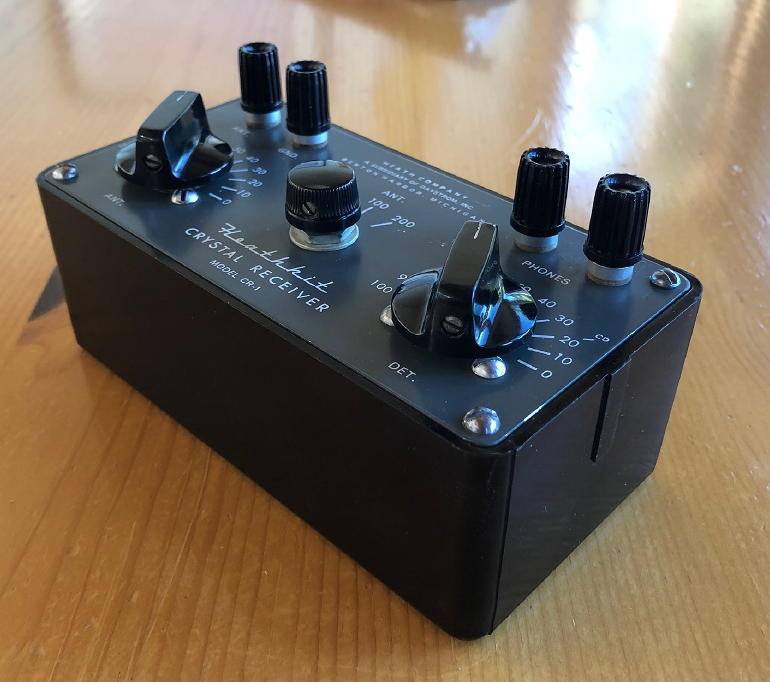
Larry went on to explain that he had been in the Air Force and his little CR-1 had been all around the world with him, from Alaska to Turkey ... but from its fine appearance, you would never know it.
 |
| Larry's gift! |
He was happy to pass it on knowing that it was going to a good home. I am most appreciative of this kind gesture from a fellow radio amateur, knowing that these things are not too easy to find ... and are somewhat pricey!
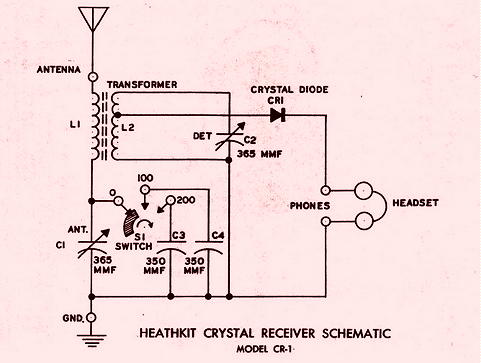
As can be seen in the schematic diagram above, the CR-1 is a simple double-tuned crystal receiver, utilizing a series-tuned tank circuit for antenna-tuning, coupled into the detector tank circuit. The detector diode, a 50’s-era 1N34, is tapped down on the tank for headphone impedance-matching and to reduce circuit loading. Reducing the load on the tank circuit improves selectivity but diminishes sensitivity. Crystal radio design is always a trade-off between these two critical characteristics.
Although I had heard good things about the CR-1, I must admit that I was somewhat skeptical ... just how good could an unmodified CR-1’s simple double-tuned design really be? I was about to find out.
My listening location, on the eastern shoreline of Mayne Island, puts me directly across several miles of saltwater from sixteen exceptionally loud 'blowtorch' signals whose antennas are located near the water on the other side of Georgia Strait. Six of these stations run 50kW ... 24/7. All of these signals are wide and strong, being well-over S9. It is a difficult location for crystal radio DXing as separating weak DX signals from the blowtorches can be challenging.
My previous experience with crystal radio DX is well-documented on my website here. Back then, I quickly adopted the standard protocols to help hear DX. This included the use if a separate ‘spotter’ radio to first find signals that might possibly be strong enough to be heard on the crystal detector. I also used an RF signal generator that let me temporarily put a weak tone-modulated carrier on the frequency of a station that I was trying to hear. Using the tone, the antenna tuning as well as the detector circuit can be optimized for maximum signal. I also used a 100 microamp meter in series with the headphones to make peaking these circuits accurately. The same protocol was used for my CR-1 DXing as well.
Since there are so many very strong signals here, I have added two inline L-C traps on the antenna lead.

My first trap was made from a ferrite bar loopstick inductor salvaged from an old transistor radio.

The second trap is made with a ferrite toroid and Litz wire and produces deeper nulls than the ferrite bar. The bar will soon be replaced by a second toroid trap.

The traps allow me to significantly null any strong signals that could be covering up a nearby weaker signal. For nulling, I set the signal generator on the frequency of the pest signal and then tune the trap for a null while watching the meter. Once everything has been tuned, I’ll often just sit and wait for the desired signal to fade up to a detectable level on the crystal radio and then confirm its audio match to what can be heard on the spotter radio. Very often, a signal initially too weak to be detected, will quickly pop up in signal strength to an easy-copy level for several minutes, before dropping below the threshold of diode detection level once again.
I am presently using a pair of RCA WWII sound-powered ('Big Cans') phones, impedance matched to the CR-1’s output with a multi-tap audio transformer. I have also used a nice set of extremely sensitive Western Electric 509Ws, manufactured in the late 20s. These are also impedance-matched to the CR-1's output. On weak signal tone tests, I can see only a very tiny improvement with the RCAs versus the old 509Ws as both are very sensitive.

There is a large variation in propagation quality on the broadcast band, especially this far north on the southern edge of the auroral zone. The difference from one night to the next can often be quite dramatic. On most nights the band favors the north-south path while on geomagnetically quieter nights it’s the east-west path that dominates. The band needs to be in good shape for any worthwhile hope of DX on a crystal radio.
On one of the recent better nights, of which there have been very few of lately, one of the stations in Alberta was so strong that it needed trapping! This was something I saw quite often with my previous DX set but I didn't expect to see it with the CR-1.
For crystal radio DX, propagation is the best helper. Small incremental improvements (in terms of db losses) can be made in any part of crystal radio's systems but on nights of good propagation, tens of db improvement will magically appear, thanks to Mother Nature!
When in Turkey, Larry had the opportunity to connect the CR-1 to the large FLR-9 circular antenna array used during the cold war for HF direction-finding of targeted signals. Covering 1.5MHz to 30MHz, the FLR-9 consisted of ninety-six 120' towers, suspending 1056 vertical elements ... all over a 1500' diameter ground screen! His notes show that he logged the BBC, Italy and West Germany on the CR-1 while using the array!
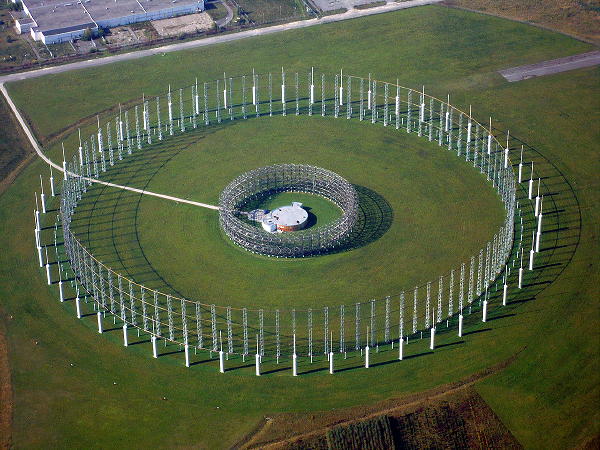 |
| The FLR-9 array in Augsburg, Germany |
Over the past few weeks, I have been spending a few nights patrolling the band between 9:30 and 10:30PM, to see what might be heard with the CR-1. So far, I've logged 50 different stations ... far more than I had expected to hear.
The log below shows all of the stations heard. The stations in red are all local line-of-sight transmitters and are extremely strong ... all are well over S9 on my Sony spotter radio. The stations shown in blue are all ‘DX’, with the furthest so far being KOA in Denver, at 1100 miles.


The log illustrates just how much the blowtorch signals prevent weak-signal detection, even with traps! The stations logged on 1510 and 1530 were only possible when the 1550 blowtorch lost their audio for about five minutes one evening! Selectivity becomes increasingly more difficult towards the top end of the band and, unfortunately, there is a larger concentration of strong locals (who seem to delight in over modulation and splatter), making reception up there extremely challenging.
There are still some lower-band signals that I have yet to log and they have been gradually growing stronger as the nights get longer. As well, the region above 1600kHz may still provide a few opportunities over the next few weeks, if the loud local on 1600 can be sufficiently trapped ... the next few weeks will tell if there’s anything left in the CR-1’s tank!
Steve McDonald, VE7SL, is a regular contributor to AmateurRadio.com and writes from British Columbia, Canada. Contact him at [email protected].
 Ham Radio Deluxe |
 W5SWL Electronics |
 Ham Radio Prep |
 KB3IFH QSL Cards  Hip Ham Shirts  HamRadioAuctions HamRadioAuctions Reliance Antennas Reliance Antennas Enigma Shop Enigma Shop |  morseDX  Ni4L Antennas  R&L Electronics R&L Electronics antennas.us antennas.us QRV QRV |
- Matt W1MST, Managing Editor
