 |
 The Astron RS20-M repairs completed
 27 November 2019 | by
 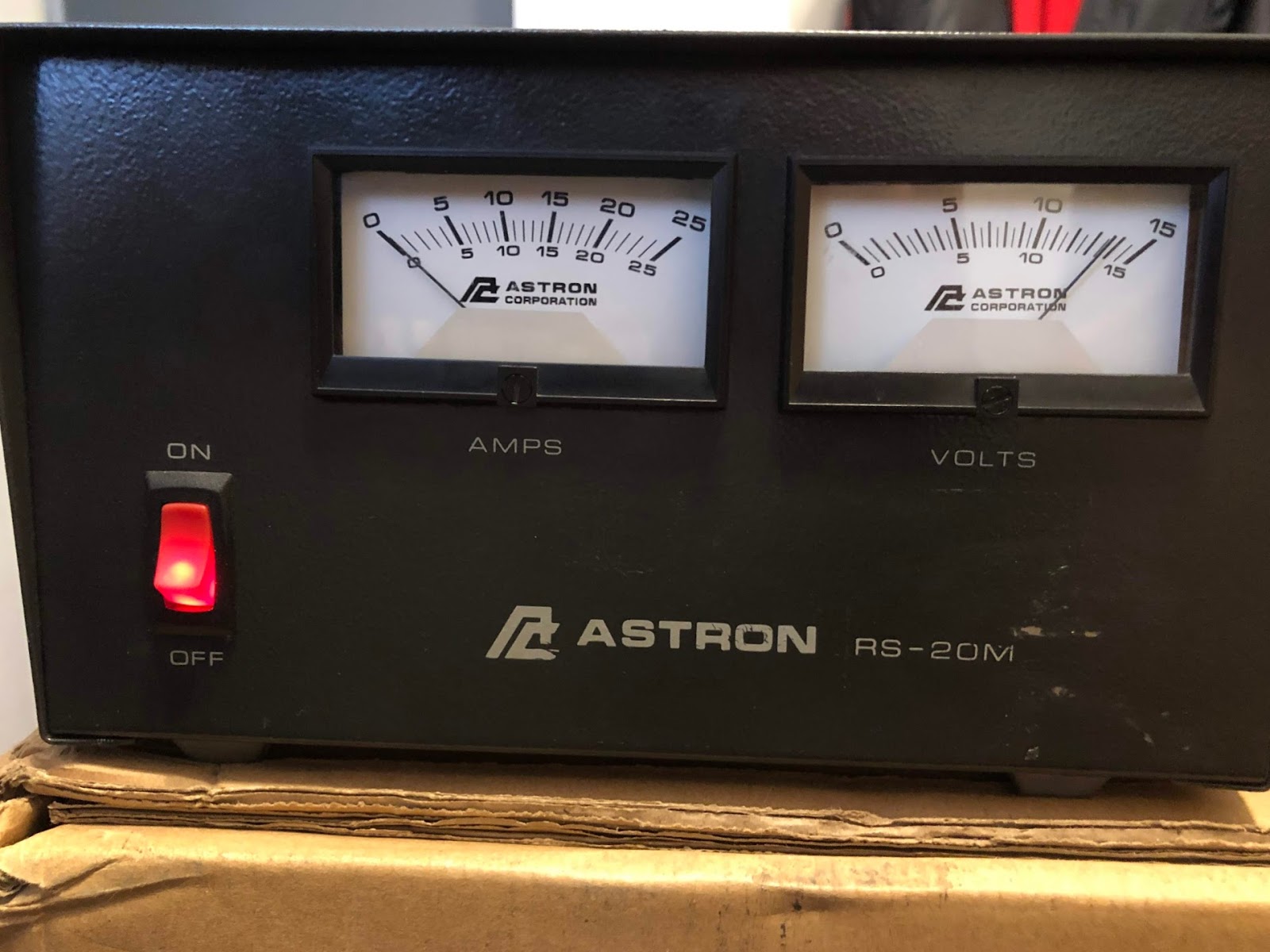 |
| Repaired and working |
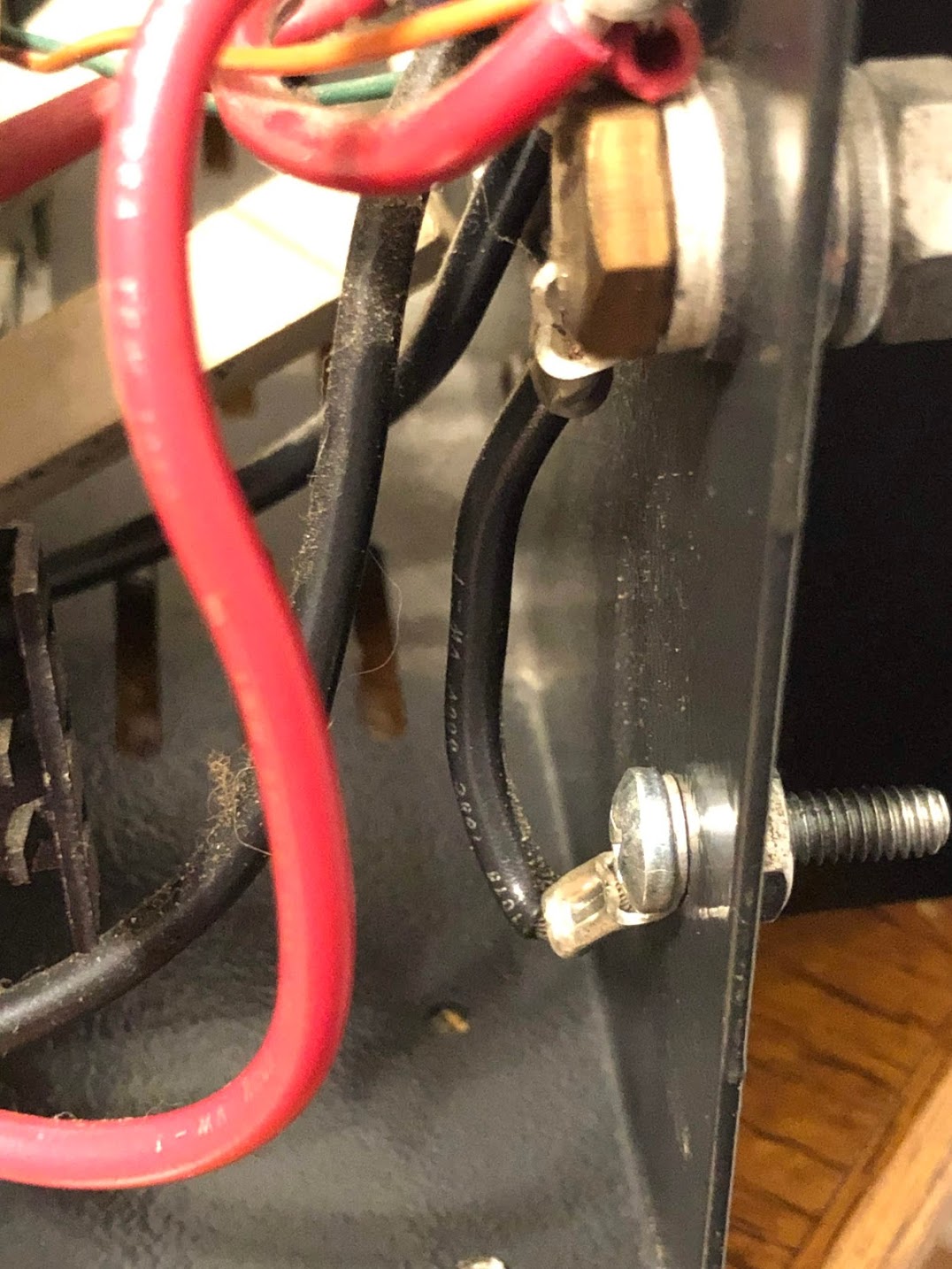 |
| Negative to case ground |
I found this great site online regarding Astron power supply trouble shooting and repairs. This document really helped me with the trouble shooting and eventual repair of the power supply. There was another online article I came across regarding how Astron now and then has the negative terminal grounded to the case of the supply.
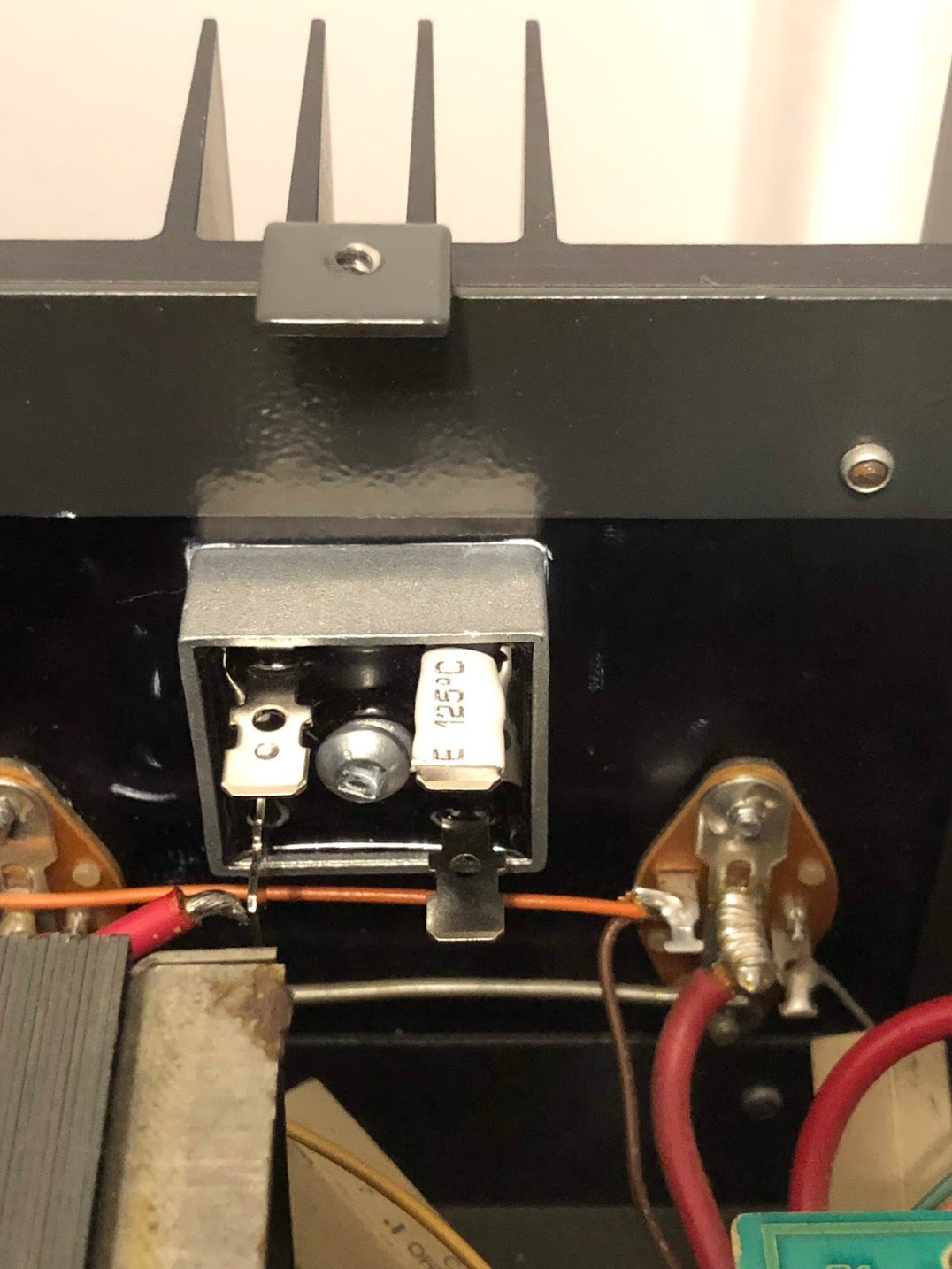 |
| New bridge rectifier |
With the new bridge rectifier installed and wires re-soldered, the pass transistors back in place and finally I did remove one connection of the Varistor to test it (tested ok) I had to also re-solder that back on as well. It was now time for the smoke test.......and I was pleased that no smoke was found and the power supply is now working without issue. I did connect it to the Icom 7610, adjusted the power to 50 watts and the power supply successfully passed the load test as well. This power supply is under sized for the Icom 7610, I now have a new Astron power supply that is sized correctly. I am now wondering if I should keep this supply or sell it?
 |
| Passed load test |
Mike Weir, VE9KK, is a regular contributor to AmateurRadio.com and writes from New Brunswick, Canada. Contact him at [email protected].
LHS Episode #313: GridTracker Deep Dive
Welcome to Episode 313 of Linux in the Ham Shack. In this episode, the hosts talk with Stephen "Tag" Loomis, N0TTL, creator of the GridTracker project. We take an in-depth look at the software application, its configuration, utilization and all of the hidden features that you may be hearing about for the first time. It's well designed, well thought out and a triumph of what someone can do when they're motivated to create a great project. And it's free! Hope you enjoy.
73 de The LHS Crew
Russ Woodman, K5TUX, co-hosts the Linux in the Ham Shack podcast which is available for download in both MP3 and OGG audio format. Contact him at [email protected].
Weekly Propagation Summary – 2019 Nov 25 16:10 UTC
Here is this week’s space weather and geophysical report, issued 2019 Nov 25 0142 UTC.
Highlights of Solar and Geomagnetic Activity 18 – 24 November 2019
Solar activity was very low. No sunspots were observed on the visible disk. No Earth-directed CMEs were observed in available coronagraph imagery.
No proton events were observed at geosynchronous orbit.
The greater than 2 MeV electron flux at geosynchronous orbit was at normal to moderate levels on 18-23 Nov. Moderate to high levels were observed on 24 Nov in response to the influence of a positive polarity CH HSS.
Geomagnetic field activity ranged from quiet to active levels. Quiet to active levels were observed on 21-22 Nov and quiet to unsettled on 23-24 Nov due to influence from a positive polarity CH HSS. Solar wind speeds increased to above 600 km/s over 21 Nov and remained elevated but in slow decline through 24 Nov. The remainder of the reporting period was at quiet levels under nominal solar wind conditions.
Forecast of Solar and Geomagnetic Activity 25 November – 21 December 2019
Solar activity is expected to be at very low levels throughout the outlook period.
No proton events are expected at geosynchronous orbit.
The greater than 2 MeV electron flux at geosynchronous orbit is expected to be at normal to high levels. High levels are expected on 25-28 Nov and again on 20-21 Dec. Moderate levels are expected on 01-17 Dec. All enhancements to electron flux are anticipated in response to multiple CH HSSs.
Geomagnetic field activity is expected to range from quiet unsettled. Unsettled conditions are expected on 25-28 Nov, 08 Dec, and 18-21 Dec in response to multiple CH HSSs. The remainder of the outlook period is expected be at quiet levels.
Don’t forget to visit our live space weather and radio propagation web site, at: http://SunSpotWatch.com/
Live Aurora mapping is at http://aurora.sunspotwatch.com/
If you are on Twitter, please follow these two users: 1. https://Twitter.com/NW7US 2. https://Twitter.com/hfradiospacewx
– – – – – – – – – – – – –
Be sure to subscribe to our space weather and propagation email group, on Groups.io
https://groups.io/g/propagation-and-space-weather
Spread the word!
– – – – – – – – – – – – –
Links of interest:
+ Amazon space weather books: http://g.nw7us.us/fbssw-aSWSC
+ https://Twitter.com/NW7US
+ https://Twitter.com/hfradiospacewx
Space Weather and Ham Radio YouTube Channel News:
I am working on launching a YouTube channel overhaul, that includes series of videos about space weather, radio signal propagation, and more.
Additionally, I am working on improving the educational efforts via the email, Facebook, YouTube, Tumblr, and other activities.
You can help!
Please consider becoming a Patron of these space weather and radio communications services, beginning with the YouTube channel:
https://www.patreon.com/NW7US
The YouTube channel:
https://YouTube.com/NW7US
..
Visit, subscribe: NW7US Radio Communications and Propagation YouTube Channel
How Did You Fare in CQ WW CW Contest Weekend?
Man, lots and lots of Morse code on the ham bands, this weekend. The CQ Worldwide CW Contest weekend was hopping with signals!
How did you do this weekend? How were conditions on the various contest bands?
Comment here and your report may make it into the propagation column in an upcoming edition of the Radio Propagation column in CQ Amateur Radio Magazine.
Here are a few moments as heard at the station of the CQ Amateur Radio Magazine propagation columnist, in Lincoln, Nebraska (yeah, that’s me, NW7US).
[embedyt]https://www.youtube.com/watch?v=eWCbtIOJmLI[/embedyt]
Here are the results of my dabbling with the Icom rig and this contest:
 NW7US's Contest Summary Report for CQ-WW
 Created by N3FJP's CQ WW DX Contest Log
 Version 5.7  www.n3fjp.com

 Total Contacts = 55
 Total Points = 8,979

 Operating Period: 2019/11/24 10:23 - 2019/11/24 22:51

 Total op time (breaks > 30 min deducted): 3:58:46
 Total op time (breaks > 60 min deducted): 4:45:17

 Avg Qs/Hr (breaks > 30 min deducted): 13.8


 Total Contacts by Band and Mode:

 Band       CW   Phone     Dig   Total       %
 ----       --   -----     ---   -----     ---
   80        8       0       0       8      15
   40        7       0       0       7      13
   20       25       0       0      25      45
   15       15       0       0      15      27
            --   -----     ---   -----     ---
 Total      55       0       0      55     100

 Total Contacts by State \ Prov:

 State       Total     %
 -----       -----   ---
                52    95
 HI              3     5

 Total = 1


 Total Contacts by Country:

 Country                      Total     %
 -------                      -----   ---
 Canada                           6    11
 Brazil                           5     9
 USA                              5     9
 Argentina                        3     5
 Costa Rica                       3     5
 Hawaii                           3     5
 Bonaire                          2     4
 Cayman Is.                       2     4
 Chile                            2     4
 Cuba                             2     4
 Japan                            2     4
 Mexico                           2     4
 Aruba                            1     2
 Bahamas                          1     2
 Barbados                         1     2
 Belize                           1     2
 Curacao                          1     2
 Dominican Republic               1     2
 French Guiana                    1     2
 Haiti                            1     2
 Honduras                         1     2
 Martinique                       1     2
 Montserrat                       1     2
 Nicaragua                        1     2
 Senegal                          1     2
 St. Kitts & Nevis                1     2
 St. Lucia                        1     2
 Suriname                         1     2
 US Virgin Is.                    1     2
 Venezuela                        1     2

 Total = 30


 Total DX Miles (QSOs in USA not counted) = 151,407
 Average miles per DX QSO = 3,028


 Average bearing to the entities worked in each continent.
 QSOs in USA not counted.

 AF =  83
 AS = 318
 NA = 124
 OC = 268
 SA = 137


 Total Contacts by Continent:

 Continent   Total     %
 ---------   -----   ---
 NA             32    58
 SA             17    31
 OC              3     5
 AS              2     4
 AF              1     2

 Total = 5


 Total Contacts by CQ Zone:

 CQ Zone   Total     %
 -------   -----   ---
 08           13    24
 03            7    13
 09            7    13
 07            6    11
 11            5     9
 13            3     5
 31            3     5
 04            2     4
 05            2     4
 06            2     4
 12            2     4
 25            2     4
 35            1     2

 Total = 13
Visit, subscribe: NW7US Radio Communications and Propagation YouTube Channel
CQ WW DX CW contest 2019

| No lack of action |
Band QSOs Pts ZN CtyPt /Q
7 6 18 3 5 3.0
14 10 29 6 10 2.9
21 2 5 2 2 2.5
Total 18 52 11 17 2.9
Score: 1,456
I found Sunday to be a tough one my signal was just not being heard and I am guessing it was just the propagation? The few times I was on the radio on Saturday I had no issues making contacts. Some of the bonus things here at VE9KK were:- The new Astron power supply worked just fine. - I was able to work Europe on 40m which never happened at the old QTH with the MFJ 1788 antenna. - Speaking of antennas it was a joy to use the End fed antenna, I was able to change bands without returning. The magloop I used for so long had to be re-tuned on the same band and for sure on band changes. - On Saturday (when I was on) I was able to get into Europe, Central America and South America without issue. During my time on Sunday during the contest I was greeted with an on screen message that N1MM+ stopped working as it was not able to communicate with com3. Com3 is my CAT control for the Icom 7610 and in a nutshell, this meant I was having RFI issues with one or more of my USB cables. I thought I had solved this issue already with snap on chokes?? I had a fast glance at the snap on chokes an noticed some had "un-snapped". I shut things down and spent well over an hour to fix the situation once and for all!! More on that later this week in another post. I restarted the rig and software and did a few tests and I was good to go, but the bands did not seem to want to co-operate. Having said that the bands sure were alive with opportunity. I heard nothing from the south pacific or Asia. Overall, I had a great time while in the chair at the radio and am looking forward to other CW contests. Mike Weir, VE9KK, is a regular contributor to AmateurRadio.com and writes from New Brunswick, Canada. Contact him at [email protected].
ICQ Podcast Episode 312 – Bob Allison (WB1GCM)
In this episode, Martin M1MRB is joined by Chris Howard M0TCH, Frank Howell K4FMH, Ed Durrant DD5LP and Bill Barnes N3JIX to discuss the latest Amateur / Ham Radio news. Colin M6BOY rounds up the news in brief and this episode’s feature is Bob Allison (WB1GCM)
ICQ AMATEUR/HAM RADIO PODCAST DONORS
We would like to thank our monthly and annual subscription donors for keeping the podcast advert free. To donate, please visit - http://www.icqpodcast.com/donate
- IARU Region 1 - Alcohol Ban at YOTA events - Ham Radio Reaching 'an Inflection Point' - W1AW Commemorate Ham Radio Spanning Atlantic - UK University Amateur Radio - YOTA Summer Camp in the Americas - 60m Band a Step Closer in France - Five Train the Trainers Courses for 2020 - ARRL Self-Guided Emergency Communication Course EC-001-S is Now Available On-Demand
Colin Butler, M6BOY, is the host of the ICQ Podcast, a weekly radio show about Amateur Radio. Contact him at [email protected].
LHS Episode #312: The Weekender XXXVII

It's time once again for The Weekender. This is our bi-weekly departure into the world of amateur radio contests, open source conventions, special events, listener challenges, hedonism and just plain fun. Thanks for listening and, if you happen to get a chance, feel free to call us or e-mail and send us some feedback. Tell us how we're doing. We'd love to hear from you.
73 de The LHS Crew
Russ Woodman, K5TUX, co-hosts the Linux in the Ham Shack podcast which is available for download in both MP3 and OGG audio format. Contact him at [email protected].
 Ham Radio Deluxe |
 W5SWL Electronics |
 Ham Radio Prep |
 KB3IFH QSL Cards  Hip Ham Shirts  HamRadioAuctions HamRadioAuctions Reliance Antennas Reliance Antennas Enigma Shop Enigma Shop |  morseDX  Ni4L Antennas  R&L Electronics R&L Electronics antennas.us antennas.us QRV QRV |
- Matt W1MST, Managing Editor
