 |
 LHS Episode #306: The Weekender XXXV
 4 October 2019 | by
It's time once again for The Weekender. This is our bi-weekly departure into the world of amateur radio contests, open source conventions, special events, listener challenges, hedonism and just plain fun. Thanks for listening and, if you happen to get a chance, feel free to call us or e-mail and send us some feedback. Tell us how we're doing. We'd love to hear from you.
73 de The LHS Crew
Russ Woodman, K5TUX, co-hosts the Linux in the Ham Shack podcast which is available for download in both MP3 and OGG audio format. Contact him at [email protected].
An Interesting FT8 Afternoon
Lest my loyal blog-followers think I’ve taken a leap to the digital-darkside, rest assured this is not the case!
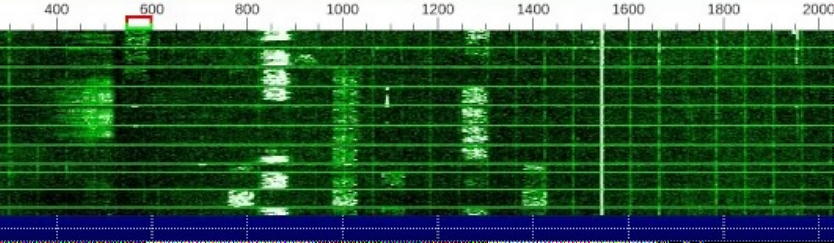
The only time that I (somewhat grudgingly) use FT8 is during the summer Es season, since most of the DX seems to have migrated to that mode. On Monday afternoon, during a moment of weakness driven by curiosity, I moved my receiver from 630m JT9 to 40m FT8 ... what might I see at around noon, via this popular weak signal digital QSO mode? To say that the results were surprising is an understatement!
 |
| 40m at noon |
With an all-daylight path between VE7 and Asia, could these signals be coming via the long-path? If so, I would expect to see at least a few signals from other countries along the great circle path to Asia but none were forthcoming. Perhaps it’s a case of there being a sufficiently weak D-layer to allow signals to propagate on the direct path via the F-layer, in spite of the all-daylight path. What do you think?
I then moved the receiver down to 80m, and monitored there for the next two hours.
 |
| 80m at 1500 local |
For both 80 and 40m, the antenna used was my 80m end-fed half-wave configured as an inverted-L ... 70’ straight up and 60’ horizontal. The feedpoint is one-foot above the ground and located beside the ocean, looking towards the east.
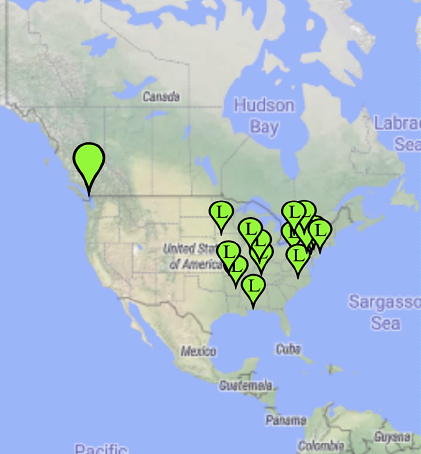
I then finished off the afternoon with a look on topband, using my 160m half-sloper. The screen capture of 160m was made at 5PM local time, fully two hours before my local sunset!
 |
| 160m at 1700 local |
Like the previous two bands, 160m was showing signals in broad daylight, from the east coast! Low D-layer absorption? ... salt water horizon gain? ... excellent antennas? ... or is this just the sensitivity of FT8 revealing 'normal propagation' that we can't hear on CW? I suspect that it's a complex combination of all of these factors and maybe others.
In reality, the weak-signal ‘digging power’ of FT8 is not too much greater than the threshold for audible CW ... hearing about 1 S-unit (~6-7db) deeper. Maybe that’s all it takes to peel-back, like an onion skin, another layer of hidden signals.
There are other weak-signal digital QSO modes much more sensitive than FT8. Both JT9 and JT65 can each hear more than an S-unit deeper than FT8 but at the expense of taking longer to do it ... there’s just no free-ride. I believe that the shorter (~15 second) sequencing of FT8 is the main reason for its overwhelming popularity, in spite of its lower sensitivity.
I’ll run this test again soon to see if Monday’s daytime prop was unusual or if it was typical of what to expect with weak-signal digital modes on the lower bands during the daylight hours ... either way, it was indeed, an interesting FT8 afternoon!
Steve McDonald, VE7SL, is a regular contributor to AmateurRadio.com and writes from British Columbia, Canada. Contact him at [email protected].
The Endfed antenna is up but with mixed results.
Band. Freq. SWR
40. 7.0001. 1.9
40. 7.070 2.5
30. 10.100. 4.4
30. 10.150. 4.5
20. 14.001. 4.5
20. 14.070. 4.3
17. 18.068. 1.5
17. 18.168 1.5
21. 21.001. 1.8
21. 21.070. 1.8
I was a bit alarmed by the results so I emailed Steve W1SFR regarding the results from his Endfed antenna. He came back with positive comments saying my results looked very normal. This is the very reason it's said that with the Endfed antennas you need to use a tuner. The next step was to connect the Icom 7610 to the whole mix and see how things worked. This is where Murphy popped his head up to give me grief! I began to transmit on 40 meters and with the power at 40 watts things started to happen around the shack and house! In the shack my PC was not running but the monitor was in sleep mode. All of a sudden the monitor would wakeup from it's sleep, on my PC desktop I have a program that allows me to post notes on the desktop when I transmitted CW I would see random letters being typed on a posted notes on the desktop, my electronic keyer would send dah's and no dits and finally our new electronic washing machine would just shut down. The other band I tried was 20m and when transmitting CW at about 60 watts the PC monitor would wake up from it's sleep but no other issues. I was wondering it it was the RF coming back on the coax or because the Endfed run parallel with the mini home is about 15 feet away from the home?
I contacted Steve again who informed me that it could be RF on the coax as it's a counterpoise. His suggestion was for me to purchase a 1:1 balun and from there see if it solves the issues. Steve suggested it may or may not solve all the issues and I may have to look at other options for unsolved issues. Well I have a decision to make....do I want to start spending more money and go down a road that may lead me to gaining more "stuff" but still not being able to use the antenna. Now I did get some comments from my blog readers who do have and are using with success an Endfed antenna.
Mike Weir, VE9KK, is a regular contributor to AmateurRadio.com and writes from New Brunswick, Canada. Contact him at [email protected].
LHS Episode #305: Morning Mink

Welcome to Episode 305 of Linux in the Ham Shack. In this episode, the hosts discuss the Amazon being invasive (no, really!), amateur radio in France, Australia and space, artificial intelligence multi-SDR boards and much more. Thank you for listening and we hope you have a great week.
73 de The LHS Crew
Russ Woodman, K5TUX, co-hosts the Linux in the Ham Shack podcast which is available for download in both MP3 and OGG audio format. Contact him at [email protected].
Weekly Propagation Summary – 2019 Sep 30 16:10 UTC
Here is this week’s space weather and geophysical report, issued 2019 Sep 30 0233 UTC.
Highlights of Solar and Geomagnetic Activity 23 – 29 September 2019
Solar activity was very low throughout the summary period and no active regions with sunspots were observed.
No proton events were observed at geosynchronous orbit.
The greater than 2 MeV electron flux at geosynchronous orbit reached very high levels on 29 Sep with high levels observed on 28 Sep. Normal and normal to moderate flux values were observed throughout the remainder of the week.
Geomagnetic field activity reached G1 (Minor) geomagnetic storm levels on 27-28 Sep due to the influence of a recurrent, positive polarity coronal hole high speed stream (CH HSS). Active conditions were observed on 24 and 29 Sep and quiet or quiet to unsettled conditions were observed throughout the remainder of the period.
Forecast of Solar and Geomagnetic Activity 30 September – 26 October 2019
Solar activity is expected to be very low throughout the outlook period.
No proton events are expected at geosynchronous orbit.
The greater than 2 MeV electron flux at geosynchronous orbit is expected to reach high levels on 30 Sep-12, 14, and 25-26 Oct. Normal and normal to moderate levels are expected for the remainder of the outlook period.
Geomagnetic field activity is expected to reach G1 (Minor) geomagnetic storm levels on 24-25 Oct and active levels on 06, 21, and 26 Oct due to coronal hole high speed stream influences.
Don’t forget to visit our live space weather and radio propagation web site, at: http://SunSpotWatch.com/
Live Aurora mapping is at http://aurora.sunspotwatch.com/
If you are on Twitter, please follow these two users: 1. https://Twitter.com/NW7US 2. https://Twitter.com/hfradiospacewx
– – – – – – – – – – – – –
Be sure to subscribe to our space weather and propagation email group, on Groups.io
https://groups.io/g/propagation-and-space-weather
Spread the word!
– – – – – – – – – – – – –
Links of interest:
+ Amazon space weather books: http://g.nw7us.us/fbssw-aSWSC
+ https://Twitter.com/NW7US
+ https://Twitter.com/hfradiospacewx
Space Weather and Ham Radio YouTube Channel News:
I am working on launching a YouTube channel overhaul, that includes series of videos about space weather, radio signal propagation, and more.
Additionally, I am working on improving the educational efforts via the email, Facebook, YouTube, Tumblr, and other activities.
You can help!
Please consider becoming a Patron of these space weather and radio communications services, beginning with the YouTube channel:
https://www.patreon.com/NW7US
The YouTube channel:
https://YouTube.com/NW7US
..
Visit, subscribe: NW7US Radio Communications and Propagation YouTube Channel
HR2.0 – ARRL West Gulf Division Candidate Interviews 9/28/2019
I had the privilege of recording an interview meeting between the two candidates running for ARRL West Gulf Division Director, in Houston this past weekend. We were able to livestream the event on Facebook, but the YouTube livestreaming ports were blocked at the meeting location. However, I did also record the meeting to disk and was able to clean-up the audio a bit, and now the raw video footage has been posted to my YouTube channel.
For those in Texas and Oklahoma who are interested in your ARRL Leadership, please see the video below. The session is 2-hours long, but some good questions were asked and answered, and I think both candidates gave a good idea of their vision for leadership inside of the League for the West Gulf Division.
Here are the website links for the candidates also:
N5AUS’ Election Page: https://votewestgulf.org
W5MJ’s Election Page: https://www.qrz.com/db/w5mj
[embedyt] https://www.youtube.com/watch?v=R7c7vUXwOTY[/embedyt]
Jason Johnston, KC5HWB, is a regular contributor to AmateurRadio.com and writes from Texas, USA. Contact him at [email protected].
ICQ Podcast Episode 306 – UK Hamfest 2019
In this episode, Martin M1MRB is joined by Chris Howard M0TCH, Ed Durrant DD5LP, and Frank Howell K4FMH to discuss the latest Amateur / Ham Radio news. Colin M6BOY rounds up the news in brief and this episode’s feature is UK Hamfest 2019.
ICQ AMATEUR/HAM RADIO PODCAST DONORS
We would like to thank Anne-Marie Nugent and our monthly and annual subscription donors for keeping the podcast advert free. To donate, please visit - http://www.icqpodcast.com/donate
- North Korea tests DRM on Amateur Radio Band - Bulgarian hams Gain Limited Access to 50 MHz - Pirate DAB multiplexes take to the Air - Saltwater and Plastic Antenna - Wanna hijack a USAF orbiting satellite? - Volunteer Monitor Program to Debut - National Club of the Year 2018 Winners Announced - VK Licence Conditions Changes - OR Prefix Celebrates Belgium Princess Birthday
Colin Butler, M6BOY, is the host of the ICQ Podcast, a weekly radio show about Amateur Radio. Contact him at [email protected].
 Ham Radio Deluxe |
 W5SWL Electronics |
 Ham Radio Prep |
 KB3IFH QSL Cards  Hip Ham Shirts  HamRadioAuctions HamRadioAuctions Reliance Antennas Reliance Antennas Enigma Shop Enigma Shop |  morseDX  Ni4L Antennas  R&L Electronics R&L Electronics antennas.us antennas.us Ears to Our World Ears to Our World |
- Matt W1MST, Managing Editor
