 |
 Ham College 58
 26 October 2019 | by
 Ham College episode 58 is now available for download.
General Amateur Radio Exam part 29. General questions pool updates 1 of 3.
01:06:31
George Thomas, W5JDX, is co-host of AmateurLogic.TV, an original amateur radio video program hosted by George Thomas (W5JDX), Tommy Martin (N5ZNO), Peter Berrett (VK3PB), and Emile Diodene (KE5QKR). Contact him at [email protected].
LHS Episode #309: The Weekender XXXVI

It's time once again for The Weekender. This is our bi-weekly departure into the world of amateur radio contests, open source conventions, special events, listener challenges, hedonism and just plain fun. Thanks for listening and, if you happen to get a chance, feel free to call us or e-mail and send us some feedback. Tell us how we're doing. We'd love to hear from you.
73 de The LHS Crew
Russ Woodman, K5TUX, co-hosts the Linux in the Ham Shack podcast which is available for download in both MP3 and OGG audio format. Contact him at [email protected].
Fun with FT-8.
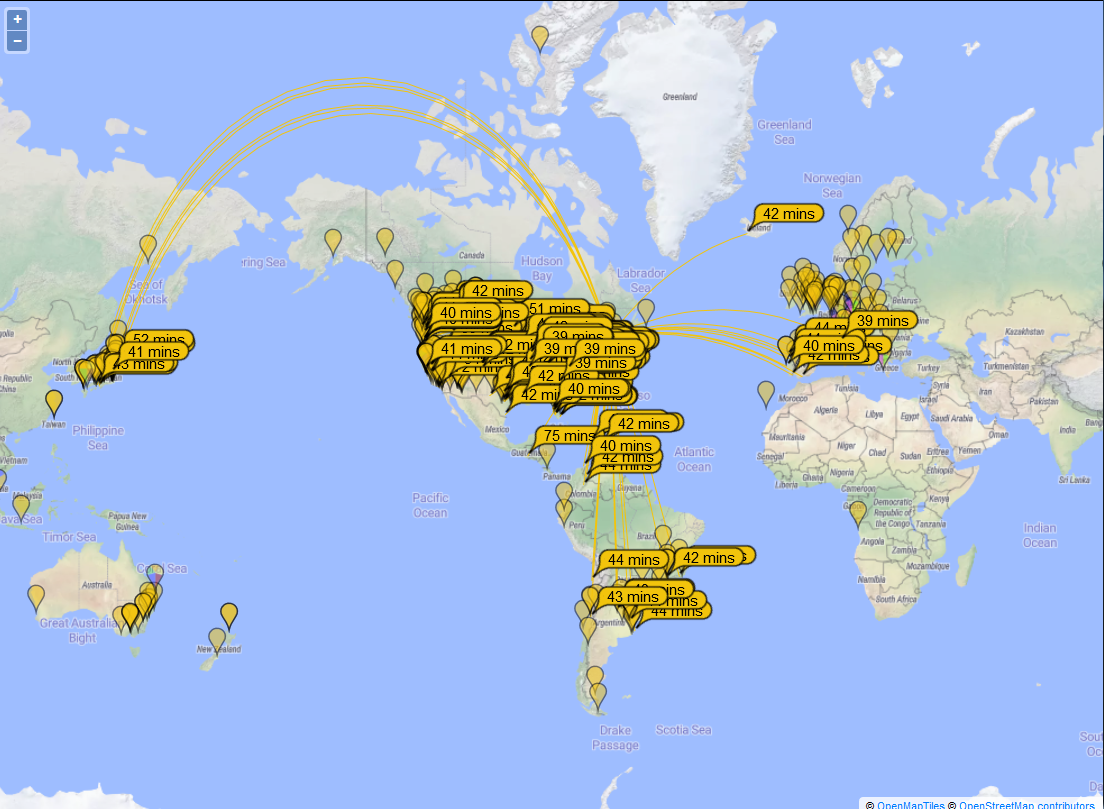 |
| Those hearing me on 20m FT-8 |
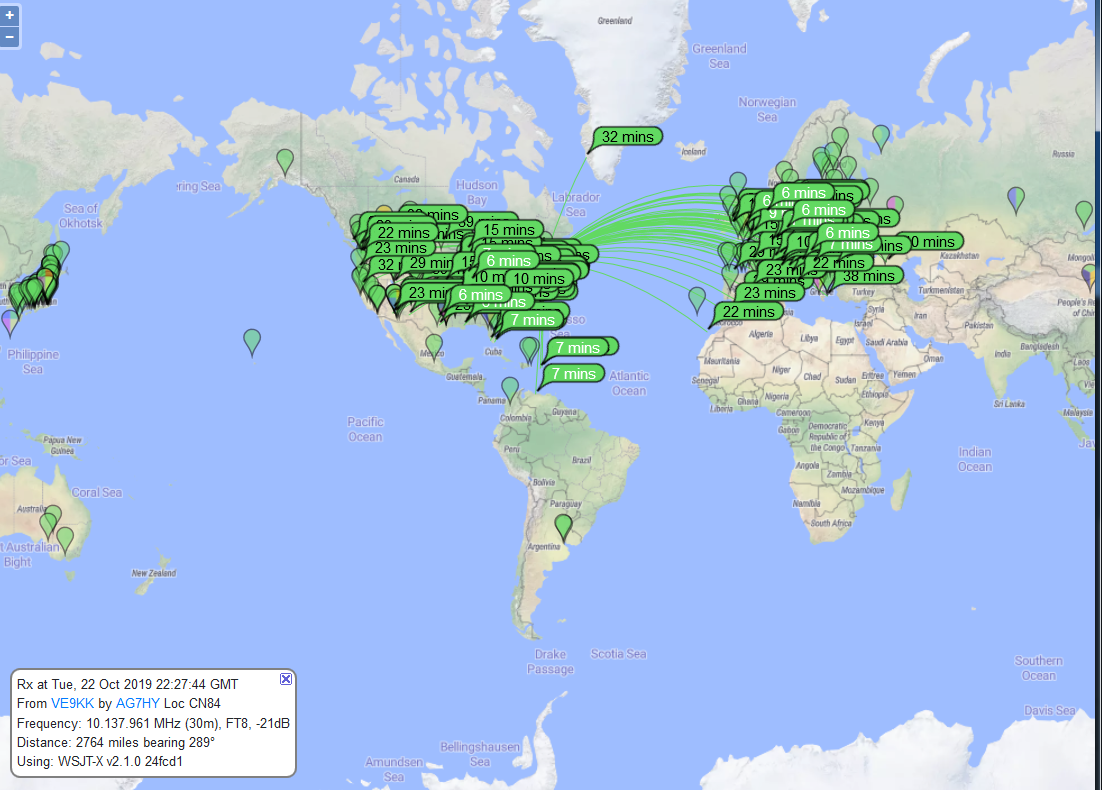 |
| Those hearing me on 30m FT-8 On 20m I was being heard in Japan, South America, Central America, Europe(including Iceland) and all over the U.S. On 30m FT-8 the food gates opened to Europe and all over the U.S but Japan closed down. Overall I am very pleased with how my Endfed antenna preformed this evening. |
Mike Weir, VE9KK, is a regular contributor to AmateurRadio.com and writes from New Brunswick, Canada. Contact him at [email protected].
LHS Episode #308: Ciao, Enzo

Welcome to Episode 308 of Linux in the Ham Shack. In this short-topic episode, the hosts discuss the JOTA/JOTI weekend, Homebrew Heroes, youths as the future of amateur radio, GNU, Perl, OpenLibra, open hardware, FOSS satellites and much more. Thank you for tuning in. We appreciate you all.
73 de The LHS Crew
Russ Woodman, K5TUX, co-hosts the Linux in the Ham Shack podcast which is available for download in both MP3 and OGG audio format. Contact him at [email protected].
Weekly Propagation Summary – 2019 Oct 21 16:10 UTC
Here is this week’s space weather and geophysical report, issued 2019 Oct 21 0358 UTC.
Highlights of Solar and Geomagnetic Activity 14 – 20 October 2019
Solar activity was very low. The solar disk was spotless throughout the period. No Earth-directed CMEs were observed.
No proton events were observed at geosynchronous orbit.
The greater than 2 MeV electron flux at geosynchronous orbit reached moderate levels on 14-15 Oct and again on 17-20 Oct with a peak flux of 777 pfu observed at 14/1500 UTC.
Geomagnetic field activity ranged from quiet to unsettled levels. Solar wind speed was mostly in the 300-400 km/s range but increased to 400-440 km/s on 16-17 Oct. Total field ranged from 1-8 nT. The geomagnetic field responded with mostly quiet conditions with isolated unsettled periods on 15 and 20 Oct.
Forecast of Solar and Geomagnetic Activity 21 October – 16 November 2019
Solar activity is expected to be at very low levels for the forecast period.
No proton events are expected at geosynchronous orbit.
The greater than 2 MeV electron flux at geosynchronous orbit is expected to reach moderate levels on 24 Oct, 04-11 Nov, and again on 13-16 Nov. High levels are expected on 25 Oct-03 Nov due to coronal hole high speed stream (CH HSS) influence.
Geomagnetic field activity is expected to reach unsettled to active levels on 21-22 Oct and 24-29 Oct with G1 (Minor) geomagnetic storm levels likely on 24-25 Oct due to recurrent CH HSS activity.
Don’t forget to visit our live space weather and radio propagation web site, at: http://SunSpotWatch.com/
Live Aurora mapping is at http://aurora.sunspotwatch.com/
If you are on Twitter, please follow these two users: 1. https://Twitter.com/NW7US 2. https://Twitter.com/hfradiospacewx
– – – – – – – – – – – – –
Be sure to subscribe to our space weather and propagation email group, on Groups.io
https://groups.io/g/propagation-and-space-weather
Spread the word!
– – – – – – – – – – – – –
Links of interest:
+ Amazon space weather books: http://g.nw7us.us/fbssw-aSWSC
+ https://Twitter.com/NW7US
+ https://Twitter.com/hfradiospacewx
Space Weather and Ham Radio YouTube Channel News:
I am working on launching a YouTube channel overhaul, that includes series of videos about space weather, radio signal propagation, and more.
Additionally, I am working on improving the educational efforts via the email, Facebook, YouTube, Tumblr, and other activities.
You can help!
Please consider becoming a Patron of these space weather and radio communications services, beginning with the YouTube channel:
https://www.patreon.com/NW7US
The YouTube channel:
https://YouTube.com/NW7US
..
Visit, subscribe: NW7US Radio Communications and Propagation YouTube Channel
Comparing receive signals with and without 1:1 balun.
 |
| 20m without balun |
14.100 to cover the CW and digi section of the band. The local time was in around 22:37 and without Balun Designs 1:1 balun installed the section of 20m from 14.000 to 14.100 showed some what I called washout sections. I did notice around the 14.040 mark there is some RFI on the waterfall. When I moved the VFO over to that section the RFI was very faint. Also a very faint indication of RFI on the waterfall just past the
 |
| 20m with balun |
When the 1:1 balun was introduced the band cleaned up regarding the washed out sections. I was able to see digi signals, in the posted picture the digi signals are almost gone from the waterfall. There was some CW signals close to the noise floor that I was able to hear (not shown in the picture). I did notice the RFI what was in the waterfall without the balun installed is gone BUT after the balun was installed at 14.080 there was a stronger RFI signal and I could hear it very well when tuned to it. This RFI was not there all the time I would say it was on and off. Not sure what it is but that is not the purpose of this post.....save that for another post.
 |
| 20m RFI without balun |
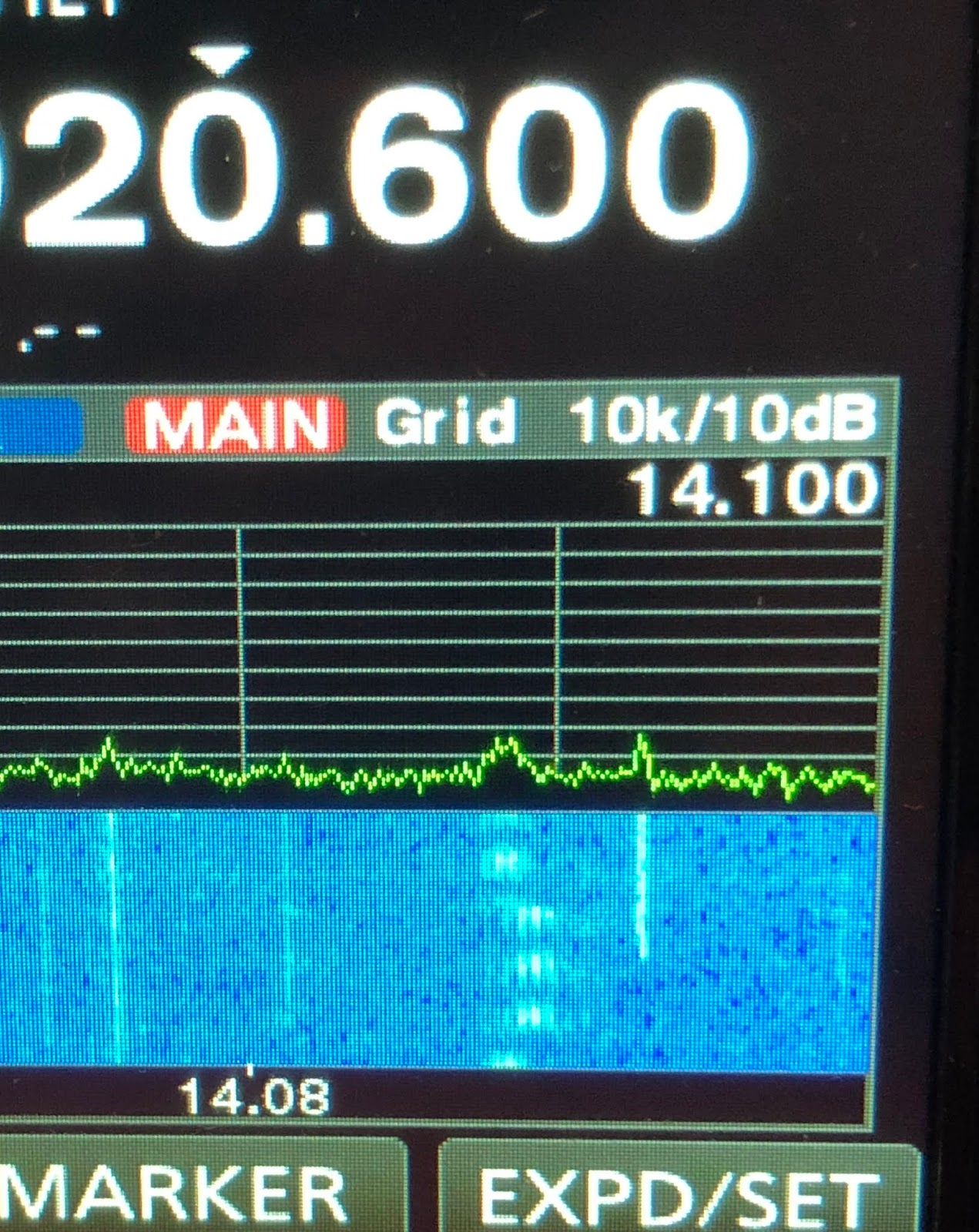 |
| 20m RFI with balun |
 |
| 30m without balun. |
Because it was later in the evening 40m seemed to really shine when I preformed the comparison with and without the balun installed. The span on 40m was 7.000 to 7.100. Without the balun there was some CW signals as well as some digi signals that I noticed. I was pleased with what I saw until I placed the balun in the picture. This cleared up the band and I was able to see more CW signals and the digi section was much more pronounced. I also noticed according to the S-meter with the balun was in around S-4 and without just over S-5.
I am very pleased how the balun has improved the reception end of things.
 |
| 30m with balun |
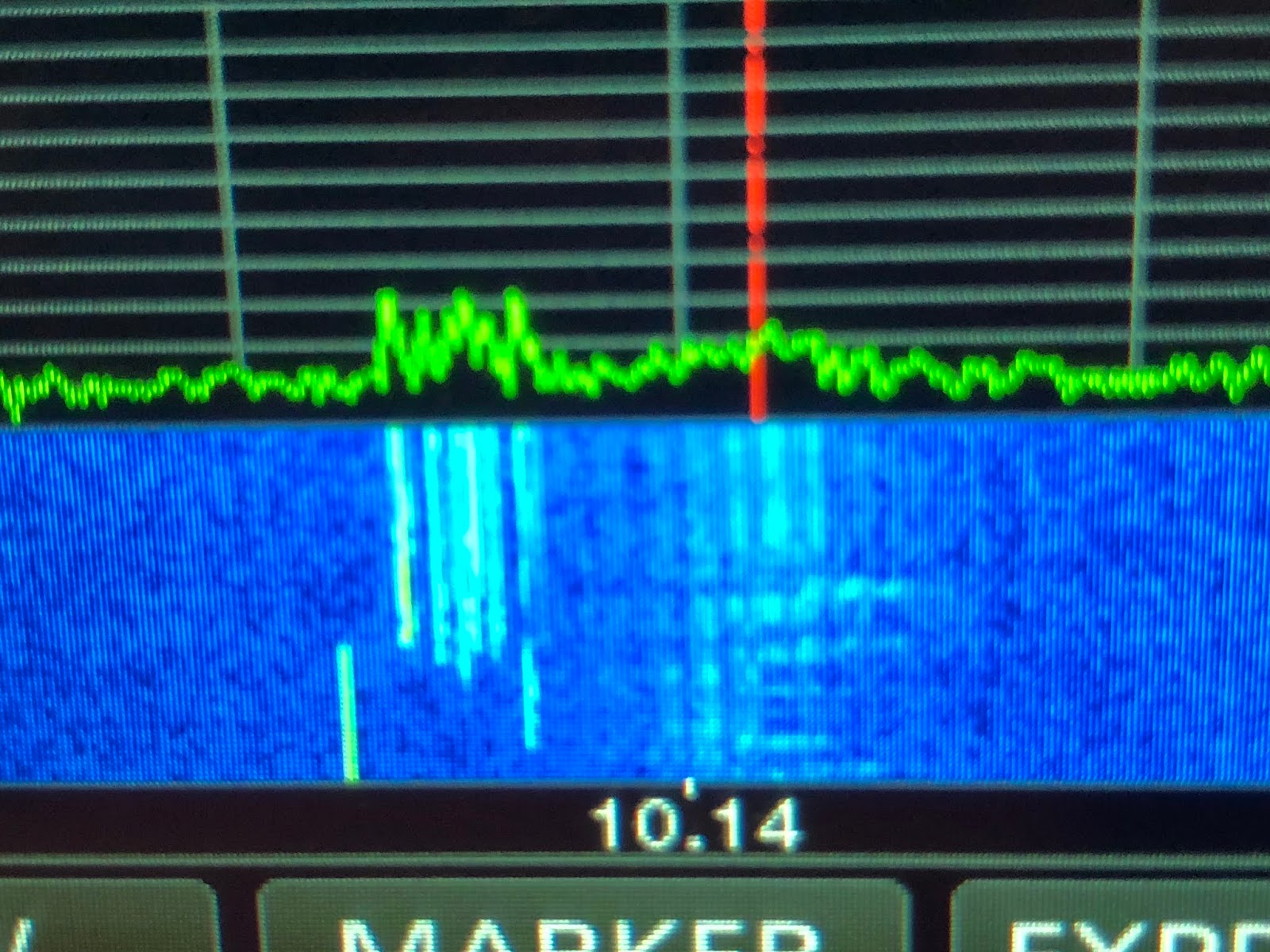 |
| 30m digi signal with something to the right? |
 |
| 40m without balun |
 |
| 40m with balun |
Mike Weir, VE9KK, is a regular contributor to AmateurRadio.com and writes from New Brunswick, Canada. Contact him at [email protected].
Hunting For NDBs In CLE249
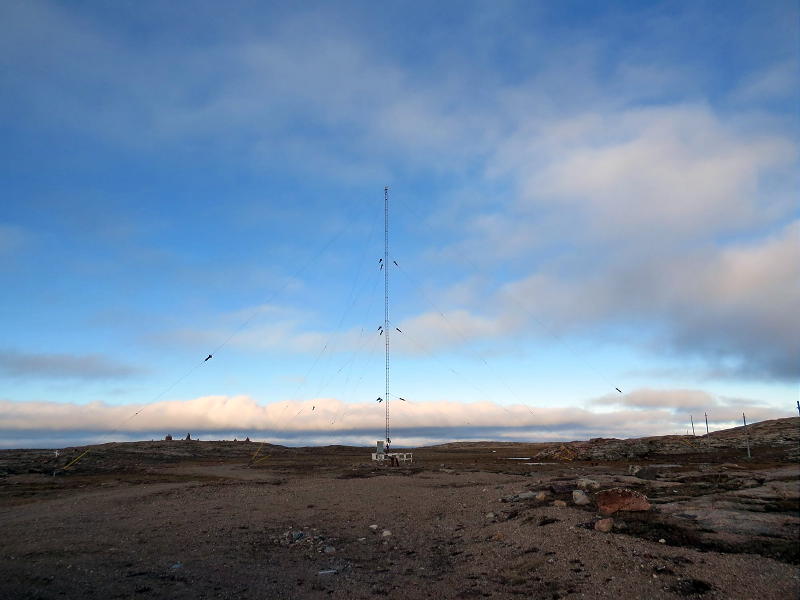 |
| YUT - 335 kHz (courtesy: VE3GOP) |
It's CLE time once again! This coming weekend the CLE hunting grounds will be 335.0 - 349.9 kHz.
For those unfamiliar with this monthly activity, a 'CLE' is a 'Co-ordinated Listening Event', as NDB DXers around the world focus their listening time on one small slice of the NDB spectrum.
If you've been meaning to participate in CLE, then maybe this weekend is a fine time to try! Lately, we've had a lot of first time submissions so you won't be alone!
As well, if you're trying to learn CW, copying NDBs is perfect practice as the identifier speed is generally slow and the letters are repeated again every few seconds!
A nice challenge in this one is to hear YUT - 335 kHz. 'YUT' is located at Repulse Bay, Nunavut, way up on Baffin Island.
'YUT' runs just 25W into a massive vertical and is well-heard throughout North America and parts of northern Europe. Listen for its upper-sideband CW identifier repeated every 10 seconds (with your receiver in the CW mode) on 335.406 kHz.
At this time of the season, summer lightning storms should be drawing down significantly and with some decent propagation there will be many stations to be logged.
When tuning for NDBs, put your receiver in the CW mode and listen for the NDB's CW identifier, repeated every few seconds. Listen for U.S. NDB identifiers approximately 1 kHz higher or lower than the published transmitted frequency since these beacons are modulated with a 1020 Hz tone approximately.
For example, 'AA' near Fargo, ND, transmits on 365 kHz and its upper sideband CW identifier is tuned at 366.025 kHz while its lower sideband CW ident can be tuned at 363.946 kHz. Its USB tone is actually 1025 Hz while its LSB tone is 1054 Hz.
Often, one sideband will be much stronger than the other so if you don't hear the first one, try listening on the other sideband.
Canadian NDBs normally have an USB tone only, usually very close to 400 Hz. They also have a long dash (keydown) following the CW identifier.
All NDBs heard in North America will be listed in the RNA database (updated daily) while those heard in Europe may be found in the REU database. Beacons heard outside of these regions will be found in the RWW database.
From CLE organizer Brian Keyte, G3SIA, comes the details:
Hello all
Our 249th Co-ordinated Listening Event is less than a week away.
Just a normal CLE using a busy range of frequencies.
First-timers' CLE logs will also be very welcome, as always.
Days: Friday 25 October - Monday 28 October
Times: Start and end at midday, your LOCAL time
Range: 335.0 - 349.9 kHz
Please join us wherever you are - just log the NDBs you can identify
having their nominal frequencies in the range (it includes 335 kHz
but not 350 kHz) and any UNIDs that you come across there too.
We last concentrated on these frequencies in CLE233 (June 2018).
Please read the 'Final Details' which will follow on Wednesday.
73 Brian
(Reminder: You could use any one remote receiver for your loggings,
stating its location and owner - with their permission if required.
A remote listener may NOT also use another receiver, whether local
or remote, to obtain further loggings for the same CLE).
- determine, worldwide, which beacons are actually in service and on-the-air so the online database can be kept up-to-date
- determine, worldwide, which beacons are out-of-service or have gone silent since the last CLE covering this range
- will indicate the state of propagation conditions at the various participant locations
- will give you an indication of how well your LF/MF receiving system is working
- give participants a fun yet challenging activity to keep their listening skills honed
The NDB List Group is a great place to learn more about the 'Art of NDB DXing' or to meet other listeners in your region. There is a lot of good information available there and new members are always very welcome. As well, you can follow the results of other CLE participants from night to night as propagation is always an active topic of discussion.
You need not be an NDB List member to participate in the CLEs and all reports, no matter how small, are of much value to the organizers.
Remember - 'First-time' logs are always VERY welcome!
Reports may be sent to the NDB List Group or e-mailed to CLE co-ordinator, Brian Keyte (G3SIA), whose address appears above. If you are a member of the group, all final results will also be e-mailed and posted there.
Please ... give the CLE a try ... then let us know what NDB's can be heard from your location! Your report can then be added to the worldwide database to help keep it up-to-date.
Have fun and good hunting!
Steve McDonald, VE7SL, is a regular contributor to AmateurRadio.com and writes from British Columbia, Canada. Contact him at [email protected].
 Ham Radio Deluxe |
 W5SWL Electronics |
 Ham Radio Prep |
 KB3IFH QSL Cards  Hip Ham Shirts  HamRadioAuctions HamRadioAuctions Reliance Antennas Reliance Antennas Enigma Shop Enigma Shop |  morseDX  Ni4L Antennas  R&L Electronics R&L Electronics antennas.us antennas.us Ears to Our World Ears to Our World |
- Matt W1MST, Managing Editor
