 |
 Weekly Propagation Summary – 2019 Nov 04 16:10 UTC
 4 November 2019 | by
Here is this week’s space weather and geophysical report, issued 2019 Nov 04 0117 UTC.
Highlights of Solar and Geomagnetic Activity 28 October – 03 November 2019
Solar activity was very low. Regions 2750 (S28, L=116, class/area = Axx/010 on 01 Nov) and 2751 (N05, L=154, class/area = Bxo/010 on 02 Nov) emerged on the solar disk, where inactive of significant flare activity, and quickly decayed to plage before the end of the reporting period. No Earth-directed CMEs were observed.
No proton events were observed at geosynchronous orbit.
The greater than 2 MeV electron flux at geosynchronous orbit reached very high levels on 28 Oct, high levels on 29-30 Oct, 01-03 Nov, and moderate levels on 31 Oct, in response to recurrent, coronal hole high-speed stream (CH HSS) activity. A peak flux of 58,500 pfu was observed at 28/1755 UTC.
Geomagnetic field activity reached active levels on 31 Oct, unsettled levels on 28-30 Oct, and quiet levels on 01-03 Nov, due to CH HSS effects.
Forecast of Solar and Geomagnetic Activity 04 November – 30 November 2019
Solar activity is expected to be at very low levels throughout the outlook period.
No proton events are expected at geosynchronous orbit.
The greater than 2 MeV electron flux at geosynchronous orbit is expected to reach high levels on 04, 21-30 Nov, with moderate levels on 05-11, 20 Nov, and normal levels on 12-19 Nov, in response to CH HSS influence.
Geomagnetic field activity is expected to reach G1 (Minor) storm levels on 21 Nov, with active levels on 06, 20, 22-24 Nov, due to recurrent CH HSS activity. Quiet to unsettled conditions are anticipated throughout the remainder of the outlook period.
Don’t forget to visit our live space weather and radio propagation web site, at: http://SunSpotWatch.com/
Live Aurora mapping is at http://aurora.sunspotwatch.com/
If you are on Twitter, please follow these two users: 1. https://Twitter.com/NW7US 2. https://Twitter.com/hfradiospacewx
– – – – – – – – – – – – –
Be sure to subscribe to our space weather and propagation email group, on Groups.io
https://groups.io/g/propagation-and-space-weather
Spread the word!
– – – – – – – – – – – – –
Links of interest:
+ Amazon space weather books: http://g.nw7us.us/fbssw-aSWSC
+ https://Twitter.com/NW7US
+ https://Twitter.com/hfradiospacewx
Space Weather and Ham Radio YouTube Channel News:
I am working on launching a YouTube channel overhaul, that includes series of videos about space weather, radio signal propagation, and more.
Additionally, I am working on improving the educational efforts via the email, Facebook, YouTube, Tumblr, and other activities.
You can help!
Please consider becoming a Patron of these space weather and radio communications services, beginning with the YouTube channel:
https://www.patreon.com/NW7US
The YouTube channel:
https://YouTube.com/NW7US
..
Visit, subscribe: NW7US Radio Communications and Propagation YouTube Channel
Elecraft KP-1500 Review, Restoring a Halli-Kit HT-40, and Hand-Held Spectrum Analyzers
 Stories you’l find in our November, 2019 edition:
TSM’s 2019 Scanner Radio Buyer’s Guide
By Larry Van Horn N5FPW
For scanner enthusiasts, the digital revolution has changed the VHF/UHF radio spectrum that we monitor. Many public safety agencies worldwide, especially in metropolitan areas, have transitioned from analog to digital communications protocols and are utilizing trunk radio technology. There are also many statewide trunk radio systems that are either operational, being built or planned that use trunking and/or digital modes. In this year’s guide, Larry breaks down the lineup of digital vs analog receivers and asks a few personal questions: What do you want to hear in your area and how much do you want to spend?
TSM Reviews: Elecraft KPA-1500 Linear Amplifier
By Mark Haverstock K8MSH
Solar Cycle expectations may lead you to conclude that, to be heard, you should try raising your voice. That’s exactly what the Elecraft KPA-1500 linear amplifier does—and it does so in style. Mark takes a look at this top-of-the-line amplifier and says, “If your budget allows, the KPA 1500 is an excellent choice–especially if you own an Elecraft K3 or anticipate getting a K4. The seamless integration is well worth the price, and even if you have another brand of radio, you’ll find the KPA-150 to be a winner, as it plays well with all rigs.”
RF Explorer ISM Combo+ Slim, Hand-Held Spectrum Analyzer
By Bob Grove W8JHD
Miniaturization of solid-state receivers and panoramic displays has evolved into more compact, even handheld, spectrum analyzers. Bob takes a look at this latest entry into the signals surveillance market and notes, “This handy handful has the ability to display signal presence over a wide range of frequencies as well as digitally analyze and display a variety of data. Added to this flexibility, the unit can also be used as an RF signal generator for the 2.35-2.55 GHz Wi-Fi band, and it includes an analyzer for this band as well.” Best of all—it’s available for under $300.
The Latent Contester
By Cory GB Sickles WA3UVV
Since the time he first became licensed as a Novice in the early 1970s, Cory has tried to experience many of the various aspects of amateur radio. Some have held his interest, some have come and gone and some really never took hold. Contesting was a sub-interest that fell into the latter category. He would periodically dabble with it in various forms then move on to something else. While he admits to possessing a competitive nature, it had never really emerged in the on-air world of amateur radio. Recently, that changed. He had been invited to sit in on a contest at one of this country’s premier contest stations. Now, he’s hooked.
Scanning America
By Dan Veeneman
Iredell County (NC) and Cape May (NJ)
Federal Wavelengths
By Chris Parris
Monitoring Road Trip: Arizona and California
Milcom
By Larry Van Horn N5FPW
DoD Aerial Refueling Frequencies
Utility Planet
By Hugh Stegman
US Coast Guard May Discontinue NAVTEX
Shortwave Utility Logs
By Mike Chace-Ortiz and Hugh Stegman
VHF and Above
By Joe Lynch N6CL
USMA Cadets Contact Alum Aboard ISS
Digitally Speaking
By Cory GB Sickles WA3UVV
Digital Voice Radio Buyer’s Guide
Radio 101
By Ken Reitz KS4ZR
Propagation: Hearing is Believing
The World of Shortwave Listening
By Ken Reitz KS4ZR
A Better Antenna for Better Shortwave Listening
The Shortwave Listener
By Fred Waterer
Radio Tirana; BBC Monthly Programming
Amateur Radio Astronomy
By Stan Nelson KB5VL
Meteor Monitoring Digital TV Carriers on Channel 2
Adventures in Radio Restoration
By Rich Post KB8TAD
The Hallikit HT-40 Transmitter
Antenna Connections
By Dan Farber AC0LW
Do the Math: Numbers Crunching for Radio Enthusiasts
The Spectrum Monitor is available in PDF format which can be read on any desktop, laptop, iPad®, Kindle® Fire, or other device capable of opening a PDF file. Annual subscription is $24. Individual monthly issues are available for $3 each.
Ken Reitz, KS4ZR, is publisher and managing editor of The Spectrum Monitor. Contact him at [email protected].
New Book: VHF, Summits and More
 I am excited to announce the release of my new book: VHF, Summits and More.
This book is about having fun with ham radio, primarily on the VHF/UHF bands. It covers the basics of VHF, with practical tips for getting on the air and “messing around with radios.” Topics include FM, SSB, repeaters, equipment, band plans, phonetics, portable operating, Summits On The Air (SOTA) activations and more. This book is a compilation of the best articles from the k0nr.com website plus some brand-new material.
The first section explains VHF/UHF concepts via tutorial articles such as “VHF FM Operating Guide,” “Getting Started on 2m SSB” and “How to Work a VHF Contest.” The second section includes blog posts from the k0nr.com website, such as “Choose Your 2m Frequency Wisely,” “VHF Grid Locators,” “Phonetic Alphabets” and “VHF FM: The Utility Mode.” The final section helps the reader understand mountaintop operating, especially Summits On The Air (SOTA) activations, including operating tips and trip reports.
The book is available from Amazon, in paperback and Kindle formats. The normal price for the print version is $22.95, but there is an introductory price of $15.95 through November 18th. The Kindle version is $9.95.


VHF, Summits and More
by Bob Witte, KØNR
Paperback Version
Kindle Version
The post New Book: VHF, Summits and More appeared first on The KØNR Radio Site.
Bob Witte, KØNR, is a regular contributor to AmateurRadio.com and writes from Colorado, USA. Contact him at [email protected].
What was your magnet to Amateur radio?
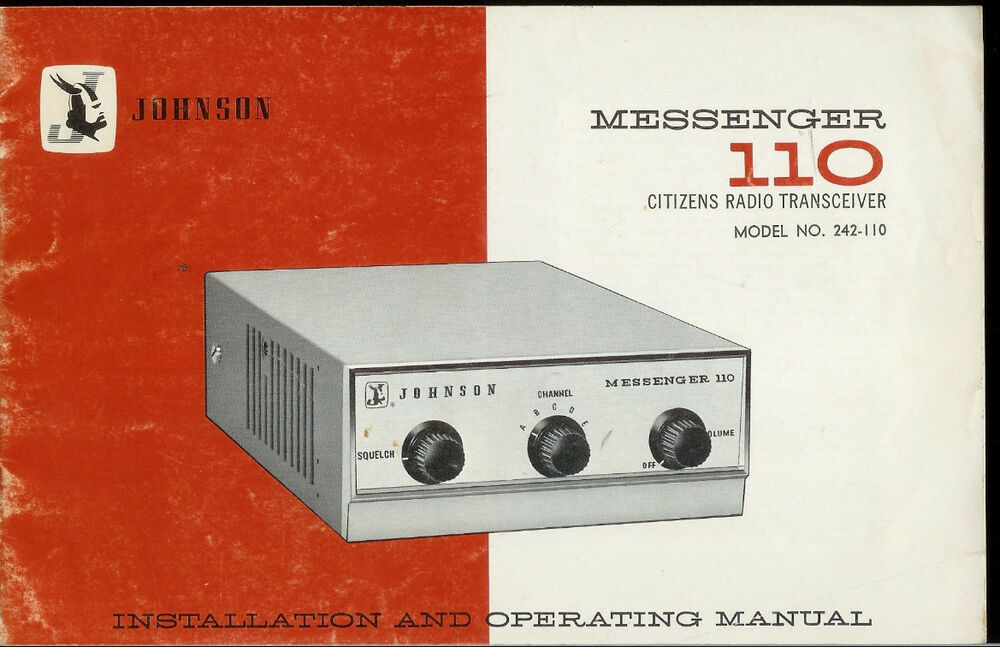 |
| My first CB radio |
 |
| My first SSB CB radio |
I now had a full time job and was working on a family but my Amateur radio thrill was still very much alive. I was able to get a part-time job at an Amateur radio store that just opened up in my town. This was great exposure and allowed me time to study for my exams which I took and passed. My wife and I were renting a house in the country at the time and I was able to put up an R6 vertical antenna and through part time amateur radio job I got a great deal on an Icom 735 radio. I was fascinated with CW after learning it for my basic licence, I wanted to keep my learning curve alive
 |
| My pre-amp mic |
 |
| The Icom 735 |
Mike Weir, VE9KK, is a regular contributor to AmateurRadio.com and writes from New Brunswick, Canada. Contact him at [email protected].
TX Factor Episode 24 Goes Live
Episode 24 of TX Factor is a Hamfest 2019 special, reporting on some of the eye-catching products and services on display at this year’s event in Newark, UK.
We investigate the current state of HF propagation, celebrate 50 years of UK’s Nevada Radio, Mike tries out a few solder stations, and Bob goes all soft over the VMARS vintage AM radios. And to cap it all, we take a look at the latest rig from Yaesu.
As always, there’s a chance to win a great bundle of prizes from our UK sponsors, ML&S and the RSGB.
We hope you enjoy the show!
Nick Bennett 2EØFGQ co-hosts TX Factor with Bob McCreadie GØFGX and Mike Marsh G1IAR. Contact the team at [email protected]
Here Comes The ’29 QSO Party!

Saturday, November 9th, as well as the following Saturday (16th), will see the annual running of the Bruce Kelley 1929 QSO Party, otherwise known as the '1929 BK'.
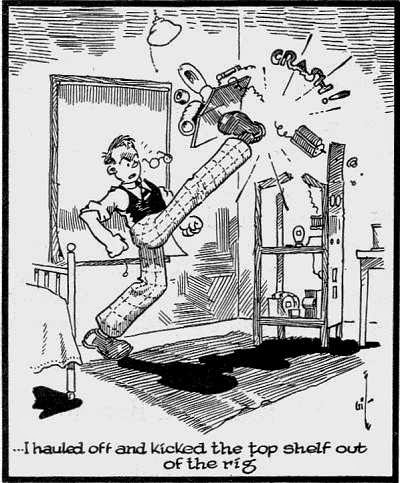
Only transmitters that are 'era-appropriate' are allowed to be used. More specifically, transmitters must employ tubes that were available in 1929 or earlier, and transmitters must be self-excited. No crystals allowed! Crystals were new and largely unaffordable for most hams back in the depression days.
The year of 1929 marked a real turning point in amateur radio as governments finally cracked-down on things such as frequency stability, out of band operations and re-alignment of call districts. In short, hams were henceforth required to behave themselves and to clean up their signals and methods of operation.
 |
| courtesy: http://www.arrl.org/ |
If you tune across the CW bands during these two upcoming Saturday nights, you will have the rare opportunity to hear exactly what the bands would have sounded like back in the very early '30s'.
For the most part you will hear single-tube Hartley, Colpitts or TNT oscillators along with a few two-tube MOPAs thrown in. Many of them will suffer the same problems encountered by the boys of '29 ... chirp, drift, buzzy notes and frequency instability from antennas swaying in the wind.
The MOPAs will sound much better but some surprisingly nice-sounding signals can be heard coming from properly tuned and optimised single-tube oscillators. I recall being blown away by the lovely sounding signal I heard from such a rig when first tuning into the BK activity several years ago, only to learn that it was a self-excited Hartley using 1/4" copper tubing for the oscillator tank circuit!
The '29 watering-hole on 80m will be around 3550-3580 kilocycles (be careful not to confuse this with kilohertz!) while the early afternoon to post-sunset 40m activity will be found from 7100-7125 kc. There may even be a few on the very low end of 160m. Although many of these transmitter styles were used on 20m and higher, the BK rule-makers have wisely decided not to inflict these sounds on the present ham populace as it would likely keep the 'Official Observers' busy for several days writing pink-slips.
Like last year, I will set up my Hull Hartley (160, 80, 40m), as I haven't used it much since building the MOPA a few years ago. If it's very windy (almost assured), the Hartley will really sound like 1929!
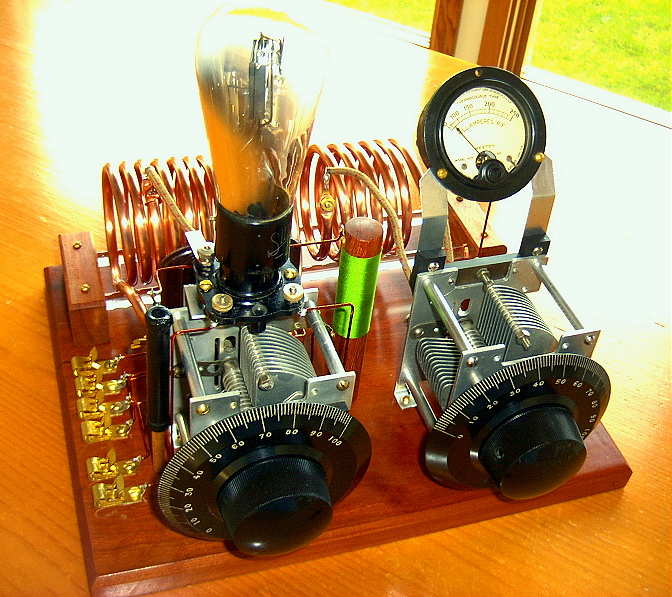 |
| My Hull Hartley |
You can learn more about amateur radio happenings leading up to and following the 1929 crackdown in my earlier series of 'Why '29' blogs here:
Part 2
Part 3
Part 4
Those wishing to put something together for next year's event can find everything needed here:
Building '29-Style - Part 1
Building '29-Style - Part 2
Let's hope for good conditions for this event as the last few years have been adversely affected by geomagnetic storming. Poor propagation or not, I guarantee there will be plenty of '29ers busy calling 'CQ AWA' on the low bands.
Complete BK details are available here.
Steve McDonald, VE7SL, is a regular contributor to AmateurRadio.com and writes from British Columbia, Canada. Contact him at [email protected].
Olivia Digital Mode (1000 Hz) on Twenty Meters – A Simple Video
The Olivia digital mode on HF radio is a mode capable of two-way chat (QSO) communication (keyboard to keyboard, like RTTY) over long-distance shortwave (HF) ionospheric propagation paths, especially over polar regions.
If you are interested in more than a logbook QSO (such as is typical with FT8 and other propagation-checking modes) but want to chat with other hams around the world using digital modes, consider Olivia as one option.
This video captures a few moments of two-way conversation on the Twenty-Meter band, up in the sub-band where 1000-Hz digital modes are commonplace. More narrow-bandwidth settings are used in a lower subband in the digital slice of Twenty Meters. More details about the mode are in the files section of this website: http://OliviaDigitalMode.org.
[embedyt] https://www.youtube.com/watch?v=FUjiBVsXrzE[/embedyt]
In 2005, SP9VRC, Pawel Jalocha, released to the world a mode that he developed starting in 2003 to overcome difficult radio signal propagation conditions on the shortwave (high-frequency, or HF) bands. By difficult, we are talking significant phase distortions and low signal-to-noise ratios (SNR) plus multipath propagation effects. The Olivia-modulated radio signals are decoded even when it is ten to fourteen dB below the noise floor. That means that Olivia is decoded when the amplitude of the noise is slightly over three times that of the digital signal!
Olivia decodes well under other conditions that are a complex mix of atmospheric noise, signal fading (QSB), interference (QRM), polar flutter caused by a radio signal traversing a polar path. Olivia is even capable when the signal is affected by auroral conditions (including the Sporadic-E Auroral Mode, where signals are refracted off of the highly-energized E-region in which the Aurora is active).
Currently, the only other digital modes that match or exceed Olivia in their sensitivity are some of the modes designed by Joe Taylor as implemented in the WSJT programs, including FT8, JT65A, and JT65-HF–each of which are certainly limited in usage and definitely not able to provide true conversation capabilities. Olivia is useful for emergency communications, unlike JT65A or the popular FT8. One other mode is better than Olivia for keyboard-to-keyboard comms under difficult conditions: MT63. Yet, Olivia is a good compromise that delivers a lot. One reason for this is that there are configurations that use much less bandwidth than 1000 Hz. 16 tones in 250 Hz is our common calling-frequency configuration, which we use lower down in the Twenty-Meter band, with a center frequency of 14.0729 MHz.
Q: What’s a ‘CENTER’ Frequency? Is That Where I Set My Radio’s Dial?
For those new to waterfalls: the CENTER frequency is the CENTER of the cursor shown by common software. The cursor is what you use to set the transceiver’s frequency on the waterfall. If your software’s waterfall shows the frequency, then you simply place the cursor so that its center is right on the center frequency listed, above. If your software is set to show OFFSET, then you might, for example, set your radio’s dial frequency to 14.0714, and place the center of your waterfall cursor to 1500 (1500 Hz). That would translate to the 14.0729 CENTER frequency.
The standard Olivia formats (shown as the number of tones/bandwidth in Hz) are 8/250, 8/500, 16/500, 8/1000, 16/1000, and 32/1000. Some even use 16/2000 for series emergency communication. The most commonly-used formats are 16/500, 8/500, and 8/250. However, the 32/1000 and 16/1000 configurations are popular in some areas of the world (Europe) and on certain bands.
These different choices in bandwidth and tone settings can cause some confusion and problems–so many formats and so many other digital modes can make it difficult to figure out which mode you are seeing and hearing. After getting used to the sound and look of Olivia in the waterfall, though, it becomes easier to identify the format when you encounter it. To aid in your detection of what mode is being used, there is a feature of many digital-mode software implementation suites: the RSID. The next video, below, is a demonstration on how to set the Reed-Solomon Identification (RSID) feature in Ham Radio Deluxe’s Digital Master 780 module (HRD DM780).
I encourage ALL operators, using any digital mode such as Olivia, to TURN ON the RSID feature as shown in this example. In Fldigi, the RSID is the TXID and RXID; make sure to check (turn on) each, the TXID and RXID.
Please, make sure you are using the RSID (Reed Solomon Identification – RSID or TXID, RXID) option in your software. RSID transmits a short burst at the start of your transmission which identifies the mode you are using. When it does that, those amateur radio operators also using RSID while listening will be alerted by their software that you are transmitting in the specific mode (Olivia, hopefully), the settings (like 8/250), and where on the waterfall your transmission is located. This might be a popup window and/or text on the receive text panel. When the operator clicks on that, the software moves the waterfall cursor right on top of the signal and changes the mode in the software. This will help you make more contacts!
RSID Setting:
[embedyt]https://www.youtube.com/watch?v=lBIacwD9nNM[/embedyt]
+ NOTE: The MixW software doesn’t have RSID features. Request it!
Voluntary Olivia Channelization
Since Olivia signals can be decoded even when received signals are extremely weak, (signal to noise ratio of -14db), signals strong enough to be decoded are sometimes below the noise floor and therefore impossible to search for manually. As a result, amateur radio operators have voluntarily decided upon channelization for this mode. This channelization allows even imperceptibly weak signals to be properly tuned for reception and decoding. By common convention amateur stations initiate contacts utilizing 8/250, 16/500, or 32/1000 configuration of the Olivia mode. After negotiating the initial exchange, sometimes one of the operators will suggest switching to other configurations to continue the conversation at more reliable settings, or faster when conditions allow. The following table lists the common center frequencies used in the amateur radio bands.
Olivia (CENTER) Frequencies (kHz) for Calling, Initiating QSOs

Current Olivia Digital Mode Calling Frequencies on Shortwave (HF)
It is often best to get on standard calling frequencies with this mode because you can miss a lot of weak signals if you don’t. However, with Olivia activity on the rise AND all the other modes vying for space, a good deal of the time you can operate wherever you can find a clear spot–as close as you can to a standard calling frequency.
Note: some websites publish frequencies in this band, that are right on top of weak-signal JT65, JT9, and FT8 segments. DO NOT QRM weak-signal QSOs!
We (active Olivia community members) suggest 8/250 as the starting settings when calling CQ on the USB frequencies designated as ‘Calling Frequencies.’ A Calling Frequency is a center frequency on which you initially call, ‘CQ CQ CQ. . .’ and then, with the agreement of the answering operator, move to a new nearby frequency, changing the number of tones and bandwidth at your discretion. Even though 8/250 is slow, the CQ call is short. But, it is narrow, to allow room for other QSOs nearby. It is also one of the best possible Olivia configurations for weak-signal decoding.
Visit, subscribe: NW7US Radio Communications and Propagation YouTube Channel
 Ham Radio Deluxe |
 W5SWL Electronics |
 Ham Radio Prep |
 KB3IFH QSL Cards  Hip Ham Shirts  HamRadioAuctions HamRadioAuctions Reliance Antennas Reliance Antennas Enigma Shop Enigma Shop |  morseDX  Ni4L Antennas  R&L Electronics R&L Electronics antennas.us antennas.us QRV QRV |
- Matt W1MST, Managing Editor
