 |
 LHS Episode #314: Epic Pie
 3 December 2019 | by
Welcome to the 314th installment of Linux in the Ham Shack. In this short-topics episode, the hosts discuss Open Source and the government, YOTA in IARU Region 2, microwave transverters, Docker, the Linux 5.5 kernel, Y2038, JS8Call and much more. Thank you for listening and have an excellent week.
73 de The LHS Crew
Russ Woodman, K5TUX, co-hosts the Linux in the Ham Shack podcast which is available for download in both MP3 and OGG audio format. Contact him at [email protected].
Weekly Propagation Summary – 2019 Dec 02 16:10 UTC
Here is this week’s space weather and geophysical report, issued 2019 Dec 02 0130 UTC.
Highlights of Solar and Geomagnetic Activity 25 November – 01 December 2019
Solar activity was very low. No sunspots were observed on the visible disk. No Earth-directed CMEs were observed in available coronagraph imagery.
No proton events were observed at geosynchronous orbit.
The greater than 2 MeV electron flux at geosynchronous orbit reached high levels on 25-28 Nov and decreased to moderate levels on 29 Nov – 01 Dec.
Geomagnetic field activity was mostly quiet. A single isolated period of unsettled was observed late on 29 Nov in response to a prolonged period of southward Bz.
Forecast of Solar and Geomagnetic Activity 02 December – 28 December 2019
Solar activity is expected to be at very low levels throughout the outlook period.
No proton events are expected at geosynchronous orbit.
The greater than 2 MeV electron flux at geosynchronous orbit is expected to range from moderate to high levels. High levels are expected to be reached on 20-25 Dec in response to CH HSS influence; moderate levels are expected for the remainder of the outlook period.
Geomagnetic field activity is expected to be at quiet to active levels. Active levels are expected on 18-19 Dec due to interaction with a positive polarity CH HSS; unsettled levels are expected on 03 Dec and 20-21 Dec; quiet levels are expected for the remainder of the outlook period.
Don’t forget to visit our live space weather and radio propagation web site, at: http://SunSpotWatch.com/
Live Aurora mapping is at http://aurora.sunspotwatch.com/
If you are on Twitter, please follow these two users: 1. https://Twitter.com/NW7US 2. https://Twitter.com/hfradiospacewx
– – – – – – – – – – – – –
Be sure to subscribe to our space weather and propagation email group, on Groups.io
https://groups.io/g/propagation-and-space-weather
Spread the word!
– – – – – – – – – – – – –
Links of interest:
+ Amazon space weather books: http://g.nw7us.us/fbssw-aSWSC
+ https://Twitter.com/NW7US
+ https://Twitter.com/hfradiospacewx
Space Weather and Ham Radio YouTube Channel News:
I am working on launching a YouTube channel overhaul, that includes series of videos about space weather, radio signal propagation, and more.
Additionally, I am working on improving the educational efforts via the email, Facebook, YouTube, Tumblr, and other activities.
You can help!
Please consider becoming a Patron of these space weather and radio communications services, beginning with the YouTube channel:
https://www.patreon.com/NW7US
The YouTube channel:
https://YouTube.com/NW7US
..
Visit, subscribe: NW7US Radio Communications and Propagation YouTube Channel
Potential Astron power supply failure solved!

One of my blog readers informed me regarding the Astron linear power supply that the outer case on the pass transistors at the rear of the supply are live with about 24 volts. These pass transistors are isolated from the case and the heat sink so the potential is there to inadvertently via a PL259 connector, USB cable or any other conducting item at the rear of your setup to short the pass transistor and destroy them. This morning I once again was searching the internet to see if anyone had devised a solution for this very issue. I came across a web page . This individual has the RS-35A power supply and came up with a great solution using a 3D printer. Now I am not at all up on the whole 3D printer thing but click on the link above (web page) and have a look at the pictures they posted. The covers look great and are very professional looking. It would look to me the plans are available to those who have access to a 3D printer to produce the guards them self. I would really like a set of these for my RS-25 but just short on the 3D printer part of things.
To my fellow bloggers have a look at the above link and do post any 3D printer info you may have as well.
As a side note below are some links to great information regarding Astron power supplies.
http://www.wb1gof.org/files/AstronPDF.pdf
http://www.repeater-builder.com/astron/pdf/astron-troubleshooting.pdf
http://www.repeater-builder.com/astron/astron-repair/astron-repair.html
https://www.ecse.rpi.edu/courses/CStudio/ham_radio_docs/astron-repair-index.htm
Mike Weir, VE9KK, is a regular contributor to AmateurRadio.com and writes from New Brunswick, Canada. Contact him at [email protected].
The Astron SS-30M power supply.

Mike Weir, VE9KK, is a regular contributor to AmateurRadio.com and writes from New Brunswick, Canada. Contact him at [email protected].
My 15 Minutes of Fame on Ham Nation
Last night, I had the pleasure of being interviewed by Amanda/K1DDN on the popular TWiT TV show Ham Nation. We discussed my book, VHF ham radio and SOTA. You can watch the whole episode here or view just my segment below.
There’s also a “photo appearance” by Stu/W0STU.
The post My 15 Minutes of Fame on Ham Nation appeared first on The KØNR Radio Site.
Bob Witte, KØNR, is a regular contributor to AmateurRadio.com and writes from Colorado, USA. Contact him at [email protected].
DXing The Utilities (Part 1)
The following blog was originally posted in 2015 but might still be of interest to anyone with a shortwave radio! Although maritime CW has all but vanished from HF, ships can still be logged and followed on digital modes, using DSC or Digital Selective Calling.
*******************************
 After building the house here on Mayne Island, in the early 90's, it was several years until I was able to set up a dedicated station. In the meantime, I limited my radio activities strictly to listening. I had a nice Icom R-71A set up in a hall closet and spent my radio-time, mostly on weekend evenings, listening to maritime CW, HF aeronautical traffic and, of course, NDBs below the broadcast band.
My HF receiving antenna consisted of three inverted-V's ... one for 160m, the second for 80m and the third for 40m ... all fed from the same coaxial line at the top of a 70' Balsam. It didn't take long to realize what an exceptional radio location I had, living right at the edge of the ocean, with dozens of miles of saltwater in most directions other than due west.

I really enjoyed following evening airline flights across both the North and South Atlantic, and in the early winter afternoons, following the commercial air-traffic all over Africa. Even though listening on 5 or 6MHz, I was amazed at how strong the signals from airliners over Africa at 30,000 feet or more could become, this far to the west. In the early mornings, directions were reversed and traffic from the far east, right into India, was fairly common. Often, small single-engine planes, usually run by various missionaries, could be heard while on the ground, taxiing at remote field locations and calling in via HF radio to request takeoff and flight-following.
Now QSL's have always been one of my top radio interests and it wasn't long before I started sending and collecting verifications for both the aircraft and the ships I was hearing ... once I had figured out how to get my reception reports to their proper destinations.
A very small portion of my 'utility' QSL collection is shown below. For the most part, it consists of PRC's or 'Prepared Reply Cards', with blank portions to be filled-in by the verification signers. Surprisingly, my return rate was around 90% and verifications were often returned with long, hand-written letters and numerous photographs ... especially from the ship RO's, as I suspect their days at sea were often quite monotonous. Even many of the military and commercial aircraft pilots would return a handwritten note along with the filled-in verification card, which I found even more surprising. It seemed that most were very surprised to hear that their radio transmissions were even making it this far and could be heard so readily.
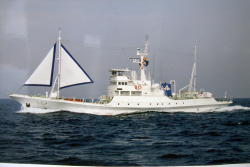
 Some of the most interesting catches came from the Pacific, with a large variety of ships operating out of Japan. There are probably still several maritime CW stations operating in Japan. Many of these were owned and operated by commercial fishing companies and could be heard working fleet vessels throughout the Pacific on their daily CW skeds.
This interesting catch from the North Pacific was the Japanese 'fisheries research vessel' 'M/V FUJI MARU'. She was about 1200 miles NW of her CW contact, JNA in Tokyo.
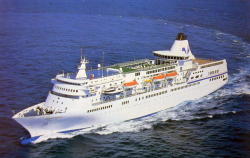
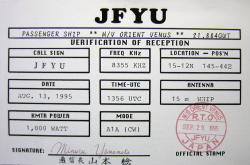
A Japanese cruise-ship, the 'M/V ORIENT VENUS' was logged early one summer morning while working JNA on 8355 KHz CW. Her position indicates she was in the Mariana Islands.

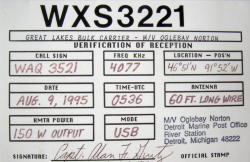
was the 'M/V Oglebay Norton', a huge bulk
carrier out of Detroit. Her 150W signal was loud and clear late one August evening while in contact with WLC, Rogers City Radio.
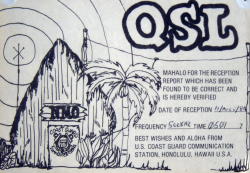
 The U.S. Coast Guard is still one of the best QSLers around.
Several of their stations will QSL with a nice printed card.
NMC (San Francisco) and NMO (Hawaii) were two
catches, regularly heard on the old 500 KHz calling
frequency.
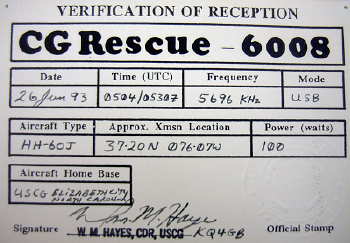
Stormy weather often provided a good chance
to catch a search and rescue mission in progress.
'Rescue 6008' was an HH-60J helo enroute from
Chesapeake Bay to Elizabeth City, North Carolina during
a midnight rescue operation.

Although not my farthest HF maritime catch,
this was one of the most surprising. 'C4PC'
was heard early one February evening on 8 MHz CW, when conditions seemed terrible. No other ships were heard on the band at the time. As I learned later, the 'M/V MAIROULI' was at anchor near Beirut, Lebanon, a distance of nearly 7,000 miles from Mayne Island.
.... cont'd
Steve McDonald, VE7SL, is a regular contributor to AmateurRadio.com and writes from British Columbia, Canada. Contact him at [email protected].
The Astron RS20-M repairs completed
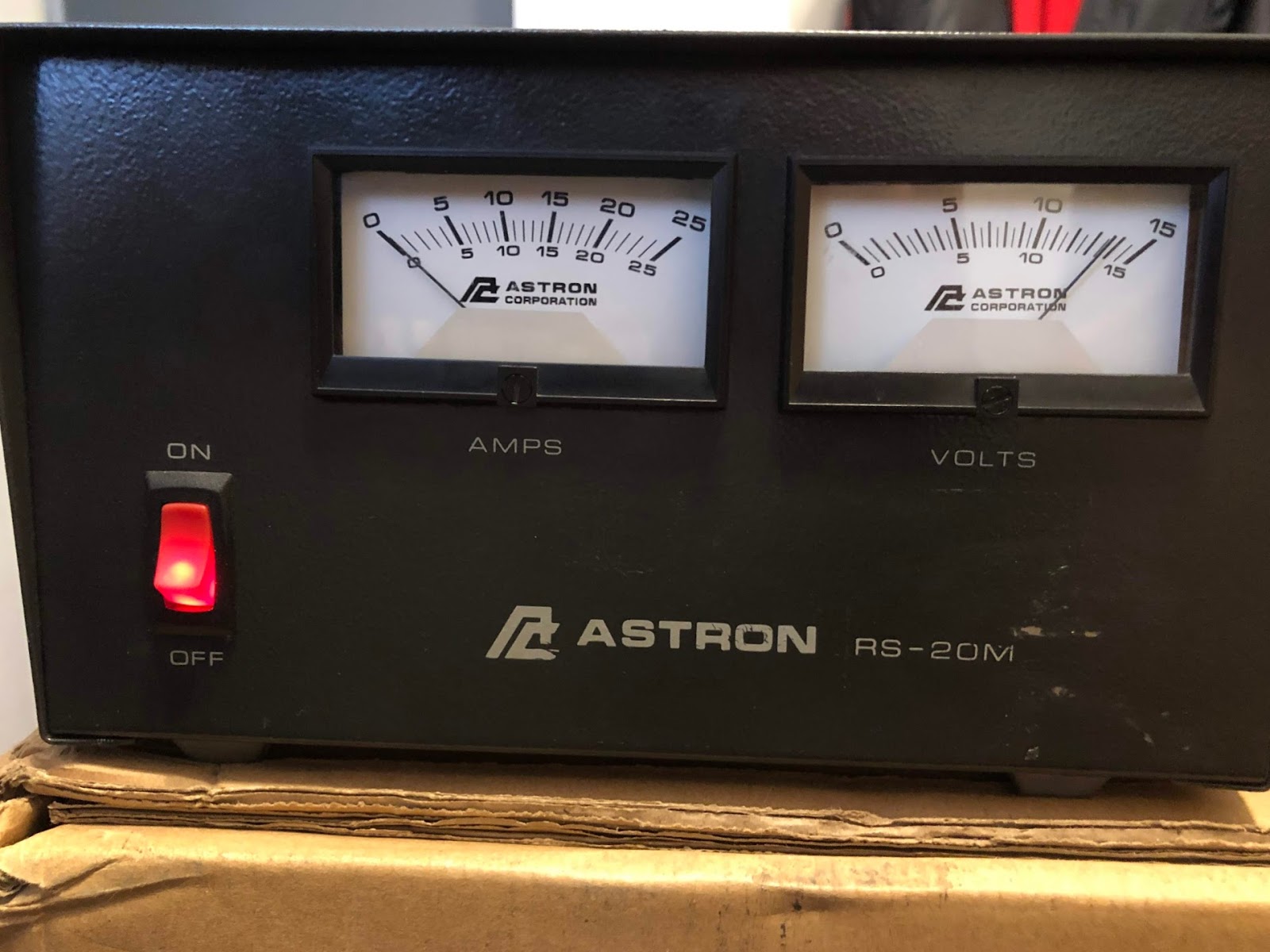 |
| Repaired and working |
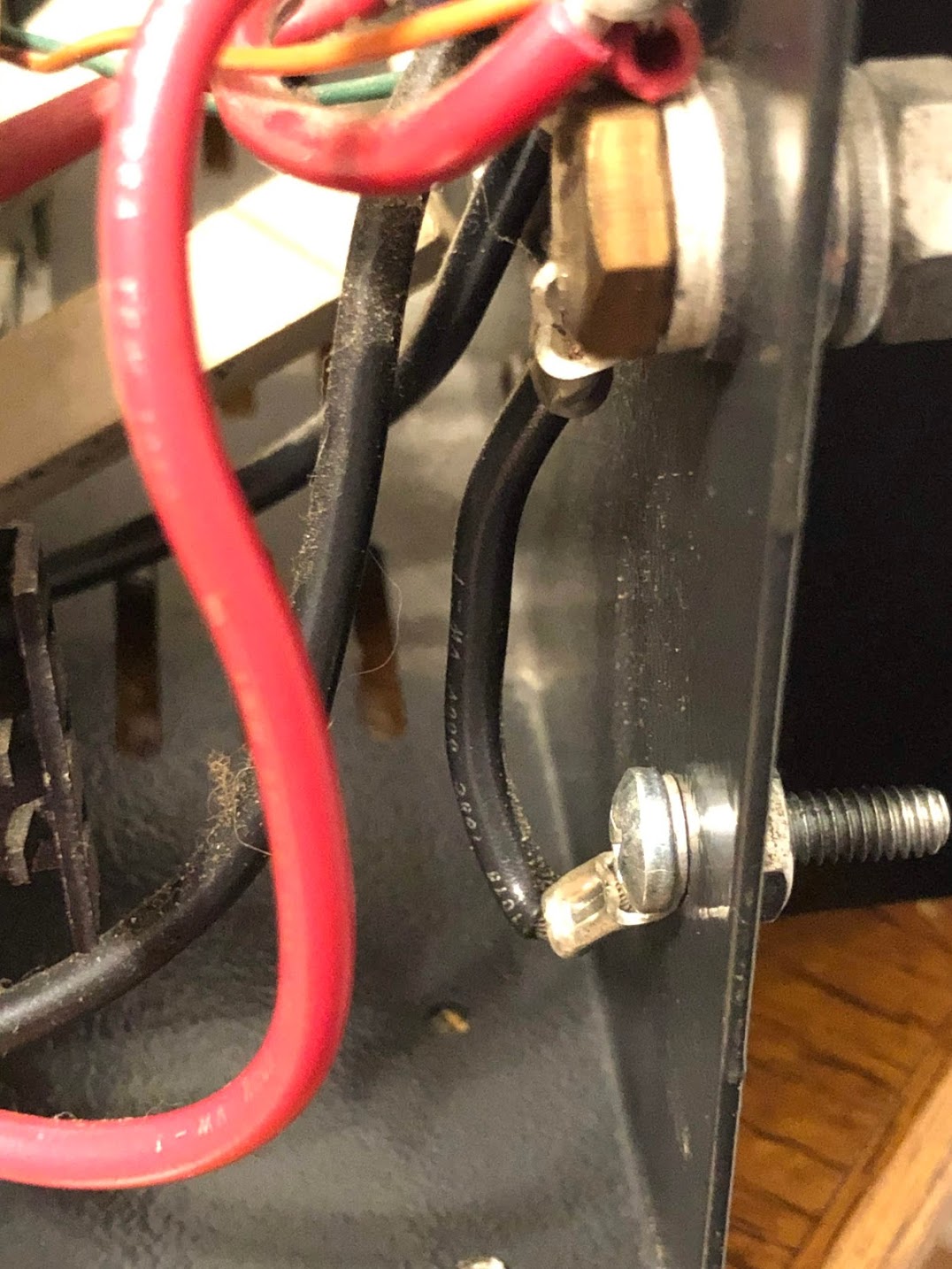 |
| Negative to case ground |
I found this great site online regarding Astron power supply trouble shooting and repairs. This document really helped me with the trouble shooting and eventual repair of the power supply. There was another online article I came across regarding how Astron now and then has the negative terminal grounded to the case of the supply.
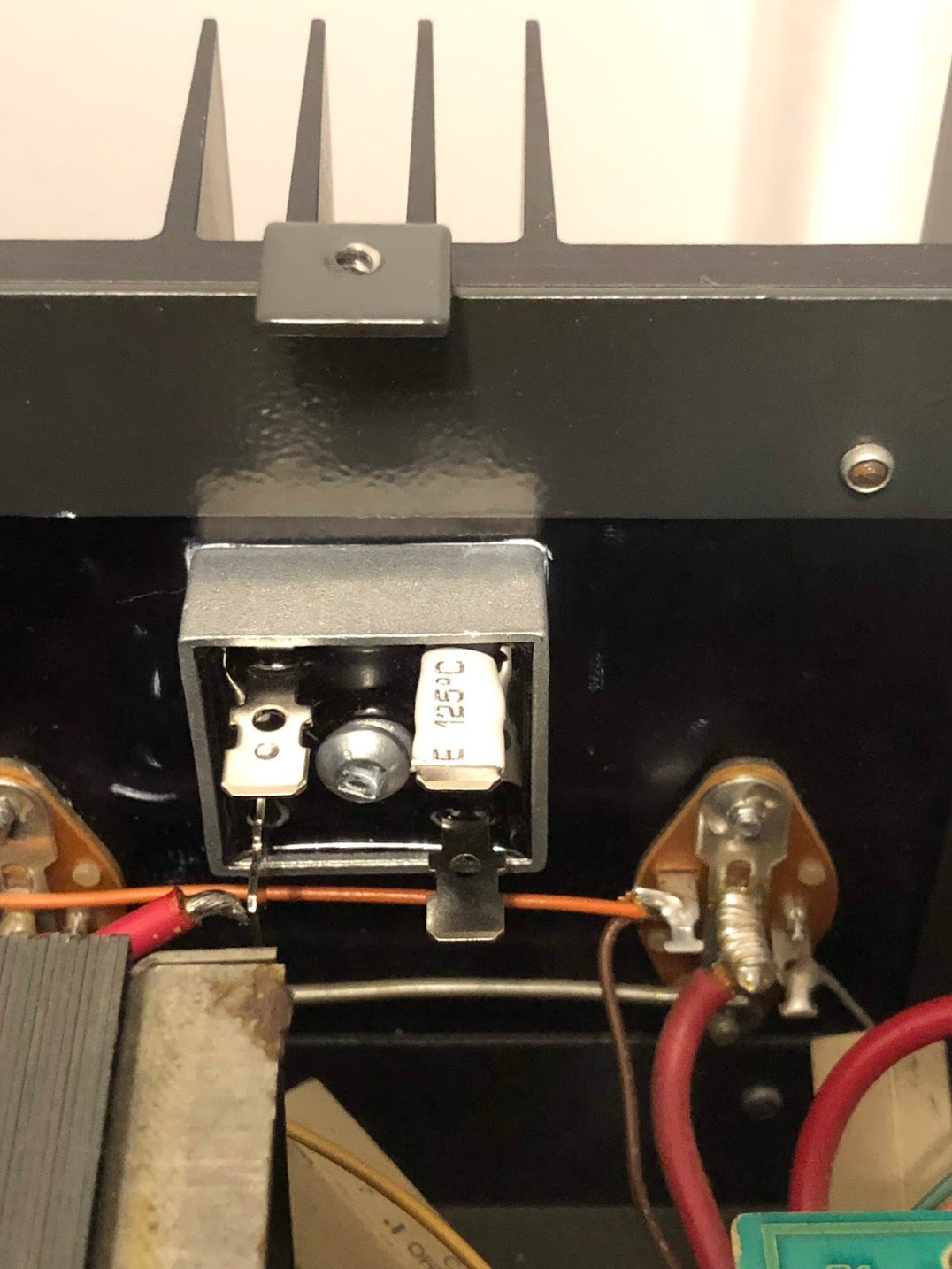 |
| New bridge rectifier |
With the new bridge rectifier installed and wires re-soldered, the pass transistors back in place and finally I did remove one connection of the Varistor to test it (tested ok) I had to also re-solder that back on as well. It was now time for the smoke test.......and I was pleased that no smoke was found and the power supply is now working without issue. I did connect it to the Icom 7610, adjusted the power to 50 watts and the power supply successfully passed the load test as well. This power supply is under sized for the Icom 7610, I now have a new Astron power supply that is sized correctly. I am now wondering if I should keep this supply or sell it?
 |
| Passed load test |
Mike Weir, VE9KK, is a regular contributor to AmateurRadio.com and writes from New Brunswick, Canada. Contact him at [email protected].
 Ham Radio Deluxe |
 W5SWL Electronics |
 Ham Radio Prep |
 KB3IFH QSL Cards  Hip Ham Shirts  HamRadioAuctions HamRadioAuctions Reliance Antennas Reliance Antennas Enigma Shop Enigma Shop |  morseDX  Ni4L Antennas  R&L Electronics R&L Electronics antennas.us antennas.us Ears to Our World Ears to Our World |
- Matt W1MST, Managing Editor
