 |
 ICQ Podcast Episode 317 – NanoVNA are they any Good?
 2 February 2020 | by
 In this episode, Martin M1MRB is joined by Leslie Butterfield G0CIB, Edmund Spicer M0MNG, Dan Romanchik KB6NU and Ruth Willet KM4LAO to discuss the latest Amateur / Ham Radio news. Colin M6BOY rounds up the news in brief and this episode’s feature is - NanoVNA are they any good?
ICQ AMATEUR/HAM RADIO PODCAST DONORS
We would like to thank Dave Pyle (KW1DX), Tim Price (G4YBU)and our monthly and annual subscription donors for keeping the podcast advert free. To donate, please visit - http://www.icqpodcast.com/donate
- Radio hams Rescue Teenage Girl from Kidnappers - Barry Shelley (N1VXY) - Interim ARRL CEO - Continued Access to 3GHz spectrum - New IARU Region 1 record on 134 GHz – 65km - Australian Bushfires Causing Major Telecommunication Outages - Maine Bicentennial Special Event - YOTA Matching Fund Drive - Greenland and Denmark Special Event
Colin Butler, M6BOY, is the host of the ICQ Podcast, a weekly radio show about Amateur Radio. Contact him at [email protected].
Plant the Seed! Sow the Future
There is much rhetoric in amateur radio about getting more people into the hobby. Especially young people. The ARRL has a Teachers Institute which reflects the conventional “train-the-trainer” model of getting K-12 school teachers (mostly) into ham radio in order to expose their students to the fun and learning. The challenge of this is that it’s quite small, even when effective.
Moreover, clubs face increasing challenges simply getting into schools, particularly public schools, to offer programs to students. It doesn’t take much imagination for a school administrator to evaluate the typical proposition. Hmm, a group of usually old guys want to spend time with students during or after school to talk about something called “ham radio.” I can say no and that’s that. I have no consequences in my decision. I can say yes but I need to do background checks to rule out folks on some nefarious list, find a teacher who will stay with them to watch over the process, deal with space requests and insurance liability (“Can we put up an antenna permanently?”) and so forth. If something bad happens, I have to deal with that and I could get demoted or worse, fired. Which option would you most likely take if you were the administrator and not a licensed amateur radio operator yourself? I have only spoken with a few Principals and Superintendents but I was told by these career professionals that this is likely to occur in many instances. It varies, of course, but this does illustrate the vagaries of getting programs from outside into schools these days.
Visiting the library remains the most common cultural activity Americans engage in, by far.
Gallup Poll Report, 2019
The ARRL and other EmComm groups often use the term, “served agency,” to indicate an agency or organization needing specific attention by amateur radio groups. We have yet to implement a similar perspective or approach for educational outreach, from everything I’ve read. Schools can be one. But so can public libraries. In fact, Gallup just reported from one of their surveys that “Visiting the library remains the most common cultural activity Americans engage in, by far.” Visits to libraries were 10.5 per year in 2019 which exceeds eight other leisure time activities. Library visits were about double annual visits to movies (5.3 per year).
The number of public libraries in 2016 (latest year data is available, covering 98% of the total public libraries in the U.S.) is more than 17,000 central libraries, branches, and bookmobiles in more than 9,000 public library systems. According to my analysis of the 2016 data, this includes a median of 122 children’s program per year, which means at least one half of the 9,000 or so public library systems had at least that many programs directed toward children. (This includes 205 that reported having zero programs directed towards children.) There is potential here!
Public libraries may well be a more efficient “served agency” within which to reach children, young adults and older persons in communities as compared to schools. I do not make this argument to lessen the attempts to get amateur radio curriculum and experiences into schools but simply want to emphasize the untapped potential that the Public Library System has for reaching the public to promote amateur radio.
Which Section can get the most libraries served by constituent ARRL Affiliated Clubs donating the League’s 10-book Library Set to libraries near them?
David Norris K5UZ ARRL Delta Division Director
Starting with the ARRL Louisiana Section Convention in Minden LA last December and continuing to last weekend’s Mississippi Section Convention in Jackson, Delta Division Director David Norris K5UZ and I created a new program just announced in Jackson. It’s the Plant the Seed! Initiative. It’s being rolled-out in the four Sections comprising the Delta Division as a Director’s Challenge to the Section Managers. Which Section can get the most libraries served by constituent ARRL Affiliated Clubs donating the League’s 10-book Library Set to libraries near them? The League offers these book sets, including the two big ones (Handbook, Antenna Handbook), for $200 including shipping. The contents and offer description from the ARRL website is as follows:
ARRL LIBRARY BOOK SET
Special money saving offer! This book set includes popular ARRL publications, intended for clubs or individuals that wish to make a gift to a local library or school. Only complete sets of these publications are available at the special price of $200 per set. Price includes ground shipping throughout the 48 contiguous states, only. Call for other shipping options. Editions sent will be those available at the time the order is received. Publications and prices are subject to change without notice. This special offer applies only to orders purchased directly from ARRL. Orders must be pre-paid.
ARRL No. Title Value (Retail Price)
 4050    ARRL Handbook $49.95
 6948    ARRL Antenna Book $49.95
 5965    ARRL Operating Manual $29.95
 #9857   ARRL Satellite Handbook $24.95
 0977    Ham Radio License Manual $29.95
 8119    ARRL General Class License Manual $29.95
 5170    ARRL Extra Class License Manual $29.95
 0823    Understanding Basic Electronics $32.95
 0915    RFI Book $29.95
 8737    ARRL Instructor's Manual $19.95
 9728    Getting Started with Ham Radio $19.95
 1173    FCC Rules and Regulations $5.95
 7717    ARRL Map of the World (Azimuthal) $15.00
As David said in his announcement to Section Managers on Friday, “This Initiative has indeed already begun. The Mississippi Section’s affiliated club, the Central Mississippi Amateur Radio Association, has already obtained two (2) commitments: one from the Board who challenged the membership to match which they quickly did. Other clubs can quickly follow suit. As described below, the affiliated club membership numbers show that the donation per-member to reach the $200 goal is minimal, ranging from $1.46 to $40.00 in the Division with an average of $7.36 (median is $5.00). So, for the average price per-member of less than ten dollars, ARRL-affiliated clubs can plant the seed of amateur radio and sow the future of the hobby.” CMSARA’s two sets of book have already been delivered and the club has identified two area libraries that will receive them shortly.
The median contribution throughout the Delta Division of just $5 per club member can potentially reach many people in the community for years to come. I constructed a map using GIS software and databases to identify which club is nearest each public library. These are shown by (tan) lines below. Spreadsheets were then exported for each of the four Sections and, within each Section, each club. These files are stored online with a link included in David’s email to each SM in the Delta Division. The Section Manager can email the club contact using information in each club’s spreadsheet with their customized listing of potential “served libraries” nearest them. This makes it very easy for Section Managers and local clubs to consider the Initiative and take action without much spin-up on their end.

Vice Director Ed Hudgens WB4RHQ added, “This is a very exciting Initiative that we are launching. It puts action in the hands of local ham groups who can easily make an impact in their communities with public libraries.” I’d have to agree with Ed’s sentiments. It’s not a vague idea to change the world waiting for “big things” to happen. The Plant the Seed! Initiative is something that for less than a pizza or hamburger lunch per member, a local club can get a broad set of books from the ARRL onto the shelves of a local public library. Getting a photo of the donation into the local newspaper wouldn’t be a bad thing for the club, either. I hope you’ll agree. You can spread the word by copying the logo I created for the Delta Division Initiative below and using it to promote the program in your club, section or Division. The Delta Division has already started and Malcolm’s (W5XX) Section is in the lead. You’re playing catch-up…but the competition is what this kind of “radiosport” is all about. And to Sow the Future of the amateur radio hobby.

Frank Howell, K4FMH, is a regular contributor to AmateurRadio.com and writes from Mississippi, USA. Contact him at [email protected].
For those of you out there
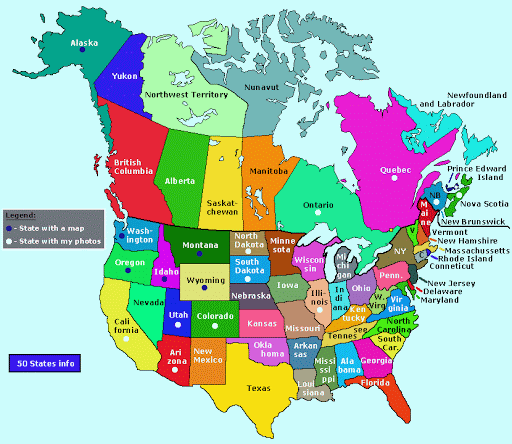
The State QSO Party Challenge is a competition comprised of other contests, namely state and provincial QSO parties. As explained on the website, the annual cumulative score program is open to any radio amateur who participates in any approved state QSO parties (SQPs).
Participants just need to submit their QSO party scores to 3830scores.com to enter the challenge. Participants’ cumulative scores will be calculated by totaling up the number of reported contacts and multiplying by the number of SQPs entered in the year to date. Periodic standings will be posted to 3830scores.com, the QSOParty Groups.io forum, and the StateQSOParty.com website.
“Using the number of QSO parties entered as a multiplier is expected to encourage radio amateurs to enter more state/province QSO parties,” the program’s organizers said. “The first SQPs in 2020 are the Vermont, Minnesota, and British Columbia QSO Parties in the first weekend of February.”
Entrants must make at least two contacts in a QSO party for it to count as a multiplier. Full details are available on the State QSO Party Challenge website. Challenge sponsors expressed appreciation to Bruce Horn, WA7BNM, for developing the SQP Activity Tracker on 3830scores.com.
This is interesting in a few ways. Even if you decide to not formally participate in this, it can be taken on as a real personal challenge. "How many State QSO Parties can I participate in?". For me, it would be a big deal to participate in all fifty, plus Canada This kind of reminds me of the QRP-ARCI Golden Jubilee event a few years back, where the goal was to work K6JSS stations in all 50 states.
Secondly, would I be able to make "at least two contacts" in all of these? With band conditions the way they are - the state QSO parties in Alaska and Hawaii and some of the Canadian Provinces might prove to be a real challenge. But then, going back to the QRP-ARCI Golden Jubilee event, Alaska and Hawaii were NOT the two states I missed!
Thirdly, this would be a great way for those who are on their way to earning Worked All Sates to actually accomplish that.
Fourthly, for those of you out there who complain about the bands being "flooded with contests" every weekend (you know who you are), this would actually make that a good thing. Instead of disdaining these QSO Parties, it would be an incentive to jump in and make them into an enjoyable and an interesting experience for you. After all, you don't have to stay in them for the entire event if you don't want to - but can you make just two QSOs in each?
I just might be tempted to take on the personal challenge myself!
72 de Larry W2LJ
QRP - When you care to send the very least!
Larry Makoski, W2LJ, is a regular contributor to AmateurRadio.com and writes from New Jersey, USA. Contact him at [email protected].
The CommRadio CTX-10 vs. Elecraft KX2, SDRplay RSPdx, and the AM band gold rush of 1920
 Stories you’ll find in our February, 2020 issue:
A Tale of Two Radios: CommRadio CTX-10 vs. Elecraft KX2
By Thomas Witherspoon K4SWL
A longtime ham and shortwave listener who enjoys taking his hobby into the field, Thomas was intrigued by two seemingly different transceivers that also appeared to have a lot in common. Which would be better for his purposes and why? Both offer low-power and battery-operated portability, but with a totally different design approach. Thomas examines the pros and cons of the CommRadio CTX-10 and the Elecraft KX2, not the least of which in the monetary component.
TSM Reviews: SDRplay RSPdx Software Defined Radio
By Larry Van Horn N5FPW
SDRplay Limited is a UK-based company that has been developing cutting-edge software defined radios since 2014 with its RSP1 model. In the ensuing years, newer models have offered advanced reception features on receivers capable of tuning from 1 kHz to 2 GHz at moderate price levels. In this review Larry takes a look at the company’s latest product, the SDRplay RSPdx and compares it with lower level SDRplay editions.
Radio in the Pre-Broadcast Era Series:
The Trailblazers of Commercial Radio Manufacturing in the 1920s
By Richard Fisher KI6SN
Beneath the dust accumulated over 100 years of consumer-entertainment radio broadcasting are the names of literally hundreds of manufacturers who have largely disappeared since the AM band gold rush of 1920. Richard takes a look at the radios available 100 years ago and finds a long list of names that urgently filled a huge void in practical receivers that could capture the signals of the handful of commercial broadcast stations that burst onto the airwaves early in the second decade of the 20th Century.
TSM Annual Review of Books for Shortwave Listeners
Klingenfuss 2020 Shortwave Frequency Guide
Reviewed by Bob Grove W8JHD
Joerg Klingenfuss never disappoints serious shortwave listeners with his exhaustive databases, and these two latest releases are no exception.
2020 World Radio Television Handbook
Reviewed by Gayle Van Horn W4GVH
The 74th edition of World Radio TV Handbook continues to be a comprehensive reference book. It remains the gold standard as the most authoritative for a global radio and television audience and the gem of the broadcast industry.
Global Radio Guide
Reviewed by Ken Reitz KS4ZR
The Winter 2019-20 edition of the Global Radio Guide, now 500 pages, includes many full length articles on shortwave listening today, but the best part is the Global Radio Frequency Guide that makes tuning in to signals from around the globe faster and easier than ever.
Scanning America
By Dan Veeneman
Nassau County, New York and TIS Stations
Federal Wavelengths
By Chris Parris
Federal Monitoring Mysteries
Milcom
By Larry Van Horn N5FPW
Monitoring the Australian Wildfires
Utility Planet
By Hugh Stegman
HF Steps Up in Australian Fire Emergency
Shortwave Utility Logs
Compiled by Mike Chace-Ortiz and Hugh Stegman
VHF and Above
By Joe Lynch N6CL
Morphing the Planned Hexagon-type Antenna into a 2-Element Quad
Digitally Speaking
By Cory Sickles WA3UVV
DV: How Low Can You Go?
Amateur Radio Insights
By Kirk Kleinschmidt NT0Z
Floods, Pestilence and Interference?
Radio 101
By Ken Reitz KS4ZR
2020 DRM Shortwave Report: Trials and Tribulations
World of Shortwave Listening
By Andrew Yoder
MW/SW Pirates; Carrier Sleuth and SWL Fest 2020
The Shortwave Listener
By Fred Waterer
Vatican Radio; BBC and WBCQ
Amateur Radio Astronomy
By Stan Nelson KB5VL
Geminids 2019 and Quadrantids 2020
Adventures in Radio Restoration
By Rich Post KB8TAD
The Reflex: Crosley Trirdyn Special
Antenna Connections
By Dan Farber AC0LW
The Spectrum Monitor is available in PDF format which can be read on any desktop, laptop, iPad®, Kindle® Fire, or other device capable of opening a PDF file. Annual subscription is $24. Individual monthly issues are available for $3 each.
Ken Reitz, KS4ZR, is publisher and managing editor of The Spectrum Monitor. Contact him at [email protected].
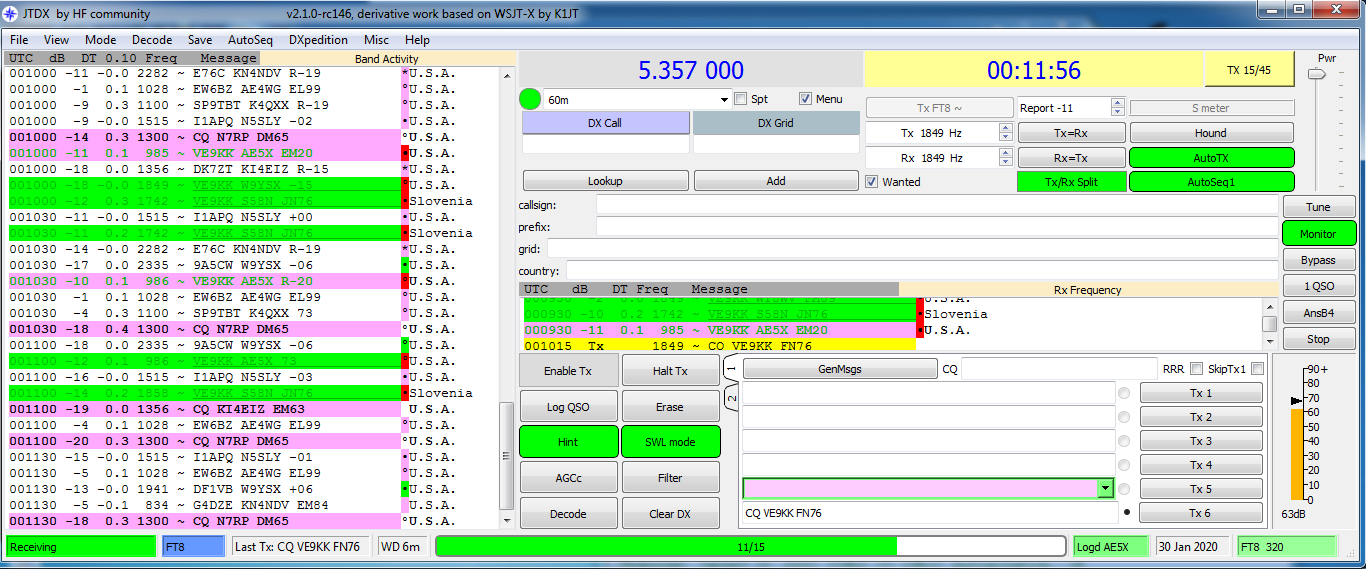
A nice surprise on 60m FT8
Mike Weir, VE9KK, is a regular contributor to AmateurRadio.com and writes from New Brunswick, Canada. Contact him at [email protected].
If you don’t like the weather in NJ
I've been keeping an eye on the long range weather forecast via WeatherUnderground for this coming Saturday - FYBO day.
A couple of days ago, they were calling for a wet weekend. This morning, they were calling for an ice storm in the morning with some showers in the afternoon after a warm up.
NOW it's supposed to be "just" a cloudy day with just a chance of showers. Meanwhile, last night on the news, the local weather prognosticator was calling for a possible Nor'Easter this weekend. It's enough to make your head spin!

Larry Makoski, W2LJ, is a regular contributor to AmateurRadio.com and writes from New Jersey, USA. Contact him at [email protected].
LHS Episode #322: YOTA Deep Dive

Welcome to the 322nd installment of Linux in the Ham Shack. In this episode, the hosts and special guest Neil Rapp, WB9VPG, of Ham Talk Live discuss the very future of amateur radio in the form of YOTA (Youth on the Air). A program started in IARU Region 1 as Youngsters on the Air, Neil and a committee of other amateurs and volunteers in the Americas is trying to foster the idea around the rest of the globe. Learn about these projects which aim to let youth teach youth about the direction of amateur radio and breed interest that will last many lifetimes.
73 de The LHS Crew
Russ Woodman, K5TUX, co-hosts the Linux in the Ham Shack podcast which is available for download in both MP3 and OGG audio format. Contact him at [email protected].
 Ham Radio Deluxe |
 W5SWL Electronics |
 Ham Radio Prep |
 KB3IFH QSL Cards  Hip Ham Shirts  HamRadioAuctions HamRadioAuctions Reliance Antennas Reliance Antennas Enigma Shop Enigma Shop |  morseDX  Ni4L Antennas  R&L Electronics R&L Electronics antennas.us antennas.us QRV QRV |
- Matt W1MST, Managing Editor
