 |
 LHS Episode #324: The Weekender XLI
 7 February 2020 | by
It's time once again for The Weekender. This is our bi-weekly departure into the world of amateur radio contests, open source conventions, special events, listener challenges, hedonism and just plain fun. Thanks for listening and, if you happen to get a chance, feel free to call us or e-mail and send us some feedback. Tell us how we're doing. We'd love to hear from you.
73 de The LHS Crew
Russ Woodman, K5TUX, co-hosts the Linux in the Ham Shack podcast which is available for download in both MP3 and OGG audio format. Contact him at [email protected].
Space in Morse Code
Silence is Beautiful

Proper Space (Timing)
Space between DITS and DAHS in a Character
Space between characters within a Word
Space between Words
How to Practice
When I hear break-in occur between every word I know that I'm putting in a good minimum amount of spacing
Conclusion
DE AA4OO
Richard Carpenter, AA4OO, is a regular contributor to AmateurRadio.com and writes from North Carolina, USA. Contact him at [email protected].
Icom IC-705
Ray Novak, N9JA came for a visit with a great new QRP Radio that’s soon to be released.
George Thomas, W5JDX, is co-host of AmateurLogic.TV, an original amateur radio video program hosted by George Thomas (W5JDX), Tommy Martin (N5ZNO), Peter Berrett (VK3PB), and Emile Diodene (KE5QKR). Contact him at [email protected].
LHS Episode #323: Sloppy Seconds

Welcome to the 323rd installment of Linux in the Ham Shack. In this episode, the hosts discuss amateur radio and the fires in Australia, state QSO parties, Brexit and CEPT, new extra pool questions, CERN, Facebook, Jericho, UNICEF and much, much more. Thank you for downloading and listening. We hope you have a fantastic week.
73 de The LHS Crew
Russ Woodman, K5TUX, co-hosts the Linux in the Ham Shack podcast which is available for download in both MP3 and OGG audio format. Contact him at [email protected].
‘Barn Door’ CLE
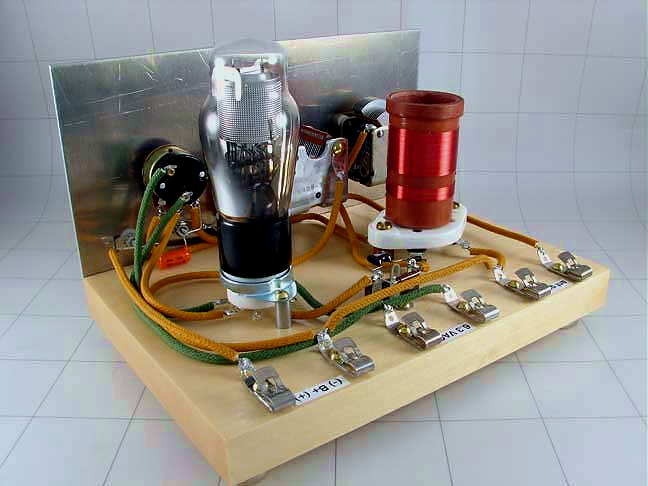 The next CLE, coming up at the end of the month, will be another ‘barn-door’ event where listeners are encouraged to use wider bandwidths than normal ... typically something that will allow you to hear beacons at least 2kHz each side of the frequency that you are tuned to.
Your ears will be the only filter that you need!
This will be the first winter event of this type and results could be very interesting! In the past, many participants have used their homebrew regens including the popular ‘1AD’ (1 Active Device) MOSFET regen, built for the NDB part of the spectrum.
The last time this event occurred, I whipped together a 1AD regen in a day which proved amazingly effective in spite of the mid-summer propagation.

There is still plenty of time for you to put something simple together and you can find some helpful suggestions in my previous '1AD' blog here.
I will have more details later, before the event, so please stay tuned and consider getting something ready ... maybe all you need to do is wind a new coil for your favorite regenerative receiver!
Steve McDonald, VE7SL, is a regular contributor to AmateurRadio.com and writes from British Columbia, Canada. Contact him at [email protected].
Weekly Propagation Summary – 2020 Feb 03 16:10 UTC
Here is this week’s space weather and geophysical report, issued 2020 Feb 03 0217 UTC.
Highlights of Solar and Geomagnetic Activity 27 January – 02 February 2020
Solar activity was very low. Region 2757 (N05, L=089, class/area Cso/100 on 27 Jan) decayed to played before rotating around the W. limb. No Earth-directed CMEs were observed in available coronagraph imagery.
No proton events were observed at geosynchronous orbit.
The greater than 2 MeV electron flux at geosynchronous orbit was at normal to moderate throughout the reporting period.
Geomagnetic field activity range from quiet to active. Isolated active conditions were observed on 30 Jan while unsettled conditions were observed on 28-27 Jan, 31 Jan and 02 Feb. Solar wind measurements suggested all enhancements in geomagnetic activity were in response to intermittent influence from the Southern Crown coronal hole. The remainder of the reporting period was quiet.
Forecast of Solar and Geomagnetic Activity 03 February – 29 February 2020
Solar activity is expected to be very low throughout the outlook period.
No proton events are expected at geosynchronous orbit.
The greater than 2 MeV electron flux at geosynchronous orbit is expected to range from normal to high levels. High levels are expected on 07-13 Feb, in response to a negative polarity CH HSS. The remainder or the outlook period is expected to be at normal to moderate levels.
Geomagnetic field activity is expected to range from quiet to active levels. Active conditions are likely on 06 Feb and 26 Feb; unsettled conditions are likely on 07-09 Feb, 25 Feb and 27 Feb. Enhancements in geomagnetic activity are in response to influence from multiple, recurrent, coronal hole high speed streams. The remainder of the outlook period is expected to be at quiet levels.
Don’t forget to visit our live space weather and radio propagation web site, at: http://SunSpotWatch.com/
Live Aurora mapping is at http://aurora.sunspotwatch.com/
If you are on Twitter, please follow these two users: 1. https://Twitter.com/NW7US 2. https://Twitter.com/hfradiospacewx
– – – – – – – – – – – – –
Be sure to subscribe to our space weather and propagation email group, on Groups.io
https://groups.io/g/propagation-and-space-weather
Spread the word!
– – – – – – – – – – – – –
Links of interest:
+ Amazon space weather books: http://g.nw7us.us/fbssw-aSWSC
+ https://Twitter.com/NW7US
+ https://Twitter.com/hfradiospacewx
Space Weather and Ham Radio YouTube Channel News:
I am working on launching a YouTube channel overhaul, that includes series of videos about space weather, radio signal propagation, and more.
Additionally, I am working on improving the educational efforts via the email, Facebook, YouTube, Tumblr, and other activities.
You can help!
Please consider becoming a Patron of these space weather and radio communications services, beginning with the YouTube channel:
https://www.patreon.com/NW7US
The YouTube channel:
https://YouTube.com/NW7US
..
Visit, subscribe: NW7US Radio Communications and Propagation YouTube Channel
Bring it on!
 |
| Using Dual watch |
The kickoff (Super bowl lingo) to the ARRL QSO party challenge was very busy with 3 QSO parties this weekend. The BC QSO party, Minnesota QSO party and the Vermont QSO party were in full swing this weekend. The challenge to me was how to participate in 3 contests using only one contest software program? The software I have used in the past for contests were N1MM+ and N3FJP's contest software. I did read regarding Scott's N3FJP's contest software that you can run multiple contests using API (application program interface). Now I never claim to be a computer guru and API meant nothing to me until Thursday last week when I read about it on the N3FJP software user group site. For this weekend I used N1MM+ and loaded all three QSO parties and just loaded the contest I was logging in and for the time being, it worked just fine for me until I can read up on this API thing.
Why has the ARRL QSO party challenge appealed to me:
- I have the weekends more or less free now.
- These contests are not a full 48-hour effort.
- They are local meaning North America and low sunspots do not have as much of an effect.
- Maximum power is 100 watts so most of us are on the same level of playing field.
- The modes are CW, Phone and in some QSO parties, the digital mode (FT8 and FT4) has been embraced so there are lots of opportunities no matter what your choice of operating is.
- If CW is your forte I have found the speeds are slower and sometimes a TU (thank you) and 73 is added to a contact.
 |
| BC QSO party shot |
So how did the first weekend of QSO party contest go.......
Vermont QSO party:
This was a tough one as I made only 2 contacts both on 40 meters and I felt because Vermont is close to home my contacts would be ground wave. I was not able to hear any Vermont stations on 20m at all. I had to settle for 2 contacts with a score of 16. When I visited the contest score webpage 3830 I was shocked to see that all others had scored low as well.
Minnesota QSO party:
There was more action in this contest but for some reason, the only station I heard were ones I already worked (Dupes). I ended making a whole 7 contacts in this contest for a final score of 98.
BC QSO party:
In this contest, I was able to hear lots of BC stations but the conditions were changing very fast such that I would make the contact but then they went below the noise level. I ended up making 6 completed contacts with a score of 116 but lots of contacts that ended up being incomplete as they were washed up in the noise floor.
The benefits of the these QSO party contests:
- It gets me on the radio as most of the time just planning to get around to it never happens.
- I want to enter the CW category this will help me improve my code.
- When CW slows and if the contest allows digital FT8/FT4 I will give this new way of contesting a go.
- Allows me to learn more about my Icom 7610 in contest situations.
Mike Weir, VE9KK, is a regular contributor to AmateurRadio.com and writes from New Brunswick, Canada. Contact him at [email protected].
 Ham Radio Deluxe |
 W5SWL Electronics |
 Ham Radio Prep |
 KB3IFH QSL Cards  Hip Ham Shirts  HamRadioAuctions HamRadioAuctions Reliance Antennas Reliance Antennas Enigma Shop Enigma Shop |  morseDX  Ni4L Antennas  R&L Electronics R&L Electronics antennas.us antennas.us QRV QRV |
- Matt W1MST, Managing Editor
