 |
 New Contest for DXers and Portable Operators
 11 August 2020 | by
 For Immediate Release

Ridgeland, Mississippi— August 10, 2020 — A new contest has been announced that will level the competitive playing field between the Big Guns and the Little Pistols who operate a portable station. It’s called the Fox Mike Hotel Portable Operations Challenge. “The scoring metric is the distance-per-power metric with multipliers for portable operators and the difficulty of the transmission mode,” said Ed Durrant DD5LP, a member of the Steering Committee for the POC. “We are using kilometres-per-watt as the score for a contact. But those using a more difficult transmission mode such as phone will get a higher multiplier than those using the more efficient modes of CW and digital. Being a portable station will receive an additional multiplier, especially when contacting another portable station.” The scoring system is based upon the golf metaphor of the handicap index used to equalize the opportunity for all players to win when they have unequal ability and play on courses with varying levels of difficulty.
The POC is being sponsored by ARRL’s National Contesting Journal, the UK DX Foundation (CDXC), the Hellenic Amateur Radio Association of Australia and the South African Amateur Radio League. NCJ Editor, Dr. Scott Wright K0MD, said, “NCJ is very pleased to be an official sponsor of this contest event. It will encourage activity by operators who are “limited by real-estate,” and do not have a full-blown contest station. Events like this stimulate more interest in contesting and it will have an international scope to give chances to snare some new DXCC entities.” Don Field G3XTT, Editor of Practical Wireless magazine and highly experienced DX contester who is President of the UK DX Foundation, added “This is an exciting new contest event. I’m happy to serve on the Steering Committee and help in any way I can!” A highly competitive contest operator from Australia, Tommy Horozakis VK2IR, was very enthusiastic to join the Steering Committee to help plan the POC: “I’m really excited to be part of the team and can’t wait to get started.” Tommy VK2IR added that the Hellenic Amateur Radio Association of Australia was pleased to be an award plaque sponsor for the event.
The Portable Ops Challenge is the brainchild of Frank Howell K4FMH who says his portable ops team was the inspiration. “I hear many operators who get outdoors and try to dip their hands in a conventional contest saying two things. They enjoyed the competition. And it’s a shame that the Big Guns dominate the realistic chances of winning. That’s simply the way it is in the vast majority of contests but it made my portable ops team think: is there a way to level the playing field? I think the Steering Committee consisting of both veteran DX contest participants and some of the best portable operators in the world has come up with something worth giving a go,” Frank K4FMH said. “I’d say the question is, whether the Big Guns can win using the handicap system that the Steering Committee has produced. With this scoring metric, it’s more about radio sport than radio gear. But we won’t know until many of the Big Guns enter the Portable Ops Challenge. We are building it but will the Big Guns come?” Only time will tell but the first POC is nearing it’s inaugural launch.
Scheduled for October 3 and 4, 2020, the POC’s rules and other relevant documents are located at foxmikehotel.com/challenge.
###
For more information:
- See the Portable Operations Challenge webpage: https://foxmikehotel.com/challenge
- [email protected]
- Graphic Logo: https://foxmikehotel.com/pr-material/
Frank Howell, K4FMH, is a regular contributor to AmateurRadio.com and writes from Mississippi, USA. Contact him at [email protected].
LHS Episode #360: Zapped

Welcome to the 360th episode of Linux in the Ham Shack. In this short-topic show, the hosts discuss 1.2GHz distance records, a hybrid antenna for geosynchronous satellite operation, data mode identification for your smart phone, being pwned, Ubuntu 20.04.1, LibreOffice, HamClock and much more. Thanks for listening and hope you have a great week.
73 de The LHS Crew
Russ Woodman, K5TUX, co-hosts the Linux in the Ham Shack podcast which is available for download in both MP3 and OGG audio format. Contact him at [email protected].
Weekly Propagation Summary – 2020 Aug 10 16:10 UTC

Here is this week’s space weather and geophysical report, issued 2020 Aug 10 0329 UTC.
Highlights of Solar and Geomagnetic Activity 03 – 09 August 2020
Solar activity was at very low levels on 03-07 and 09 Aug. Low levels were reached on 08 Aug as Region 2770 (N23, L=023, class/area Cso/070 on 06 Aug) produced an isolated C1/Sn flare at 08/0349 UTC. This was the first C-class flare observed since 29 May. No Earth-directed CMEs were observed.
No proton events were observed at geosynchronous orbit.
The greater than 2 MeV electron flux at geosynchronous orbit was at moderate to high levels. Moderate levels were observed on 03-04 Aug. High levels were observed on 05-09 Aug due to coronal hole high speed stream (CH HSS) influence. The maximum flux of the period was 2,815 pfu observed at 05/1630 UTC.
Geomagnetic field activity ranged from quiet to active levels. The period began with the onset of a positive polarity CH HSS. Total field reached 10 nT at the beginning of the period and solar wind speed reached a maximum of 754 km/s at 04/0516 UTC. By early on 05 Aug, solar wind speed was in decline and nominal background levels returned by 07 Aug. The geomagnetic field responded with quiet to active levels on 03-04 Aug and quiet conditions on 05-09 Aug.
Forecast of Solar and Geomagnetic Activity 10 August – 05 September 2020
Solar activity is expected to be very low levels with a slight chance for isolated C-class flares through 15 Aug. Very low levels are expected for the rest of the outlook period.
No proton events are expected at geosynchronous orbit.
The greater than 2 MeV electron flux at geosynchronous orbit is expected to reach high levels on 10-11 Aug and again on 01-05 Sep due to CH HSS influence.
Geomagnetic field activity is expected to be reach unsettled levels on 29-31 Aug with active levels likely on 30 Aug due to recurrent CH HSS effects.
Don’t forget to visit our live space weather and radio propagation web site, at: http://SunSpotWatch.com/
Live Aurora mapping is at http://aurora.sunspotwatch.com/
If you are on Twitter, please follow these two users: 1. https://Twitter.com/NW7US 2. https://Twitter.com/hfradiospacewx
– – – – – – – – – – – – –
Be sure to subscribe to our space weather and propagation email group, on Groups.io
https://groups.io/g/propagation-and-space-weather
Spread the word!
– – – – – – – – – – – – –
Links of interest:
+ Amazon space weather books: http://g.nw7us.us/fbssw-aSWSC
+ https://Twitter.com/NW7US
+ https://Twitter.com/hfradiospacewx
Space Weather and Ham Radio YouTube Channel News:
I am working on launching a YouTube channel overhaul, that includes series of videos about space weather, radio signal propagation, and more.
Additionally, I am working on improving the educational efforts via the email, Facebook, YouTube, Tumblr, and other activities.
You can help!
Please consider becoming a Patron of these space weather and radio communications services, beginning with the YouTube channel:
https://www.patreon.com/NW7US
The YouTube channel:
https://YouTube.com/NW7US
..
Visit, subscribe: NW7US Radio Communications and Propagation YouTube Channel
QSO Today Ham Expo: Having Fun With VHF
 The QSO Today Ham Expo is an exciting event that takes the fun of an amateur radio convention online!
Congrats and thanks to Eric/4Z1UG who conceived the idea and took the initiative to make it happen.
I was pleased to participate in the event, talking about Having Fun With VHF. In case you missed it, here is the video of my presentation.
Slides are here: Having Fun With VHF – Bob K0NR slides
73 Bob K0NR
The post QSO Today Ham Expo: Having Fun With VHF appeared first on The KØNR Radio Site.
Bob Witte, KØNR, is a regular contributor to AmateurRadio.com and writes from Colorado, USA. Contact him at [email protected].
QSO Today Virtual Ham Expo 2020
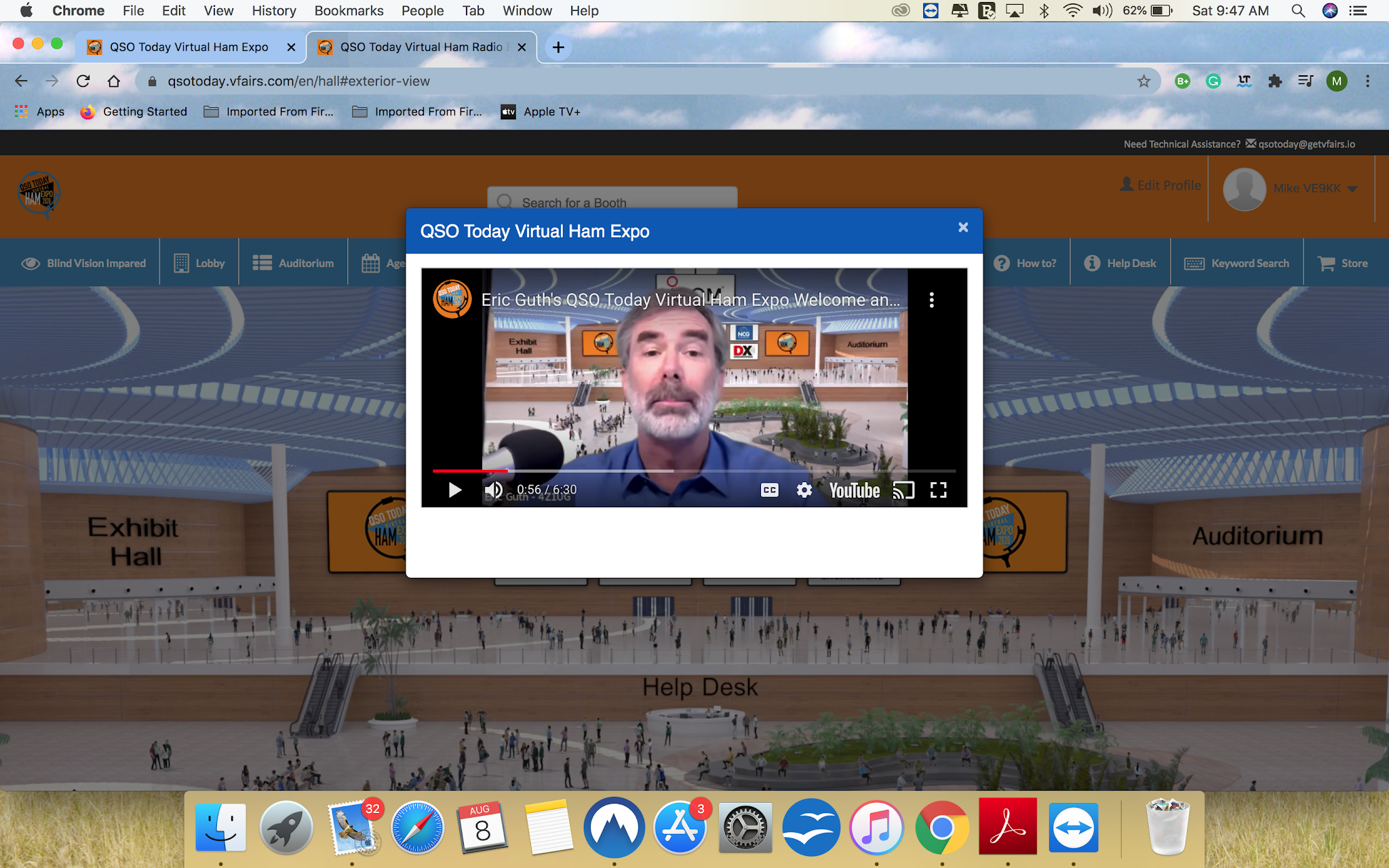 |
| The welcome message. |
Mike Weir, VE9KK, is a regular contributor to AmateurRadio.com and writes from New Brunswick, Canada. Contact him at [email protected].
Simplex Channel Confusion on 2 Meters
I often get asked questions about the band plan for 2 meters (144 to 148 MHz). Usually, this is about choosing a suitable simplex frequency, because the repeater frequencies are already coordinated and visible.
I’ve written about 2m band plans before. This article attempts to cover the topic in a way that applies to all of the US. This is actually a challenge because VHF/UHF band plans are regional in nature.
I also wrote this article which is specific to the state of Colorado.
It is always best to check your local VHF band plan, usually supplied by the frequency coordinating body for your area. Typically, their main focus is coordinating repeaters but simplex frequencies are also listed. Most frequency coordinating bodies kind of follow the ARRL 2m band plan, while adapting it for local use.
Channel Spacing: 15 kHz or 20 kHz
A big issue for the 2-meter band is that some areas have adopted a 15-kHz channel spacing while others use a 20-kHz channel spacing. A typical FM signal is about 16 kHz wide, so the 15 kHz channel spacing is a bit tight but does allow for more channels (resulting in more adjacent channel interference issues). The 20-kHz spacing is “cleaner” but with fewer channels.
This map from the ARRL web site shows the channel spacing in use across the various states.

The channel spacing is driven by factors associated with repeater coordination, and simplex usage tends to adopt the same spacing. (There is no technical reason that simplex has to use the same channel spacing as the repeaters but that’s what usually happens.)
Some repeater coordinating organizations have done a good job of prescribing FM simplex frequencies. The Colorado 2m band plan (called the Frequency Use Plan) lists each simplex frequency individually. The Illinois Repeater Association uses a similar approach: Illinois 2m Band Plan. The Southeastern Repeater Association (SERA) 2m band plan is also very specific. Note that the SERA band plan indicates that some of the usual 2m simplex frequencies may be used as repeater pairs — an example of a local decision on frequency use.
The Arizona 2m band plan shows a range of frequencies to be used for FM simplex, such as 146.400 – 146.600 MHz along with a note that says the Even 20 kHz Frequencies should be used. So that means the preferred simplex frequencies in this range are 146.40, 146.42, 146.44, 146.46, 146.48, 146.50, 146.52, 146.54, 146.56, 146.58 and 146.60 MHz. Some repeater coordinating bodies just give the frequency segment allocated to FM simplex and don’t mention the channel spacing. And some organizations don’t say anything about FM simplex so you have to figure them out on your own.
Recommendations
So what do we make of all of this? When it comes to 2m FM simplex frequencies, try to find your local band plan. If it recommends 2m FM simplex frequencies, then follow that guidance.
If that doesn’t work, look at the map above to determine if your state uses 15 kHz or 20 kHz spacing. Then follow the guidance in the HamRadioSchool.com article: What Frequency Do I Use on 2 Meters?
| 2M FM Simplex Frequencies (typical usage, check your local band plan) | |
| 15 kHz Channels | 146.400, 146.415, 146.430, 146.445, 146.460, 146.475, 146.490, 146.505,146.520, 146.535, 146.550, 146.565, 146.580, 146.595 147.405, 147.420, 147.435, 147.450, 147.465, 147.480, 147.495,147.510, 147.525, 147.540, 147.555, 147.570, 147.585 |
| 20 kHz Channels | 146.400, 146.420, 146.440, 146.460, 146.480, 146.500, 146.520, 146.540, 146.560, 146.580, 146.600 147.400, 147.420, 147.440, 147.460, 147.480, 147.500, 147.520, 147.540, 147.560, 147.580 |
In all cases, remember that these are shared frequencies so you need to cooperate with other radio hams. If you bump into existing activity, go ahead and try another frequency. There are usually plenty of quiet simplex channels around.
The one simplex frequency that everyone does seem to agree on is the National Simplex Calling Frequency: 146.52 MHz. For some thoughts on how to use that frequency see: The Use of 146.52 MHz.
I do think that frequency coordination bodies would be wise to provide guidance on simplex channels. This is not frequency coordination but it helps the amateur radio community be more effective in using the spectrum.
73 Bob K0NR
The post Simplex Channel Confusion on 2 Meters appeared first on The KØNR Radio Site.
Bob Witte, KØNR, is a regular contributor to AmateurRadio.com and writes from Colorado, USA. Contact him at [email protected].
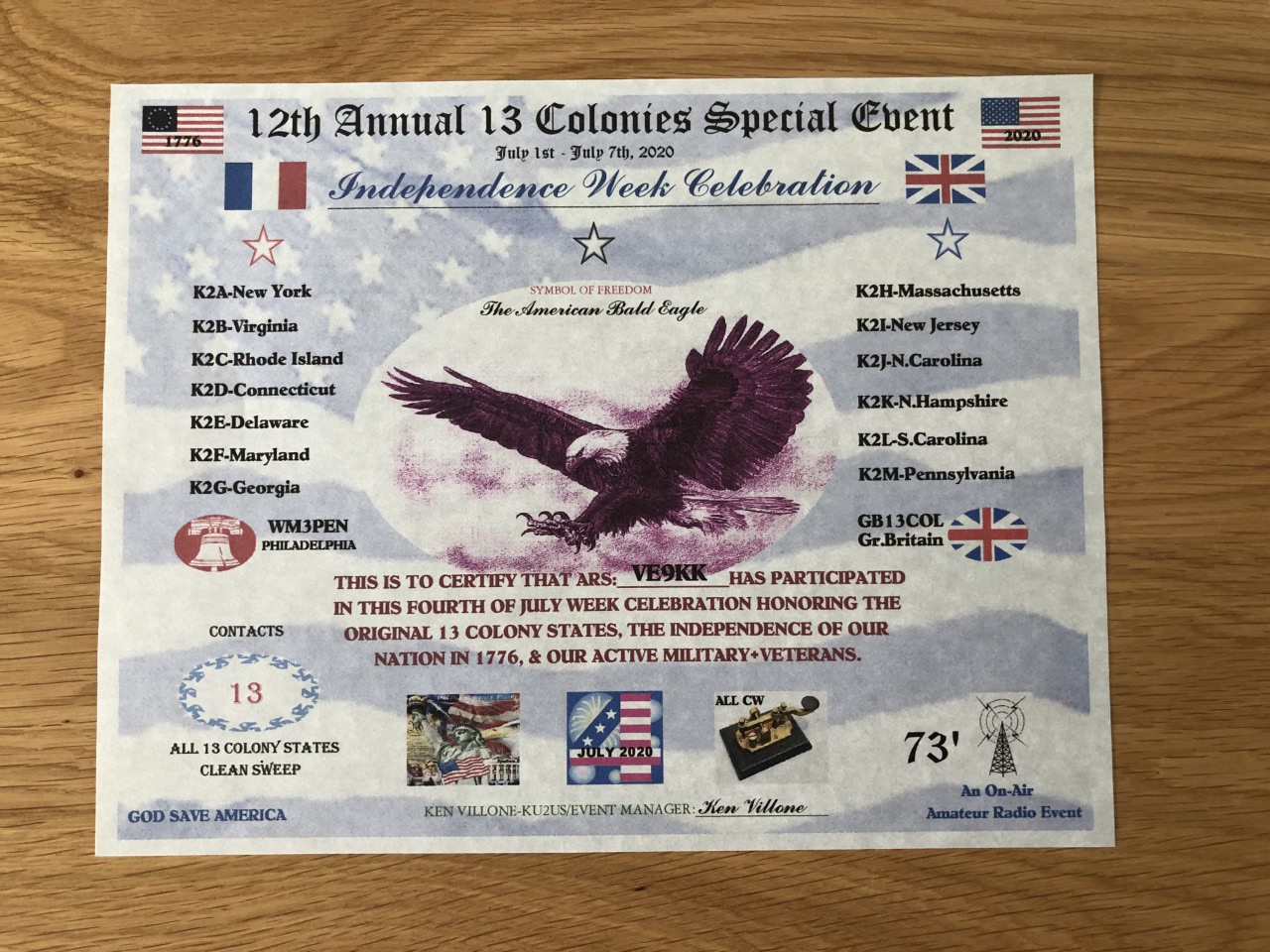
13 Colonies wallpaper arrived today.
Mike Weir, VE9KK, is a regular contributor to AmateurRadio.com and writes from New Brunswick, Canada. Contact him at [email protected].
 Ham Radio Deluxe |
 W5SWL Electronics |
 Ham Radio Prep |
 KB3IFH QSL Cards  Hip Ham Shirts  HamRadioAuctions HamRadioAuctions Reliance Antennas Reliance Antennas Enigma Shop Enigma Shop |  morseDX  Ni4L Antennas  R&L Electronics R&L Electronics antennas.us antennas.us Ears to Our World Ears to Our World |
- Matt W1MST, Managing Editor
