 |
 RFI on SOTA Summits
 31 August 2020 | by
 One thing to watch out for when doing SOTA activations is the presence of strong Radio Frequency Interference (RFI) on some peaks. The typical scenario is that the summit is also an established radio site with transmitters that interfere with your ham radio operations.

I use the VHF/UHF bands for SOTA, so I am writing from that perspective. My impression is that HF interference is much less likely because these radio sites don’t usually have any HF transmitters. However, they may have broadband noise sources such as networking equipment, power line arcing or switching power supplies that can create problems on HF. Anyway, this post is focused on 2 meters and higher bands.
In my experience, the transmitters at radio sites may include land mobile repeaters (VHF or UHF), NOAA Weather (162.xx MHz), TV/FM broadcast stations and mobile wireless (cellular) systems. The TV/FM broad stations are really bad news because they run a crapton of RF power.
The worst summit I have encountered is Sandia Crest (W5N/SI-001) near Albuquerque, NM. See trip report here. They even have a sign in the parking lot to warn you that the RFI may wipe out your car’s keyless remote.

Some other notable RFI-heavy SOTA summits are Monarch Ridge South (W0C/SP-058), Squaw Mountain (W0C/PR-082), Terry Peak (W0D/NW-002), and Greentop (W4T/SU-076).
In a high RFI environment, your radio receiver gets overloaded such that you can’t hear stations calling you but they can hear you just fine. This results in the SOTA activator calling and calling while the chasers get frustrated that the activator never hears their call. Not good. It may not be obvious that this is happening. This blocking of the receiver may come and go, depending on which transmitters happen to be active.
Mitigation Strategies
There are a few things that you can do to deal with the RFI:
Move Away From The Source
Probably the first thing to try is just moving away from the source of interference. This may mean moving away from the highest point on the summit but it may be better overall to give up a few feet of elevation to not have the interference. You’ll need to stay in the activation zone to be a legitimate SOTA activation.
Use A Better Radio
Some radios are better than others when it comes to receiver performance including the ability to reject unwanted signals. The low cost radios from China (Baofeng or similar) generally have lousy receivers so they are a poor choice for operating from an RFI-intense summit. Many people report better results with the Yaesu FT-60, a solid performer. Commerical radios from Motorola are even more robust. I’ve been using a small mobile radio for SOTA (Yaesu FT-90) which outperforms most handheld radios.
Change Your Antenna
Using a directional antenna can help…just point it away from the source of the interference. Oddly enough, using a worse performing antenna can help improve your ability to communicate. For example, a rubber duck antenna on a handheld radio will allow less of the interfering signal to get into your receiver which may improve your ability to receive. As long as the antenna is “good enough” to complete the radio contact, it may be the way to go. One trick I’ve used is to deploy two radios, one for receive with a crummy antenna and the other for transmit with a better antenna. That way, you still radiate a stronger signal while reducing the interference into the receiver.
Use A Bandpass Filter
You can insert a filter into your antenna feedline to reduce the interfering signal. The best approach is to use a bandpass filter that passes the frequency you are operating on but attenuates other signals. SOTABeams offers a compact bandpass filter for the 2m band. (Note that it has a 5W power rating which is fine for handheld radios but not more powerful transceivers.) DCI Digital Communications offers higher power filters but they are much larger in size.
Change Frequency
Sometimes a small change in frequency might help a bit if the interference is limited to certain frequencies. Another tip is to try another band. That is, if you are getting interference on 2 meters, you may find that the 70 cm band is better. Or vice versa. It all depends on the transmitters at the site.
73 Bob K0NR
The post RFI on SOTA Summits appeared first on The KØNR Radio Site.
Bob Witte, KØNR, is a regular contributor to AmateurRadio.com and writes from Colorado, USA. Contact him at [email protected].
ICQ Podcast Episode 332 – Exciting Bumper New Solar Cycle
In this episode, Martin M1MRB is joined by Chris Howard M0TCH, Martin Rothwell M0SGL, Ed Durrant DD5LP, Frank Howell K4FMH and Bill Barnes WC3B to discuss the latest Amateur / Ham Radio news. Colin M6BOY rounds up the news in brief and this episode’s feature is a discussion with Dr. Scott McIntosh of the National Center for Atmospheric Research, Boulder, CO, USA regarding Exciting Bumper New Solar Cycle.
ICQ AMATEUR/HAM RADIO PODCAST DONORS
We would like to thank Richard Langmead (5B4AJG) along with our monthly and annual subscription donors for keeping the podcast advert free. To donate, please visit - http://www.icqpodcast.com/donate
- Researchers Predict a Surge in Cosmic Rays - Radio Hams Assist Teams on Ground with Contact Tracing - International Air Ambulance Week 2020 - Hawaii Ham Radio exams in USA during pandemic - German Radio Amateur Falsely Accused in Greece - UK Ham Completes Lands End to John O Groats Solo Cycle - ARRL Board Elects New CEO - Findlay Radio Club Hamfest Cancelled - FCC Proposes to Reinstate Amateur Radio Service Fees
Colin Butler, M6BOY, is the host of the ICQ Podcast, a weekly radio show about Amateur Radio. Contact him at [email protected].
Ham College 68
Ham College episode 68 is now available for download.
Extra Class Exam Questions – Part 6.
E1F Miscellaneous rules: external RF power amplifiers, prohibited communications, spread spectrum, auxiliary stations, Canadian amateurs operating in the U.S., special temporary authority, control operator of an auxiliary station.
57:10
George Thomas, W5JDX, is co-host of AmateurLogic.TV, an original amateur radio video program hosted by George Thomas (W5JDX), Tommy Martin (N5ZNO), Peter Berrett (VK3PB), and Emile Diodene (KE5QKR). Contact him at [email protected].
LHS Episode #364: The Weekender LV

It's time once again for The Weekender. This is our bi-weekly departure into the world of amateur radio contests, open source conventions, special events, listener challenges, hedonism and just plain fun. Thanks for listening and, if you happen to get a chance, feel free to call us or e-mail and send us some feedback. Tell us how we're doing. We'd love to hear from you.
73 de The LHS CrewAudio Player
Russ Woodman, K5TUX, co-hosts the Linux in the Ham Shack podcast which is available for download in both MP3 and OGG audio format. Contact him at [email protected].
Issue with my feed line.
 |
| Troubling reading of coax |
 |
| Faulty PL259 |
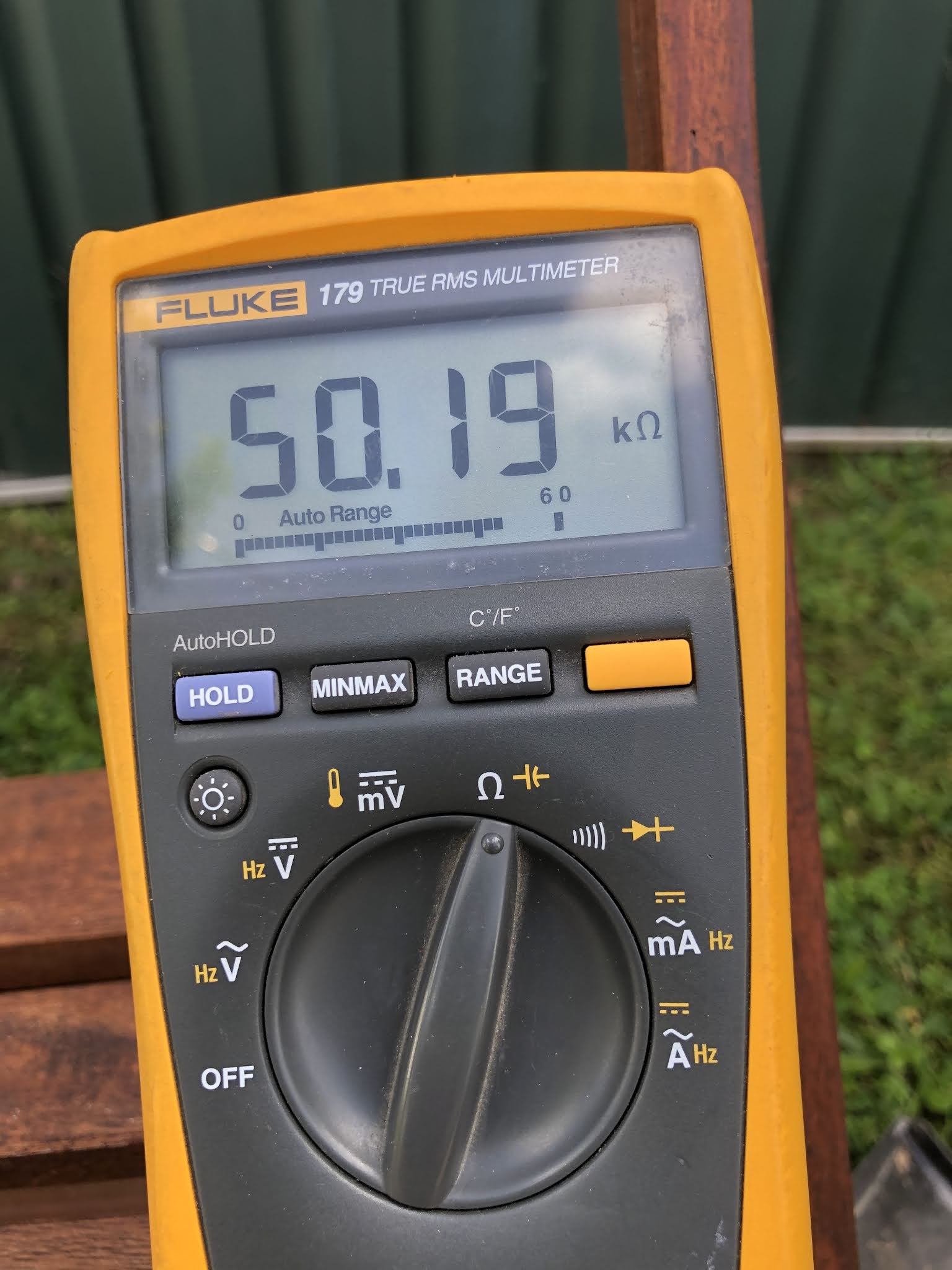
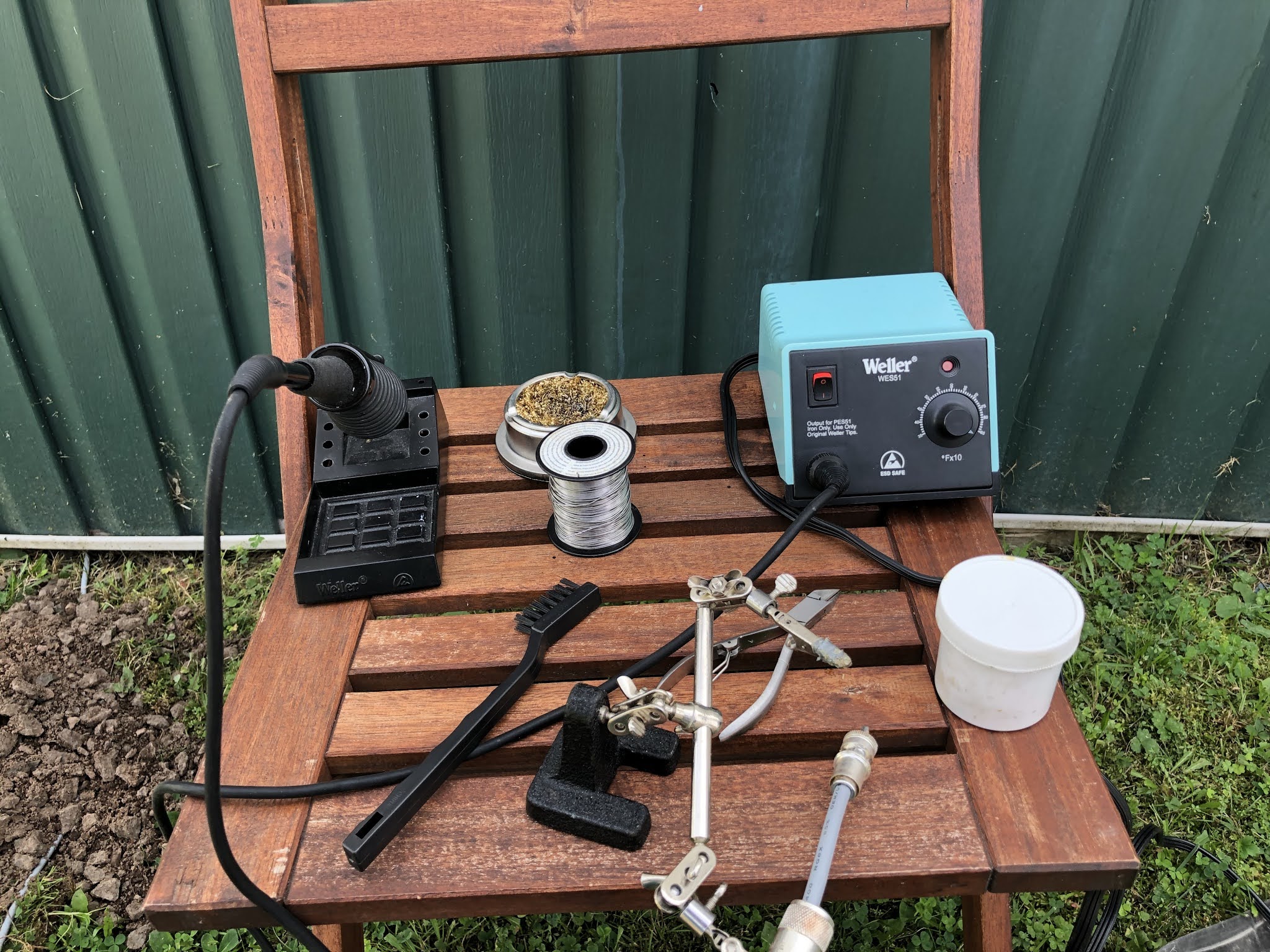
Last week I posted about a wonky SWR reading I was getting and I figured it may be the result of a loose PL259. The issue returned again but not as bad last week. Since moving my Endfed antenna to be able to extend the wire the coax was also moved and now has to be buried. I needed to place the coax in some PVC conduit and not direct buried underground. It was a nice day and I decided to place the coax in the PVC conduit. While I had the coax disconnected from the Endfed antenna to feed it through the PCV conduit I thought I would connect my Fluke multimeter to the coax. With both ends of the coax disconnected, I placed the multimeter leads across the centre and barrel of the PL259 just to make sure my reading was "OL" and low and behold it was not!
 |
| Outdoor soldering station. |
Mike Weir, VE9KK, is a regular contributor to AmateurRadio.com and writes from New Brunswick, Canada. Contact him at [email protected].
Hunting For NDBs in CLE259
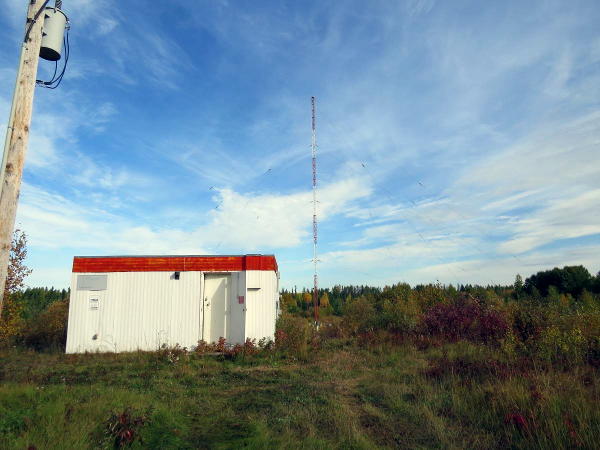 |
| YPM-274 Pikangikum, ON (ve3gop) |
It's CLE time again!
'CLE's are 'Co-ordinated Listening Events, and NDB DXers around the world focus their listening time on one small slice of the NDB spectrum.
This time the hunting ground is the 50kHz slice from 270.0 - 319.9 kHz. kHz
A worthy target for listeners in North America is YPM (274Hz) in Pikangikum, in western Ontario. YPM has been logged from coast-to-coast and out to Hawaii. Listen for YPM's upper sideband on 274.361kHz with your receiver in the CW mode.
When tuning for NDBs, put your receiver in the CW mode and listen for the NDB's CW identifier, repeated every few seconds. Listen for U.S. NDB identifiers approximately 1 kHz higher or lower than the published transmitted frequency since these beacons are modulated with a 1020 Hz tone approximately.
For example, 'AA' near Fargo, ND, transmits on 365 kHz and its upper sideband CW identifier is tuned at 366.025 kHz while its lower sideband CW ident can be tuned at 363.946 kHz. Its USB tone is actually 1025 Hz while its LSB tone is 1054 Hz.
Often, one sideband will be much stronger than the other so if you don't hear the first one, try listening on the other sideband.
Canadian NDBs normally have an USB tone only, usually very close to 400 Hz. They also have a long dash (keydown) following the CW identifier.
All NDBs heard in North America will be listed in the RNA database (updated daily) while those heard in Europe may be found in the REU database. Beacons heard outside of these regions will be found in the RWW database. These databases have recently been re-vamped and are slicker than ever before!
From CLE coordinator Brian Keyte (G3SIA), comes the following CLE info:
Hello all
Here are brief details for our 259th co-ordinated listening event next weekend.
It spans a 50 kHz frequency range - about three times wider than usual.
In that range, the Rxx database is showing about 200 active NDBs located in
Europe, 135 in North America, 35 in Oceania and about 250 more, scattered
in other parts of the World.
Days: Friday 28 August – Monday 31 August
Times: Start and end at midday, your LOCAL time
Range: 270.0 - 319.9 kHz (NDB signals only)
Part of the frequency range also has DGPS signals among the NDBs.
We last listened on these frequencies in CLE243 in April 2019.
Any first-time CLE logs will be very welcome, as always.
Please look out for our Final Details on the NDB List website, with full advice on log making, etc.,
in a few days.
Brian and Joachim
-----------------------------------------------------------------
From: Brian Keyte G3SIA ndbcle'at'gmail.com
Location: Surrey, SE England (CLE coordinator)
-----------------------------------------------------------------
These listening events serve several purposes. They:
• determine, worldwide, which beacons are actually in service and on-the-air so the newly-re-vamped Rxx online database can be kept up-to-date
• determine, worldwide, which beacons are out-of-service or have gone silent since the last CLE covering this range
• will indicate the state of propagation conditions at the various participant locations
• will give you an indication of how well your LF/MF receiving system is working
• give participants a fun yet challenging activity to keep their listening skills honed
Final details can be found at the NDB List website, and worldwide results, for every participant, will be posted there a few days after the event.
The NDB List Group is a great place to learn more about the 'Art of NDB DXing' or to meet other DXers in your region. There is a lot of good information available there and new members are always very welcome. As well, you can follow the results of other CLE participants from night to night as propagation is always an active topic of discussion.
You need not be an NDB List member to participate in the CLEs and all reports, no matter how small, are of much value to the organizers.
Remember - 'First-time' logs are always VERY welcome!
Reports may be sent to the NDB List Group or e-mailed to CLE co-ordinator, Brian Keyte (G3SIA), whose address appears above. If you are a member of the group, all final results will also be e-mailed and posted there.
Please ... give the CLE a try ... then let us know what NDB's can be heard from your location! Your report can then be added to the worldwide database to help keep it up-to-date.
Have fun and good hunting!
Steve McDonald, VE7SL, is a regular contributor to AmateurRadio.com and writes from British Columbia, Canada. Contact him at [email protected].
LHS Episode #363: Too Hot
Welcome to the 363rd installment of Linux in the Ham Shack. In this episode, the hosts discuss some big changes for the show, Google and 6GHz, an upcoming contest for portable operators, identifying and dealing with HF noise, Warpinator, GhostBSD, Bitcoin and much more. Thank you for listening and have a spectactular week.
73 de The LHS Crew
Russ Woodman, K5TUX, co-hosts the Linux in the Ham Shack podcast which is available for download in both MP3 and OGG audio format. Contact him at [email protected].
 Ham Radio Deluxe |
 W5SWL Electronics |
 Ham Radio Prep |
 KB3IFH QSL Cards  Hip Ham Shirts  HamRadioAuctions HamRadioAuctions Reliance Antennas Reliance Antennas Enigma Shop Enigma Shop |  morseDX  Ni4L Antennas  R&L Electronics R&L Electronics antennas.us antennas.us Ears to Our World Ears to Our World |
- Matt W1MST, Managing Editor
