 |
 Ham Radio Antennas For Apartments
 12 October 2020 | by
 There are many challenges for today’s amateur radio operators. Low sunspots and poor propagation, Covid-19 virus limiting ham club meetings and normal fraternizing of local hams, HOA’s and other limits on outside antennas are real and must be dealt with. This also limits the help of ELMERS who can help new hams to understand how to cope with these problems.
One of the biggest problems is the limitations of apartment living. Many older hams have been forced to downsize as well as younger hams who cannot afford a single family home face these challenges daily. I hope I can provide some help for this challenge.
First let us consider the type of apartment. If a first floor apartment- consider moving. Really being on a higher floor is a big help with antennas. OK, well that can be dealt with anyway. Does the apartment have a balcony? How about a screened in porch. Are the windows small, or picture window size? Is there access to the roof? Are the walls concrete, wood or full of steel? Does the apartment management allow antennas? These are valid considerations and will affect antenna choices.
Not all antennas are equal. The half-wave dipole is the basis of comparison for antennas. Mobile whip antennas for HF are usually less than 20 percent efficient. However many apartment dwellers have operated using whips installed on their balconies.
Magnetic loop antennas of 1 to 3 meter diameters have been used successfully even they are about 40 to 60 percent efficient. Larger loops of 30 to 50 feet circumference can be used multiband operation with 60 to 80 percent efficiency. Fortunate amateurs that can install an end fed antenna can see 60 to 90 percent efficiency depending on the frequency of operation.
How does efficiency factor into antenna selection? The old saying “The bigger the better” certainly applies. Assuming a 100 watt transmitter, 50 percent efficiency would indicate a 3 dB loss of received and transmitted signal. Many sources state that the receiving station would hardly notice a reduction from 100 watts to 50 watts.
It is estimated that it takes a 6 dB reduction in transmitted signal for the receiving station to notice a change. Remember that a loss also means received signal loss so it affects your reception also. However, many stations operate successfully from apartments with QRP (5 to 10 watt) transmitters. So if you have a balcony where you can install an antenna, there are several choices.
Let’s review some of the issues facing apartment dwellers. Full size antennas for HF are not viable for apartments due to space restrictions.
Apartment antenna considerations
Size
This is one of the most important considerations. Area for antennas is limited and you will want to keep as low a profile as possible. Your neighbors and landlord may not appreciate the beauty of your ham antenna. Full size antennas are surely prohibitive.
Bands
A multiband antenna is probably the first choice. Of course if you have a single band transceiver, like many QRP radios, then a monoband antenna is good.
Ease of installation
You may want the antenna to be removed when not in use. A wire antenna should not be easily viewed when installed. Wire end fed antennas require a support at the far end. If possible, get the antenna outside.
Cost
The antenna should be the best possible at the least cost.
Location
Inside the apartment means the antenna is susceptible to local manmade noise and may cause interference to TV, Stereos’ and other appliances. The building will also affect the reception and transmission of RF signals depending on the materials of building construction. Installed on balconies it should not be visually offensive to neighbors. Remember, the further away from the building the better the performance of the antenna.
What types of antennas are possible
Mobile whips installed on balcony railings with a wire counterpoise have been used with some success. These are usually monoband antennas and have limited bandwidth unless they are auto-tuned screwdriver antennas. Those are expensive. Also remember mobile antennas are often only 7 to 12 percent efficient.

Small loops are a bit more efficient but again they are expensive unless you do make your own. Good variable capacitors used for tuning are expensive. Efficient loops require large diameter or cross section conductors. They work well on the upper HF bands.


Larger loops 0.10 wave length to ¼ wave circumferences have been used both inside apartment walls and around ceilings. These loops can be 40 to 60 percent efficient compared to a halfwave dipole.
I have used a loop 15 feet top and bottom and 10 foot sides for operation on 80 and 40 meters. Using 30 feet of wire works well for 40 and 30 operations.
MFJ sells a QRP tuner that suggests these lengths loops. They also have a 100 watt loop tuner and several other loop tuners.

MFJ makes an apartment antenna which is a base coil and whip with a mounting system. They work about the same as a mobile antenna.

They also make a bracket that holds two mobile whips to make a dipole.

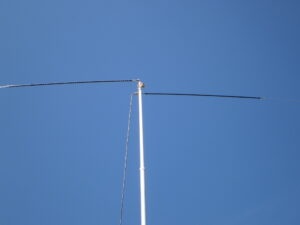
Wire antennas can be dipoles, loops or endfed antennas. Usually there is insufficient room for half wave dipoles, except for ten meters. Shortened dipoles are possible but as the antenna gets shorter the band width get smaller. Many experimenters have found that the dipole as short as ¼ wavelength can be efficient if the RF can be matched properly to the antenna. Coils and traps add losses to the antenna.


Of course, if allowed, half wave antennas can be installed on the roof. Or they can be installed around the ceilings or walls of a room or in an attic space. “Slinky” toys have been used to make antennas also. They can be end fed with an unun balun and matchbox or using two to make a shortened dipole. They can be strung on a plastic line, pvc pipe or telescoping fishing pole. This makes them easily hidden when not in use.
Another possibility is a shortened dipole about 44 to 50 feet long, center fed with balanced feed line or two lengths of TV coax, using the center conductors as the feed line. The shields should be connected at each end and the shack end grounded if possible.
If each half is wound around a 7 meter telescoping fishing pole the antenna can be mounted on a balcony railing, pointing away from the building. This will make a multiband antenna for 40 to 10 meters. One half can be on the pole and one half hanging vertical also. Just make sure the hanging side does not hit apartments or people below. These antennas require a matchbox to feed RF from the transmitter to the feedline. The internal antenna tuners in most modern transceivers do not have enough range to match them on all bands.


End fed wire on a telescoping fishing pole. The far end hangs down.

End fed wires are possible using a 49 :1 balun and 33 to 72 feet of antenna wire. The wire runs from the balcony or window to a tree or support away from the building. The antenna should not cross any power lines or be where people can contact the wire.
Verticals or semi-verticals can be installed on balconies. Perhaps a 15 foot aluminum tubing vertical mounted on the railing with a 15 foot wire counterpoise hanging down fed with a tuner and short coax feedline or a balanced line. This should make a good antenna for 20 to 10 meters and possibly used on 40 and 30 meters with less efficiency depending on the tuner.

This is a DIY TAKTENNA with Petlowany coils on each end making a short vertical dipole.
Antennas for stealth, limited areas or apartments are a challenge but there are many ideas available on the internet. Just allow your mind to think out-side-the-box and visualize different antenna installations.
For more info and ideas on apartment antennas I suggest this URL:
https://officinahf.jimdofree.com/antenne-hf-mf/hf-antenne-da-balcone-1/
My thanks to the many that have purchased my new book: “Basic Wire Antennas for Hams and Preppers” as shown below. Send $5.00 US to my email address via PayPal for a PDF copy. W4BWS1 at gmail. com. More info at QRZ.com/db/W4BWS. Be sure to include your email address with the PayPal order.

As Rick Barrow, K3IW writes: Dear Dr. Don, Thank you very much, I enjoyed perusing your new antenna book. After reading it the work is worth more than five bucks, but I don’t know if youngsters read much these days versus watching YouTube instructional videos.
Dr. Donald Sanders, W4BWS, is a special contributor and writes from Florida, USA.
LHS Episode #372: Pond Scum

Welcome to the 372nd installment of Linux in the Ham Shack. In this episode, we have a rogue co-host join the crew for stories about Jamboree on the Air/Internet, Supreme Court cases of a deeply important nature, revised band plans, losing frequencies, graphical WSL, GPL enforcement, the pre-release WSJT-X and much more. Thank you for listening and have a wonderful week.
73 de The LHS Crew
Russ Woodman, K5TUX, co-hosts the Linux in the Ham Shack podcast which is available for download in both MP3 and OGG audio format. Contact him at [email protected].
ICQ Podcast Episode 335 – Massive DXing on 2m
In this episode, Martin M1MRB is joined by Leslie Butterfield G0CIB, Dan Romanchik KB6NU and Edmund Spicer M0MNG to discuss the latest Amateur / Ham Radio news. Colin M6BOY rounds up the news in brief and this episode’s features is Massive DXing on 2m, an interview by Edmund Spicer M0MNG with Cesar Regalado Leon EA8CXN
ICQ AMATEUR/HAM RADIO PODCAST DONORS
We would like to thank our monthly and annual subscription donors for keeping the podcast advert free. To donate, please visit - http://www.icqpodcast.com/donate
- Ofcom to introduce new spectrum licence conditions - French Investigation to 5G Risk - AO-27 satellite celebrates 27 years in space - New WSJT Candidate Release Features FST4 - Italy Adopts Remote Oral Amateur Radio Exams - Radio Signals from Mars - Belgium Suspends Ham Radio Exams - EANET Sprint Contest 2020 - Two Astronauts Achieve Amateur Radio Licenses
Cesar Regalado Leon EA8CXN YouTube Channel - https://www.youtube.com/channel/UCqKCJjL_2fxxu79e5onsK6Q/featured
Cesar Regalado Leon EA8CXN Website - https://ea8cxn.es/
Colin Butler, M6BOY, is the host of the ICQ Podcast, a weekly radio show about Amateur Radio. Contact him at [email protected].
LHS Episode #371: The Weekender LVIII

It's time once again for The Weekender. This is our bi-weekly departure into the world of amateur radio contests, open source conventions, special events, listener challenges, hedonism and just plain fun. Thanks for listening and, if you happen to get a chance, feel free to call us or e-mail and send us some feedback. Tell us how we're doing. We'd love to hear from you.
73 de The LHS Crew
Russ Woodman, K5TUX, co-hosts the Linux in the Ham Shack podcast which is available for download in both MP3 and OGG audio format. Contact him at [email protected].
Just Get On The Air! (A Makeshift Temporary Dipole Shortwave Antenna)
It might not take as much antenna as you may think would be necessary to make two-way contacts on shortwave radio (as an amateur radio operator putting an HF transceiver on the air). However, often, makeshift antennae are effective enough to be viable–just look at all the contacts many amateur radio operators make with their low-power (QRP) rigs (transceivers) using short, helically-wound, mobile antenna sticks. If they can work magic with such inefficient antenna setups, surely your effort at an antenna would pay off to some degree. Right?
[embedyt] https://www.youtube.com/watch?v=-k5Su–ez2Y[/embedyt]
Of course, I want to make a proper dipole out of this example antenna. But, while I wait for the rest of the parts I need to complete this antenna project (pulleys and a ladder, and maybe a potato launcher), I’ve put this makeshift antenna on the air, with it just high enough so that I can enjoy some time on the shortwave bands.
With this antenna, I’ve made successful two-way voice and Morse code contacts (QSOs) with stations in Europe and across North America. I am able to tune it on the 60-, 40-, 30-, 20-, 15-, 17-, 12-, and 10-Meter bands. Reverse beacon detection picks up my Morse-code CW signals, especially on 40 meters (the band on which it is tuned physically).
The bottom line: just get something up in the air and start communicating. Improve things over time. You’ll have much fun that way.
73 de NW7US dit dit
Visit, subscribe: NW7US Radio Communications and Propagation YouTube Channel
The 2020 Fall “Classic Exchange”
 |
| W7OS - Radio Club of Tacoma working the CX |
The "CX" encourages participants to use older vintage gear including any homebrew equipment, both receivers and transmitters. A unique scoring system provides bonus points for various equipment and combinations as well as encouraging 'repeat contacts' when you switch to different equipment. Some of the the CX's previous participants are shown here.
 |
| W8KM and his wonderful vintage station |
No vintage gear? ... no problem! All amateurs are invited to participate and get in on the fun no matter what they are using and submit their scores.
 |
| K3MD's Heathkit AT-1 and Hallicrafters HT-37 |
The CX is a low-key relaxing affair and the 'extra' Tuesday operating period should encourage a lot of midweek activity from the vast numbers of retired operators who cherish and run older gear.
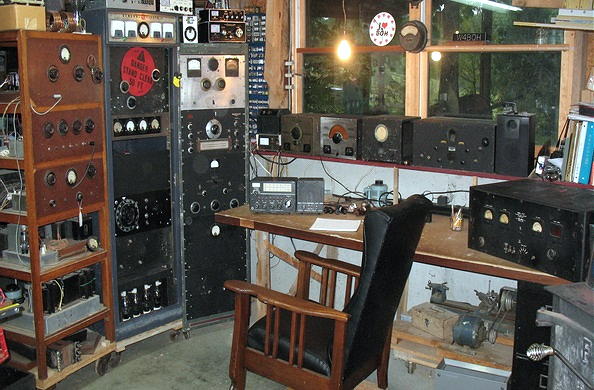 | ||||||||||||||||||||||||
| Lots of combos ready at W4BOH |
 |
| K6ZI, Las Vegas - WWII ARC-5s ready to go |
This year's event includes a new real-time chat page where participants can announce their operating frequencies or make skeds. For complete details, check out the rules here.
If you've never entered the Classic Exchange, why not give it a try this year as it truly is a case of 'the more the merrier' ... and eastern operators, make sure to keep the porch light on for us out west!
Steve McDonald, VE7SL, is a regular contributor to AmateurRadio.com and writes from British Columbia, Canada. Contact him at [email protected].
Will You Take the Challenge? Or do you like getting caught in the rain?
The final rules for the Fox Mike Hotel Portable Ops Challenge have been posted! This weekend, October 3-4, 2020, is the first year of this new and very differently scored HF contest. The Steering Committee has come up with a metric to make the playing field “more level” between the Big Gun contest stations and the portable operators. By making the basic score scaled on a distance-per-watt metric, the QRO operators don’t necessarily have the advantage that they have in most contest pile-ups. In addition, the POC has multipliers to make the focus on Radio Sport rather than Radio Equipment.
Take the annual Stew Perry 160 meter contest for 2019. I took the public logs and computed data visualizations (box plots) for the average distance in kilometers as well as the longest (“best”) DX distance, both by reported power level. This was QRP, barefoot (100 watts), or QRO. No surprise! The level of power largely shaped the medians and extremes as shown in the Raw Distance panel (row).

But look at the Distance Per Watt panel! When made relative to power, the QRP operators flipped the field by dominating those scores. Why? Because it didn’t take more power to make the contact! Getting the optimal power level to make the contact is more about sport than equipment.
So the POC is using these types of results to handicap the field as more fixed stations use QRO than portable ones. While QRP is not synonymous with portable ops, there is a similar tendency for them to operate that way. Barefoot operators can easily be in either location. But the point here is clear: distance per watt can be a great equalizer across these groups. No, wait, the QRPers actually have a distinct advantage. That could be challenging to the QRO contestants, no?
…the POC has multipliers to make the focus on Radio Sport rather than Radio Equipment.
Frank K4FMH
The mode of transmission multiplier, for instance, doesn’t just give extra advantage to CW operations since CW gets through when phone can’t, right? So other than a particular choice of emphasizing using Morse Code, why do that? In addition, CW that can’t be heard by the human ear can’t be copied. But some digital modes (ahem, FT8) that can’t be heard above the noise floor can get through, after some time. The POC gives multipliers that favor the “all else equal” mode that is more difficult to get through. Digital gets a x1, CW gets a x2, and phone gets a x3.
Some Super Stations run a dozen rigs during contests. Wow. How’s that for going up against a single operator? The POC for the first year limits the number of simultaneous transmitters to two (2). But it goes a bit further by dividing the final point total by the number of TXes (or 2, if two are used). For sport, it’s the per-transmitter-production that counts, not the amount of radio equipment. In future years, the POC will consider allowing unlimited transmitters but make the per-transmitter-production scaled so as to level that obvious advantage too. We will see how this year goes in the submitted logs.
Well, does this make the typical fixed contest station (if there is such a thing) equal to a portable one? Directional antennas with gain still give an advantage unless the portable operator sets one or more up as in Field Day activities. ERP was considered but getting a reliable gain estimate can be troublesome. Just read what some manufacturers claim versus what some user measurements come up with. You get idea here about the unreliability of gain estimates perhaps being as much trouble as it is worth. So, the Steering Committee examined some data, did some statistical simulations to compare hypothetical fixed (QTH) stations with portable ones, and came up with a multiplier for operating portable as a type of “tuning parameter” to get things more equal. This is not unlike the slope rating of golf courses which reflects professional judgment of the difficulty of the course itself. The POC has a set of four multipliers depending on the location of the pair of stations in each contact. A QTH to QTH contact has a x1 multiplier. A QTH to Portable has a x1.4 (and Portable to QTH). A portable to portable contact has a multiplier of x2. (Mathematicians note: 1.4 squared is about 2). The Steering Committee will analyze this year’s results to see how this “tuning parameter” performs with an eye on perhaps adjusting it for next year.
The key question is: Will you take the Challenge? If you’re operating from the comforts of your home shack, can you beat the portable operator on a level playing field? We won’t know if you don’t take the Challenge! Or, perhaps you rather get caught in the rain…
Frank Howell, K4FMH, is a regular contributor to AmateurRadio.com and writes from Mississippi, USA. Contact him at [email protected].
 Ham Radio Deluxe |
 W5SWL Electronics |
 Ham Radio Prep |
 KB3IFH QSL Cards  Hip Ham Shirts  HamRadioAuctions HamRadioAuctions Reliance Antennas Reliance Antennas Enigma Shop Enigma Shop |  morseDX  Ni4L Antennas  R&L Electronics R&L Electronics antennas.us antennas.us Ears to Our World Ears to Our World |
- Matt W1MST, Managing Editor
