 |
 TX Factor Episode 27 is Now Available to Watch
 4 December 2020 | by
 Another post-lockdown special? – Indeed! And we hope you are safe and well and looking forward to some TX Factor action. In this final show of 2020, we visit the home of a well-known and long-established amateur radio aficionado Don Field G3XTT. A year ago Don moved to a new QTH near Wells in Somerset, and back in March we visited him to find out how he’s settled in.
Bob and Mike get to grips with setting up an OpenSpot Gateway for mobile use.
And, we hear from RSGB General Manager Steve Thomas M1ACB on the amazing media response to this summer’s amateur radio revival during the lockdown period. All this and a free-to-enter draw!
Nick Bennett 2EØFGQ co-hosts TX Factor with Bob McCreadie GØFGX and Mike Marsh G1IAR. Contact the team at [email protected]
LHS Episode #382: The Weekender LXII

It's time once again for The Weekender. This is our bi-weekly departure into the world of amateur radio contests, open source conventions, special events, listener challenges, hedonism and just plain fun. Thanks for listening and, if you happen to get a chance, feel free to call us or e-mail and send us some feedback. Tell us how we're doing. We'd love to hear from you.
73 de The LHS Crew
Russ Woodman, K5TUX, co-hosts the Linux in the Ham Shack podcast which is available for download in both MP3 and OGG audio format. Contact him at [email protected].
Time to house clean and sell sell some equipment.
Recently I have been doing some thinking......It's always nice when there is an easy answer to things BUT it just does not seem to be! In the past, I have sold radio equipment to later find myself kicking myself. There have been way too many times than I would like to admit where I have sold something to later purchase that same item!
Lately, I have been (in my head) going back and forth with regards to selling some radio items....I don't want to keep it just to have it just in case and it just gets older and holds less value......or sell it and take a chance. It reminds me of when I dabbled in stocks if I only knew the right time to sell and buy. My best information I have at this time is it's time to move some equipment out the door.
Locally (in Canada) I have put the following items up for sale:
1. Chameleon CHA P mag loop antenna.
2. Elecraft KX3 along with some extras.
3. LDG DTS-4 antenna switch.
4. Palm mini paddle.
The first two items are my portable op's stuff and we moved to the east coast over a year ago and it has just sat on my desk doing lots of nothing. I just don't want to see it sitting there if someone else can use it. The other items have been doing the same and I hope I don't end up next year or so kicking myself in the backside that I sold them but such is life.
Mike Weir, VE9KK, is a regular contributor to AmateurRadio.com and writes from New Brunswick, Canada. Contact him at [email protected].
Strongest X-Ray Solar Flare in New Cycle 25! A Class M4.4 Flare on 29 Nov 2020

Here’s a look at the strongest X-ray flare so far in Cycle 25, and the strongest in three years. The flare measured as an M4.4-class Solar Flare, and it peaked at 13:11 UTC on 29 NOV 2020.
Visit, subscribe: NW7US Radio Communications and Propagation YouTube Channel
Choosing A First Handheld Radio
 Once again, I was asked by a new ham “which handheld transceiver should I get?” This is a frequent and valid question that comes up. Often the question gets framed as “Baofeng or something better?” I say “something better.” I am not writing to bash Baofeng radios or the people that use them. The radios are an incredible value on the low end of the market…amazing what they can do for $30 or so. Besides, I own several of them. I just think that if you have a few more $$ to spend, you can get a much better radio. What’s wrong with these low-end Chinese radios? Out of spec harmonics on transmit and poor adjacent channel rejection on receive.
Digital? Probably Not
The other question that usually surfaces is “should I get a digital radio?” Here “digital radio” means D-STAR, Yaesu Fusion or DMR. My answer to that is “No,” unless you have a specific reason for going digital. Adding digital to a radio results in two things: 1) a higher price and 2) a more complex radio. Actually, the price difference may not be that significant, especially for a DMR radio. However, the complexity factor is always there.
What is a specific reason for going digital? You already know that there are digital repeaters in your area that you want to use, you have ham radio friends already using digital or you are technically-oriented and have researched the topic to know that it is something you want to try. If one of these things is true, then go for it.
Oh, you do need to know which digital format to get. No radio does them all and the industry is fragmented between D-STAR, Fusion and DMR. I find this very disappointing but life is sometimes like that.
Narrowing It Down
So narrowing the topic down, we are looking for an affordable (under $100) dual-band handheld that is not a cheap Chinese radio (Baofeng, etc.) and is not a fancy digital radio. My opinion is the quality ham radio manufacturers are pretty much Alinco, Icom, Kenwood, and Yaesu. The price points on basic handheld transceivers keep changing, so be sure to check the date on this post and do a little price shopping.
The Alinco DJ-VX50 is about $100, so not too expensive, but I am not seeing any eham.net product reviews on it. Also, it seems to be out of stock at several vendors, so I am not sure of its production status. Icom and Kenwood have exited the low-end handheld market, so nothing to consider there. This leaves Yaesu as the only “brand name” player in this space. I have been recommending the Yaesu FT-4XR as a good alternative: see What About the Yaesu FT-4XR? at about $80. I recently noticed that the Yaesu FT-65R has come down in price to about $85. With this price difference, it probably makes sense to go with the FT-65R. (I really wonder about Yaesu’s product line strategy at this point. Why are there two similar radios priced so close together?)
Here is a quick comparison of the two radios: Yaesu FT-4XR vs FT-65R, which is right for you? Conclusion: FT-65R is probably better for most people. Also, check out the HamRadioSchool.com article: Yaesu FT-65R Product Review. The eham.net product reviews are generally positive on the FT-65R, but there are a few negative themes that surface. Some people are reporting radio failures that may indicate a manufacturing issue with the product. (It is made in China.)
The Good Old FT-60
The other theme that surfaces is that the FT-65R is not a complete replacement for the venerable FT-60R. Joyce/K0JJW and I have a couple of FT-60Rs that we really like and frequently use. Yaesu still sells this older model because it is so popular and, frankly, it is a really solid radio. The HamRadioSchool.com review of the FT-65R mentions several things that people tend to like on the FT-60R that were left out of the FT-65R (e.g., dedicated VFO and Squelch knobs.) The biggest complaint I hear about the FT-60R is that it has an old-school NiMH battery (the FT-65R has lithium-ion).
My conclusion is to recommend the FT-65R to newcomers to the hobby. At ~$85, it fits most people’s budgets. There is some risk that you will outgrow it down the road and want a more capable handheld for digital or APRS or whatnot. In that scenario, the FT-65R will still be a good second/backup radio. (Ya gotta have more than one, right?)
That’s my opinion. What y’all think?
73 Bob K0NR
The post Choosing A First Handheld Radio appeared first on The KØNR Radio Site.
Bob Witte, KØNR, is a regular contributor to AmateurRadio.com and writes from Colorado, USA. Contact him at [email protected].
CQ WW CW 2020 contest is on the books!
This past weekend was the CQ WW CW contest which if I can I always partake in. This year I made it a point to set aside the time to indulge.....well I'm retired now so it's really not all that hard to set the time aside. But this time around it was going to be a toss-up whether the monitor troubles I was having were going to give me issues. In a nutshell, if the monitor was turned off it was a 50/50 chance I could be greeted with a black screen. If that was the case I then had to play around starting and restarting the PC and turning the monitor off and on to get it working again. My solution was during the day when I took a break from contesting was to leave the PC and monitor on. This seemed to work very well and it was only when the PC was turned off at night did I only have one time with issues trying to get the monitor up and working.
I was really looking forward to seeing how the new upswing in the solar conditions treated me with my 100 watts of power into a mediocre Endfed antenna. I did have plans to hit the airwaves on Friday evening but Julie and I decided to have a date night COVID style at home with a home-cooked meal and a movie. On Saturday and Sunday, I was able to spend a good amount of time in the operating chair. The new solar conditions made the contest a pleasure!
There was really no dead bands from 10m to 80m in my case. The highlight for me was making contact on 2 occasions with Hawaii both times on 15m. There were other possible opportunities with some exotic places but the pile-up was that of a DXpedition. I did not want to waste valuable time to make or not make the contact.
It was a pleasure to see 10m meters open and it had me rope some contacts in South America and Europe and well as the U.S. I also gave 80m a shot as I can use my external tuner (AT200Pro II) to get a decent SWR. This opportunity netted me some U.S contact points.
My score for sure is not going to be in the CQ WW CW record books but I really enjoyed this contest and the propagation brought even more joy and really had me staying in the radio chair to make contacts.
Below is the score breakdown:
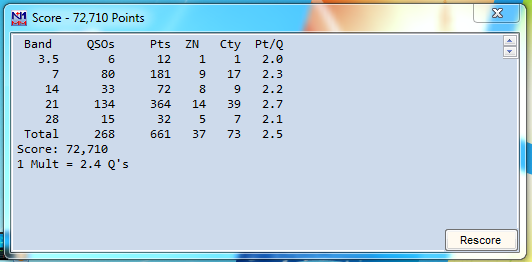
Mike Weir, VE9KK, is a regular contributor to AmateurRadio.com and writes from New Brunswick, Canada. Contact him at [email protected].
Ham College 71
Ham College episode 71 is now available for download.
Extra Class Exam Questions – Part 9.
E2C Operating methods: contest and DX operating, remote operation techniques, Cabrillo format, QSLing, RF network connected systems.
1:10:07
George Thomas, W5JDX, is co-host of AmateurLogic.TV, an original amateur radio video program hosted by George Thomas (W5JDX), Tommy Martin (N5ZNO), Peter Berrett (VK3PB), and Emile Diodene (KE5QKR). Contact him at [email protected].
 Ham Radio Deluxe |
 W5SWL Electronics |
 Ham Radio Prep |
 KB3IFH QSL Cards  Hip Ham Shirts  HamRadioAuctions HamRadioAuctions Reliance Antennas Reliance Antennas Enigma Shop Enigma Shop |  morseDX  Ni4L Antennas  R&L Electronics R&L Electronics antennas.us antennas.us Ears to Our World Ears to Our World |
- Matt W1MST, Managing Editor
