 |
 Flea Power
 18 March 2026 | by
 Making QSOs with a Tiny Solar Panel
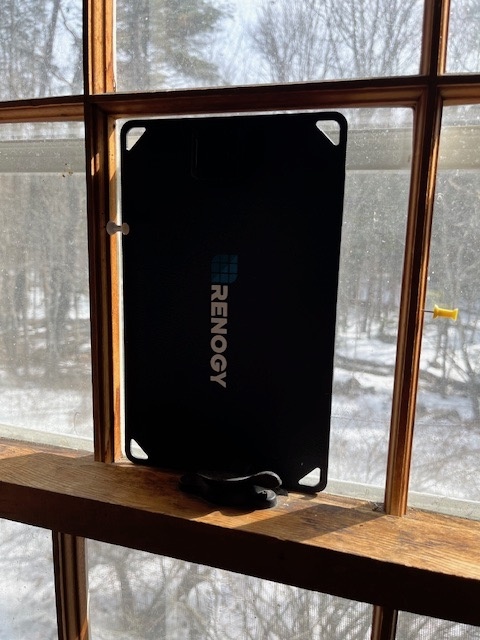
Last year I bought a 5 watt solar panel and a little rechargeable battery for $14. This week I made two QSOs a day for 8 days powered only by the solar panel in the window. I wanted to find out if I could really make QSOs with minimal power. I worked 9 states and 3 countries.
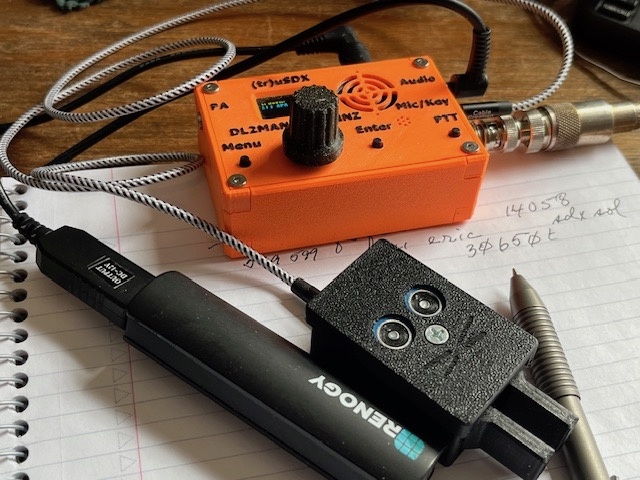
I used the (tr) uSDX at 4 watts. The antenna was a 136 ft OCF dipole. In the foreground is the little battery. It’s only 2500 mAh. To convert the 5 volts from the battery to 12 volts for the rig, I used a Baofeng charging dongle. Everyday after making a couple of QSOs, I’d put the panel in a window and charge up the battery.
Of course using QRP is essential. The rig draws 66 mAh on receive
and 570 mAh on transmit.
Here’s my log for the 8 days I conducted the experiment:
11 Mar-26 1507 14.060 W0ANM CW 569 559 MN
12 Mar-26 1405 7056 VE3KZE CW 579 579 ON
12 Mar-26 1407 7053 K0DOG CW 579 579 PA
13 Mar-26 1511 14.060 KA5TXN CW 339 559 TX
13 Mar-26 1921 14.027 DL8DYL CW 599 599 Germany
13 Mar-26 1923 14.0 HA3MAR CW 599 599 Hungary
14 Mar-26 1405 7054 KB3NSK CW 559 599 PA
14 Mar-26 1407 7052 K3EW CW 559 599 MD
15 Mar-26 1359 7052 K4TNE CW 449 579 NC
15 Mar-26 1406 7057 K3OP CW 529 559 PA
16 Mar-26 1611 14.044 K5OHY CW 539 559 TX
16 Mar-26 1614 14.057 AF8T CW 599 599 OH
17 Mar-26 1541 7051 WA1TOM CW 339 559 MA
17 Mar-26 1549 14.044 N4DH CW 339 549 NC
18 Mar-26 1550 14.058 KF8FCC CW 599 599 MI
18 Mar-26 1555 14.047 NS1C CW 449 559 FL
For many months, I’d been using the panel and the battery to power
my WSPR transmitter at 200 mw. I’d send out a beacon every morning
on 20 meters. I was heard all over the world. So I thought I’d try CW
with a little more power.
Jim Cluett, W1PID, is a regular contributor to AmateurRadio.com and writes from New Hampshire, USA. Contact him at [email protected].
Do you need the newest test equipment?
Tektronix 475 - The Beats Keep Coming

How to test?
The scope's fastest native setting is 10 ns/div (labeled as .01µs)


I'd venture to say they don't make'em like they used to
Conclusions
Richard Carpenter, AA4OO, is a regular contributor to AmateurRadio.com and writes from North Carolina, USA. Contact him at [email protected].
LHS Episode #608: OpenHamClock Deep Dive
Show Notes
Deep Dive Topic
- OpenHamClock
- A real-time amateur radio dashboard for the modern operator.
- OpenHamClock brings DX cluster spots, space weather, propagation predictions, POTA activations, SOTA activations, WWFF activations, WWBOTA activations, PSKReporter, satellite tracking, WSJT-X integration, direct rig control, and more into a single browser-based interface. Run it locally on a Raspberry Pi, on your desktop, or access it from anywhere via a cloud deployment.
- 📝 License: MIT — See LICENSE
- Installation Instructions - gotcha
- Setup - .env, rigctld
- Features - many
- Thoughts - Getting through the setup was rough, payoff is pretty good.
- Source: https://lhs.fyi/KZ (github)
- Demo: https://lhs.fyi/L0 (openhamclock)
Related Topics
- DXChrono - https://lhs.fyi/L1 (Peter MM9SQL)
Announcements/Feedback
- Support the show (Patreon, Paypal, Merch, Share, Rate)
- Hamvention - May 15-17, 2026 - Booth 2206
Subscribers & Supporters
Free Patreons
- Mayerdoor
Live Show Participants
- Don, KB2YSI
Russ Woodman, K5TUX, co-hosts the Linux in the Ham Shack podcast which is available for download in both MP3 and OGG audio format. Contact him at [email protected].
CW or Morse code?
Unpacking the FAA's Boeing 787 Transponder Directive
As SARC Communicator editor I read a lot of blogs, club websites and other sources of amateur radio news. This one particularly caught my eye.
The source
The ‘click-bait’ headline:
Ham Radio Enthusiasts Land US Airlines With 8 Million Bill To Fix Faulty Equipment On Boeing 787s
Ham radio enthusiasts could be partly responsible for landing U.S. airlines with an $8 million bill to fix faulty equipment on Boeing 787 Dreamliner airplanes after it was discovered that simple radio signals can knock out a faulty transponder on the popular widebody plane used by American, United, and Alaska Airlines.
The issue came to light after the Federal Aviation Administration (FAA) reported “multiple instances of loss of transponder for airplanes entering airspace in the presence of CW interference.”

CW interference refers to continuous-wave radio signals like Morse code, military transmitters, and even amateur ham radio signals, which could interfere with the transponder on some Boeing 787s...
When I saw this story it didn’t seem to add up. After all, Amateurs have been sending CW for a century and there has never been an allegation such as this. Although my own and other readers’ feedback has resulted in an adjustment of the original deceptive headline, the underlying story deserved further investigation.
The actual facts
When the FAA warns of "CW interference," hams think of Morse code. Aviation engineers think of something far more dangerous—a silent, invisible wall of noise that can blind a Dreamliner to oncoming traffic.
In the world of amateur radio, "CW" is a beloved mode—the rhythmic cadence of Morse code cutting through the static, a testament to communication's simplest form. But when the Federal Aviation Administration (FAA) uses the same two-letter abbreviation in an airworthiness directive, it is describing something far more insidious and utterly unrelated to the operator in the shack.
For an avionics engineer, "Continuous Wave (CW) interference" refers to a pure, unmodulated, single-frequency carrier signal that has no business being where it is. It is a rogue tone, a sustained note of radio energy that can overwhelm sensitive aircraft receivers. And according to a new Notice of Proposed Rulemaking (NPRM) from the FAA, this type of interference is posing a direct threat to the Boeing 787 Dreamliner's ability to see and be seen by other aircraft.
The proposed directive, https://www.federalregister.gov/documents/2025/06/13/2025-10759/airworthiness-directives-the-boeing-company-airplanes which would affect 150 U.S.-registered 787-8, -9, and -10 aircraft, mandates a costly hardware replacement to fix a vulnerability that could, quite literally, render an aircraft invisible in busy airspace. But what exactly is this interference, and why is a simple hardware swap estimated to cost U.S. operators nearly $8 million?
The Problem: A Transponder That Won't Talk Back
At the heart of the issue is the 787's Integrated Surveillance System Processor Unit (ISSPU), a critical component that manages the aircraft's transponder. The transponder's job is to listen for interrogations from Air Traffic Control radar and other aircraft's Traffic Alert and Collision Avoidance Systems (TCAS) on 1030 MHz, and reply on 1090 MHz. Note that this is far from the usual HF frequencies that Amateurs normally operate at.
According to the FAA directive (Docket No. FAA-2025-0924), multiple reports have surfaced of 787s entering airspace with active "CW interference" and suffering a specific, dangerous failure: the transponder stops meeting its Minimum Operational Performance Standards (MOPS). Instead of correctly replying to at least 90% of interrogations, the unit becomes desensitized, failing to respond.
This is not a gradual degradation. It is an "unannunciated" loss, meaning the pilots receive no warning light, no aural alert, no indication that their aircraft is no longer replying to ground radar or TCAS inquiries. The first sign of trouble could be a gap in the sky where an airliner used to be, visible to everyone except the pilots of the aircraft that just went silent.
"CW" for the Layman: Not Morse Code, But a Wall of Noise
This is where clarification for the broader technical community is essential. For the amateur radio operator, "CW" (Continuous Wave) is synonymous with Morse code—a carrier wave that is turned on and off to form characters. It is intermittent, intentional, and communicative.
The "CW interference" cited by the FAA is something else entirely. In engineering terms, a "continuous wave" simply means a steady, unmodulated carrier signal. Think of it less as a conversation and more as a sustained, single-frequency tone—a pure, unbroken note of radio energy. If a pulsed radar signal is like a strobe light, CW interference is a laser pointer held steadily on a sensor, blinding it.
For a transponder receiver trying to pick out weak interrogation pulses from the sky, a powerful CW signal on or near its operating frequency (1030 or 1090 MHz) acts as a "jammer." It raises the noise floor, drowning out the very signals it needs to hear.
The Hunt for the Source: Who Is Generating This Noise?
The FAA directive is notably silent on the source of this interference, focusing instead on fixing the aircraft's vulnerability to it. So, who or what is generating these rogue continuous wave signals? The answer is complex and points to a crowded, modern radio spectrum. While the public document does not specify frequencies, the affected systems point squarely at the 1030/1090 MHz bands. Likely culprits for high-power CW interference in or near these frequencies include:
- Ground-Based Military and Civilian Radars: Some radar systems, particularly those used for long-range surveillance or specific military applications, can produce strong continuous or quasi-continuous output that generates harmonics or spurious emissions.
- High-Power Data Links: Terrestrial microwave data links, used for point-to-point communication by telecom companies and utilities, operate in frequency bands that can, with faulty equipment, generate out-of-band emissions that bleed into the aviation surveillance bands.
- The 5G Debate, Revisited: The recent spectrum battles between aviation and 5G carriers centered on the potential for signals from powerful ground-based transmitters to cause interference with radar altimeters. While that specific fight involved different frequencies (3.7-3.98 GHz), it perfectly illustrates the principle: a powerful, continuous transmission on a nearby frequency can overwhelm aircraft receivers if filtering and shielding are insufficient.
The $7.95 Million Fix
Because the sources of interference are myriad and largely outside an airframer's control, Boeing and the FAA have chosen to harden the aircraft itself. The proposed solution is not a software tweak, but a physical replacement of the vulnerable hardware.
While then issue is a worldwide problem, the directive would require US based operators to replace the left and right ISSPU units, swapping out current part numbers (822-2120-101 and -102) with a new, presumably better-shielded or more selective unit (part number 822-2120-113) .
The FAA estimates the parts alone will cost $52,661 per aircraft. With labor, each of the 150 affected U.S. planes will incur a $53,001 expense, bringing the total for U.S. carriers to $7,950,150 .
This is a significant investment for a problem that many in the industry suspect is not going away. As the radio spectrum grows ever more congested with diverse signals, the threat of "CW interference"—in its true engineering sense—will only increase. For the pilots of the Dreamliner, this hardware upgrade can't come soon enough. For the amateur radio operator tuning up on 40 meters, rest assured: your key is not the culprit. The real threat is coming from elsewhere in the increasingly noisy radio spectrum we all share.
73,
~John VE7TI
AmateurLogic 215: Not another Friday 13th?
AmateurLogic.TV Episode 215 is now available for download.
Cutting a 1/4 wave shorted stub. DR Mode travel prep for automatic repeater memories. ATS 20+ Firmware update improvements. Emile’s latest shack update.
George Thomas, W5JDX, is co-host of AmateurLogic.TV, an original amateur radio video program hosted by George Thomas (W5JDX), Tommy Martin (N5ZNO), Peter Berrett (VK3PB), and Emile Diodene (KE5QKR). Contact him at [email protected].
Amateur Radio Weekly – Issue 412

2026 Hamvention Award Winners announced
Please join us in congratulating these very deserving winners.
Hamvention
FT0 digital mode
The next evolution in digital modes — featuring a 0-second sequence time.
FT0
LinHT hardware documentation
LinHT is an open-source handheld software-defined radio (SDR) transceiver built around a modern Linux System-on-Module and a true IQ RF front-end.
M17 Foundation
HamDash
Free and Open Source Ham Radio dashboard.
HamDash
Ten watts to Spain. Ten watts to Germany. Ten watts to Austria
The EFHW at 35 feet made all the difference.
David Saylors
Alliance Amateur Radio Network
Radio for those left out.
AARN
Is the CIA using radio to instruct Iran agents? Listen for yourself
An amateur sleuth thinks ghostly broadcasts are a revival of Cold War ‘numbers stations.’
The Times
DXtra FCC radio database explorer
We have computed Longley-Rice coverage maps for the entire US, Canada, UK and European fleets of FM stations. Also we have computed VOACAP coverage maps for most of the world’s HF.
DXtra
Installing an M17 Reflector on a cloud server
I document what worked for me after more than half a dozen attempts to build a working system.
EtherHam
Be gone pesky radials!
One of the biggest bugbears of portable operations in a public space when using a vertical antenna is having to lay out radials.
Ham Radio Outside the Box
MyHamStudyHub
The complete study platform for FCC Technician, General, and Extra class amateur radio licenses. No cost.
MyHamStudyHub
868MHz DX
This is 139m above sea level, with a clear line of sight across the Irish Sea to Cumbria, the Isle of Man, and the Mourne Mountains in Northern Ireland.
Real-World Amateur Radio
Video
2026 Hamvention Award Winners announcement video
Tim Duffy, K3LR, and Hamvention spokesperson Michael Kalter, W8CI announce the 2026 Hamvention Award Winners.
DX Engineering
Get Amateur Radio Weekly in your inbox.
Sign-up here
Amateur Radio Weekly is curated by Cale Mooth K4HCK. Sign up free to receive ham radio's most relevant news, projects, technology and events by e-mail each week at http://www.hamweekly.com.
LHS Episode #607: Fastest Digital Mode Ever
Show Notes
Introduction
- ARDC Community Meeting - I attended this on Saturday
- IC-7100 Setup - FT8-a-thon
- Cheryl stared at a powered off radio for 5 minutes, trying to work up the nerve to turn it on. Didn’t happen. 😂
Amateur Radio Topics
MFJ Documentary On The Horizon
- Martin F. Jue: Life and Legacy: A documentary about MFJ Enterprises, ingenuity, legacy, and community.
- Martin F. Jue (K5FLU) founded MFJ Enterprises and helped shape modern amateur radio. This documentary explores his life, his work, and the people who built MFJ alongside him: preserving a uniquely American story of ingenuity, labor, and community.
- The project appears to still be seeking funding and has a trailer released already.
- Source: https://lhs.fyi/KS (Preston Booth)
D-Star Beacon by OK1CHP
- Simple D-Star transceiver for TTGO T-Beam ESP32 SX1278 written with Platformio.
- Technical details and features
- It uses sx127x FSK Continuous direct Mode, PreambleDetect and SyncAddress on DIO0, Dclk(DIO1) and Data(DIO2)
- RX stop happens after D-Star ending frame or failed receiving frame sync packet.
- Decodes D-Star RF Header, 20 characters message and and sends DV Slow data payload to the Bluetooth Connection where it could be decoded with RS-MS1A or D-Rats or some other app.
- Could send DPRS possition report with coordinates from local GPS with configured timeout.
- Web interface is used to configure the transceiver.
- It looks for preconfigured WiFi ssid and password and eventually starts it’s own hotspot.
- Source: https://lhs.fyi/KT (github)
- Featured: https://lhs.fyi/KU (HackADay)
The Fastest Digital Mode Ever Created?
- FT2 is a revolutionary digital mode for amateur radio, developed by IU8LMC with the support of ARI Caserta. It uses the same codec as FT8 and FT4 (77-bit payload, LDPC 174/91, GFSK modulation) but compresses the transmission cycle to just 3.8 seconds. Software required for this is currently: Decodium v3.0 FT2 “Raptor”. It is an optimized weak-signal FT2 client with enhanced sensitivity, extended frequency range, and real-time NTP/DT feedback. Based on WSJT-X 3.0.0 RC1 — focused exclusively on FT2 mode. License: GPL v3 (Windows, macOS, Linux)
- Source: https://lhs.fyi/KV (ft2.it)
Indiana prohibits HOAs from restricting amateur radio antennas
- HB 1152 was just signed into law and prohibits HOAs from adopting or enforcing any rule that restricts amateur radio equipment including antennas, towers, and feedlines.
- According to Hunter Reed KD9YLQ, the ham who wrote the amendment for State Senator Alexander, “the bill would require that once an HOA updates its governing documents, then they have to comply with the law.” There’s nothing in the law that would require an HOA to change or not enforce their existing rules unless the rules were adopted or amended after June 30, 2026.
- Relevant section of the bill to follow:
- SECTION 6. IC32-25.5-3.4 IS ADDED TO THE INDIANA CODE AS A NEW CHAPTER TO READ AS FOLLOWS [EFFECTIVE JULY 1, 2026]:
- Chapter 3.4. Homeowners Association Regulation of Amateur Radio Antennas
- Sec. 1. As used in this chapter, “amateur radio antenna” means an antenna, support structure, tower, feed line, or related equipment used by an amateur station as defined by 47 CFR 97.3.
- Sec. 2. As used in this chapter, “governing documents” has the meaning set forth in IC 32-25.5-2-3.
- Sec. 3. This chapter applies only to a homeowners association’s adoption or amendment of governing documents after June 30, 2026.
- Sec. 4. A homeowners association may not adopt or enforce a regulation, rule, or other policy that has the effect of prohibiting a person from maintaining an amateur radio antenna on a property that the person owns, rents, or leases.
- Chapter 3.4. Homeowners Association Regulation of Amateur Radio Antennas
- SECTION 6. IC32-25.5-3.4 IS ADDED TO THE INDIANA CODE AS A NEW CHAPTER TO READ AS FOLLOWS [EFFECTIVE JULY 1, 2026]:
- Source: https://lhs.fyi/KX (reddit)
- House Bill Details: https://lhs.fyi/KY (Indiana General Assembly)
Open Source / Linux
Carl Richell, CEO System 76, Responds To Age Verification
- System76 CEO Carl Richell has issued a strong critique of new U.S. state laws requiring operating systems to implement age verification, particularly California’s Assembly Bill 1043 and Colorado’s Senate Bill 26-051. While acknowledging the legal obligation to comply, Richell argues these laws are ineffective and threaten user privacy and digital freedom. He highlights New York’s proposed bill as being more dangerous.
- “New York’s proposed Senate Bill S8102A requires adults to prove they’re adults to use a computer, exercise bike, smart watch, or car if the device is internet enabled with app ecosystems. The bill explicitly forbids self-reporting and leaves the allowed methods to regulations written by the Attorney General. Practical methods for a bill of such extreme breadth would require, in many instances, providing private information to a third-party just to use a computer at all.”
- “The challenges we face are neither technical nor legal. The only solution is to educate our children about life with digital abundance. Throwing them into the deep end when they’re 16 or 18 is too late. It’s a wonderful and weird world. Yes, there are dark corners. There always will be. We have to teach our children what to do when they encounter them and we have to trust them.”
- Despite concerns, System76 plans to implement a minimal, privacy-preserving age prompt to comply with the law, while continuing to advocate for its repeal or constitutional challenge.
- Source: https://lhs.fyi/KO (system76 blog)
- System76 CEO Carl Richell has issued a strong critique of new U.S. state laws requiring operating systems to implement age verification, particularly California’s Assembly Bill 1043 and Colorado’s Senate Bill 26-051. While acknowledging the legal obligation to comply, Richell argues these laws are ineffective and threaten user privacy and digital freedom. He highlights New York’s proposed bill as being more dangerous.
Podman 5.8.0 Released
- Podman (the POD MANager) is a tool for managing containers and images, volumes mounted into those containers, and pods made from groups of containers. Podman runs containers on Linux, but can also be used on Mac and Windows systems using a Podman-managed virtual machine. Podman is based on libpod, a library for container lifecycle management that is also contained in this repository. The libpod library provides APIs for managing containers, pods, container images, and volumes. Podman releases a new major or minor release 4 times a year, during the second week of February, May, August, and November. Patch releases are more frequent and may occur at any time to get bugfixes out to users.
- Features
- The podman quadlet install command can now install files which contain multiple separate Quadlet files. The files must be separated with a — delimeter on a new line, and each section must begin with a # FileName= line to name the new Quadlet (#27384).
- The podman update command now features a new option, –ulimit, to update container ulimits (#26381).
- The podman exec command now features a new option, –no-session, which disables tracking of the exec session to improve performance and startup time (#26588).
- Changes
- Podman will now automatically attempt to migrate legacy BoltDB databases to SQLite when the system reboots. This is necessary as support for BoltDB will be removed in Podman 6.0 in May. If automatic migration is not possible, a new option, podman system migrate –migrate-db, will manually force a migration.
- The podman secret create - command no longer requires that the secret be provided through a pipe, and instead allows typing the secret through the terminal (#27879).
- Bugfixes
- Fixed a bug where healthchecks would sometimes fail to execute due to systemd rate limits.
- API
- Added new APIs for interacting with Quadlets, including GET /libpod/quadlets/{name}/file (print contents of a Quadlet file), GET /libpod/quadlets/{name}/exists (check if the given Quadlet exists), POST /libpod/quadlets (install one or more Quadlets), DELETE /libpod/quadlets (remove one or more Quadlets), and DELETE /libpod/quadlets/{name} (remove a single Quadlet)..
- Misc
- Updated Buildah to v1.43.0
- Updated the containers/storage library v1.62.0
- Updated the containers/image library to v5.39.1
- Updated the containers/common library to v0.67.0
- Source: https://lhs.fyi/KQ (github)
NVIDIA R595 Linux Driver Beta Brings New Vulkan Support & DRI3 v1.2
- Exciting for Linux users with the NVIDIA 595 driver series is adding some long sought Vulkan capabilities plus also enabling DRI3 version 1.2 support. The NVIDIA 595.45.04 beta driver for Linux brings support for the descriptor heap (VK_EXT_descriptor_heap) and present timing (VK_EXT_present_timing) extensions as some great additions to now see with the NVIDIA driver to enhance the Linux gaming experience. The NVIDIA 595.45.04 Linux driver also now enables the modesetting parameter by default for the nvidia-drm kernel driver, improved GPU reset handling, a new application profile for CUDA apps to reach P0 p-state, and raising the minimum Wayland version to v1.20. Plus there are various bug fixes – including hang fixes.
- Source: https://lhs.fyi/KP (Phoronix)
Gentoo on Codeberg
- Gentoo now has a presence on Codeberg, and contributions can be submitted for the Gentoo repository mirror at https://codeberg.org/gentoo/gentoo as an alternative to GitHub. Eventually also other git repositories will become available under the Codeberg Gentoo organization. This is part of the gradual mirror migration away from GitHub, as already mentioned in the 2025 end-of-year review. Codeberg is a site based on Forgejo, maintained by a dedicated non-profit organization, and located in Berlin, Germany. Thanks to everyone who has helped make this move possible! These mirrors are for convenience for contribution and we continue to host our own repositories, just like we did while using GitHub mirrors for ease of contribution too.
- Source: https://lhs.fyi/KW (gentoo news)
Linux in the Ham Shack
iNTERCEPT
- iNTERCEPT, a free and open-source platform that unites the best signal intelligence tools into a single, accessible interface.
- Features
- Pager Decoding - POCSAG/FLEX via rtl_fm + multimon-ng
- 433MHz Sensors - Weather stations, TPMS, IoT devices via rtl_433
- Sub-GHz Analyzer - RF capture and protocol decoding for 300-928 MHz ISM bands via HackRF
- Aircraft Tracking - ADS-B via dump1090 with real-time map and radar
- Vessel Tracking - AIS ship tracking with VHF DSC distress monitoring
- ACARS Messaging - Aircraft datalink messages via acarsdec
- VDL2 - VHF Data Link Mode 2 aircraft datalink decoding via dumpvdl2
- Listening Post - Wideband frequency scanner with real-time audio monitoring
- Weather Satellites - NOAA APT and Meteor LRPT image decoding via SatDump with auto-scheduler
- WebSDR - Remote HF/shortwave listening via KiwiSDR network
- ISS SSTV - Slow-scan TV image reception from the International Space Station
- HF SSTV - Terrestrial SSTV on shortwave frequencies (80m-10m, VHF, UHF)
- APRS - Amateur packet radio position reports and telemetry via direwolf
- Satellite Tracking - Pass prediction with polar plot and ground track map
- Utility Meters - Electric, gas, and water meter reading via rtlamr
- ADS-B History - Persistent aircraft history with reporting dashboard (Postgres optional)
- WiFi Scanning - Monitor mode reconnaissance via aircrack-ng
- Bluetooth Scanning - Device discovery and tracker detection (with Ubertooth support)
- BT Locate - SAR Bluetooth device location with GPS-tagged signal trail mapping and proximity alerts
- GPS - Real-time GPS position tracking with live map, speed, altitude, and satellite info
- TSCM - Counter-surveillance with RF baseline comparison and threat detection
- Meshtastic - LoRa mesh network integration
- Space Weather - Real-time solar and geomagnetic data from NOAA SWPC, NASA SDO, and HamQSL (no SDR required)
- Spy Stations - Number stations and diplomatic HF network database
- Remote Agents - Distributed SIGINT with remote sensor nodes
- Offline Mode - Bundled assets for air-gapped/field deployments
- Source: https://lhs.fyi/KR (github)
OpenHamClock
- A real-time amateur radio dashboard for the modern operator.
- OpenHamClock brings DX cluster spots, space weather, propagation predictions, POTA activations, SOTA activations, WWFF activations, WWBOTA activations, PSKReporter, satellite tracking, WSJT-X integration, direct rig control, and more into a single browser-based interface. Run it locally on a Raspberry Pi, on your desktop, or access it from anywhere via a cloud deployment.
- 🌐 Live Site: openhamclock.com
- 📧 Contact: Chris, K0CJH — [email protected]
- ☕ Support the Project: buymeacoffee.com/k0cjh — Running openhamclock.com comes with real hosting costs including network egress, memory, CPU, and the time spent maintaining and improving the project. There is absolutely no obligation to donate — OpenHamClock is and always will be free. But if you find it useful and want to chip in, your donations are greatly appreciated and go directly toward keeping the site running and funding future development.
- 🔧 Get Involved: This is an open-source project and the amateur radio community is encouraged to dig into the code, fork it, and build the features you want to see. Whether it’s a new panel, a data source integration, or a bug fix — PRs are welcome. See Contributing below.
- 📝 License: MIT — See LICENSE
- Source: https://lhs.fyi/KZ (github)
- Demo: https://lhs.fyi/L0 (openhamclock)
Announcements/Feedback
Support the show (Patreon, Paypal, Merch, Share, Rate)
Hamvention - May 15-17, 2026 - Booth 2206
Website - Adding Search
Youtube Comment on LHS Episode #585 SDR++ Brown Deep Dive from pumptrackerpavel
- How to install it on Dragon OS. Could you please help
Subscribers & Supporters
Patreon
- William Collins
Paypal (since January)
- Fred Cole
- Dillon Angle
- Michael Jopling
- John Clark
- Robert Black
- Ronald Eike
- Robert Yerke
- Thomas Foy
- Allan Wilson
- Kevin Long
Free Patreons
Facebook
- Curtis Cheyney
- Matthew Obuchowski
Instagram
X / Twitter
Mastadon
Bluesky
Live Show Participants
- Steve, KJ5T
- Mike, K6GTE
- Tony, K4XSS
Russ Woodman, K5TUX, co-hosts the Linux in the Ham Shack podcast which is available for download in both MP3 and OGG audio format. Contact him at [email protected].
 Ham Radio Deluxe |
 W5SWL Electronics |
 Ham Radio Prep |
 KB3IFH QSL Cards  Hip Ham Shirts  HamRadioAuctions HamRadioAuctions Reliance Antennas Reliance Antennas Enigma Shop Enigma Shop |  morseDX  Ni4L Antennas  R&L Electronics R&L Electronics antennas.us antennas.us QRV QRV |
- Matt W1MST, Managing Editor
