 |
 UK Regulator Ofcom Releases Ham Licenses By Age: Compares Favorably with US Estimates
 31 March 2021 | by
 In response to a Freedom of Information Act, the United Kingdom amateur radio license regulator, Ofcom, has released counts of ham licenses by age group (see here). The ICQ Podcast covered this story in this week’s episode. They are simple counts but I’ve taken them and added UK population data for comparison. Using a graph from my recent NCJ article on aging in American radiosport, I also make general comparisons to the US ham population. How does the UK compare to the US in terms of the age distribution relative to the overall population? Are hams becoming more elderly? Is there an influx of younger people into amateur radio in these two countries? The results are concerning to anyone interested in the long term viability of amateur radio in either country.

The bar chart shows the three UK license classes—Foundation, Intermediate, and Full—with the corresponding total UK population by age group. These categories are what the Ofcom report contains so I was unable to reconfigure it for other groupings. The purple total population bar in comparison to any of the ham licenses illustrates the “aging” of the British ham population. This is especially the cast for Full licenses. As the age group enters mid-life (post-50), the imbalance becomes clear and gets more imbalanced as age increases.

The second bar chart is from my NCJ article on US hams. The ARRL membership data are proxies for the US FCC ULS license database. (The FCC stopped collecting birth year some decade or so ago.) The tan bar is the total population from the Census Bureau. The green bar is from an ARRL survey of current and previous NCJ subscribers and are a proxy for contest participants.
Clearly, the US amateur radio population compares favorably with those in the UK as represented in the Ofcom data release. There may be a slightly more aging pattern in the US data. It’s the post-60 year old category where the ham population surpasses the comparable share of the total population. As noted in my NCJ article, the contesting data show that this group is even more elderly than hams in general.
Ofcom is an evidence-based regulator, so market research is important to us. Many of our decisions are informed by research evidence, and our market research ensures that we have a thorough, robust and up-to-date understanding of consumers in the UK.
Source: https://www.ofcom.org.uk/research-and-data/about-ofcoms-research
These data released by Ofcom show a revealing, but not entirely surprising, picture of the amateur population in the United Kingdom. Most would agree that they “see” hams at rallys and elsewhere and most “look older” than “younger.” In these data, there are younger hams in the data but they are indeed smaller in number and share. But until we have actual data on all licensed hams (and even the Ofcom release warns about their under-coverage), it’s like building the proverbial dinosaur from some bones discovered in an archaeological dig from one site. We also do not know about how many “late-in-life” hams will emerge during their mid to later years (see here for survey estimates). By inference, the hypothesis that amateur radio is a cultural phenomenon mostly engaged in members of the the Western “Baby Boom” (see here) is not inconsistent with these data. Until we have data where longitudinal and age-cohort variables are measured will we even begin to be able to move beyond the ubiquitous: “well, the blokes at the rally…” or “in my club, I’m the youngest and I’m 50 years old”. Those comments may indeed be characteristics of the full ham population, but we simply do not know this for sure or with any precision.
Even though Ofcom says it’s an evidence-based regulator, until more data like this is released and analyzed, we won’t be able to really get a handle on social change in the hobby and public serve of ham radio. Age and cohort comparisons (e.g., Glenn, Cohort Analysis) are the standard to measure change like this. In the US, the FCC isn’t even in the ball game. Sad.
Frank Howell, K4FMH, is a regular contributor to AmateurRadio.com and writes from Mississippi, USA. Contact him at [email protected].
LHS Episode #403: MVoice and MRefD Deep Dive

Welcome to the 403rd installment of Linux in the Ham Shack. In this episode, the hosts bring in guest Tom early, N7TAE. Tom is the creator and lead developer in the MVoice and MRefd projects. MVoice is the original M17 client software and MRefD is a spinoff of XLXD which creates software reflectors for the M17 voice protocol. We take an in-depth look at how each piece of software was developed and written. Then from a user perspective we detail downloading, building, configuring and running each project. Thanks for listening and have a great week.
73 de The LHS Crew
Russ Woodman, K5TUX, co-hosts the Linux in the Ham Shack podcast which is available for download in both MP3 and OGG audio format. Contact him at [email protected].
ICQ Podcast Episode 347 – RSGB Q1 Review and Radio Scouting
In this episode, Martin (M1MRB) is joined by Leslie Butterfield G0CIB, Dan Romanchik, KB6NU, Matthew Nassau M0NJX and Edmund Spicer M0MNG to discuss the latest Amateur / Ham Radio news. Colin (M6BOY) rounds up the news in brief and in this episode we have a double feature RSGB Quarter 1 Update and Scouting Radio.
ICQ AMATEUR/HAM RADIO PODCAST DONORS
We would like to thank Michael Bridak (K6GTE), Christopher Naylor (VK3TLA) and our monthly and annual subscription donors for keeping the podcast advert free. To donate, please visit - http://www.icqpodcast.com/donate
- Ofcom Released Age of Radio Amateurs Data - Modified French Amateur Radio Callsign for Great Britain Nationals - Cooperative Effort to Resolve Potential 70-Centimetre Interference Issue - New RSGB EMF Calculator Available - 4M IRTS News in the East Leinster region - Resuming UK Examinations in Clubs - Ham Radio Friedrichshafen Physical Event Cancelled
Colin Butler, M6BOY, is the host of the ICQ Podcast, a weekly radio show about Amateur Radio. Contact him at [email protected].
Ham College 75
Ham College episode 75 is now available for download.
Extra Class Exam Questions – Part 13.
E3B Transequatorial propagation, long-path, grayline, ordinary and extraordinary waves, chordal hop, and sporadic E mechanisms.
55:06
George Thomas, W5JDX, is co-host of AmateurLogic.TV, an original amateur radio video program hosted by George Thomas (W5JDX), Tommy Martin (N5ZNO), Peter Berrett (VK3PB), and Emile Diodene (KE5QKR). Contact him at [email protected].
Hunting For NDBs In CLE266
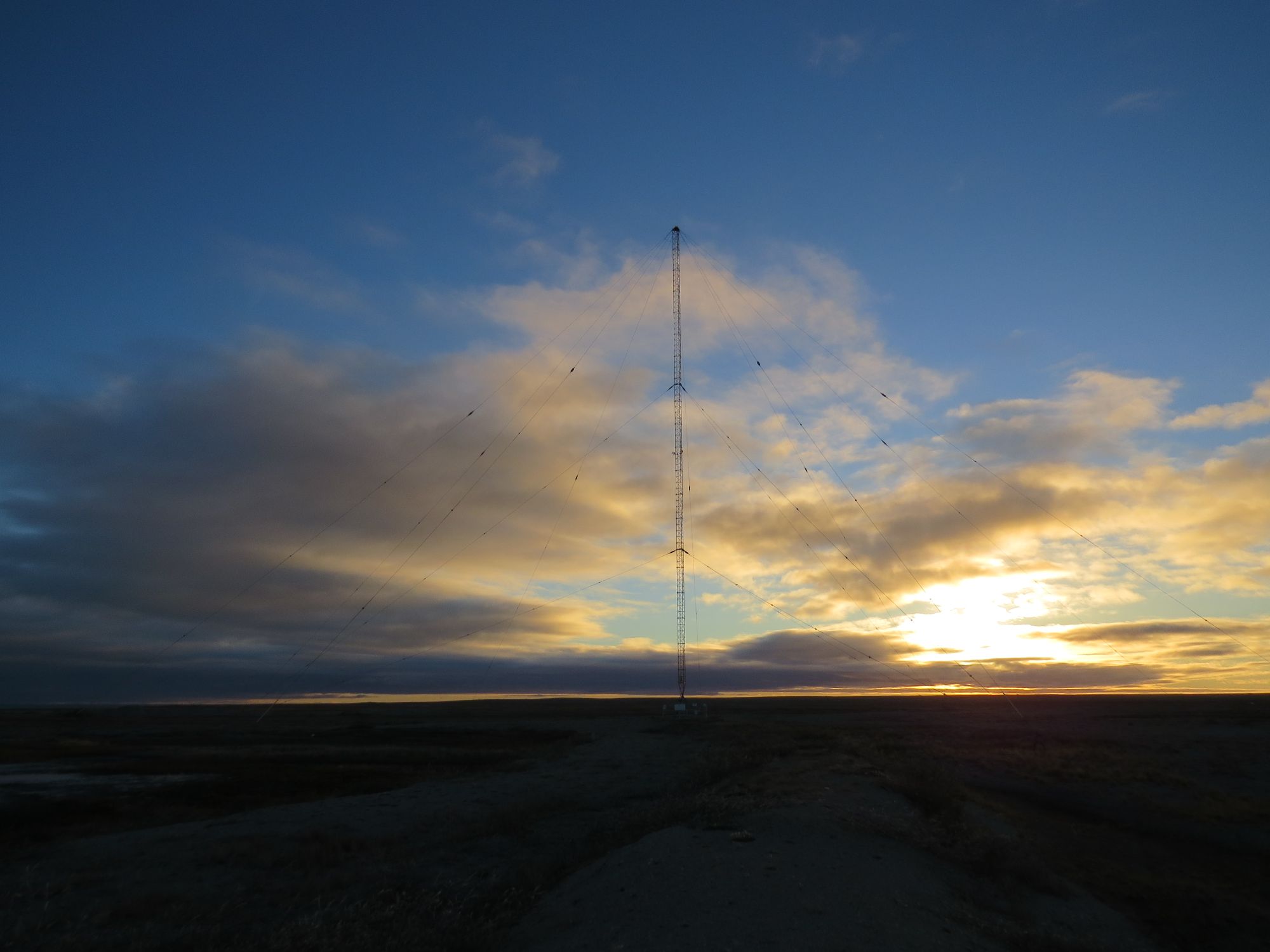 |
| YZS-362kHz Coral Harbour, NU (www.ve3gop.com) |
Propagation on MF has been both hot and cold for the past few weeks, seemingly depending on where you live and the amount of geomagnetic activity affecting your region.
A 'challenge target' for listeners in North America is YZS - 362kHz in Coral Harbour, NU, on Southampton Island at the north end of Hudson Bay. It's widely heard throughout North America and Europe and is a good target for listeners everywhere. Listen for YZS's upper sideband on 362.405 kHz.
When tuning for NDBs, put your receiver in the CW mode and listen for the NDB's CW identifier, repeated every few seconds. Listen for U.S. NDB identifiers approximately 1 kHz higher or lower than the published transmitted frequency since these beacons are modulated with a 1020 Hz tone approximately.
For example, 'AA' near Fargo, ND, transmits on 365 kHz and its upper sideband CW identifier is tuned at 366.025 kHz while its lower sideband CW ident can be tuned at 363.946 kHz. Its USB tone is actually 1025 Hz while its LSB tone is 1054 Hz.
Often, one sideband will be much stronger than the other so if you don't hear the first one, try listening on the other sideband.
Canadian NDBs normally have an USB tone only, usually very close to 400 Hz. They also have a long dash (keydown) following the CW identifier.
All NDBs heard in North America will be listed in the RNA database (updated daily) while those heard in Europe may be found in the REU database. Beacons heard outside of these regions will be found in the RWW database. These databases have recently been re-vamped and are slicker than ever before!
From CLE coordinator Brian Keyte (G3SIA), comes the following CLE info:
Hello all
Our 266th Co-ordinated Listening Event is almost here.
Can new 'listening eventers' join in too? YES, PLEASE!
Joachim and I are always pleased to help first-time CLE logs
through the harvester program.
Days: Friday 26 March - Monday 29 March
Times: Start and End at midday, your LOCAL time
Range: 350.0 - 369.9 kHz
Please log all the NDBs you can identify that are listed in this range (it includes 350 kHz but not 370) plus any UNIDs that you come across there.
You can find full information to help you, including seeklists made from
REU/RNA/RWW, by going to the CLE page http://www.ndblist.info/cle.htm and clicking on CLE SEEKLIST there.
Please send your 'Final' CLE log to the List, if possible as a plain text
email and not in an attachment and - important - with 'CLE266' and 'FINAL'
in its title.
Please show the following main items FIRST on EVERY line of your log:
# The full Date (e.g. 2021-03-26) or just the day (e.g. 26)
and UTC (the day changes at 00:00 UTC).
Many of us will be changing our house clocks during
the weekend, but UTC CONTINUES UNCHANGED.
# kHz - the beacon's nominal published frequency, if you know it.
# The Call Ident.
Optional details such as Location and Distance go LATER in the same line.
Please always include details of your own location and brief details of the
receiver, aerial(s) and any other equipment you were using.
Joachim or I will send the usual 'Any More Logs?' email at about 19:00 UTC
on Tuesday so you can check that your log has been found OK.
Make sure that your log has arrived at the very latest by 08:00 UTC on
Wednesday 31 March. We hope to make all the combined results within a day
or so.
Good listening
Brian
-------------------------------------------------------------------
From: Brian Keyte G3SIA ndbcle'at'gmail.com
Location: Surrey, SE England (CLE coordinator)
-------------------------------------------------------------------
If you are interested in some remote listening - maybe due to local difficulties - you could use any one remote receiver for your loggings, stating its location and with the owner's permission if required.( e.g. see kiwisdr.com ) A remote listener may NOT also use another receiver, local or remote, to make more loggings for the same CLE.
These listening events serve several purposes. They
• determine, worldwide, which beacons are out-of-service or have gone silent since the last CLE covering this range
• will indicate the state of propagation conditions at the various participant locations
• will give you an indication of how well your LF/MF receiving system is working
• give participants a fun yet challenging activity to keep their listening skills honed
Final details can be found at the NDB List website, and worldwide results, for every participant, will be posted there a few days after the event.
The NDB List Group is a great place to learn more about the 'Art of NDB DXing' or to meet other DXers in your region. There is a lot of good information available there and new members are always very welcome. As well, you can follow the results of other CLE participants from night to night as propagation is always an active topic of discussion.
You need not be an NDB List member to participate in the CLEs and all reports, no matter how small, are of much value to the organizers.
Remember - 'First-time' logs are always VERY welcome!
Reports may be sent to the NDB List Group or e-mailed to CLE co-ordinator, Brian Keyte (G3SIA), whose address appears above. If you are a member of the group, all final results will also be e-mailed and posted there.
Please ... give the CLE a try ... then let us know what NDB's can be heard from your location! Your report can then be added to the worldwide database to help keep it up-to-date.
Have fun and good hunting!
Steve McDonald, VE7SL, is a regular contributor to AmateurRadio.com and writes from British Columbia, Canada. Contact him at [email protected].
Looking at VHF/UHF SOTA Data
On Twitter, someone recently commented that it would be nice to have more 2m SSB activity for Summits On The Air (SOTA). It is well known that FM is a more commonly used mode but that its performance suffers for weak signals. This got me wondering about which bands and modes are being used for SOTA above 50 MHz.
Above and Below 50 MHz
First off, I wondered what portion of SOTA radio contacts are on VHF/UHF. Looking at the SOTA database Facts and Figures page, I simply grouped the number of QSOs as “Above 50 MHz” and “Below 50 MHz.”
| Frequency | QSOs | % of Total |
| Above 50 | 1346206 | 21% |
| Below 50 | 5144547 | 79% |
| Total | 6490753 | 100% |
So we can see that about 1/5th of the SOTA QSOs are done using VHF and higher frequencies. Certainly, we’d expect that the HF bands would dominate the total but this VHF+ percentage is higher than I expected.
Breaking Down > 50MHz
That leads to the question of what bands are used above 50 MHz? The table below shows the >50 MHz data broken out by band. The % of Total column indicates the percent of all QSOs (Above and Below 50 MHz), while the % of >50 MHz column shows the percentage relative to only >50 MHz radio contacts. Simply put, the % of Total column will sum to 21%, matching the number in the first table. The % of >50 MHz column sums to 100%.
| Frequency | QSOs | % of Total | % of >50 MHz |
| 50MHZ : | 48035 | 0.74% | 3.57% |
| 70MHZ : | 10921 | 0.17% | 0.81% |
| 144MHZ : | 1202311 | 18.5% | 89.3% |
| 220MHz : | 1064 | 0.02% | 0.08% |
| 433MHZ : | 126202 | 1.94% | 9.37% |
| 900MHz : | 204 | 0.00% | 0.02% |
| 1240MHZ : | 12526 | 0.19% | 0.93% |
| 2.3GHZ : | 1554 | 0.02% | 0.12% |
| 3.4GHz : | 142 | 0.00% | 0.01% |
| 5.6GHZ : | 468 | 0.01% | 0.03% |
| 10GHZ : | 1186 | 0.02% | 0.09% |
| 24GHZ : | 167 | 0.00% | 0.01% |
| Microwave : | 382 | 0.01% | 0.03% |
Well, it doesn’t take a degree in statistics to see that the 144 MHz band (2 meters) is the most popular VHF/UHF band for SOTA. Almost 90% of the QSOs are on this band. The next most used band is 433 MHz (70 cm) at a little over 9%. The 6m band (50 MHz) comes in at third with about 3.5%. The other bands are so small, they don’t really add much to the total.
The data on the SOTA page does not break out mode used by band but it does provide some aggregate mode numbers. The number of FM contacts (using any band) is 1186542. It is reasonable to assume that almost all of these FM QSOs were made above 50 MHz. (FM is used a bit on the 10m band but that combination is rare in SOTA.) That means, for frequencies >50 MHz, 88% of the QSOs (186542/1346206) were completed using FM. We don’t know how the remaining 12% splits out but I would expect them to be a mix of SSB and CW, but dominated by SSB.
Given the high number of 144 MHz contacts in the mix, it is safe to say that 2m FM is the dominant mode for VHF/UHF SOTA. After all, it is The Utility Mode. The reasons are obvious…almost every radio ham has a handheld transceiver that can do 2m FM. It makes for an easy way to get on the air and active a summit. More importantly, it is an easy way to chase a summit. When I plan a SOTA activation, I think about the kinds of operators that will be within range and what kind of gear they are likely to have. It does me no good to drag along equipment for 2m SSB/CW if there is no one around to work that band/mode.
This analysis does confirm that the number of non-FM QSOs on VHF/UHF is relatively small. The 12% of non-FM QSOs above 50 MHz corresponds to only 2.5% of all SOTA QSOs. So why is this? Clearly, the affordability and popularity of the FM handheld transceiver is a big factor. There are portable radios that can do “all modes” on VHF/UHF such as the Elecraft KX3 (2m option), Yaesu FT-818, and the Icom IC-705, but these are much more expensive.
What About 70cm and 6m?
Now, it is interesting that the 70cm numbers are small compared to 2m. Many of those handheld transceivers that get used for 2m also have 70cm included, so you might expect there to be more 70cm QSOs in the mix. For a given boom length, a 70 cm Yagi antenna will have more gain than a 2m Yagi. So gain is easier to come by on the higher band.
Note that the SOTA rules do not encourage working the same station on more than one band. You only get credit for working a station once on an activation. (Compare this to VHF contest scoring which usually adds in additional credit for working stations on multiple bands.) So if a chaser works someone on 2m, they typically don’t bother working them on other bands. I am not saying this is bad, I am just trying to explain why we don’t see more QSOs on 70cm.
The other band you might expect to see more activity is 50 MHz (6 meters). This band is available to Technicians in the US and, when the band opens up, you can easily work a thousand miles or more via Sporadic-e propagation. (Sometimes F-layer propagation, too, but we’ll need a whole bunch more solar activity for that to happen.) Many HF rigs include 6m as a “bonus band”, even some of the QRP radios popular with the SOTA crowd (KX3, IC-705, etc.) So why are the 6m numbers so low? This band offers a metric ton of fun, but it dishes it out randomly. There is a reason they call it the Magic Band…sometimes the Magic is there and sometimes it is dead quiet. When it’s dead quiet, it is a poor imitation of the 2m band. It also requires larger antennas, so if an activator decides to use antenna gain to help their signal, a portable Yagi for 2 meters is going to be a lot handier than one for 6 meters.
CW and SSB
This data does show that CW and SSB are lightly used for SOTA on the VHF/UHF bands. This is an opportunity. If more of us used these modes, it would improve our ability to squeeze out contacts when the signals are weak.
Bob K0NR
The post Looking at VHF/UHF SOTA Data appeared first on The KØNR Radio Site.
Bob Witte, KØNR, is a regular contributor to AmateurRadio.com and writes from Colorado, USA. Contact him at [email protected].
LHS Episode #402: Payment Required
Hello and welcome to the 402nd installment of Linux in the Ham Shack. In this episode, the hosts start by wrapping up the most recent QSO Today Virtual Ham Expo. Afterwards, discussion topics range from in-person ham radio events that are (currently) still happening to Garuda Linux, Audacity, Kooha, Raspberry Pi pico SDRs and much more. Thank you for listening we hope you have a fantastic week.
73 de The LHS Crew
Russ Woodman, K5TUX, co-hosts the Linux in the Ham Shack podcast which is available for download in both MP3 and OGG audio format. Contact him at [email protected].
 Ham Radio Deluxe |
 W5SWL Electronics |
 Ham Radio Prep |
 KB3IFH QSL Cards  Hip Ham Shirts  HamRadioAuctions HamRadioAuctions Reliance Antennas Reliance Antennas Enigma Shop Enigma Shop |  morseDX  Ni4L Antennas  R&L Electronics R&L Electronics antennas.us antennas.us Ears to Our World Ears to Our World |
- Matt W1MST, Managing Editor
