 |
 Amateur Radio Weekly – Issue 387
 28 June 2025 | by
Field Day locator
To find a location near you, type in your town and state.
ARRL
Field Day safety – Tips from an experienced compliance officer
One of the many ways to earn bonus points during ARRL Field Day is to have a Safety Officer on site.
ARRL
For-proft AST SpaceMobile Seeks Use of 70 cm Amateur Band
The company has a history of impeding on Ham Radio bands.
Amateur Radio Daily
The APRS Documentation Project
It’s hard to find good information on APRS. A web search produces mostly outdated misinformation.
WB2OSZ
Packet Commander
The terminal app for AX.25 packet radio on iOS.
Packet Commander
The M17 Nokia 3310
This board enables FM/FSK/M17 communication on the 70cm band and turns the good old 3310 into an interesting toy in conjunction with the M17 project.
RZ01
What’s new at Digital Library of Amateur Radio & Communications
My new favorite example is Neil Carleton VE3NCE’s “Radio Stamps” radio show, which celebrated the intersection of radio and philately. His specialty was stamps about radio.
Kay Savetz K6KJN and Zero Retries
Toilets on the Air (TOTA)
Yes, Toilets on the Air. But before you flush the idea entirely (sorry!) read on…
QRPer
Satellite paint experiment tackles light pollution
What is blacker than black? It’s the super black paint designed it to absorb 98 percent of light. AMSAT-UK will use it on an upcoming mission.
Amateur Radio Newsline
A new radiosonde decoder and tracker program for Windows
The received data can be sent to servers such as Radiosondy, Wettersonde, or other APRS-based weather radiosonde servers.
RTL-SDR
Ham radio network celebrating 50th anniversary
The Burning River Traffic Net is turning 50.
The Chronicle
Video
How we used APRS to enhance our operation
This is how we used ham radio and APRS at the air show.
KM4ACK
Meet Audrey, an amazing Ham
Audrey, KM4BUN, is a young leader in Ham Radio with multiple awards and accomplishments, soon finishing an electrical engineering degree at Georgia Tech.
Ham Radio Perspectives
Decoding SSTV transmissions from the QO-100 satellite
How to set up the virtual audio cable and the decoding software.
dereksgc
Get Amateur Radio Weekly in your inbox.
Sign-up here
Amateur Radio Weekly is curated by Cale Mooth K4HCK. Sign up free to receive ham radio's most relevant news, projects, technology and events by e-mail each week at http://www.hamweekly.com.
CQ WW VHF Contest Allows 146.52 MHz
 I’ve been whining about the fact that for many years the 2m FM calling frequency, 146.52 MHz, was prohibited for use in VHF contests and Field Day. See The One Frequency You Should Never Use on Field Day. Well, the ARRL removed this restriction in 2015, so that issue has been resolved.
The CQ WW VHF contest also prohibited the use of 146.52 MHz, and up until now stuck with it. During the reconfiguration of this contest into two separate contests: analog contest (CW/SSB/FM) and digital contest (FT8, FT4, etc.), the 146.52 rule was dropped. The rules now say:
Use of commonly recognized repeater frequencies is prohibited. Recognized FM simplex frequencies such as 146.49, .52, .55, and .58, and local-option simplex channels may be used for contest purposes.
Of course, this change is only relevant to the analog contest, as FM is not allowed in the digital contest.
This is a relatively minor change, not earth-shattering at all, but it cleans up an outdated rule in the CW WW VHF contest. This eliminates the need for me to explain to new VHF contesters that you can’t use the calling frequency.
73 Bob K0NR
The post CQ WW VHF Contest Allows 146.52 MHz appeared first on The KØNR Radio Site.
Bob Witte, KØNR, is a regular contributor to AmateurRadio.com and writes from Colorado, USA. Contact him at [email protected].
Field Day: Season to Taste
 This weekend is the ARRL Field Day, a great opportunity for individual hams, small groups, and radio clubs to get on the ham bands and have some fun. But what is Field Day all about? The ARRL says this:
Field Day is ham radio’s open house. Every June, more than 31,000 hams throughout North America set up temporary transmitting stations in public places to demonstrate ham radio’s science, skill and service to our communities and our nation. It combines public service, emergency preparedness, community outreach, and technical skills all in a single event. Field Day has been an annual event since 1933, and remains the most popular event in ham radio.
I have always thought that one of the great things about Field Day is that it can be tuned to whatever interests you or your club. It can be a Radio Contest, an Emergency Communications Exercise, a Radio Campout; a Food Fest, a Beer-Drinking Party, a Social Event, a SOTA or POTA activation, a Public Relations event, an Educational Event, a Mentoring or Training event, or (very likely) some combination of these ideas. Or insert your idea here. In other words, “season to taste” and make it your own.
Always remember the Universal Purpose of Amateur Radio:
The Universal Purpose of Amateur Radio is To Have Fun Messing Around with Radios.
If you’re not having fun, you’re not doing it right.
73 Bob K0NR
The post Field Day: Season to Taste appeared first on The KØNR Radio Site.
Bob Witte, KØNR, is a regular contributor to AmateurRadio.com and writes from Colorado, USA. Contact him at [email protected].
LHS Episode #583: Department of Redundancy Department

Hello and welcome to the 583rd installment of Linux in the Ham Shack. In this short topics episode, the hosts discuss European countries transitioning to Linux, the upcoming hurricane season, open source CRM solution Huly, Morse Maven, DragonLog and much more. Thanks for listening and have a great week.
73 de The LHS Crew
Russ Woodman, K5TUX, co-hosts the Linux in the Ham Shack podcast which is available for download in both MP3 and OGG audio format. Contact him at [email protected].
Odd looking SWR
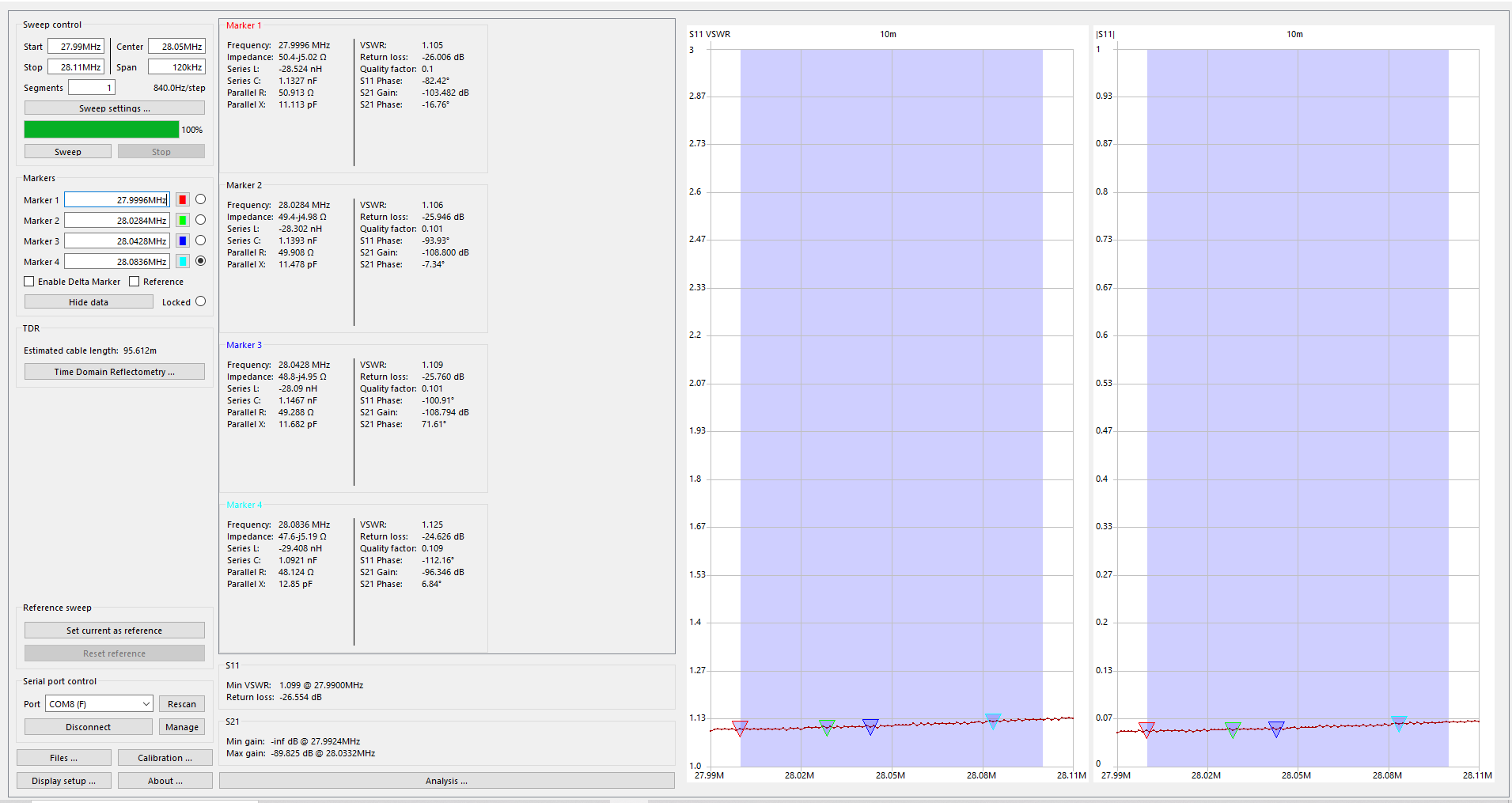
My 10m sweep
My Hustler 4BTV has now been up to 5 years and I was thinking it was due time to take it down and give it a good cleaning. Before I do that I wanted to take a baseline SWR of each band and see if the SWR changes after the cleaning. I used my NanoVNA to take the SWR readings and in my opinion, my 15m readings looked a bit odd. I have posted a sweep of 10m and then 15m and you can see the large spikes in the 15m readings. I am not sure why this is and I am searching for some input.

15m sweep
Mike Weir, VE9KK, is a regular contributor to AmateurRadio.com and writes from New Brunswick, Canada. Contact him at [email protected].
AmateurLogic 206: HackRF Porta Pack
AmateurLogic.TV Episode 206 is now available for download.
Tommy explores the HackRF Porta Pack H2 SDR. Emile and the Simulated Emergency Test. George’s adventures in spot welding and Laptop Battery Replacement.
George Thomas, W5JDX, is co-host of AmateurLogic.TV, an original amateur radio video program hosted by George Thomas (W5JDX), Tommy Martin (N5ZNO), Peter Berrett (VK3PB), and Emile Diodene (KE5QKR). Contact him at [email protected].
KH8 SOTA/POTA (3) – Ofu Island
See Part 2 of this report.
Ofu Island is not easily accessible, so it was a key decision on whether to include it as part of the trip. The more I read about American Samoa, the more I noticed that many of the best photos were from Ofu Island. It has a huge beach that stretches along the south side of the island, located within the national park. Not only that, Ofu has an attractive SOTA summit with an excellent view. So, yeah, we needed to go there.

Getting There
Flights from Pago Pago to Ofu are scheduled for Tuesday and Thursday mornings on Samoa Airways. We wanted more than two days on Ofu, so we arrived on a Thursday with a return flight on the following Tuesday. These are small planes with strict weight limits on baggage: 5 kg (11 lbs) for one carry-on bag and 15 kg (33 lbs) for one checked bag. The airline weighs everything and everybody going onto the flight. You can pay for extra luggage, but you risk having it left behind for a later flight if your flight happens to be overweight.
We opted to take only the essentials to Ofu, repacking our gear to fit into just a few bags. Only the lightweight SOTA station went with us, along with snorkel gear and minimal clothing. Everything else was stored at the Tradewinds Hotel.

Lodging
There are limited lodging options on Ofu. We chose to stay at the Vaoto Lodge, right next to the airstrip. The rooms at the lodge are very basic but do have air conditioners. There are no restaurants on the island. The lodge offers a shared kitchen for its guests to prepare their own meals, as well as a limited but adequate selection of groceries for purchase. This may not work for everyone, but Joyce was able to come up with some excellent meals for us.
Four people were staying at the lodge when we were there, including us. One person was there to work on a government-sponsored project. The other was a tourist from New Zealand. So there were probably only three tourists on Ofu at that time.
The best information I found concerning Ofu is: The Ultimate Guide to Ofu Island, American Samoa. This was very helpful, but also double-check the details concerning lodging and airline flights, as things do change with time. Based on the advice of the locals, we concluded that Tumu Mountain was our only SOTA option on Ofu. Sunuitao Peak and Piumafua Mountain (on Olosega Island, connected to Ofu by a bridge) are not considered hikeable.
Tumu Mountain (KH8/MI-003)
The trail to the summit is 3 miles one-way, with 1500 feet of elevation gain. This trail used to be a road, starts out wide and narrows as the elevation increases. It is overgrown in spots, and there is a rope assist in one difficult spot. This video provides a good overview of the climb. This trail is not in the national park.

Our host at Vaoto Lodge dropped us off at the trailhead and picked us up afterward. The hike begins in some 18-inch-high brush that includes some plants with stickers. I wore shorts and accumulated quite a few scratches on my legs. If I do this hike again, I would start with long pants or gaiters and switch to shorts at the first trail marker, about one-half mile up the trail. This trail marker indicates a left turn that starts the climb up the side of the mountain. As the map shows, there is a big switchback that keeps the slope of the trail reasonable.
 Near the summit, we noted a sign indicating a trail to the left for the viewpoint, but we continued to the summit. The actual summit is covered by dense vegetation, so we stopped where the trail faded out, labeled “Operating Location” on the map, within the activation zone. There is a small radio installation here. To get to the actual summit would require a serious bushwhack through the tropical forest.
We set up the SOTA station using our smaller antenna mast (fishing pole) and fired up the IC-705 on 17m FT8. Conditions were not great, but we both worked four stations on HF plus each other on VHF/UHF. We were running behind schedule for our pickup time, so we did not operate any longer than necessary.

On our descent, we took the side trail over to the viewpoint, which was fantastic. This is the best photo we took in American Samoa. We are accustomed to hiking in the Rocky Mountains, where reaching a high summit always provides a great view. Tropical forests are a lot different…the vegetation may not allow you to see anything of interest on a summit. Finding a good viewpoint can be challenging.
POTA (AS-0001)
We found a nice spot on Ofu Beach (-14.17776, -169.65428), about a one-mile walk from Vaoto Lodge that is a great place to snorkel and operate ham radio. There is a little shelter there that provides some protection from rain. We did seven POTA activations from this location using the smaller SOTA station with 10 watts. These QSOs were mainly on 15m and 17m, using digital transmissions (FT8 via the iPhone app and the IC-705).


We were supposed to leave Ofu on Tuesday morning, but our flight was delayed until the afternoon. We were aware that flights to/from Ofu can be delayed or cancelled, and we planned some flexibility into our schedule to mitigate this risk. We still made it to Pago Pago that day, returning to the Tradewinds Hotel. After our wonderful stay on Ofu, this felt like a welcome return to civilization.
We were delighted to have visited Ofu Island and highly recommend it. However, it did add six days to the trip, so it may not work for travelers with a more limited schedule.
Wrap Up On the Whole Trip
This concludes our KH8 trip report. Joyce and I had a fantastic time in American Samoa and enjoyed the ham radio aspect of the trip. The only stations we worked on VHF/UHF were each other, which was not a big surprise, but still disappointing. Oh, well, I guess that’s why we have access to the HF spectrum.
Some additional travel notes here:
K0NR Guide to American Samoa
73 Bob KH8/K0NR
The post KH8 SOTA/POTA (3) – Ofu Island appeared first on The KØNR Radio Site.
Bob Witte, KØNR, is a regular contributor to AmateurRadio.com and writes from Colorado, USA. Contact him at [email protected].
 Ham Radio Deluxe |
 W5SWL Electronics |
 Ham Radio Prep |
 KB3IFH QSL Cards  Hip Ham Shirts  HamRadioAuctions HamRadioAuctions Reliance Antennas Reliance Antennas Enigma Shop Enigma Shop |  morseDX  Ni4L Antennas  R&L Electronics R&L Electronics antennas.us antennas.us Ears to Our World Ears to Our World |
- Matt W1MST, Managing Editor
