 |
 Why People Hate FT8
 8 April 2021 | by
 Let’s just be real for a moment. A lot of people hate FT8. You all have seen it in social media and on the air. It’s a popular mode, so popular in fact that one report citing Club Log data recently showed that 80% of HF contacts in their tracking nowadays are FT8. This increase has come at the expense of other mode activity, especially CW. What’s worse in the minds of some, is that accomplishments like DXCC which used to take several to many years to reach is being significantly shortened with the use of FT8.
I’ve often thought it’s a fait accompli achieving DXCC, one just needs to sit in a chair long enough. FT8 has given a means to bypass a lot of that chair-sitting. I think FT8 just exposed an inconvenient truth that there really wasn’t a whole lot of skill involved in DXCC. Skill may lessen the amount of time it takes. FT8 just automated the process and significantly reduced the time needed and totally removed any skill advantage.
FT8 or another similar mode was going to happen sometime. It’s like the concept of steam engine time. The idea or theory is that the steam engine would have been invented at probably the same time in history by anyone or several people simultaneously in the world, even if many inventors were isolated and not in contact with each other. It was just bound to happen at some point given the progression of technology and the availability of materials and know-how to do it. We all knew (well, those of us with engineering know-how) that a semi-synchronous extremely low baud rate, low signal-to-noise ratio mode would work and be quite robust. It’s Shannon’s Theorem applied. What is at issue is the way Joe Taylor packaged it. We could do great things with low baud rate/low S/N modes. How about a TCP/IP link to a BBS on the moon or an open global resilient messaging network that works on every band in the lowest of the low sunspot cycles? Instead, it was packaged as a low effort point-and-click QSO slot machine, unable to convey anything intelligent.
There are fully automated FT8 stations out there where the operator just clicks a button and the station makes contacts all day. We all know it, we just don’t know the extent of it. This I think is the crux of the problem. FT8 has become something akin to Bitcoin-mining, but it’s QSO-mining, and FT8 with automation which is undoubtedly happening has devolved pursuit of accomplishments into a virtual QSO Battlebots competition.
Personally, I’ve become indifferent to the whole FT8 debate, and frankly anything that involves DXing, DXCC, contesting, or collecting wallpaper. I don’t hate FT8, but I get the discontent about it that is expressed in amateur radio circles. I have always been one to tell others to not be mode bigots, or put down other modes. The FT8 mode itself is not bad technology, or detrimental to amateur radio. The mindless fashion in which it is in use I’m not so sure about.
This article was originally posted on Radio Artisan.
Anthony, K3NG, is a regular contributor to AmateurRadio.com.
You just never know………
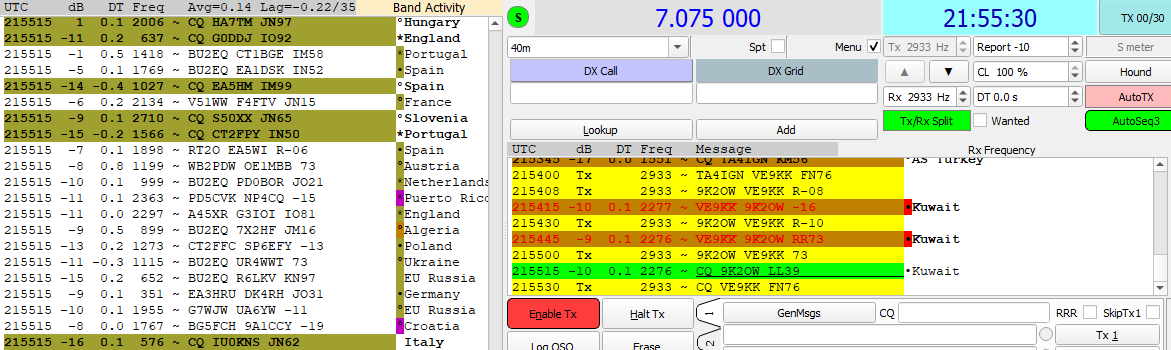 |
| 9K2OW in the log |
This evening I decided to settle into the shack and once again get on FT8 to see what was happening. I went directly to 40m and set my power to 70 watts. As a side note funny thing about 40m I used to bother the washer machine and an office light would turn on and off but for some reason not anymore. Anyway, this post was about a very nice FT8 contact I made. I was calling CQ well to be more accurate my computer was calling CQ. Right out of the blue I had a call from 9K2OW in Kuwait!!
With a couple of mouse clicks and he was in the log. Recently I have been reading some positive and negative opinions regarding FT8. Personally, I like to stay neutral when I read these posts maybe that is the Canadian in me but I do know I had a blast having Kuwait answer my CQ call on 40m. It was a short but good evening on ham radio!
Mike Weir, VE9KK, is a regular contributor to AmateurRadio.com and writes from New Brunswick, Canada. Contact him at [email protected].
LHS Episode #405: It Lives

Hello and welcome to the 405th installment of Linux in the Ham Shack. In this episode, the hosts discuss the zombie apocalypse--well, almost. Topics range from World Amateur Radio Day to the return of RMS to the cancellation of big amateur radio events around the world. There's also a new edition of Deepin and AlmaLinux, available funding for open source projects and much more. We hope you enjoy this episode and as always, thanks for listening.
73 de The LHS Crew
Russ Woodman, K5TUX, co-hosts the Linux in the Ham Shack podcast which is available for download in both MP3 and OGG audio format. Contact him at [email protected].
AmateurLogic Shorts 2: MotionEyeOS
In the new AmateurLogic Shorts episode 2 Mike shares a great Pi project. MotionEyeOS turns your Raspberry Pi and camera into a motion tracking device.
Please Subscribe and click the Like and Share buttons if you enjoy our content.
Note AmateurLogic Shorts are only available on YouTube.
George Thomas, W5JDX, is co-host of AmateurLogic.TV, an original amateur radio video program hosted by George Thomas (W5JDX), Tommy Martin (N5ZNO), Peter Berrett (VK3PB), and Emile Diodene (KE5QKR). Contact him at [email protected].
LHS Episode #404: The Weekender LXIX

It's time once again for The Weekender. This is our bi-weekly departure into the world of amateur radio contests, open source conventions, special events, listener challenges, hedonism and just plain fun. Thanks for listening and, if you happen to get a chance, feel free to call us or e-mail and send us some feedback. Tell us how we're doing. We'd love to hear from you.
73 de The LHS Crew
Russ Woodman, K5TUX, co-hosts the Linux in the Ham Shack podcast which is available for download in both MP3 and OGG audio format. Contact him at [email protected].
A nice FT8 afternoon.
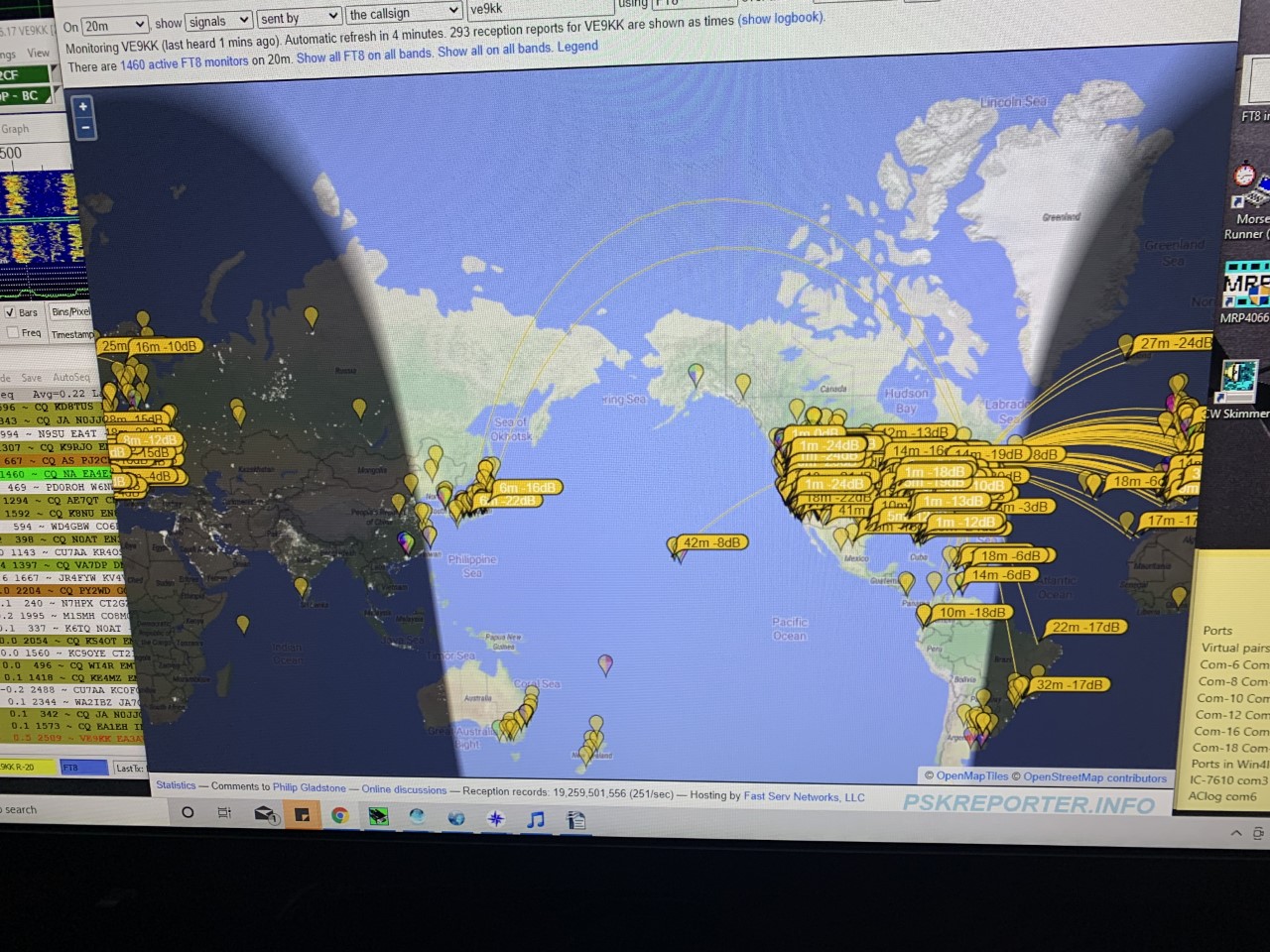
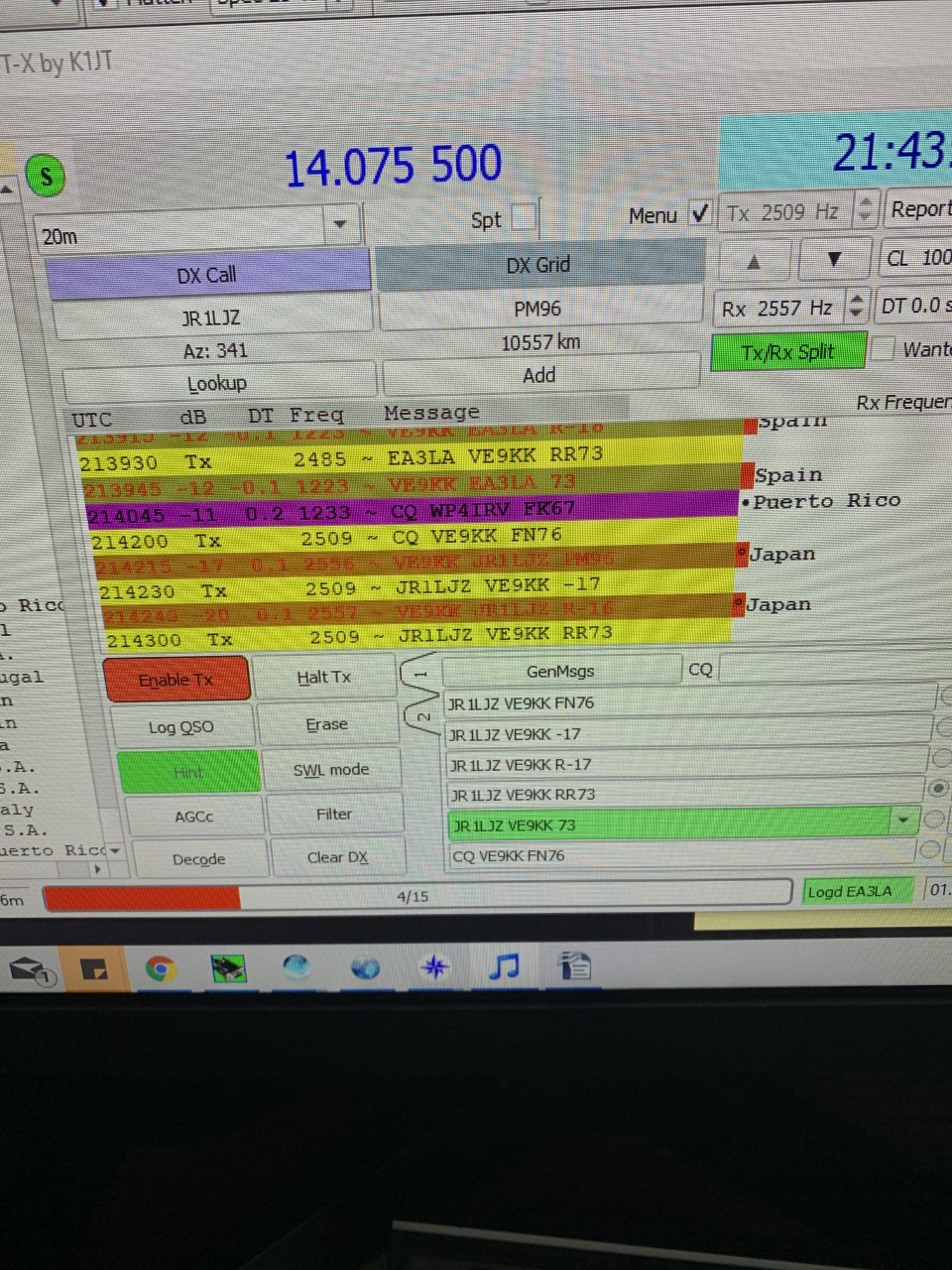
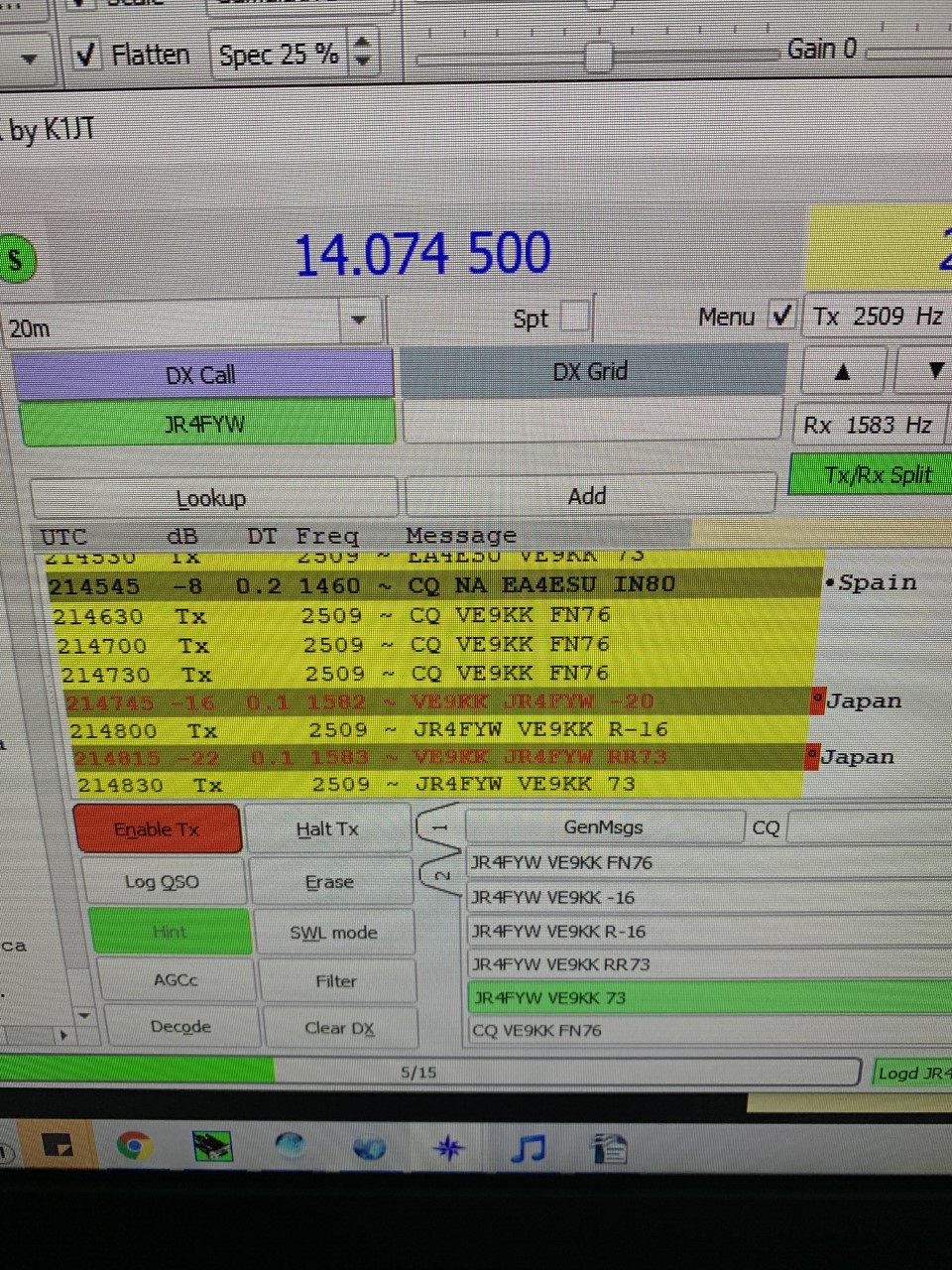
I was on the radio this afternoon and decided to give FT8 a try on 20 meters. I made some contacts in the U.S., France, Germany and Spain. Then out of the blue, I had a station from Japan call me and I did not notice any J stations I was decoding but I was very pleased regarding the contact. Then once again out of nowhere another J is calling me and I made my second contact. I took a look at PSK reporter to see where my FT8 signal was being spotted. I was shocked to see not only Japan but also Hawaii. A very nice time on the radio today.
Mike Weir, VE9KK, is a regular contributor to AmateurRadio.com and writes from New Brunswick, Canada. Contact him at [email protected].
UK Regulator Ofcom Releases Ham Licenses By Age: Compares Favorably with US Estimates
In response to a Freedom of Information Act, the United Kingdom amateur radio license regulator, Ofcom, has released counts of ham licenses by age group (see here). The ICQ Podcast covered this story in this week’s episode. They are simple counts but I’ve taken them and added UK population data for comparison. Using a graph from my recent NCJ article on aging in American radiosport, I also make general comparisons to the US ham population. How does the UK compare to the US in terms of the age distribution relative to the overall population? Are hams becoming more elderly? Is there an influx of younger people into amateur radio in these two countries? The results are concerning to anyone interested in the long term viability of amateur radio in either country.

The bar chart shows the three UK license classes—Foundation, Intermediate, and Full—with the corresponding total UK population by age group. These categories are what the Ofcom report contains so I was unable to reconfigure it for other groupings. The purple total population bar in comparison to any of the ham licenses illustrates the “aging” of the British ham population. This is especially the cast for Full licenses. As the age group enters mid-life (post-50), the imbalance becomes clear and gets more imbalanced as age increases.

The second bar chart is from my NCJ article on US hams. The ARRL membership data are proxies for the US FCC ULS license database. (The FCC stopped collecting birth year some decade or so ago.) The tan bar is the total population from the Census Bureau. The green bar is from an ARRL survey of current and previous NCJ subscribers and are a proxy for contest participants.
Clearly, the US amateur radio population compares favorably with those in the UK as represented in the Ofcom data release. There may be a slightly more aging pattern in the US data. It’s the post-60 year old category where the ham population surpasses the comparable share of the total population. As noted in my NCJ article, the contesting data show that this group is even more elderly than hams in general.
Ofcom is an evidence-based regulator, so market research is important to us. Many of our decisions are informed by research evidence, and our market research ensures that we have a thorough, robust and up-to-date understanding of consumers in the UK.
Source: https://www.ofcom.org.uk/research-and-data/about-ofcoms-research
These data released by Ofcom show a revealing, but not entirely surprising, picture of the amateur population in the United Kingdom. Most would agree that they “see” hams at rallys and elsewhere and most “look older” than “younger.” In these data, there are younger hams in the data but they are indeed smaller in number and share. But until we have actual data on all licensed hams (and even the Ofcom release warns about their under-coverage), it’s like building the proverbial dinosaur from some bones discovered in an archaeological dig from one site. We also do not know about how many “late-in-life” hams will emerge during their mid to later years (see here for survey estimates). By inference, the hypothesis that amateur radio is a cultural phenomenon mostly engaged in members of the the Western “Baby Boom” (see here) is not inconsistent with these data. Until we have data where longitudinal and age-cohort variables are measured will we even begin to be able to move beyond the ubiquitous: “well, the blokes at the rally…” or “in my club, I’m the youngest and I’m 50 years old”. Those comments may indeed be characteristics of the full ham population, but we simply do not know this for sure or with any precision.
Even though Ofcom says it’s an evidence-based regulator, until more data like this is released and analyzed, we won’t be able to really get a handle on social change in the hobby and public serve of ham radio. Age and cohort comparisons (e.g., Glenn, Cohort Analysis) are the standard to measure change like this. In the US, the FCC isn’t even in the ball game. Sad.
Frank Howell, K4FMH, is a regular contributor to AmateurRadio.com and writes from Mississippi, USA. Contact him at [email protected].
 Ham Radio Deluxe |
 W5SWL Electronics |
 Ham Radio Prep |
 KB3IFH QSL Cards  Hip Ham Shirts  HamRadioAuctions HamRadioAuctions Reliance Antennas Reliance Antennas Enigma Shop Enigma Shop |  morseDX  Ni4L Antennas  R&L Electronics R&L Electronics antennas.us antennas.us Ears to Our World Ears to Our World |
- Matt W1MST, Managing Editor
