 |
 ICQ Podcast Episode 351 – New RSGB President discusses IARU/RSGB Survey
 23 May 2021 | by
 In this episode, Martin (M1MRB) is joined by Leslie Butterfield G0CIB, Dan Romanchik KB6NU and Edmund Spicer M0MNG to discuss the latest Amateur / Ham Radio news. Colin (M6BOY) rounds up the news in brief and in the episode we feature we discuss the RSGB Survey with the New RSGB President.
ICQ AMATEUR/HAM RADIO PODCAST DONORS
We would like to thank Patrick Bean, Simon Bracegirdle, Walter Washburn (KT0D), and our monthly and annual subscription donors for keeping the podcast advert free. To donate, please visit - http://www.icqpodcast.com/donate
- CANWARN Online Training 2021 - Amateur radio on BBC Essex Breakfast Show - IRTS AGM Rejects New Licence Level Proposal - Congress Seeks to Designate National Amateur Radio Operators Day - Amateur Radio Software Award Goes to KN4CRD for JS8CALL - M0IBG Inducted into CQ Hall of Fame - RSGB National Radio Centre to reopen - Final Details on EMF from Ofcom
Colin Butler, M6BOY, is the host of the ICQ Podcast, a weekly radio show about Amateur Radio. Contact him at [email protected].
About Those Drive Up SOTA Summits
The Summits On The Air (SOTA) program was designed with hiking/climbing in mind but some SOTA summits have roads that go to the top. Some notable ones that come to mind are Pikes Peak (W0C/FR-004), Mount Scott (W5O/WI-002), Mount Coolidge (W0D/BB-012), Sandia Crest (W5N/SI-001), Mount Greylock (W1/MB-001) and Mount Mitchell (W4C/CM-001). There are also summits that have trams, trains and chairlifts that provide easy access.

Some SOTA activators dismiss drive-up summits as not being the real SOTA experience. Everyone is entitled to their point of view and can choose their summits accordingly. I am too pragmatic (read: lazy) to worry about that. If there’s a road to the top, I am probably going to use it, whether it’s a serious 4WD road or a well-paved surface.
The Rules
The specific terminology used in the various SOTA Association Reference Manuals (ARMs) may vary a bit so I will refer to the Colorado (W0C) ARM:
The SOTA General Rules state that the method of final access to the radio operating location must be nonmotorized. The General Rules do not specify the distance, either vertical or horizontal, that this final access must cover. The use of non-motorized vehicles (e.g. bicycle) or pack animals to enter the Activation Zone (AZ) is permitted. Operations must not be in, or in the close vicinity of a motor vehicle, cannot use a permanent electrical power source, nor use a fossil fuel generator in any fashion. No part of the station may be connected in any way with the motor vehicle. All equipment must be operated from portable power source (batteries, solar cells, etc).
The intent of the rules is quite clear: SOTA is not a motorized activity…you need to operate independently of a motor vehicle. Like most rules though, there are shades of grade on the interpretation. Just how independent do we need to be? Unless you started your hike from your home location, all SOTA activations have some form of mechanized transport involved. It is just a question of how far you ride and how far you walk.
Some SOTA Associations used to suggest or require a qualifying hike for drive-up summits. This means that you hike down from the summit for some minimal vertical distance (100 feet or so) and then hike back up to “qualify” your activation. This idea seems to be on the way out and this language was removed from the W0C ARM some years ago. However, your Association may still encourage it or you could just decide that it is a practice that you want to do. (You can find ARMs here.)
Some new SOTA activators look at the rules and suggest they are too restrictive. They argue that people with limited mobility should be allowed to operate from a vehicle. These requests have been heard before and are immediately rejected. I do think the SOTA Management Team has crafted a workable approach that keeps SOTA oriented towards backpack portable operating while still allowing for minimal mobility.
Our Approach
The guiding principle that we use on our drive-up or tram-up summits is to use our normal backpack-portable SOTA station. However we get to the summit, everything goes into a pack which is carried for some minimal distance away from the vehicle, tram or chairlift. This keeps the drive-up SOTA station configured just like the hike-in variety: compact, lightweight, no chairs, no tables (unless they fit into our packs.) This avoids the “Field Day” style set up with lots of gear carried from the vehicle via multiple trips to create a Big Portable Station. Sometimes the drive-up summits are overrun with people, so a short hike away from the crowds can get you to a quieter spot.
That’s how we do it. What are your thoughts?
73 Bob K0NR
The post About Those Drive Up SOTA Summits appeared first on The KØNR Radio Site.
Bob Witte, KØNR, is a regular contributor to AmateurRadio.com and writes from Colorado, USA. Contact him at [email protected].
LHS Episode #413: The Weekender LXXII

It's time once again for The Weekender. This is our bi-weekly departure into the world of amateur radio contests, open source conventions, special events, listener challenges, hedonism and just plain fun. Thanks for listening and, if you happen to get a chance, feel free to call us or e-mail and send us some feedback. Tell us how we're doing. We'd love to hear from you.
73 de The LHS Crew
Russ Woodman, K5TUX, co-hosts the Linux in the Ham Shack podcast which is available for download in both MP3 and OGG audio format. Contact him at [email protected].
LHS Episode #412: WFView Deep Dive

Hello and welcome to the 412th episode of Linux in the Ham Shack. In this episode, we have a fantastic interview with Elliott, Phil and Roeland, developers of the WFView project. WFView is an open source rig management application which implements rig control, network access, audio transport, full display view and more. It's open source and cross platform and available for download today. We hope you check out the project and enjoy the podcast.
73 de The LHS Crew
Russ Woodman, K5TUX, co-hosts the Linux in the Ham Shack podcast which is available for download in both MP3 and OGG audio format. Contact him at [email protected].
AmateurLogic 156: Radiogram
AmateurLogic.TV Episode 156 is now available for download.
What’s a Shortwave Radiogram? OpenWebRX v1.0 Update. UBLOX7 Winlink and Time Sync using GPS.
1:04:56
George Thomas, W5JDX, is co-host of AmateurLogic.TV, an original amateur radio video program hosted by George Thomas (W5JDX), Tommy Martin (N5ZNO), Peter Berrett (VK3PB), and Emile Diodene (KE5QKR). Contact him at [email protected].
Spotted down under on 40m
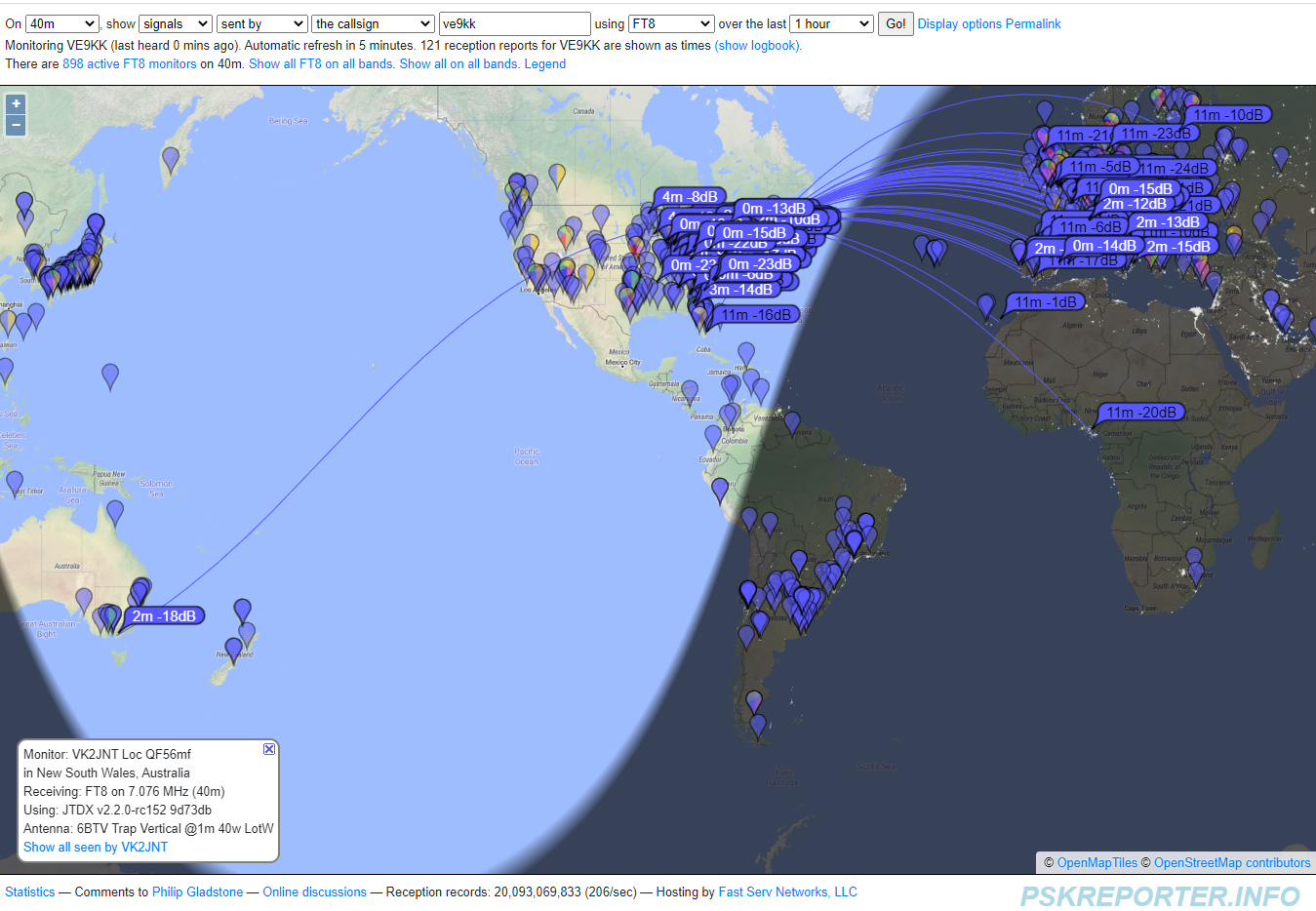
I was on 40m using FT8 this evening and I checked PSKreporter after being on for only a short time and was pleasantly surprised with a spot in Australia.
Mike Weir, VE9KK, is a regular contributor to AmateurRadio.com and writes from New Brunswick, Canada. Contact him at [email protected].
LHS Episode #411: We Named the Dog Indiana
Hello and welcome to the 411th installment of Linux in the Ham Shack. In this short-topics episode the hosts discuss youths on the air, operations on rare IOTA sites, the future of Audacity, LibreOffice, the continued existence of OpenSolaris, cheap CubeSats, Fedora 34 and much more. Thank you for listening and have a great week!
73 de The LHS Crew
Russ Woodman, K5TUX, co-hosts the Linux in the Ham Shack podcast which is available for download in both MP3 and OGG audio format. Contact him at [email protected].
 Ham Radio Deluxe |
 W5SWL Electronics |
 Ham Radio Prep |
 KB3IFH QSL Cards  Hip Ham Shirts  HamRadioAuctions HamRadioAuctions Reliance Antennas Reliance Antennas Enigma Shop Enigma Shop |  morseDX  Ni4L Antennas  R&L Electronics R&L Electronics antennas.us antennas.us Ears to Our World Ears to Our World |
- Matt W1MST, Managing Editor
