 |
 Safely Hamming In the Woods In Hunting Season
 10 December 2009 | by
Anthony Good, K3NG, is a regular contributor to AmateurRadio.com and writes from Pennsylvania, USA. Contact him at [email protected].
Handiham World for 09 December 2009 – Repost
Welcome to Handiham World!
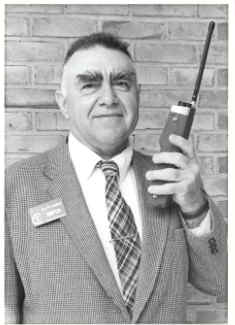
Photo: Ralph Andrea, W0FCO, became a silent key in 1993. (Thanks to George, N0SBU & the History Project for this photo of Ralph posing with a handheld radio.)
Recently I had a phone call from the elderly mother of a long-time Handiham member. She explained to me that her son needed some help with his radio. Of course we visited on the phone for awhile so that I could learn a bit more about the radio and what it was and wasn’t doing, but then we got to talking about how her son had gotten help from a Handiham volunteer in past years.
“Ralph Andrea used to come over to the house and help us with the station”, she said. Ralph had passed away long ago, and now her son needed help again.
I remember when I first started with the Handiham program myself. It was 1991, and one of the first people Sister Alverna, WA0SGJ, told me about was Ralph, W0FCO. “Ralph”, she explained, “will never miss an opportunity to tell someone about the Handiham System – even complete strangers.”
It was true. If Ralph saw someone who used a wheelchair or a white cane, he would introduce himself and start his sales pitch about how much fun ham radio was and how the Handiham System could help them get started. He was an awesome volunteer, and I was privileged to meet him and work with him in the Handiham System for two years, until his death in 1993. There was almost no volunteer job that Ralph wouldn’t handle. He would pay calls to members who needed antenna work or station setup help. He kept a massive collection of electronics parts in his basement, which was jammed with floor to ceiling shelves like a commercial repair shop. If someone needed a left-handed resistively-coupled doofrazzle, Ralph was going to find one in that collection, because everything was neatly stacked, organized, and labeled.
When Ralph got sick and spent his final days in the V.A. Medical Center in Minneapolis, I got the feeling that he was still very much the Handiham volunteer. During one of my visits to his hospital room shortly before his death, he wanted to make sure that I would take good care of the Handiham System. That was the kind of guy Ralph was. Other people, especially Handiham members, came first.
It was a sad day when we had to say goodbye to such a kind and dedicated friend of Courage Center. After Ralph became a silent key, Doris, his XYL, got help from the local ham community to sell the parts collection and radios, donating the proceeds to help us and even setting up a special fund to help Handihams into the future. The parts sale was so big that it filled the garage and the wide driveway. Hams from the 3M Amateur Radio Club and the St. Paul Radio Club as well as others pitched in to help.
That gift of support still helps us offer services today, and I know that some of you, our readers and listeners, will step up to the plate and help keep the Handiham System healthy. Maybe you can give your time to help someone else. Perhaps you can teach a ham radio licensing class at your local radio club or school. Some of you will be able to help with gifts of financial support. Ralph did all of that stuff, but I sometimes wonder where he found the time. The thing is, if you truly want something in life, you are more likely to make it happen. He liked ham radio and made the special mission of the Handihams his priority.
I want you to think about Ralph Andrea when someone asks you to help set up a rig or teach a class. Or yes, write a check to support us. Working together, we are sure to succeed when we have something as exciting as amateur radio to share.
For Handiham World, I’m…
Patrick Tice, [email protected]

Pat Tice, WA0TDA, is the manager of HANDI-HAM and a regular contributor to AmateurRadio.com. Contact him at [email protected].
Handiham World for 09 December 2009
Welcome to Handiham World!
Photo: Ralph Andrea, W0FCO, became a silent key in 1993. (Thanks to George, N0SBU & the History Project for this photo of Ralph posing with a handheld radio.)
Recently I had a phone call from the elderly mother of a long-time Handiham member. She explained to me that her son needed some help with his radio. Of course we visited on the phone for awhile so that I could learn a bit more about the radio and what it was and wasn’t doing, but then we got to talking about how her son had gotten help from a Handiham volunteer in past years.
“Ralph Andrea used to come over to the house and help us with the station”, she said. Ralph had passed away long ago, and now her son needed help again.
I remember when I first started with the Handiham program myself. It was 1991, and one of the first people Sister Alverna, WA0SGJ, told me about was Ralph, W0FCO. “Ralph”, she explained, “will never miss an opportunity to tell someone about the Handiham System – even complete strangers.”
It was true. If Ralph saw someone who used a wheelchair or a white cane, he would introduce himself and start his sales pitch about how much fun ham radio was and how the Handiham System could help them get started. He was an awesome volunteer, and I was privileged to meet him and work with him in the Handiham System for two years, until his death in 1993. There was almost no volunteer job that Ralph wouldn’t handle. He would pay calls to members who needed antenna work or station setup help. He kept a massive collection of electronics parts in his basement, which was jammed with floor to ceiling shelves like a commercial repair shop. If someone needed a left-handed resistively-coupled doofrazzle, Ralph was going to find one in that collection, because everything was neatly stacked, organized, and labeled.
When Ralph got sick and spent his final days in the V.A. Medical Center in Minneapolis, I got the feeling that he was still very much the Handiham volunteer. During one of my visits to his hospital room shortly before his death, he wanted to make sure that I would take good care of the Handiham System. That was the kind of guy Ralph was. Other people, especially Handiham members, came first.
It was a sad day when we had to say goodbye to such a kind and dedicated friend of Courage Center. After Ralph became a silent key, Doris, his XYL, got help from the local ham community to sell the parts collection and radios, donating the proceeds to help us and even setting up a special fund to help Handihams into the future. The parts sale was so big that it filled the garage and the wide driveway. Hams from the 3M Amateur Radio Club and the St. Paul Radio Club as well as others pitched in to help.
That gift of support still helps us offer services today, and I know that some of you, our readers and listeners, will step up to the plate and help keep the Handiham System healthy. Maybe you can give your time to help someone else. Perhaps you can teach a ham radio licensing class at your local radio club or school. Some of you will be able to help with gifts of financial support. Ralph did all of that stuff, but I sometimes wonder where he found the time. The thing is, if you truly want something in life, you are more likely to make it happen. He liked ham radio and made the special mission of the Handihams his priority.
I want you to think about Ralph Andrea when someone asks you to help set up a rig or teach a class. Or yes, write a check to support us. Working together, we are sure to succeed when we have something as exciting as amateur radio to share.
For Handiham World, I’m…
Patrick Tice, [email protected]

Pat Tice, WA0TDA, is the manager of HANDI-HAM and a regular contributor to AmateurRadio.com. Contact him at [email protected].
My first 160m contest
If you asked me a couple of years ago whether I’d ever participate in a contest on 160 meters I’m sure I would have said no. If you’d asked me two weeks ago, I would have said no. In fact, I did say no, answering the weekly ARRL website survey. It turns out that I was mistaken.
The main reason why I never expected to participate in a contest on 160m is because I really don’t use the 160m band very much. The two reasons why I tend to stay away are because I don’t really have a very good antenna for that band, and because the relatively few times that I’ve been on it’s always been horribly noisy (mostly from atmospheric noise, though perhaps there’s some man-made electronic noise there as well.) The reason for the lack of a decent antenna is that antennas for that band tend to be very, very long. As a reminder, 160 meters is about 525 feet. Although you don’t need an antenna that long to transmit on the band, what I do have in place (my G5RV antenna) is really too short to operate properly on that band. I can use the antenna tuner in my radio to cause the radio to think that the antenna is suitable for use on that band, but in reality there’s a lot of loss and my signal just isn’t very strong. Despite the relatively short antenna length, I do manage to pick up an awful lot of noise.
160m is primarily a nighttime band. Although you can make groundwave (those that don’t bounce off the ionosphere) contacts during the day, the band is even noiser during the day and it’s just not practical to try to make a lot of contacts. (That’s not to say that the hardcore contesters aren’t out there trying.) The fact that it’s a late-night band worked to my benefit, since I’m a nightowl.
The 160m contest starts at 5PM local time on a Friday and ends at 11AM local Sunday morning. I was chatting with my friend Larry, N4VA Friday afternoon, and he suggested that I try to make a few contacts in the contest. I was going to be home anyway (my son was recovering from a minor surgical procedure) so I figured that I’d at least listen and see if I could hear anything other than static.
By the time I started to listen, it was around 5:30PM local time, which is after dark at this time of the year and 30 minutes past the contest starting time. I was surprised to hear that not only were there a lot of strong signals, but where nobody was transmiting, the band was actually relatively quiet. I figured that I’d see if I could get the antenna to tune and maybe make a few contacts, “giving out points” to others in the contest.
I was surprised that for the first hour, I made around 20 contacts (and that includes a break for dinner; as I mentioned, I wasn’t really expecting to spend a lot of time in the contest.) What was even more surprising was that for the 4th hour of the contest, I was up to 33 contacts for that hour and 30 the next hour. (All those contacts were “search & pounce”, I wasn’t going to attempt to run stations.) While this isn’t “super-station rate”, those 63 contacts are 3 more contacts than I’d made in total on the 160m band prior to the contest. I continued to operate for a while, taking a few breaks and turned in relatively early Friday night. (I’d been up since 6:30 AM for my son’s procedure).
Late Saturday afternoon, I made another handful of contacts, and then, after we came back from dinner with friends, I got back on the air at 1AM (now Sunday morning) and picked up another 17 stations in that hour. At that point, tuning up and down the band all I was hearing for the most part were stations that I’d already worked, which meant it was tough to find “fresh meat” to work. I figured that I’d try to find a frequency to “run” stations, which means that instead of me trying to find stations who are calling CQ, I’d find a frequency and call CQ myself.
If you’re not a contester yourself, I should explain that in most contests, it’s generally the “big guns” (more powerful stations) that “run” other stations. For one thing, it’s generally easier to hear their signals, and for another, it’s a lot tougher for another station to just jump on top of them and start CQing, “stealing” their frequency. Having your frequency “stolen” is unethical and could theoretically be illegal. For US hams, the FCC says that you cannot intentionally interfere with another station, but in a contest, it’s very difficult to prove (especially for a weak station) since when a stronger station “takes over” your frequency they can simply say they never heard you. That might or might not be true, but it’s hard to prove. The simple thing to do, for a “little pistol” station like me, is to simply move elsewhere.
Fortunately me for me, for the 2AM (local time) hour, I was lucky enough to get a frequency pretty low in the band (1808 mHz) and actually keep that frequency for over an hour. (Lower in the frequency is better, usually, since other operators who get on the band to make a few contacts typically start at the lower end of the band and work their way up.) Remember that his is now 2AM local, and most of the stations that I was working were relatively local, within a timezone or two of me. While I didn’t set any rate records, over the next hour I worked almost 30 stations, which was just for me a lot of fun. I probably could have kept going, but at about 3:15 AM I decided that I’d had enough fun and shut down the radio.
Overall, I wound up working 251 stations (plus 2 “dupes” who I’d previously worked but who called me when I was “running”). Most of the stations that I worked were in the US or Canada, but I did work stations in Jamaica (6Y), the Bahamas (C6), Netherlands Anitilles (PJ), Turks and Caico (VP6) and possibly (the contact was a little “iffy”, hopefully I am in his log) Martinique (FM). In total, I worked stations in 43 ARRL or RAC sections pluss the 5 other countries), which I thought was pretty respectable.
My final claimed score looks like this:
    Band    QSOs    Pts  Sec
    1.8     251     517   48

   Score : 24,816
I don’t think I’m going to win any awards, but I’ve very pleased with my results. And, as I’ve said in the past, the most important thing is that I had a lot of fun.

David Kozinn, K2DBK, is a regular contributor to AmateurRadio.com and writes from New Jersey, USA. Contact him at [email protected].
Polar Bear Goes Deer Hunting


Anthony Good, K3NG, is a regular contributor to AmateurRadio.com and writes from Pennsylvania, USA. Contact him at [email protected].
ICQ Podcast Series Two Episode Twenty-Five (06 December 2009) – PC Interfacing
Series Two Episode Twenty-Five of the ICQ Amateur / Ham Radio Podcast. News Stories include:-
- New antenna installed on ISS
- Icom ceases IC706 production
- Re-launch of Darwen ARC
- 10 GHz Rainscatter video
- Yaesu Heritage Year 2010 - GS2MP
- Version 2.0 of WSPR
- New Technician questions released Jan 2010
- G8KW Silent Key
- UK's 1st G2 connected simplex D-Star node
- Belgian hams get 4m allocation
- Climate Change Conference
- SKN on OSCAR 2010
- Radio mast 'thumbs up' from planners
- Kish Lighthouse activation
Your feedback, upcoming events and Martin, M1MRB discusses PC Interfacing
Colin Butler, M6BOY, is the host of the ICQ Podcast, a weekly radio show about Amateur Radio. Contact him at [email protected].
Handiham World for 02 December 2009
Welcome to Handiham World!

I hope you had a wonderful thanksgiving holiday. We certainly had a wonderful time sharing the holiday with extended family. With the new technology, I didn’t have to leave my ham radio friends behind, either. At my XYL’s sister’s house my first job was to repair the broken cable internet, an easy fix that simply required rebooting the cable modem and the wireless router. Now that the internet was back in business, it was easy to check in to the Handiham Echolink net using a tiny netbook computer and a USB microphone. I also managed a couple of check-ins on the 75 meter PICONET during the visit. No one minded, because there always seems to be some “down time” during these multi-day visits, and sometimes I think the best thing for everyone’s mental health is to spend some time doing relaxing activities like reading or getting on the air.
One interesting thing I noticed just before we headed out over the river and through the woods for Thanksgiving was the release of an NPRM, or Notice of Proposed Rulemaking, by the FCC. The topic: Amendment of the Amateur Service Rules Governing Vanity and Club Station Call Signs. The notice came to me in an FCC bulletin on the day before Thanksgiving, though the NPRM was actually issued on the day before, which was Tuesday, November 24. I have posted the NPRM on the Handiham website in a format that is more easily read than the original downloads. Because of the timing of the release during a busy, short holiday week, I suspect that many ham radio operators missed the announcement altogether, even though we posted it as soon as it was released, and the ARRL produced a story on ARRLweb that included an excellent explanation of what the NPRM is all about.
Here are the main points. At the end of this story, I will provide links to the ARRL story and the NPRM on the Handiham website.
To look up anything on the FCC website or to offer comments on a notice of proposed rulemaking, one needs to know the docket number: WT Docket No. 09-209.
The vanity callsign program began in 1996, but the FCC did not set forth all of the procedures governing vanity calls. This NPRM attempts to do a bit of fine-tuning by specifying some procedures.
Club station licensing is also due to be addressed in this NPRM, stating: “The Commission also decided in the Vanity Report and Order to resume issuing new club station licenses. We believe that certain rule changes to the club station licensing rules may be appropriate.” and “…call signs shown on the license of a deceased licensee generally are unavailable to the vanity call sign system for two years after the license expires or is canceled. Below, we propose to amend our rules to clarify the process by which such call signs become available for reassignment.”
If the rule changes are made, Novice Class licensees would be able to serve as club station trustees.
The conclusion states: “In summary, we believe that the public interest will be served by amending certain rules in order to make the amateur service’s vanity call sign system more equitable and transparent. We also propose changes in the rules governing club station licensing, to promote equitable and administratively efficient processes. We therefore seek comment on these proposed rule changes. In addition, we invite commenters to propose any other amendments to the rules governing the vanity call sign system and club station licensing.”
I urge you to do some further research on this NPRM, even though it is a busy time of year. You will find the appropriate links after my identification.
For Handiham World, I’m…
Patrick Tice, [email protected]

Pat Tice, WA0TDA, is the manager of HANDI-HAM and a regular contributor to AmateurRadio.com. Contact him at [email protected].
 Ham Radio Deluxe |
 W5SWL Electronics |
 Ham Radio Prep |
 KB3IFH QSL Cards  Hip Ham Shirts  HamRadioAuctions HamRadioAuctions Reliance Antennas Reliance Antennas Enigma Shop Enigma Shop |  morseDX  Ni4L Antennas  R&L Electronics R&L Electronics antennas.us antennas.us QRV QRV |
- Matt W1MST, Managing Editor
