 |
 Handiham World for 23 December 2009
 23 December 2009 | by
 Welcome to Handiham World!
A few little changes…
Well, we have made it almost to the end of another year of publishing your weekly e-letter and podcast. Since I am taking a week of vacation between the holidays, this is your last weekly e-letter for the year of 2009. When we meet again in 2010, we are looking toward an exciting new decade in amateur radio. Just think about it — the next sunspot cycle, Cycle 24, is underway and sunspot activity should begin to climb in earnest in 2010. The 10 m band, which has languished in the seemingly endless solar minimum, will start showing signs of life again. It will be possible to work amazing amounts of DX with low power and small antennas. Even Handiham members living in apartments and condominiums will find that DX is within reach.
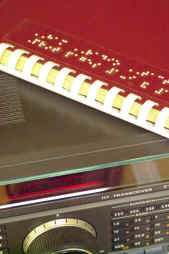 As the decade moves forward, we will learn about new technologies. Ham radio is about innovation and experimentation in communications, so I think that’s a safe bet! I believe we will see advancements in accessibility for people with disabilities, partly because of software development and partly because of the now-assumed handshaking between amateur radio equipment and computers. Could it also be possible that manufacturers will build accessibility features right in instead of having users buy and install extra modules?
Amateur Radio education is going to be quite different in the next decade. You can see the change coming as we can access more and better online courses, and instructional materials in multimedia formats that are delivered in new and better ways. I feel confident that we are on the right track at Handihams when we stopped reading instruction manuals and instead began offering audio training based on a more practical method of simply teaching our members how to use their radio equipment. In the same way, we have stopped reading licensing manuals and instead teach online in a way that makes sense to our members with disabilities. No one is suggesting that books are going away, but they will be in new digital formats, available as digital downloads on portable electronic devices. The jury is out on whether these digital books will be accessible to readers who are blind or have reading disabilities and require audio readout of the text. Although it is easy to do with today’s technology, there is some fear among publishers that users will get a free audio book when they have only paid for a print version. Thus, some of our biggest hurdles remain social and political rather than technological!
Legal disputes over content management rights and patents could also cloud the future of accessibility. If software is found to violate a patent and must be withdrawn or changed, accessibility features within the software might be affected. This is a complicated area where technology and the law intersect and where breaking new ground is more likely to be the norm than the exception. I can only hope that accessibility does not go on the back burner in favor of time being spent to resolve other pressing issues in software design.
Still, I remain optimistic. In the natural tug-of-war between rapidly evolving technology and the legal system, there is enormous pressure to make content more easily accessible in spite of the efforts of those who simply can’t change with the times and learn to work with the new technology.
In the world of amateur radio software, rig control will become an expected feature and manufacturers will have to meet these expectations. If accessibility is built-in from the get go, we will not have a problem. On the other hand, if inaccessible features are placed on the software’s front end interface just to create a “pretty” screen, we may be in for an uphill climb. It is not, mind you, that we are insisting that software interfaces need to be bland and uninspiring. It is just that the functions of the software need to be accessible to people who must access computers by voice dictation or through screen readers. Traditional menu bar features really should be retained if at all possible. If a program presents a front-end interface designed for users without disabilities, that is only acceptable if there is an accessible alternative. I would like to hear from some of our readers and listeners who are knowledgeable about software. Specifically, what features must be designed into the software to make it accessible? Frankly, if we do not put our expectations on the table, we should not be surprised when new amateur radio software is designed for users without disabilities only. Yes, I know that this is the 21st century and people should know better, but I have learned that it is best not to assume that everyone really knows what they are doing! It is not that software designers purposely exclude people with disabilities. Rather, design is sometimes driven by a marketing department that is more concerned with the “look and feel” of the software’s interface and the engineers work toward that goal, unaware that users with disabilities may have difficulty using the software. In short, there is still plenty of ignorance out there!
In the past few weeks, I was notified that a user could not access all of our links in the newsletter. Even though we are aware of accessibility issues, it does show that problems will still crop up from time to time. In 2010, improving accessibility in the newsletter, website, and podcasts will be on our agenda. In fact, this very newsletter is now being produced using a new, state-of-the-art HTML editor, Microsoft Expression Web. Although Microsoft FrontPage has been a workhorse for us for over a decade, new web standards dictate that we needed to move forward with better editing tools. The Drupal content management system that we now use for Handiham.org also brings us into better accessibility compliance and offers us the opportunity to update web content more frequently and from anywhere, thus better serving our members and the amateur radio community.
One issue that I still struggle with is maintaining backward compliance. A reader informed me that a link would not work in Pine. I was surprised that this would come up, but it does show that there are legacy e-mail systems that are still in use and work perfectly well, provided that newer technologies maintain backward compliance. The question for me is, “how do I know what will be backward compliant?”
The answer is that sometimes I don’t, and that means that I depend on our readers and listeners to let me know when something does not work for them. We will do our best to maintain accessibility, though there may come a time that the new technology will become so obviously better and widely accepted that it may no longer pay to support backward compatibility. Believe me, this is a common problem in the world of technology. One obvious change that is certainly coming in the next decade is the retirement of the venerable Library of Congress four-track audio cassette. Maintaining backward compatibility for this old system right now means that we are converting MP3 files to a cassette system that is decades old. Most of us are familiar with a conversion from analog television to digital, a situation where the technology changed so radically that maintaining backward compatibility became somewhat of a political issue. In the world of radio, HD radio is now being promoted by broadcasters, both commercial and public. In amateur radio, you will find some communities that have really embraced D-Star repeaters while others live firmly and confidently in the world of analog repeater systems.
When does the big change get made? There is no firm answer to this. Taking the example of digital repeater systems and radios, there will always be a period of transition with people who are so-called “early adopters” leading the way and plucking down big bucks for the latest digital technology. Most users of repeater systems will take a wait-and-see attitude. After all, new repeater systems are expensive and require a lot of effort to change out. A radio club has to be able to not only pay for the cost of a new repeater system, but they also have to promote the new digital technology to all of the club members and prove that it is so much better that it is worth the money that each member will have to spend for a new digital-compatible radio. This is a huge hurdle to overcome because most of us have perfectly good analog equipment and many of us use their repeater system only occasionally. This makes it hard to justify spending several hundred dollars for new equipment. I think what needs to happen is that there needs to be a “critical mass” of users before everyone jumps on board with new technology. Holdouts who refuse to change at that point will simply be left behind or find it necessary to form a new user group for the old technology.
It will be interesting to see the new ARRL website next month when it comes online. The League has been careful to maintain accessibility on its website and I’m looking forward to using the new website and learning how its accessibility features compare to the current website. Most website developers these days do not provide plain text alternatives. The reason is that common web authoring software and content management systems provide for accessibility as long as they are used correctly. The assumption is that the user with a disability will upgrade his or her software system as the technology advances. This means using a reasonably current voice dictation system or screen reader program to access the new content or new software interfaces. At some point there is a critical mass of users with disabilities who are comfortable with the new technology and at the same time the number of users with old technology who cannot access new software and content falls below a critical mass necessary to continue support for backward compatibility.
I am confident that sometime in the next few years the number of users of the old four track tape system will drop below critical mass. With only a few users left, it will no longer be economically feasible to continue to produce materials for them. They will have to make the choice to move on to the new technology or provide some way themselves to get the new technology converted to the old technology format.
One thing that I would like to see in every amateur radio equipment review is a paragraph on accessibility. I am willing to reach out to our readers and listeners to discuss this topic and to exchange e-mails with anyone who is writing a review of equipment. The only thing is that I am not an expert on accessibility in the same way that our users are. After all, I can use my hands to type or control the knobs and buttons on a radio. I can see the radio’s display and I can view the computer screen and use a mouse. That means I’m likely to only be able to give superficial advice on accessibility. If any of our readers and listeners can help, I would certainly appreciate it. We will share your contributions with our audience on the website and credit you with your name and callsign if you wish. As we move into the next decade, let’s make sure that accessibility is job one.
For Handiham World, I’m…
Patrick Tice, [email protected]

Pat Tice, WA0TDA, is the manager of HANDI-HAM and a regular contributor to AmateurRadio.com. Contact him at [email protected].
ICQ Podcast Series Two Episode Twenty-Six (20 December 2009) – A Weekend in Radio
- Spectrum Defence Fund announced
- Logbook of The World Reaches New Milestones
- National Amateur Radio Centre construction
- AO51 magnetic 'flip' experiment successful
- Scott Robbins, W4PA, to purchase Vibroplex
- Experienced CW op for rare IOTA DXpedition
- SDR-Radio.com
- Ofcom - Release of the 59 - 64 GHz band
- 500kHz 1mW QRP gets to Norway
- Website for amateur satellite XW-1
- Indian amateurs get new frequencies
- Amateurs in Bahrain gain new frequencies
Your feedback, upcoming events, Hints, Tips and Tricks and Martin, M1MRB discusses a Weekend in Radio
Colin Butler, M6BOY, is the host of the ICQ Podcast, a weekly radio show about Amateur Radio. Contact him at [email protected].
The Noisy K3
“Bill has linked to and quoted Eric’s paper which quite frankly seems way too complicated to me. IMHO, a modern DSP, microprocessor-controlled receiver should figure all of this stuff out automatically and do it for me … If the receiver has a properly designed AGC system then there are only two variables that are potentially the operator’s responsibility: 1) Preamp On/Off and 2) Attenuator On/Off. With the smarts built into modern radios, why can’t the radio do, for example upon band switching, a little routine of turning each of these on and off and measuring the resulting SNR and then setting them accordingly?” — N7WS
“I’m used to leaving the RF gain wide open on the MkV, leaving the audio gain pretty much alone, and maybe switching between SLOW and FAST occasionally. I don’t seem to have any trouble hearing the weak ones under the strong ones. Now I have to fiddle with the RF gain (a small knob hidden amongst the others) while running a pileup. Not enough hands (or enough brains).” — VE7XF
- AGC DCY: SOFT
- AGC HLD: 0.20
- AGC PLS: NOR (default)
- AGC SLP: 012 (default)
- AGC THR: 002
- AGF-F: 100
- AGC-S: 020 (default)
LHS Episode #029: Evil Empires
 It occurs to me that having an episode discussing evil empires during a celebration- and holiday-filled time of year might be a bit ironic but that's just how things turned out.
Thank you to everyone who has so generously donated to the podcast so that we might have a presence at the upcoming Dayton Hamvention in May, 2010. It was an idea spawned at Ohio Linux Fest in September, 2009 and we've come a long way since then. Every contribution helps and we hope you'll continue to support Linux in the HAM Shack in the future. We also hope to provide timely and essential information to amateur radio enthusiasts and computer users for a long time to come.
From our world to yours, have a Merry Christmas, Happy Hannukah, Joyous Saturnalia, or just a good ol' time--whatever your "thing" might be. We hope you enjoy our latest installment of the podcast, and please: Keep spreading the word. Every month our audience grows, and we predict world takeover by 2014. Well, maybe not, but we are talking about evil empires after all...
73 de Russ, K5TUX
Russ Woodman, K5TUX, co-hosts the Linux in the Ham Shack podcast which is available for download in both MP3 and OGG audio format. Contact him at [email protected].
RTTY Got Me Into Amateur Radio


Anthony Good, K3NG, is a regular contributor to AmateurRadio.com and writes from Pennsylvania, USA. Contact him at [email protected].
Handiham World for 16 December 2009
Welcome to Handiham World!
What’s on your wish list for the holidays?

Besides world peace, I mean? If you have asked Santa for some new ham radio gear, I hope your wishes are fulfilled. (I’m not holding my breath about getting one of those most excellent $11,000 Icom transceivers like the one I posed with for a photo op at HRO, but then again, I might rate something more affordable for Santa’s budget.)
Yes, I have placed a new HF rig on the wish list at the WA0TDA QTH. The reason is that I’m tying up my Icom IC-706 M2G on 2 meters and 70 cm, sometimes using it as an Echolink node, and that leaves me only an old Yaesu FT-747 for HF. Alas, the Yaesu has seen better days. I had acquired it around 20 years ago as a result of a lightning strike on my tower. My wife and I were at home when the storm moved through the Twin Cities, and we about jumped out of our shoes when the blinding flash of lightning lit up the neighborhood like a million camera flashes. The thunder was instant and loud, and that meant just one thing to me: We had just taken a lightning strike, because the thunder came at the same time as the flash of light. I opened the door to the ham shack and my old FT-101B was smoked. Literally. There was even an outline of the metal louvers on the bottom of the rig burned into the wooden desktop.
So I replaced that rig with the FT-747, which worked like a champ for 10 years. It started flaking out in subtle ways. Once I called CQ on what I thought was a clear frequency, only to be chastised by some guy whose QSO I’d interrupted. A bit of sleuthing with a plastic probe led me to an intermittent on a circuit board that had muted the receiver. After that fix, I had a couple more years of trouble-free operation out of the 747 until the display started to disappear at random, accompanied by a total receiver failure. That was also an intermittent, because you could prod the rig and wiggle connectors to get the display and receiver back to normal. Many tries later, both by me and our shop volunteer CJ, K0CJ, and the problem still crops up at random. But the rig really started to annoy me when it would decide to suddenly shift frequency about 500 Hz or so, also at random. This thing was definitely getting on my nerves!
In the 23 years since the FT-747 came out in 1987, the technology built into ham radio transceivers has evolved – a lot! Although the Icom IC-706M2G is a decade newer, its design is still dated. I would like a better receiver section and more options for signal processing. So a new transceiver in the $1000 class went on my Santa list.
Will Santa deliver? Have I been a good boy? Stay tuned to the Handiham podcast and weekly e-letter news to find out!
For Handiham World, I’m…
Patrick Tice, [email protected]

Pat Tice, WA0TDA, is the manager of HANDI-HAM and a regular contributor to AmateurRadio.com. Contact him at [email protected].
Why Are Radios Horizontal?

 Ham Radio Deluxe |
 W5SWL Electronics |
 Ham Radio Prep |
 KB3IFH QSL Cards  Hip Ham Shirts  HamRadioAuctions HamRadioAuctions Reliance Antennas Reliance Antennas Enigma Shop Enigma Shop |  morseDX  Ni4L Antennas  R&L Electronics R&L Electronics antennas.us antennas.us QRV QRV |
- Matt W1MST, Managing Editor
