 |
 HAM Radio?
 19 January 2010 | by
 A perennial annoyance of mine is the use of the phrase “HAM radio.” Not “ham radio,” mind you, but “HAM radio” with the word “ham” capitalized as though it’s an acronym like NOAA, IRS, MVP, UCLA or STFU. It usually occurs in news articles like this one which are obviously written by non-hams, but I also see it used in places like eHam product reviews by people who should know better. While no one can say with certainty how, when or where the term “ham” originated, it is beyond argument that it doesn’t stand for anything. It really isn’t a life-or-death problem, but every time I see “HAM radio” I have an overwhelming urge to slap someone. Is it just me?
Handiham World for 20 January 2010
Welcome to Handiham World!
Net or not?

We have been urging our readers and listeners to monitor 14.305 MHz for activity before we begin a new Handiham HF net on that frequency. I have heard some stations on 14.305 in the early afternoon Minnesota time. Lyle, K0LR, suggests that an afternoon time might find the band conditions being “short”, meaning that we could possibly get more stations checking in from the United States. If we were to look at evenings, I think the band has been dead as often as not, so we cannot wait until it is too late in the day. During the morning hours the band is open, but the skip is longer. As I write this at 09:30 local time, I hear a Spanish-speaking station on 14.305.
As important as band conditions is the question of when our members can get on board with the net! It does not matter if conditions are perfect if everyone is working at their jobs or otherwise busy and can’t get on the air. The original net schedule was set up for 9:30 in the morning Minnesota time, but most of us are busy at that hour. I’m not saying that we should keep the morning hour schedule, but nothing kills a net like bad timing! Before we decide to just keep the 9:30 morning hour but shift frequency from 14.265 to 14.305, let me know your thoughts. One successful Friday evening schedule we used to keep was on 17 meters, and I can’t call it a net, because the informal gathering started by Alan, K2WS, was a “non-net get together”, as Alan always reminded us. After all, the unofficial rule is that nets do not belong on 17 meters, at least not formal nets.
20 meters is different and nets are all right, even scheduled formal nets. Can we narrow it down to daytime or evening? And what day? Monday? Friday? Saturday or Sunday? Remember, we want to pull in working folks, so scheduling it in the middle of the work day may not be the best idea.
One of our repeater hosts, Chris, KG0BP, mused that we might not really need a daily Echolink net if net control stations are too hard to find. So what about that? Do we add a few HF nets and pare down the daily Echolink schedule?
Also at this time we are asking for HF net control volunteers. You will need at least a General Class license and an HF station with a 20 meter antenna.
George, N0SBU, has pointed out that once nets are suspended for the summer as many clubs do with their nets, it is usually pretty difficult to get those nets going again. The lesson to be learned from that is to keep your nets running! Taking time off or reducing your net schedule means that you may never get those times and frequencies back again. George would also like to see the Wednesday night Echolink net be used more often for training purposes, maybe every Wednesday night.
A couple of you thought that having the Echolink nets every other day, Monday, Wednesday, Friday, then on Saturday would be enough activity to keep things running.
Every net needs to have a critical mass of users. This is a basic truth: If you don’t have enough regular participants checking in, you will not keep your net running. That means paying attention to having the net on at a time when you can get people away from whatever they are doing and to the radio. Band conditions, in the case of HF at least, have to be suitable. If band conditions are not right, you may have few check-ins no matter how convenient you make the time and day.
Another concern is that we have competent net control stations. Every time a net is poorly run, we lose some stations who either give up while waiting to check in or simply get annoyed by the poor operating practices they encounter on the net. Every net has this challenge, too, not just ours. I have heard some terrible operating on HF nets whose participants were long-time license holders and whose net control station held a higher class of license.
As we continue with our planning for nets, keep these handy net control practices in mind:
- Begin your net with a preamble explaining the purpose of the net, who may check in, and anything else about how the net will be conducted. This is the time to tell participants if the net is formal or informal and whether you need to be a net member to check in. The end of the preamble is the place to tell stations how to check in, namely, “Check in with your callsign only”, or other appropriate instructions.
- Call for stations in this order:
- Stations with emergency or priority traffic
- Mobile stations
- Portable stations
- Stations on “short time”
- Stations with announcements of interest to the net
- General check-ins (and limit the crowd by geography, type of technology used to check in, callsign area, or whatever.) Example: “I will now take check-ins from stations outside North America.” or “I will now take check-ins from repeaters only.”
- Be sure you have firm control of the net. Do not allow stations to simply give their callsigns and then start rambling on about the weather, their computer problems, and how their dog has fleas. Make it clear that stations checking in must give their callsigns and be recognized before the net control allows them to have their say! Do not let stations grab the air and take over. Net control stations should do the controlling.
- You can make the net more interesting if you have a net topic. Sometimes the net will enjoy discussing a topic introduced by one of the stations checking in.
- Don’t forget to call often for stations throughout the net time. Always allow enough time for emergency check ins to get your attention. You never know when the system may need to pass emergency traffic.
- Be patient but firm, and always polite. Insist that everyone use their callsigns. This will help everyone keep track of who is on the air.
- When the net winds down, thank the participants and the repeater and system owners, and mention when the net will be on again, then sign off.
For Handiham World, I’m…
Patrick Tice, [email protected]

Pat Tice, WA0TDA, is the manager of HANDI-HAM and a regular contributor to AmateurRadio.com. Contact him at [email protected].
NAQP SSB – Jan 2010
- QSOs: 154
- US States: 37
- VE Provinces: 3
- Total Mults: 84
- Score: 12,936 pts.
- 15m: 4 QSOs, 3 states
- 20m: 46 QSOs, 23 states, 3 provinces
- 40m: 64 QSOs, 30 states
- 80m: 40 QSOs, 25 states
ICQ Podcast Series Three Episode Two (17 January 2010) – Learning Morse Code
Series Three Episode Two of the ICQ Amateur / Ham Radio Podcast. News Stories include:-
- UK Space Exploration Review
- Scatterpoint 2008 issues now online
- UK CW Table
- Police sue over 'radio injuries'
- Essex packet network closes
- Tangled aerials solution
- New 10m beacon in Indiana
- BACAR to launch in Western Cape
- New club for Morse enthusiasts
- Swedes withdraw Powerline
- New Indian Amateur Radio Satellite
- SOTA Winter Bonus
- New Mountain Goat - M0RCP
- 960kms with 1mW ERP 500kHz WSPR
Your feedback, upcoming events and Martin discusses learning morse code.
Colin Butler, M6BOY, is the host of the ICQ Podcast, a weekly radio show about Amateur Radio. Contact him at [email protected].
Handiham World for 13 January 2010
Welcome to Handiham World!
Sadly, the big news today is the earthquake disaster in Haiti. I wanted to get this right up front, as the Salvation Army net is active on 14.265 MHz, which is the regular Handiham 20 meter net frequency. As always, all Handiham activity on the frequency will cease whenever the Salvation Army is running emergency nets. We will soon be choosing a new 20 meter net frequency and time anyway, so that we will not run into any conflicts with the Salvation Army net. More about new net frequency proposals later.
The earthquake disaster in Haiti is unparalleled in our lifetime. We are told from the news reports that nothing of this magnitude has occurred on the island since the 1770s. I will be providing you with some amateur radio links later on in this edition, because amateur radio is often the most reliable form of communication at times when widespread disaster causes communications infrastructure failure. Unfortunately, this earthquake struck near Port-au-Prince, the largest city in Haiti and one with a very high population density. Many of the buildings in Haiti are constructed of concrete that is not reinforced in the way modern building codes would require in first world countries. Haiti, the poorest Third World country in the Western Hemisphere, already suffers from poor utility services and overcrowding. You can imagine the effect of a magnitude 7 earthquake in such a place. Unreinforced concrete buildings came tumbling down, trapping people. Because the earthquake came late in the afternoon on a winter day, there would be little daylight remaining to assess the disaster and begin recovery efforts. Because of this, it is expected that much more information will be available now that the sun has risen on a new day in Port-au-Prince.
It was in the mid-1970s that my friend Don Newcomb, W0DN, and I decided on the spur of the moment to take a short trip to Haiti, a place that I had never been. I was living in the Caribbean at the time, and Don was visiting me. Since I was teaching school and had a break, the short trip to Port-au-Prince would be fun. Also, Don could speak French. That would certainly prove to be valuable in French speaking Haiti. A year later, Don and I would form the antenna company known as Butternut Electronics, but of course that is another story!
Even the plane ride to a Third World country can be memorable. The old airplane that carried us to Port-au-Prince leaked oil from the engines, and I remember watching the streaks of oil trail across the wing that I could see through the window. As is traditional, everyone cheered and clapped when we landed safely. Neither of us brought along any ham radio equipment on the trip, as we didn’t want to deal with import or customs problems.
Our short visit was mainly in Port-au-Prince and the surrounding area. I do still remember the concrete buildings, most of which do not exceed three or four stories in height. Nonetheless, I am glad that I did not know about the unreinforced construction and the possibility of earthquakes while I was visiting. Had I known, I guess I would have been pretty nervous! In fact, we had a wonderful short visit, typical tourist stuff, and I bought an oil painting showing a Haitian market scene from a street vendor. I still have that painting on my wall today. Of course as a tourist I had to see the presidential palace. This morning, watching the scene of devastation on television, the collapsed presidential palace brought back that same sick feeling that I recall watching the video of the World Trade Center towers falling on 9/11. I had seen both places and was struck by how fragile even seemingly iconic buildings can be, toppled by disasters that we seem unprepared to deal with and that are more or less unpredictable. My heart goes out to the people of Haiti.
That is why as amateur radio operators we should always be ready for an emergency. Monday morning quarterbacking does no good when communications infrastructure fails and we need to make way for emergency communications traffic. The next emergency could come anywhere at any time. Will you be ready?
For Handiham World, I’m…
Patrick Tice, [email protected]

Pat Tice, WA0TDA, is the manager of HANDI-HAM and a regular contributor to AmateurRadio.com. Contact him at [email protected].
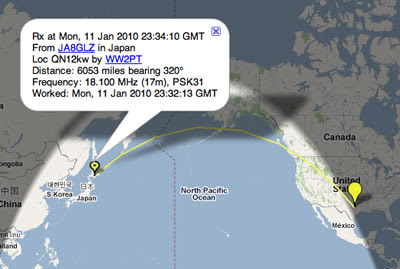
CQ 17m…
LHS Episode #031: Linux Journal Invasion
 Linux in the HAM Shack has arrived in 2010! It's hard to believe that 2009 is over already. We've have so much fun putting together the podcast for everyone, the time has literally flown by. Soon it will be time for the snow to melt, the world to turn green once again, and for LHS to travel to Dayton, OH for the 2010 Hamvention in May. We're so ready we can almost taste it.
In this episode, we had the honor of interviewing two prominent figures from Linux Journal magazine. David Lane, KG4GIY, is the magazine's eminent blogger and ham radio advocate. He is a large part of the reason the January 2010 issue of LJ is all about amateur radio. Shawn Powers is the magazine's associate editor, which gives him the dubious honor of being a guest on our show. He's the go-to guy when the editor, publisher and just about everyone else needs something done. We have to say we were greatly honored to have the LJ folks join us, and we sure hope we haven't scared them off so they'll come back and talk with us in the future.
Hope everyone is having a fantastic 2010 so far, and thanks for downloading LHS in the new year. And if you have a couple of dollars leftover from holiday binging, please drop us a donation as the deadline for acquiring a booth in Dayton is coming up fast. And remember, we appreciate our listeners, each and every one. Thank you!
73 de Russ and Richard
Russ Woodman, K5TUX, co-hosts the Linux in the Ham Shack podcast which is available for download in both MP3 and OGG audio format. Contact him at [email protected].
 Ham Radio Deluxe |
 W5SWL Electronics |
 Ham Radio Prep |
 KB3IFH QSL Cards  Hip Ham Shirts  HamRadioAuctions HamRadioAuctions Reliance Antennas Reliance Antennas Enigma Shop Enigma Shop |  morseDX  Ni4L Antennas  R&L Electronics R&L Electronics antennas.us antennas.us QRV QRV |
- Matt W1MST, Managing Editor
