 |
 FCC: Lazy Or Just Lackadaisical? (Part 2)
 11 March 2010 | by
 The robot seems like a very clever product that will undoubtedly be successful and save lives in coming years. The only problem is the company requested to use three 6 Mhz channels with the amateur radio 440 Mhz band. Amateur radio has secondary privileges in this band which is primarily allocated to the Federal radiolocation service, which the PAVE PAWS system operates under.
Though it may not be obvious, the FCC's granting of the waiver has some parallels with the Broadband over Powerline (BPL) situation from a few years ago. From a technical standpoint ReconRobotics couldn't be more different than BPL. BPL radio emissions were just a spectral pollution byproduct of a wired network that blanketed the HF spectrum. The ReconRobotics product actually uses the airwaves for transmitting information and uses set frequencies in the UHF spectrum. What is quite similar is that the FCC allowed an unlicensed service to use licensed spectrum in a way that is not beneficial to either licensed or unlicensed users. Both BPL and ReconRobotics provide a valuable service to the public, Internet access and support for law enforcement. Although this may ruffle some feathers in the radio artisan community, it's arguable that these services are more valuable than amateur radio. (Ignore for a moment BPL isn't actually using the frequencies, but is polluting them.) Operating under Part 15 rules, BPL operators had to shut down operations if it interfered with licensed services like amateur radio. As we learned from FCC actions (or rather inactions) this wasn't going to be enforced to the letter of the law and BPL systems would be allowed to interfere with amateur radio for months or years. It just wasn't realistic to expect a for-profit business to turn off tens or hundreds of customers to investigate or stop interference, and the FCC quietly let the BPL industry off the hook.
In the ReconRobotics request it was acknowledged that a robot video system would be required to shut down if it interfered with licensed operations such as amateur radio. But we all know that this is just not practical or realistic. No law enforcement officer is going to shut down a robot during an enforcement event because it is interfering with amateur radio, nor would it be advisable or justified for an radio amateur to complain about reconnaissance robot interference. But even worse, if an amateur radio operator transmitting interfered with a robot on a mission, it's likely that the event would be reported on by local media and would it put amateur radio in a bad light. Overall it's a bad situation for all involved.
It's obvious the FCC still hasn't learned from BPL and has some things backwards. Important services like data networks or communications for law enforcement need to be in licensed and/or dedicated spectrum, not shoehorned in with quite dissimilar licensed services as an unlicensed squatter that will ultimately demand and garner licensed allocation type protection and privileges. Unfortunately it looks like this unlicensed / de facto licensed arrangement is going to be more common in coming years if the FCC continues to sidestep real spectrum management.

Anthony Good, K3NG, is a regular contributor to AmateurRadio.com and writes from Pennsylvania, USA. Contact him at [email protected].
RadioSport Software | N1MM Logger Website
 I want to thank Team N1MM and all the volunteers who are working hard at producing no-cost RadioSport software. The new website appearance is streamlined and easy-to navigate. Drop down menus are superior, overall, a job well done!
N1MM Logger Free Contest Software for Phone, CW, and Digital Modes.
Contest on.

Scot Morrison, KA3DRR, is a regular contributor to AmateurRadio.com and writes from California, USA.
Handiham World for 10 March 2010
Welcome to Handiham World!

Recently I had a nice visit with another operator, and what do you think we talked about?
That’s right – we talked about our stations! The conversation took a turn to receiver performance, and he mentioned that one of his radios has a much more sensitive but quieter receiver than the other. I wondered how he knew that, and he said that he had performed an “A-B” test. That’s what today’s essay is about – not receiver performance.
When we compare two pieces of equipment, we want to know which one performs the best. How many times have you heard someone make a claim on the air for one rig’s superiority over another one? Or that one antenna works better than another? Whenever I hear such claims, I wonder if they are really backed up by testing. I know that most of us will never have a test lab full of instrumentation to run tests the way they are done at the ARRL product review lab, but that doesn’t mean that we have no way to perform simple, but more meaningful testing.
Imagine these situations:
Scenario 1: I have two HF antennas in my back yard. One is a vertical and one is a dipole. The dipole is connected to my Icom IC-706M2G and the vertical is connected to my Icom IC-7200. I decide to see which antenna works best for DX, so I listen on 20 meters and I hear a European on 14.060 MHz. The station is easy to copy on the vertical antenna, and the S-meter reading shows S9. I listen on the dipole and the same station on 14.060 is only S5. Do I conclude that the vertical works better?
Scenario 2: I have two HF antennas in my back yard. One is a vertical and one is a dipole. I have both of them connected to an antenna switch, so that I can switch from the vertical to the dipole by turning the antenna switch. The antenna switch is connected to my Icom IC-7200 transceiver. I start my test by listening on the vertical. I hear a station on 14.060 MHz, and the S-meter reading is S9. Then, without changing anything on the radio, I flip the antenna switch to the dipole. I now have an S-meter reading of S9 + 10 dB. I quickly change the antenna switch back to the vertical and the signal drops back down to S9 again. Changing the switch once more to the dipole brings the signal back up. Do I conclude that the dipole works better?
In both situations, I was listening on one antenna and then the other, but the results in scenario 2 were different than those in scenario 1. What could have caused the difference?
Here is a basic rule about comparing two things: You must try to eliminate as many “variables” as possible so that you are really only comparing the two things you want to compare. This is how scientists and engineers perform tests related to theoretical concepts or engineering projects. To make this as simple as possible, let’s make up a very basic example. Let’s say we have a family argument about which sibling is taller. One brother says that he is growing faster and is taller than his brother. Of course as a parent you can easily make the two kids stand side by side and then you can easily see which one is taller. But what if one stands on his tiptoes? Or if one wears shoes and the other is barefooted? Or if one wears a hat and the other doesn’t? As a parent who needs to be fair about deciding, you will have to insist that the variables of shoes, hats, and standing flat-footed are all eliminated so that the one variable you really want to measure, which kid is tallest, will not be affected by those other things.
Getting back to our scenarios about the antennas, we see that in the first situation we are using two different antennas, which is the variable we want to test, but we are also using two different radios. The difference between one radio and the other is a variable that we are not controlling, and that could account for the results we are getting instead of the choice of antenna. Perhaps the attenuator was turned on for one radio and not for the other. Maybe the antenna tuner was not activated for one radio. It could be that the run of coax between an antenna and one of the radios was defective. Do you see all these variables?
In scenario 2, we use only one radio, and we have an “A-B” antenna switch to make it easy to change from one antenna to the other, and to do so very quickly to eliminate changing band conditions or radio settings and radio performance as variables. Furthermore, we can change the switch back and forth several times to confirm our tests. Now we have performed a more scientific test, because we have eliminated as many variables as we could, at least the easy ones, so that we could really compare just the antennas.
I am convinced that there are a lot of folks out there who are simply talking baloney when they brag about how one piece of equipment is so much better than another one. As often as not, they have never performed a real A-B test and are relying on their impressions rather than empirical evidence. Building up a habit of eliminating variables and focusing on only the thing you really want to test is at the core of successful troubleshooting when you are trying to find a problem. It is essential to making sense of how things work in ham radio, as well as in so many other parts of life.
So think to yourself, “When I test my equipment, am I really testing just one thing?”
If you can answer yes, you are well on the way to solving all of your ham radio mysteries!
For Handiham World, I’m…
Patrick Tice, [email protected]

Pat Tice, WA0TDA, is the manager of HANDI-HAM and a regular contributor to AmateurRadio.com. Contact him at [email protected].
Company Offers Biodegradable QRP Kits
Dick Rich, founder of GreenKits said "We discovered that most QRP kit builders build kits not because they want or need another QRP rig. Far from it. In our initial market feasibility study we found several hams that had 20 or more monoband rock-bound 40 meter QRP rigs, but were eager to build more 40 meter rigs. The primary motivators for buying and building QRP rigs was to be part of a fad and impress other QRP rig builders. Most hams only have one or two or even no QSOs on newly built rigs before they are tossed into a desk drawer."
Rich has designed a rig that lasts just long enough after powered up to make a few contacts and then the rig nonviolently self-destructs into a pile of harmless biodegradable ash, with a slight emission of hydrogen. The ash can be dumped into a garden or houseplant pot and the QRPer doesn't have to worry about storing or hiding the unused rig so his wife doesn't ask why he spent money on a rig he'll never use regularly.
GreekKits has created email reflectors for support of the rigs and also to give builders a place to brag about the contacts they made, or even didn't make. Each kit comes with a one time usable password that gives the builder ten days of access to the reflector. Once the password expires, the builder is banished from the reflector forever. Rich says this prevents flame wars about what serial number kits are better than others. GreenKits has an online virtual shrine where customers can worship company founders and kit designers. Virtual flowers can be purchased and placed at the feet of an online statue of founder Rich. Rich says, "We didn't think of the shrine, one of our customers did. We weren't really excited about the idea but several customers really bugged us to do it, so we did."
Rich noted that business is doing well, despite the recession. "We've even released a transceiver called the ESP that doesn't actually transmit any RF. It's selling like hotcakes. Surprisingly, we have customers who have announced on the rig reflector that they have made contacts. One guy has even achieved Worked All States with it and one ham worked Russia with the rig using a three foot loaded whip antenna in a basement apartment. I think this speaks volumes about the quality and performance of our kits."

Anthony Good, K3NG, is a regular contributor to AmateurRadio.com and writes from Pennsylvania, USA. Contact him at [email protected].
RadioSport History | CQ World Wide DX CW 1978
 How did the titans of RadioSport in the 70s score inside the Box or achieve a world record score without our modern version of spotting networks? How did they manage without the availability of today’s technology such as software controlled radios, switching boxes for single operator 2 radios, or CW Skimmer capable computers?
Perhaps, hours and hours, of skill development in front of the radio, continually improving antenna systems, melting solder on the workbench, and listening to the airwaves for nearly the same amount of time.
Spotting Networks.
Brockman and Cox (1979) stated, “All of a sudden the adrenaline is flowing. The eyes are now bright and intense. In a flash our hero has his VFO zeroed in on the prize. There, on 40 CW, is zone 23! But who? Not to be denied, our hero plunges in with his call. As he comes up for air, he hears the prize once more. JT1AN.” (p 43)
Today, the art of listening before taking on the flash swarm generated by spotting networks, is in need of serious re-purposing. The proliferation of junk data is reaching epic proportions as described in various RadioSport reflectors. The utility of the networks, at least in my estimation, is in slow decline. One that, if, left on its own in its present configuration, may harm Box scores and world record attempts.
In 1978, OH2BH piloted CT3BZ in the Madeira Islands, to a new single operator all band world record held only for a year by Dick Norton, N6AA who operated 9Y4AA. Additionally, according to Brockman and Cox, for the first time ever a single band entrant broke the one million point barrier (1979). Jorge, LU8DQ accomplished the impossible.
It was a tremendous year for those seeking world or continental records.
599 Never Dies.
Are we still having this conversation? Apparently, we are, because in 1978 many operators according to the article lobbied the committee asking them to jettison the report. It was suggested that the committee would look into the matter.
RadioSport Ethics.
Computerized logging begins its slow march toward dominating RadioSport. However, in its infancy, an alphabetized cross check reference list was required. Padded logging plagued log checkers then like the unsavory method of rubber clocking in the 21st Century.
On the other hand, one entrant miscopied JA callsigns to the tune of 20 percent of the log total, according to Brockman and Cox (1979); it was unacceptable. The voice of history suggested everyone concentrate on accuracy and not as much on speed.
Conclusion.
They managed to compete and win without the aid of flash swarms generated by spotting networks. Perhaps, back in the day, data traveled slowly weaving itself through VHF/UHF links while a team of spotters carefully listened on high frequency. One’s reputation was on the line while waiting for an opportunity in the pilot’s seat.
I’m convinced a new spotting platform is needed for the longevity of the sport. One that will correct errant oft times malicious data which may lead to irreparable damage when chasing a world or continental score.
My take away in a sport that cherishes speed is one can be accurate and speedy however accuracy trumps speed ever time.
Lastly, will we ever retire 599?
73 from the shackadelic on the beach.
Reference: Brockman, L. N6AR, Cox, B. K3EST (October, 1979). CQ Magazine: 1978 CQ World Wide DX Contest: C.W. Results. pp. 43 – 53.

Scot Morrison, KA3DRR, is a regular contributor to AmateurRadio.com and writes from California, USA.
NCJ: What’s the Best Contest Rig?
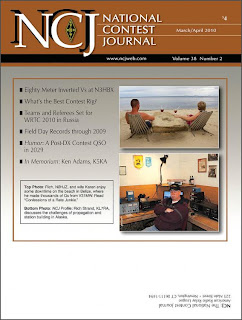 The March/April 2010 National Contest Journal arrived yesterday, torn and tattered as always (thanks again, US Postal Service!), and with it the results of K3MD’s informal poll of top contesters asking, “What’s the best contest rig?” It’s by no means a scientific survey, nor all-inclusive, but many of the Big Guns you’d expect participated.
Nano-40 schematic
I didn’t plan to produce a schematic of the Nano-40, the tiny 40m CW transceiver I built based on Roger G3XBM’s 80m XBM80-2 design as modified by Alan VK2ZAY as I don’t claim any originality for the circuit. I provided the original sources and discussed the changes I made to the circuit and thought that other builders would follow the same path.
 However I have been asked by a couple of people already if I could provide a schematic so I have patched a copy of the circuit diagram produced by Alan to show what I ended up with. I hope that will keep everyone happy, but please remember that without Roger G3XBM’s genius and Alan VK2ZAY’s improvements the Nano-40 would never have happened.

Julian Moss, G4ILO, is a regular contributor to AmateurRadio.com and writes from Cumbria, England. Contact him at [email protected].
 Ham Radio Deluxe |
 W5SWL Electronics |
 Ham Radio Prep |
 KB3IFH QSL Cards  Hip Ham Shirts  HamRadioAuctions HamRadioAuctions Reliance Antennas Reliance Antennas Enigma Shop Enigma Shop |  morseDX  Ni4L Antennas  R&L Electronics R&L Electronics antennas.us antennas.us QRV QRV |
- Matt W1MST, Managing Editor
