 |
 Working W1AW
 19 March 2010 | by
 It was a fine day, too fine to stay indoors, so I decided to go out for a couple of hours and do some more mobile operating with the K2 and MP-1 antenna. I didn’t want to drive all the way to the coast as it takes a bit too long so I wanted to find a good site nearer home. I studied the map and found a likely spot not much more than three miles away near Tallentire Hill. There is a narrow lane that runs high up along the side of the hill with a good takeoff from north through west to south. At the high point there is a wide verge where you can park clear of the road. The only people who disturb you up there are a few dog walkers from Tallentire village, so it is ideal.
 Today 15m didn’t seem quite as good as on Tuesday – or perhaps being beside the sea made a difference? Anyway after a while of tuning around on 15 I moved down to 17m and had a 5 minute chat with Sonny W8FHF in Ohio. Shortly after that I heard W1AW the ARRL headquarters station in Newington, Connecticut calling. It was being operated by Ron, K1RKD from nearby West Hartford. As an ARRL member I was particularly pleased to work HQ and Ron promised to log me on the computer so I would receive a QSL card via the bureau.
I heard several other US stations and also Javier, XE2CQ very loud. I was sure he would hear me given the chance but he was having a long chat with someone and I didn’t get an opportunity to call him. I made one more Stateside contact, with Roger N4ZC near Charlotte, North Carolina, though he struggled a bit to hear my 12W signal so it wasn’t a long one.
I went back to 15m after that, but the only other station I worked was Yussuf, CN8YZ, 59 both ways (he was running 25W.) Not great DX but still a nice contact.
I am getting a bit hooked on this mobile lark as I seem to be hearing much better DX than I do from home and it is just so pleasant to hear atmospheric band noise and copy weak signals instead of the awful racket demonstrated on my recent video. In fact I must find out where I can obtain another power cable for my K3 as I would like to try my best radio in the car. It would be nice to have a bit more power, although I’m getting a real kick out of making SSB contacts with 12W to a mobile whip, but the main thing is the K3 receiver is much better.

Julian Moss, G4ILO, is a regular contributor to AmateurRadio.com and writes from Cumbria, England. Contact him at [email protected].
False accusations
I received an email this morning (actually it was posted in my guest book of all places, though I have since deleted it) from a ham named Mike informing me that the program Morse Machine on my website contains a Trojan. It’s a false alarm, and I’ve had it before. I blogged about it a few months ago, so I pointed Mike to that blog posting by way of an explanation.
Mike didn’t mention which scanner gave the false alarm but I was able to deduce from the copy of the scanner log he posted that it was ClamWin, a free GPL virus scanner. Now I’m a fan of free software and in fact experimented with ClamWin a few years ago, but the honest truth is it barely deserves to be called a virus scanner. A bunch of enthusiasts working in their spare time do not have the resources to develop a commercial quality virus scanner and I don’t think anyone should be depending on such a program to detect viruses, especially as there are plenty of free (though not GPL) alternatives that are much better.
After Mike read my blog post he replied:
“I downloaded your CW learning program for my grandson, trying to help steer him into Ham Radio.
With the preponderance of malware out there, I find your opinions a bit disingenuous if not downright arrogant. i.e. the “Im ok and your not” attitude.
You could would write your own installer like I (and others have) and stop the complaints (and your belly aching) rather than baiting users with KNOWN problems.
That’s my opinion, although I will concede you have the right to yours and say and do what you want :)”
My opinion is that I don’t see why poorly written virus scanners should become my problem? Why should I rewrite the installers for all these programs, which doubtless will then be accused of containing a different Trojan? I don’t make these programs available for money and no-one pays me for my time working on them. If making them available means I am obligated to spend more of my ham radio time supporting and updating them because of issues like this, the best thing from my point of view would be to remove the programs entirely.
Nor do I see why I should have to put up with complaints like this just for making available programs I’ve written in the hope that others would find them useful. Of all the things I’ve done on this website, only the software results occasionally in emails that spoil my day and make me angry.
I don’t have time to delete the software section at the moment but I will when I get around to it.

Julian Moss, G4ILO, is a regular contributor to AmateurRadio.com and writes from Cumbria, England. Contact him at [email protected].
Another operation from Lido Key, NA-034
I just wanted to put up a quick note to say that I expect to be active from IOTA NA-034, Lido Key from March 22-24, 2010. I’ll be down there visiting family but I expect to have a few hours each day (probably between about 15:00-20:00 GMT) to operate. Instead of using hamsticks as I have in the past, I’m going to be using my Buddistick which gives me a bit more flexibility as to the bands I’ll be using (and was a lot easier to ship; I didn’t want to have to deal with checking a 6-foot long hamstick for the flight). It should perform reasonably well since my normal operating position is from a parking lot that’s just a few dozen meters from the Gulf of Mexico, and the saltwater should help with propagation, particularly to the south and west.
Most likely I’ll only be on SSB for this short trip, and I’ll stay close to the standard IOTA frequencies, primarily on 20m (14.260) and 15m (21.260), though I may move around if the bands cooperate.
If anyone is in the area (Sarasota, FL) and wants to get together during one of those afternoons, please drop me line.

David Kozinn, K2DBK, is a regular contributor to AmateurRadio.com and writes from New Jersey, USA. Contact him at [email protected].
Imagine…
(post your 'imagine' thoughts in the comments below....)

Anthony Good, K3NG, is a regular contributor to AmateurRadio.com and writes from Pennsylvania, USA. Contact him at [email protected].
DL8MBS Analysis Of Russian DX Contest
 Chris, DL8MBS wrote an excellent article regarding RadioSport operating time, its relationship to power, and band conditions. His graphical analysis of the Russian DX Contest (RDXC) logs in addition to CQ World Wide DX logs suggested one’s power level correlates with hours of operating time.
Analysis.
His analysis of 2007 RDXC data revealed an average operating time of 9.7 hours (n = 984) out of (n = 1006) or 66.9 percent operated no more than 12 hours out of 24 available hours. Additionally, only 6.4 percent of the total, invested 23 or 24 hours in this event.
Furthermore, his 2009 analysis of available operating data, supported his 2007 conclusion that is, 69 percent operated less than 14 hours subsequently; due to band conditions, high power categories invested greater operating time.
The Long Tail.
I was struck by the distribution of operating hours for the CQ World Wide DX franchise. Chris, DL8MBS discovered Morse code operators remain in the chair longer than phone counterparts. His analysis suggested 90.47 percent of phone operators operated less than 24 hours while 80.5 percent operated less than 18 hours.
The average phone operation was 11.3 hours contrasted against 14.5 hours for Morse code operators.
Conclusion.
Perhaps, the competitive RadioSport reality is, as one begins investing financial and material resources toward the Box then operating time is proportional. It goes up. Likewise, one’s power level is an important factor when considering “how much” time to spend in the chair as well.
However, given Cycle 24 trends, low power operators may begin spending additional time in the chair?
My plan this weekend for the 2010 RDXC event will focus on high bands only. In effect, I want to spend about 12 hours in the operating chair, that’s average. The question I’m asking, “Is average good enough?”
73 from the shackadelic on the beach.

Scot Morrison, KA3DRR, is a regular contributor to AmateurRadio.com and writes from California, USA.
Handiham World for 17 March 2010
Welcome to Handiham World!
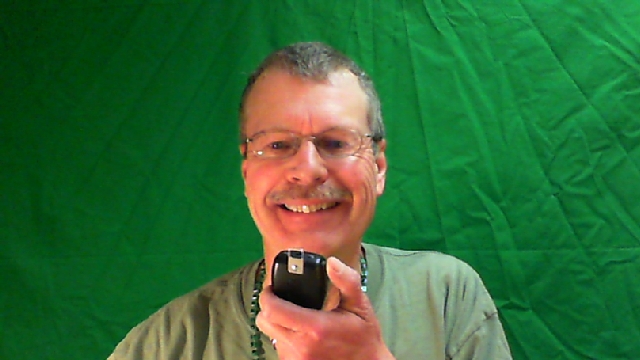
Photo: Pat, WA0TDA, with microphone, sports a green T-shirt, green beads, and a green screen background for St. Patrick’s Day. Hey, if Chicago can dye a river green, we can do this!
Happy St. Patrick’s Day, everyone. This is the first time in my memory that the Irish holiday has fallen on the same day as our weekly newsletter and podcast, so why not just use it as an excuse for a fun way to start our weekly column?
I’m not sure if there are any special ham radio events associated with St. Patrick’s Day, but I do know that there are plenty of parades and other civic events. St. Patrick’s Day is always a big deal in cities like Boston, Massachusetts and St. Paul, Minnesota where there are historical Irish roots. Any time you have a parade or civic event there is an opportunity for amateur radio support in the form of communications. While I know of no amateur radio support for parade activities during today’s activities here in the Twin Cities, amateur radio volunteers do support plenty of other worthwhile civic events. Marathons, bicycle races, walkathons, and other types of parades or large events that cover considerable territory are all candidates for amateur radio communications support.
These types of activities are similar in many ways to the volunteer work that amateur radio operators do in emergencies. However, there is a difference in that many of the communications in an event are much more routine and may be structured in a more informal way than communications in an emergency where a command structure is set up under very specific guidelines. In a public service event, which is what these non-emergency activities are called, your radio club may decide to participate as a group and call for volunteers. It always helps when public service communicators have some training and experience, but public service communication may be a less demanding place to get started than in emergency communications. It all depends on the event and the person in charge of communications. Some events are so large and complicated or cover so much territory or have potential for generating emergency response-style situations that they may be looking for volunteers who are more familiar with a structured incident command system. On the other hand, some events are more easily managed with semi-formal organization and communication. While good operating practice is essential for either, you may want to get your feet wet by helping with communications at one of these smaller events in the realm of public service.
Good communications basics will include knowing how to identify your station, including identification by location if that is the most efficient way to identify and it is what your group has agreed to do. This is called a tactical identification. Of course you do still have to use your FCC-issued callsign periodically as specified by Part 97 rules. A tactical identification might be something like “rest stop five”. At the end of a series of transmissions and every 10 minutes you do have to use your regular callsign. There are many other things to learn about public service communications that will help you learn “on the job” as you gain experience and work toward being a capable volunteer in ARES, able to handle more demanding formal communications within an incident command structure.
In many ways, amateur radio is like other learning activities. If you were to have to learn calculus or how to speak Chinese, you would not begin with differential equations or interpretation of ancient Chinese texts. You would instead choose to begin at, well, the beginning! You would start with simple concepts and easy tasks, practicing and learning incrementally, gaining knowledge every time you study or practice. Amateur radio is a huge and complicated activity when you consider all of the different licensing classes, the many different types of technology, multiple modes of operation, and extraordinary array of on the air activities. No one expects you to get your first license and be able to do everything — and that goes for being a public service communicator. You need to start at the beginning, perhaps volunteering at an event like a St. Patrick’s Day parade. Don’t forget to wear green, and a reflective vest if you are on the parade route.
For Handiham World, I’m…
Patrick Tice, [email protected]

Pat Tice, WA0TDA, is the manager of HANDI-HAM and a regular contributor to AmateurRadio.com. Contact him at [email protected].
G4ILO’s noise
This afternoon I decided to tune around the HF bands to see how they compared with what I heard when I was out mobile yesterday and at the weekend. It was very depressing. I didn’t hear any DX at all. The high noise level obliterated anything interesting and made listening very tiring and unpleasant. From the mobile out in the countryside the only man-made noise was the occasional burst of ignition interference from a passing car and I could copy signals right down to atmospheric noise.
I thought I would use my Pentax digital camera to make a video that demonstrated just what the HF bands sound like from here. It’s a ham radio horror movie.

Julian Moss, G4ILO, is a regular contributor to AmateurRadio.com and writes from Cumbria, England. Contact him at [email protected].
 Ham Radio Deluxe |
 W5SWL Electronics |
 Ham Radio Prep |
 KB3IFH QSL Cards  Hip Ham Shirts  HamRadioAuctions HamRadioAuctions Reliance Antennas Reliance Antennas Enigma Shop Enigma Shop |  morseDX  Ni4L Antennas  R&L Electronics R&L Electronics antennas.us antennas.us QRV QRV |
- Matt W1MST, Managing Editor
