 |
 Interview with the Red Hot Chili Peppers
 1 April 2010 | by
 "I've got it loaded up for 160...the whole tower. Radials all over the [expletive] place. Damn thing was hell to put up!" he said.
Kiedis and Flea laugh as we walk inside. Flea's living room filled with old tube gear of every kind and parts are lying everywhere on tables, shelves and the floor. Amid the mess, various Hallicrafters, Collins, and Drake rigs can be seen, though Flea's affinity for Johnson equipment is obvious as it dominates the landscape.
"I love AM. A bunch of wankers told me AM was old and too wide on the band. I told 'em to [expletive] off and I went to AM and never looked back."
Flea takes us into a back room. A four bay Gates AM transmitter graces the room which is amazingly spotless in contrast with the previous room. Flea flips on a huge breaker mounted to a piece of plywood on the wall and the beast comes to life and a deafening roar of fans and tube air blowers fills the room. We go into the next room which is soundproof and contains his operating position with a mixing board and a high-end Heil microphone on a boom.
Kiedes explains that he currently doesn't have a station, though he often comes over to Flea's shack on the weekend and operates while having a few beers and grilling steaks.
(This is a brief excerpt from my upcoming book, Unknown and Undercover Amateur Radio, due out in September from Simon & Shuster.. )

Anthony Good, K3NG, is a regular contributor to AmateurRadio.com and writes from Pennsylvania, USA. Contact him at [email protected].
Code Requirement
"It has been known throughout the ages that knowing and using Morse code makes one a more whole person. We today officially make it a requirement of canonization....one must know the code to be recognized a saint."The move was applauded by millions in countries throughout the world. "This should keep the quality of saints high" noted one blogger in France. One person interviewed in Times Square in New York City exclaimed "It's about time. This should keep the riff-raff out of sainthood. Several hundred years ago you had to perform real miracles to become a saint. Today you can just feed a few million starving people and, like, instantly you're considered for sainthood. Having to know Morse code will finally raise the standards back to where they need to be."

Anthony Good, K3NG, is a regular contributor to AmateurRadio.com and writes from Pennsylvania, USA. Contact him at [email protected].
A five-star blog
A new posting by Dan KB6NU alerted me to the fact that eHam.net is now allowing users to rate ham radio blogs. I followed his link, selected the Blogs category and found that of all the blogs currently rated, G4ILO’s Blog is (or was, when I went there just now) the only blog that had a rating of five stars! I am amazed, humbled and proud, even if only two people had actually contributed to the rating. 🙂
If you would like to help keep my blog at the top of the table, please pop over to eHam, click on the stars next to G4ILO’s blog and add your rating and comment. Thanks!

Julian Moss, G4ILO, is a regular contributor to AmateurRadio.com and writes from Cumbria, England. Contact him at [email protected].
VOIP contacts now valid for ham radio awards
 With the growing popularity of ham radio simulations like QSONet and HamSphere, I guess it had to happen sooner or later. According to an announcement just out on the IARU website, from today contacts made using these VOIP systems are now officially amateur radio contacts and can count towards amateur radio awards.
The announcement says: “There is an ever increasing use of computer and internet technology to facilitate the making of contacts between amateur radio operators. For many years use of the DX Cluster has been permitted to locate DX contacts to work and many operators now use internet sites to arrange skeds for needed contacts. We also see the development of new digital modes that can make possible contacts between stations that neither side can even hear. Permitting the use of VOIP modes to make contacts is simply an extension of the use of this facilitating technology, by removing the unreliability caused by the behaviour of the ionosphere. This move will also be welcomed by the many radio amateurs living in antenna-restricted locations who are no longer able to be active on what have traditionally been regarded as ‘the airwaves’.”
Addressing the criticism that no radio is actually used when making contacts via QSONet or HamSphere, the statement says: “Many amateur operators nowadays use laptop computers which are connected to the internet via a wi-fi router. This does, of course, involve the use of radio. Initially, therefore, only contacts made using a laptop with a wireless connection will be allowed to count under this new ruling. The frequency should be logged as 2.4GHz. This restriction will be reviewed at a later date.”
More information on this development will apparently be posted on the site at midday today.

Julian Moss, G4ILO, is a regular contributor to AmateurRadio.com and writes from Cumbria, England. Contact him at [email protected].
ITU Declares Texas A DXCC Entity
The United States FCC will no longer issue amateur radio licenses to Texans; all licenses will be issued out of the Republic of Texas government office in Houston. Texan amateur radio licenses will automatically include a concealed weapons permit and VIP parking permits for Chilis restaurants.
Texas, as part of the United States secession agreement, will also assume responsibility for the portion of national debt incurred by Texans. This has been calculated at nearly $5 trillion, or roughly 39% of the current US national debt.
The new Texan TX prefix will become active April 2 at 00:00 UTC and is eligible for DXCC credit.

Anthony Good, K3NG, is a regular contributor to AmateurRadio.com and writes from Pennsylvania, USA. Contact him at [email protected].
CQ2
Martin, G8JNJ, sent me an email with some suggestions for getting the super-regenerative Fredbox receiver to work. He also sent me a link to the blog of Steve, G4AQB, which mentions the Practical Wireless CQ2 receiver design on which the Fredbox receiver is supposed to be based. I remember the name “CQ2” and the picture on the magazine front cover and circuit diagram shown on Steve’s site look similar to the receiver I built in the early 70s to listen to the 2 metre band which finally gave me the interest to get my Class B (144MHz and up) amateur radio license. I seem to recall that the article also had detailed drawings of how the components in the receiver were to be laid out.
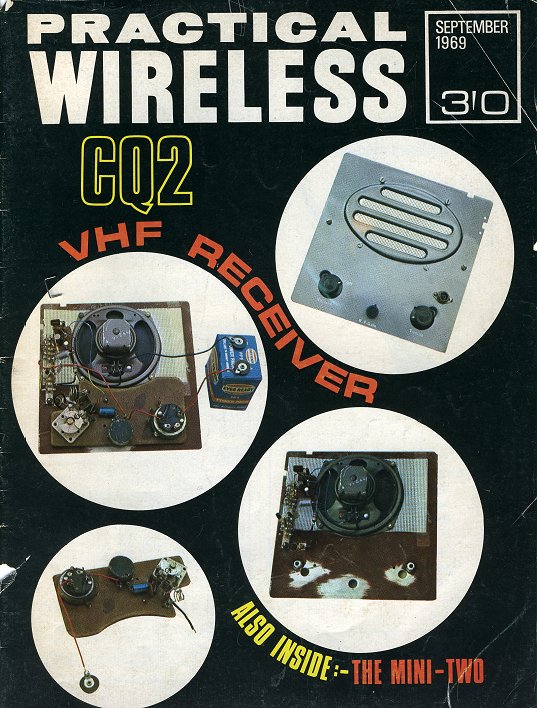 Steve writes that he mounted the receiver on an aluminium front panel but that this played havoc with the tuned circuit so he rebuilt it on a piece of plywood! My memory is pretty poor these days but my recollection is that I built it into an aluminium box of the sort that you could readily buy from the local radio parts shop (those were the days when there were local radio parts shops!), like a box with a lid secured with two self tapping screws. The box stood on its side so the lid was the front panel of the receiver.
Steve writes that he built a quad antenna to use with the receiver. My antenna was a dipole mounted on a wooden stand in my bedroom and fed with a few feet of audio co-ax, since at the time I was ignorant of coaxial cable properties like impedance or loss! In those days I lived with my parents in Rayleigh, Essex. I was able to receive the local police on the CQ2 receiver, as well as amateurs in the Southend area such as Barry G8HNX, John G8IDI and Chas G8HVS. I could receive the GB3VHF beacon from Wrotham, Kent, and also a couple of old-timers who had a regular sked: G6LL whom I think was in Hertfordshire and G5OX who may have been in Ashford, Kent (or perhaps it was the other way round.) This was nearly 40 years ago and I’m surprised I can still remember any of it!
Steve also writes that the radiation from the super-regenerative receiver wiped out the local TVs. I don’t remember that, fortunately, or an end may have been put to my aspirations to be a radio ham before they even started!
But my first proper transceiver – a Hudson AM108 ex-taxi radio that I bought for £5 at the RSGB Woburn Rally in 1973 (which was actually before I was licensed) caused patterning on my parents’ TV on receive! After I got my license I soon found that it caused serious breakthrough on my father’s stereo hi-fi on transmit as well, so my operating was done mobile /M from the car after that.
Later I built my own 4-channel 2m FM transmitter (using tubes, to another PW design) which I used in conjunction with a Microwave Modules receive converter and my short wave receiver (also home built, using tubes, from a PW design.)
So much fun with such primitive equipment! I often wonder if all the technological advances we have today have really added to the enjoyment of the hobby.

Julian Moss, G4ILO, is a regular contributor to AmateurRadio.com and writes from Cumbria, England. Contact him at [email protected].
Showing M$ who’s boss
One of the things that annoys me about Microsoft is that it has created an operating system that behaves as if it is your job to service its needs rather than a tool that is supposed to serve yours.
I’m thinking specifically about updates. Windows constantly nags you to install updates (which wouldn’t be necessary if they’d designed the thing properly in the first place) and then it expects you to interrupt what you’re doing while it does. After you have downloaded updates it nags you to restart the computer in order to install them. Perhaps they could have designed it so you didn’t have to restart the entire OS after every change? When you do shut down it won’t let you switch off while it is installing updates, so you have to wait around twiddling your thumbs until it is finished.
Hey, Microsoft, it’s MY computer, okay?
I just received an update to Internet Explorer 8 (which I don’t even use) today. After it was downloaded, Windows nagged me twice to restart the system by popping up a window in front of what I was doing, even though I was in the middle of writing something and did not want these interruptions to my train of thought.
Fortunately there is a magic incantation you can remember to show Microsoft who’s boss. It’s:
net stop wuauserv
Just click Start, Run, type the magic words into the box and hit the Enter key. What it does is kill the Windows update service for the remainder of that session. Windows will nag you no longer, and your updates will be installed the next time YOU decide to restart.

Julian Moss, G4ILO, is a regular contributor to AmateurRadio.com and writes from Cumbria, England. Contact him at [email protected].
 Ham Radio Deluxe |
 W5SWL Electronics |
 Ham Radio Prep |
 KB3IFH QSL Cards  Hip Ham Shirts  HamRadioAuctions HamRadioAuctions Reliance Antennas Reliance Antennas Enigma Shop Enigma Shop |  morseDX  Ni4L Antennas  R&L Electronics R&L Electronics antennas.us antennas.us QRV QRV |
- Matt W1MST, Managing Editor
