 |
 A stroke of luck
 8 April 2010 | by
  Sometimes you just get lucky. After I repaired the TH-205E I recently won on eBay, I was looking around for ideas on what to do about the dead battery pack and I found someone selling brand new Kenwood KNB-4 battery packs for £2.40. Well, not brand new, but never used, in the manufacturer’s box, though they would have been manufactured some time around 1993. The seller claimed that, although stored for a long time, after three full charge / discharge cycles they should be capable of holding a reasonable charge.
The KNB-4 was not actually made for the TH-205E. However due to Kenwood keeping the same form factor for its hand-held transceivers for several years the newer battery pack is able to be used in the older radio, as I was able to confirm from the W&W Manufacturing website, which claims it is equivalent to the PB-4 accessory battery for the TH-205. This is the large “high capacity” battery, with 1500mAH capacity as compared to the 500mAH of the one that came with the radio. Unfortunately it is only 7.2V which gives a power out of 1.5W according to the manual. It would have been nice to have had the 12V 1200mAH one which gives 5W out but you can’t have everything.
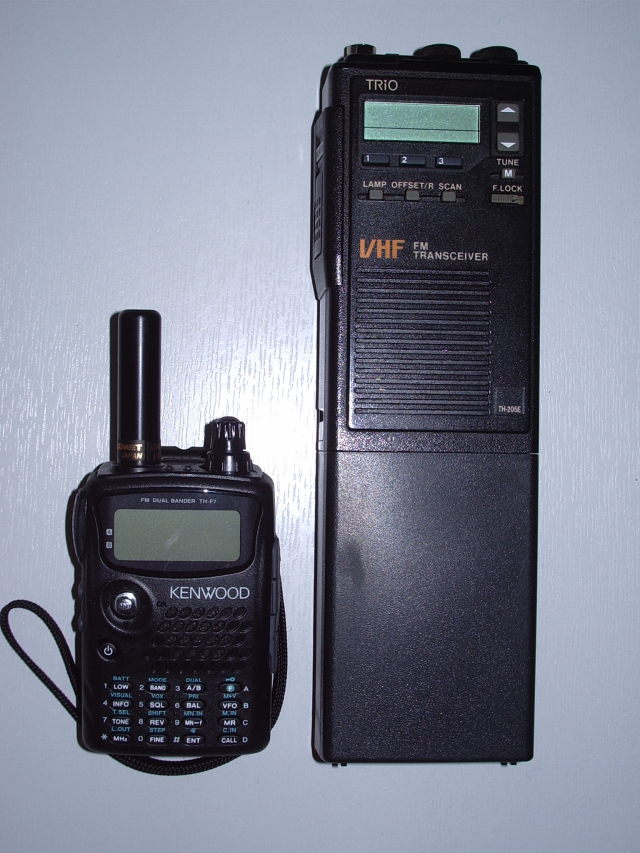 This is a big battery pack and it turns the already large TH-205E into a veritable giant, as the picture of it next to the TH-F7E shows. This is more than just a radio! You give your biceps a workout every time you use it. The radio will hold down your log sheets on a windy hilltop where lesser rigs would blow away and it also makes a handy weapon to beat off any assailants who might try to mug you whilst you are on the air.
Unlike the supplied battery, the KNB-4 doesn’t have its own charging socket, just contacts for a drop-in charger. So I will need to make a drop-in charger for it. I have already made a start using a piece of Veroboard with contacts made from a paperclip. The battery is charging at 240mA from the shack power supply, so after 10 hours I’ll know if it can hold a charge. If it does then I’ll make up a proper constant current charging circuit and put it in a nice box. Then I’ll have a great little, err, I mean great big 2m radio that will certainly attract a lot of attention wherever it goes!

Julian Moss, G4ILO, is a regular contributor to AmateurRadio.com and writes from Cumbria, England. Contact him at [email protected].
Ham Radio Odyssey | XR0Y’s 21st Century Journal | Part Three and Four
XR0Y – Rapa Nui Videoblog – Part 3 from SQ8X on Vimeo.
XR0Y – Videoblog – part 4 from SQ8X on Vimeo.
Rising Cost.
What is the future of DXpeditions given the rising cost of logistics? Is air transportation of equipment sustainable and, or, even economical? I imagine lightweight, flexible expeditions may incur a cost that is par with or exceeds that of the airline ticket, when including premium baggage pricing.
I’m wondering if shipping through Federal Express would actually reduce logistically cost? I have homework given high frequency airwave conditions. The ionosphere is blown out at the moment.
The cost of reaching remote, rarified locations will as ham radio moves toward 2020, require sharing cost from printing analog QSL cards too sponsoring a day worth of meals. Or, team leaders may consider, looking at the menus of alpine expeditions and how they prepare meals at high altitude.
Non-Profits.
The cost of DXpeditions, at least from perspective, continues arcing sharply upwards and one might begin thinking about supporting non-profit organizations like the Northern California DX Foundation (NCDXF) whose mission is, “[A]ssist worthwhile amateur radio and scientific projects with funding and equipment.”
Frankly, the days of privately funding an expedition to rarified locales, is probably peaking.
Conclusion.
Will siege like DXpeditions survive? Will operators around the world need to work a little more on skill and improve antenna systems a little more because big gun DXpedition signals will just cost too much?
Help those helping others and consider making a donation to the Northern California DX Foundation sometime in the near future.
73 from the shack relaxation zone.

Scot Morrison, KA3DRR, is a regular contributor to AmateurRadio.com and writes from California, USA.
EchoLink hotspot update
I just had a reply from the RSGB’s ETCC regarding my NoV application. In a nutshell, applying for an NoV to use a 2m frequency for a personal short-range node is a non-starter as “it would be entirely inappropriate for RSGB to assign one of the scarce channels available within the 2M band for your personal use.” However it is possible to use provisions already in the license for “remote control of your station” to operate on any frequency I choose, without an NoV. So I have asked them to withdraw my application.
As a holder of a full UK amateur radio license, there are apparently no restrictions on frequency or power that I can use for the remote control circuit (other, of course, than those that apply to normal amateur radio operation.) However the link has to be “adequately secure” to prevent unauthorized transmissions. Typically for a legal document, no specific guidance is given as to what “adequately secure” means from a technical point of view. Limiting the power – or, perhaps more importantly, the receiver sensitivity – so that it cannot receive anything other than my own transmissions might be good enough, but I certainly would not consider it adequate security for my WiFi network (though a few years ago, before everyone got WiFi equipment, I certainly used to.)
Using a transceiver that supports DCS like my FT-817 – as I am currently doing – might be considered acceptable, though it wouldn’t take too long for someone to run through all the available codes and find out which one I am using. However I don’t want to use the FT-817 for this forever, I’d prefer to find something cheap that I can dedicate to it, and most of the cheap ex-commercial radios don’t support things like DCS. They also run too much power. So at the moment I’m not sure what the best long-term solution is.
I hate to admit it, but I can see that D-Star has the advantage here. Being digital, it knows who is calling in to the system. I presume that the DVAP Dongle has a facility to limit access to your own specific call, which would solve the security issue once and for all.
Perhaps I’m worrying too much about this. After all, the reason I’m doing this is because there is very little local VHF FM activity receivable from here. Which means the likelihood of anyone accessing my node, even if it was unsecured, is practically zero.
Postscript: I think I may have found the solution.

Julian Moss, G4ILO, is a regular contributor to AmateurRadio.com and writes from Cumbria, England. Contact him at [email protected].
Handiham World for 07 April 2010
Welcome to Handiham World!
Media Hit: NPR reports that ham radio is experiencing a surprising and healthy growth

Image: Phil Temples, K9HI, operates on the HF bands at a recent Handiham Radio Camp session.
We consider any mention of ham radio on a network like National Public Radio to be a real media hit! NPR is reporting that far from being a fading 20th-Century technology, ham radio is instead experiencing healthy growth. The story appeared on the NPR network’s “All Things Considered” afternoon show on April 5, 2010.
There was some interesting listener feedback today – we heard one fellow who took the story to task for not including a mention of amateur radio’s role in emergency communications. You will also find many interesting comments on the NPR website.
HF band conditions remain generally poor as solar wind buffets ionosphere

Image: SOHO solar view as of 7 April 2010.
Spaceweather.com reported last Monday that a solar wind struck Earth’s magnetosphere at approximately 0800 UT and sparked the strongest geomagnetic storm of the year. The event registered 7 on the K index scale.
The ham radio HF bands remain in exceptionally poor shape, with widespread outages. Aurora activity is continuing. Strange whistling sounds are being heard on the HF bands, and usually reliable net frequencies have been nearly wiped out by poor propagation and noise.
One Handiham Remote Base user reported that the station wasn’t working right – he could only hear noise. Of course not all of us have experienced the effects of a widespread solar wind and the resulting poor HF conditions. This morning the Remote Base was checked on 75m, and stations are being heard somewhat better than they were in the past two days.
Today’s Spaceweather.com reports: “NOAA forecasters estimate a 45% chance of geomagnetic activity and a 10% chance of severe geomagnetic storms around the Arctic Circle during the next 24 hours. The source of this activity is a fast and gusty solar wind stream that has been blowing around Earth for two days.”
FCC loses in case regulating Internet service providers

Washington Post: Comcast on Tuesday won a legal challenge against the Federal Communications Commission, in a ruling by a federal court that undermines the agency’s ability to regulate Internet service providers. For more information, visit the Washington Post online.
April Events by N1YXU

As you look through the events page for this month, you will notice there are quite a few activities. I confess my bias in the “Editor’s Pick of the Month” since a good friend of ours is one of thirteen operators who are currently in Iraq. Check out the details, and be sure to listen for them.
Regards,
Laurie Meier, N1YXU
[email protected]
Nets and Emergency Communications Review by WA0TDA

Photo: Patrick Tice, WA0TDA, in his ham radio shack.
Nets & Emergency Communications – second in our series of an operating basics review.
By Patrick Tice
[email protected]
This web outline is based on a PowerPoint presentation that I use to teach these concepts to prospective new hams who have enrolled in the Technician Class course. We are presenting it here because the skills and terms related to nets and emergency communications are so basic to good operating that we can all do with a review. Read the rest on handiham.org, or listen to the audio version.

Pat Tice, WA0TDA, is the manager of HANDI-HAM and a regular contributor to AmateurRadio.com. Contact him at [email protected].
Broken duck
I went for another stroll up Tallentire Hill this afternoon with the TH-F7E. The FT-817 is tied up running my EchoLink hotspot until I can find something cheap I can dedicate to the task – I have my eye on a pair of PMR446 radios that are modifiable to 70cm.
I took along my DIY 2m rubber duck antenna and a “Black Rod” 2m 5/8 telescopic whip that I recently bought on eBay. In case you are wondering, I use an “HT Saver” SMA to BNC adapter to take the strain of the longer whip. But I am seriously considering using the TH-205E for such outings in future, if I can sort out a battery pack for it, because it has a proper BNC antenna socket and is much better suited to use with a large telescopic whip.
The 2m FM channels were not exactly buzzing with activity but I heard the GB3CS repeater 100 miles away and a GW station (Wales) in QSO. I tried swapping the two antennas for a comparison, but could hear nothing on the rubber duck at all. This surprised me, as the last time I did a comparison there was hardly any difference between it and a quarter wave telescopic, and I didn’t expect the 5/8 to make such a huge difference.
The TH-F7E is multimode on receive, so I took a listen on 2m SSB as well. I heard the GB3NGI Northern Ireland beacon much stronger than I can receive it from here. But I couldn’t hear GB3VHF from South East England at all. I haven’t heard it from home at all recently either, although it is supposed to be back on the air after a move to a new location. I guess the new location isn’t as favourable as the one it has operated from for longer than I have held a ham radio license. GB3VHF was the first amateur 2m signal I ever heard, after building my first 2m receiver, so hearing its call in Morse always causes some nostalgia.
I put out several CQ calls on 145.500 and was eventually called by Bill G3WJH in Seaton, only a few miles away by line of sight. I swapped the antennas again, and he couldn’t hear me at all on the duck. Colin, 2E0XSD then joined us, and then we were called by Richard G0IBE/P on Lord’s Seat (a SOTA and WOTA summit) so we all exchanged reports with him for chaser points. Jim G3ZPD from just south of Cockermouth then called in and worked Richard as well. By that time I was getting a bit chilly as it was a lot colder up there than it was at home, so I came back.
On my return I checked the DIY Duck on my antenna analyzer and found an infinite SWR. I pulled off the whip and the copper wire had fractured just about level with the top of the BNC adapter, which is probably the point that experiences the most bending. I guess 22SWG enamelled copper wire isn’t flexible enough to use for a helical antenna. Back to the drawing board.

Julian Moss, G4ILO, is a regular contributor to AmateurRadio.com and writes from Cumbria, England. Contact him at [email protected].
Ham Radio Odyssey | XR0Y’s 21st Century Journal | Part Two
XR0Y – Rapa Nui Videoblog – part 2 from SQ8X on Vimeo.
Stan begins laying out the team’s goal and mission for Rapa Nui.
73 from the shack relaxation zone.

Scot Morrison, KA3DRR, is a regular contributor to AmateurRadio.com and writes from California, USA.
3830 Claimed Scores | 2010 SP DX | Low Power
Multi Single.
- YU1AAV | 156 CW | 211 SSB | 41 Mults | 10hrs | 45,141 Points [YU CC].
n = 1 score submitted in this category.
Single Operator 3 Band (SO3B) [Morse Code].
- N2WN | 35 Qs | 14 Mults | 1,470 Points [TCG].
n = 1 score submitted in this category.
SO3B [Mixed].
- OR2A (ON7YX) | 230 CW | 174 SSB | 47 Mults | 56,964 Points [RR DX].
n = 1 score submitted in this category.
Single Operator All Band [Morse Code].
- SN3C (SP3ASN) | 768 Qs | 119 Mults | 145,180 Points.
- SP3BJK | 662 Qs | 106 Mults | 92,856 Points.
n = 10 scores submitted in this category.
Contest on!

Scot Morrison, KA3DRR, is a regular contributor to AmateurRadio.com and writes from California, USA.
 Ham Radio Deluxe |
 W5SWL Electronics |
 Ham Radio Prep |
 KB3IFH QSL Cards  Hip Ham Shirts  HamRadioAuctions HamRadioAuctions Reliance Antennas Reliance Antennas Enigma Shop Enigma Shop |  morseDX  Ni4L Antennas  R&L Electronics R&L Electronics antennas.us antennas.us QRV QRV |
- Matt W1MST, Managing Editor
