 |
 Handiham World for 28 April 2010
 28 April 2010 | by
 Welcome to Handiham World!
When did “anything goes” become acceptable?

Today we are going to try something completely different. I want you to relax and close your eyes and empty your mind of all of the worries and details of what you are doing right now. Turn down the radio, turn off the television, and prepare to take a trip backward in time. Now, I don’t want to admit that I am “old”, but I have been an amateur radio operator for quite a few decades — since 1967, in fact. For me, this trip back in time will take me to those teenage years in the 1960s when amateur radio first appeared on my horizon and ultimately grabbed my attention with its promise of communications technology and cutting-edge connections to science and learning. These were the days of the great space race when science and technology were really cool things and everyone knows that teenagers go for the “cool” stuff. Gee, today I’m not sure the word cool is even so cool anymore.
Some of you will be older than I am and will be able to remember World War II and the exciting and interesting role communication played during those years. Others will be younger but will still be able to remember a time when they became fascinated with amateur radio and its promise of civic engagement in public service communications, new and exciting technologies, and a great way to make new friends.
One thing that will be common to all of us traveling backward in time today and remembering those first days of fascination with amateur radio will be a good feeling about those who helped us to learn amateur radio and the civil and friendly nature of the amateur radio service. Sure, there may have been more rules about Morse code and keeping a log book, but the more important consideration was the fact that the amateur radio bands were by and large a safe place for a teenager to hang out, for a kid to learn basic electronics, and even for a grandma to work DX.
In fact, no matter how old you are you can probably remember kindergarten or your first few grades of elementary school and how you learned basic civil behaviors like sharing, being polite, not talking while others are talking, and what is and what is not appropriate language and behavior. Your teacher would certainly not allow you to wear a cap in the classroom or get up and start running around during a history lesson. If one of your classmates let loose with a swear word, even a mild one, it would certainly result in a trip to the principal’s office and some sort of punishment. Oh, how we hated to stay after school on a sunny Spring day while the rest of our classmates headed out the school door to enjoy the rest of the afternoon.
Can you guess where this little essay is going?
Well, I have to bring you back to today and reality. Yesterday I was tuning around on the HF bands. Propagation has been rather poor these last few days and I was anxious to find out if there was something wrong with my station after I had been away on vacation for a couple of weeks. You never know; perhaps a feedline had gone bad or something had happened to the antenna system. Anyway, in the course of my travels up and down the HF spectrum I came across a conversation on the 20 m band. As is often the case, I could hear some of the stations on the frequency but not others. Listening for a while allowed me to find out whether propagation conditions allowed communication to the east and west coasts from my location in Minnesota.
It turned out to be a more or less informal roundtable net without a formal net control station. In this kind of a situation, stations just take turns and remember who is next in the roundtable discussion. It generally works pretty well in a small group situation where all of the stations can hear each other. Of course I would not consider entering this roundtable myself, because I could not hear at least two of the other stations, but it certainly wouldn’t hurt to listen along for awhile to see if propagation conditions would change.
That certainly proved to make for some interesting listening.
One of the stations started to go on what I could only describe as a rant about former VP Al Gore and how terrible he is and what a liar he is, and on and on and on. Another station picked up on that theme and spiced it up with several derogatory words that I can only say would not be acceptable in polite company — and that certainly would have gotten him sent to the principal’s office for detention had he been in Mrs. Cunningham’s third-grade class.
Of course at this point my ear was glued to the speaker. How bad could this train wreck of a QSO possibly get? It wasn’t long before I found out.
The roundtable continued along these lines of character-bashing and complaining with nary a single positive thing to say. In due course, one of the stations started tearing into President Obama, saying, “I won’t even call him president; just Obama.”
But wait, folks — that’s not all. This poor guy got himself so worked up about how awful President Obama is that he dropped the proverbial “F-bomb”. Mind you, this is all going out on the air for anyone and everyone with a short-wave receiver to hear. No one in the roundtable group complained about this jeremiad and inappropriate language, at least as far as I could tell. It seemed like everyone in the group was like-minded, joining together in their celebration of stupid, boorish behavior.
Okay, so that’s bad language being used on the air. My wife and I both drive and since we are often in the car together, we observe other drivers and their behavior. We have developed a theory about bad drivers: “When they’re bad, they’re bad.” What this means is that when we see a driver failing to signal or wandering around the road while using a cell phone or some other careless behavior, it is also highly likely that that same driver will exhibit bad behavior across the driving spectrum. For example, that same inattentive driver is more likely to blow a stop sign if they fail to signal and wander back and forth across the driving lane. “When they’re bad they’re bad.”
This same concept applied to the guy in the roundtable who dropped the F-bomb while trashing the President. He went on and on and on talking and talking even though band conditions were changing and the other stations in the roundtable complained over the top of him that they were only getting every third word or so. An operator who has one egregiously bad habit is more likely to exhibit other undesirable and perhaps illegal behaviors on the air, such as failing to comply with identification requirements as set forth in Part 97. When they’re bad they’re bad.
As part of our ongoing operating skills review, I think we need to not only revisit the necessity to comply with basic station identification rules, but we also need to recall a time long ago when we were taught in elementary school to be nice to each other and play well together. Courtesy, respect, thoughtful consideration of other people’s feelings — all of these things are basic to a civil society and good communications skills. Please don’t get me wrong; I am not saying that no one should discuss politics or political figures on the amateur radio bands. What I am saying is that respectful civil language is called for at all times when we are using the shared resource of the amateur radio spectrum. Anyone could be listening. Furthermore, coarse, rude, or inflammatory language demeans and degrades the amateur radio experience for all of us — even for those who were participating in that ghastly roundtable on 20 meters. A coarsening of language pulls everyone down and makes it more difficult to have an honest discussion about any topic.
I don’t care what your politics are or what your religious or other personal preferences might be. When I first got started in amateur radio, I read and heard from others of the time that it was always best to stay away from topics like sex, religion, or politics while on the air. Of course times have changed. Commercial talk radio and cable television news channels cross over into territory where we don’t want to go. Bad language and insulting and demeaning comments along with sexual innuendo might have found their way into these other services, but they are still not welcome in the amateur radio service. If you want to talk about politics, there is no rule against your doing so. If you want to talk religion, you can do that as well. The thing to remember is that as an amateur radio operator you have an obligation — a duty, if you will — to maintain the amateur radio bands as a place for anyone to safely visit for a listen. Political discourse can be polite and civil. Name-calling and bad language will only ruin the bands for everyone else.
So that is my operating skills lesson for today. Think before you speak and always be polite and civil even when you disagree with someone else. Share the bands and remember that children or newcomers to the short-wave bands may be listening anywhere and at anytime. Always be kind and helpful.
And won’t you please use your callsign? Use it every 10 minutes during a conversation and at the end of a series of transmissions to comply with the legal requirements, but use it even more than that to help avoid confusion about who is talking and when. When I teach the Technician class for my local radio club, I tell these new hams to be, “Use your callsign often — you won’t wear it out.”

Pat Tice, WA0TDA, is the manager of HANDI-HAM and a regular contributor to AmateurRadio.com. Contact him at [email protected].
GP300 success
 Two more items for the Motorola GP300 arrived from Hong Kong today, an 1800mAH NiMH battery pack and a charger. I’m a bit dubious about the charger. I put the battery pack on the radio and started charging it, and when I checked six hours or so later the battery pack and radio were really hot. I would have thought the charger should have shut off by that point. So I’ll have to watch the charge times.
I wanted to have another try at programming the radio using a newer version of the software from the hampedia site but when I started up the Toshiba Satellite 1800 and tried to go into the Bios to re-enable the cache (which I disabled yesterday to slow the computer in the hope of overcoming the programming problem) it asked for a password. Somehow when I disabled the cache I must have accidentally enabled a Bios password, but of course as I didn’t do it intentionally I have no idea what the password is. I tried to start Windows 98SE but it took 20 minutes to load and was unusable once it eventually did. So that’s that.
But in the end another solution was found. I registered with the forum at the curiously named Batwing Laboratories website, which apparently is the fount of all knowledge for all things Motorola, and posted about my problem there. Tom in D.C. (W2NJS) replied that the DOS in Windows 98SE wouldn’t do, I must use MS-DOS 6.22.
Now I was programming micros since before IBM invented the PC. I’ve read Ray Duncan’s “Programming MS-DOS” from cover to cover several times so I was pretty much an expert on the subject at one time (though I’ve forgotten just about all of it now) and I would never have thought that there were any differences between the two versions affecting the use of the serial port. But Tom was firm enough in his advice that I downloaded an MS-DOS 6.22 boot CD image and made myself a boot disk. It wouldn’t recognize my Windows 98SE partition so I had to vape that, reformat under MS-DOS 6.22 and set everything up from scratch. Fortunately I still remembered enough about things like config.sys and autoexec.bat to get it to work.
I reinstalled the programming software, connected the interface, and this time I got “Radio Communication OK!” Tom in D.C. probably heard my cheers from there. So I was finally able to program eight 2m frequencies into the radio – five simplex channels plus the three local repeaters – and have just completed two QSOs on the GB3LA repeater from inside the house using a quarter wave telescopic whip, so it works!
The Motorola GP300 seems to work a bit differently to ham radios. For example, there are three power levels but the power level is fixed for each channel, so if I set High power in order to access a repeater from home I can’t reduce the power to Low to save batteries when I’m in line of sight of it from a hilltop. And if you want a Scan function you have to dedicate a channel to that.
Possibly there are some tips for setting up these radios for ham band use that I’m not aware of yet. But even if there aren’t, it’s still a nice radio for £1. Even if by the time you add in the cost of the programming interface, the battery pack, the charger and the adapter that converts the Motorola proprietary antenna socket into a BNC it ended up costing more like £40.

Julian Moss, G4ILO, is a regular contributor to AmateurRadio.com and writes from Cumbria, England. Contact him at [email protected].
Motorola programming frustration
The renovation of the G4ILO shack is about half completed. The wood for the new shelf module needs another coat of paint, then it can be built and everything put back in again. Unfortunately old age is catching up with me and I am just sooooo tired and have so many aches and pains from all the work so far that progress is (literally) painfully slow. I missed the talk on SOTA at the radio club on Monday evening because I would probably have just fallen asleep!
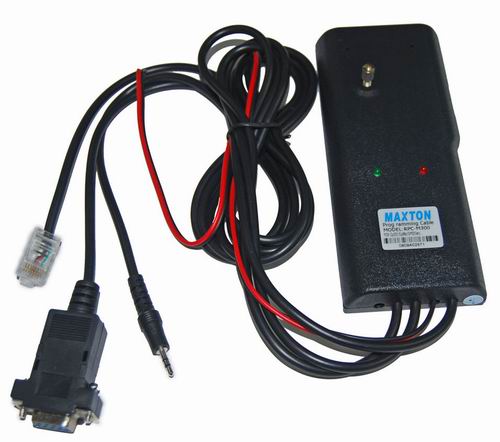 After the flying hiatus some items I ordered from China and Hong Kong are starting to filter through including the programming interface for the Motorola GP300 radio. It is a Maxton RPC-M300, pictured on the right, and it came with a CD containing the necessary programming software. (The software can also be found on the hampedia website, so please don’t ask me for a copy.)
The software runs under real MS-DOS, not a DOS window. My researches had already established that it doesn’t run properly on newer, faster computers, so I installed it on the oldest PC I had available, a 2002 vintage Toshiba Satellite 1800, which happens to have both a floppy drive and a serial port. It doesn’t have network access, so getting anything on and off it is a bit of a headache, but I still have a copy of a Windows 98SE install CD and the required boot disk, so I was able to use that to provide the MS-DOS access.
No instructions came with the interface. It’s obvious that it clips on the back of the radio, and the red and black wires are used to provide power, but there is no indication of what voltage to use. Some DIY interfaces that have been published use a 9V battery so I set the variable power supply to 9V. The other two plugs – one like a telephone plug and the other a 3.5mm stereo jack – are presumably for other radios that the interface can be used with, so I left them dangling free.
I applied power and the red light on the interface came on. I then tested communication between the software and the radio, and the green light flashed for a few seconds, then I got an error #2 “No acknowledgement.” I tried again, this time after switching the radio on with the volume control, but then I got an error #7 “Invalid opcode.”
I had read that the programming software may not run properly on any Pentium computer at all, due to its use of timing loops. One of the suggestions to slow a faster computer down is to disable the CPU cache, so I went into the Bios and did this. This didn’t make any difference to my inability to program the radio, but it did make Windows 98 take 20 minutes to load and be unusable once it has done so. Unfortunately I discovered this morning that I had somehow managed to set a password on the Bios which of course I don’t know, so now I can’t get back in to the Bios to re-enable the cache. 🙁
It seems as if I will have to give up on the idea of programming this radio myself. My only hope now is that someone at my radio club is able to help with this. Unless anyone has any other suggestions?

Julian Moss, G4ILO, is a regular contributor to AmateurRadio.com and writes from Cumbria, England. Contact him at [email protected].
Today’s silver lining
Today’s bad news is that the toothache that I’d had for about a week hadn’t gone away this morning, and after my dentist took a look yesterday and tried one thing to fix it that didn’t work, this morning I made an appointment with an endodontist to see if I needed to have a root canal on that tooth. The folks in his office were nice and managed to get me a late-morning appointment, which meant that I’d work from home in the morning (the endodontist’s office is only about 10 minutes from home, so going all the way to work in Secaucus and coming back made no sense) then head to the appointment. (The other bad news is that I did indeed have the root canal procedure done. The procedure itself wasn’t so bad, but now that the anesthetic has worn off it’s pretty uncomfortable.)
As usual, when I work from home I usually leave that packet cluster up and running, and this morning was no exception. I saw a spot for Charlie, VR2XMT in Hong Kong on 20m, which is another entity that I still needed to work. I’ve heard Charlie before and even tried working him but hadn’t had any success. While working on some emails for work on my laptop, I tuned to the spot frequency and heard Charlie’s very strong signal. I called him several times but wasn’t able to get through, so I turned down the volume a bit and kept listening while working. After a while it seemed that there weren’t as many callers, and in fact it got to the point where there seemed to be nobody calling at all, so I gave my callsign a few times in response to Charlie’s “CQ”, and he responded to “the station ending in Echo Bravo Kilo”. I figured that he might have been calling me so I called phonetically a few more times and sure enough, he was calling me. We exchanged 5×5 signal reports, I thanked him, and I had a new one in the log!
Unfortunately, Charlie doesn’t participate in Logbook of the World, but since this is an all-time new entity I would have been sending for a paper QSL card anyway, which I will get in the mail very soon. It’s always great to work a new DXCC entity, and it was especially great to have worked my 2nd new one this year within less than a week of working the previous one.

David Kozinn, K2DBK, is a regular contributor to AmateurRadio.com and writes from New Jersey, USA. Contact him at [email protected].
LHS Episode #038: XDX ‘n Stuff
 The season of Linux fests is now under way. The Texas Linux Fest took place a couple of weeks ago. By all accounts, the turnout was excellent, the educational opportunities were plentiful and fun was had by all.
Oggcamp in the UK is next on the list. Then there will be ham fests and Linux fests all over the country and the rest of the world for the rest of the spring, summer and early fall. Linux in the Ham Shack will be represented at the Dayton Hamvention in May and at the Southeast Linux Fest in June. I’m also trying to start a new Linux fest called the Mid-America Linux Fest which will be held in early November. It’s possible that could be November of 2010, but it’s more likely to be November 2011. If you want more information about the Mid-America Linux Fest or are willing to volunteer your time or services, please check out the Web site at http://midamericalinuxfest.org.
And yes, I know this episode of Linux in the Ham Shack is late. Life has been very busy of late and I think all of our listeners for your eternal patience. We hope to see you at the live recording of Episode #037 on April 27th at 8:00pm.
73
Russ Woodman, K5TUX, co-hosts the Linux in the Ham Shack podcast which is available for download in both MP3 and OGG audio format. Contact him at [email protected].
3830 Claimed Scores | 2010 NS Summer Ladder VIII | Low Power

Atlantic Single Operator.
- NO3M | 53 Qs | 39 Mults | 2,067 Points [NCC].
- N4AF | 49 Qs | 35 Mults | 1,712 Points [PVRC].
- W4OC | 49 Qs | 34 Mults | 1,666 Points [SECC].
n = 10 scores submitted in this division.
East Central Single Operator.
- N4OGW | 53 Qs | 36 Mults | 1,908 Points [ACG].
- K9BGL | 51 Qs | 36 Mults | 1,836 Points [SMC].
- W9RE | 51 Qs | 35 Mults | 1,785 Points [SMC].
n = 16 scores submitted in this division.
West Central Single Operator.
- WD0T (@KD0S) | 52 Qs | 37 Mults | 1,924 Points.
- K0AD | 48 Qs | 35 Mults | 1,680 Points [MWA].
- N3BB | 48 Qs | 35 Mults | 1,680 Points [CTDXCC].
n = 10 scores submitted in this division.
West Single Operator.
- KQ7W | 49 Qs | 35 Mults | 1,715 Points [Kaunas Univ of Technology].
- K0UK | 37 Qs | 25 Mults | 925 Points [Grand Mesa].
- KI7Y | 21 Qs | 14 Mults | 294 Points [WVDXC].
- K7SS | 1 Q | 1 Mult | 1 Point [WWDXC].
n = 4 scores submitted in this division.
NCCC in CA/NV Single Operator.
- K6VVA | 56 Qs | 37 Mults | 2,072 Points.
- N6RO | 51 Qs | 36 Mults | 1,836 Points.
- N6ZFO | 48 Qs | 33 Mults | 1,584 Points.
n = 7 scores submitted in this division.
Three more Qs in the log is enough and congratulations Ric, K6VVA on a stunning victory for his remote station while propelling the North California Contest Club into this week’s banner position!
His commitment to the fastest 30 minutes in RadioSport paid significant dividends. I’d call this a 12th round, gone the distance competition between Ric, K6VVA affectionately known as “The Locust” and Eric, NO3M.
Contest on!

Scot Morrison, KA3DRR, is a regular contributor to AmateurRadio.com and writes from California, USA.
QRP TTF 2010 * Disappointed in Orlando!
On the road again… happy feet dance! K4UPG is loaded and ready for a good day by the lake operating the QRP To The Field event for 2010.

K4UPG ready to roll to QRP TTF site

Loaded with ALL the options!
Then came the wind knots in the antenna launching rig! I wanted to get a doublet up as high as possible. Took nearly 2 hours to get my antennas up in the air. LESSON LEARNED: It is really helpful to have another person along to help untangle all the knots that wire and string seem to make all by themselves. Getting the antenna up quickly is a key to portable ops. Grrrrr!

One of several tangled messes that delayed the antenna deployment
LESSON TWO: After a delayed start, I spent a lot of time moving my portable table to keep out of the direct sun! With temperatures in the upper 80′s it was HOT and direct sun causes my Sierra to drift a bit which makes qso’s more difficult. Need to get a sun shade setup and not waste time moving my position.
The band conditions were pretty poor and I did not hear as many stations as I had hoped. The ones I did work were tough going and seemed like others could not hear me responding to their CQ’s. I didn’t even hear a lot of Florida QSO party ops, but sounds like others that were farther away did. In 5 hrs I managed three whole qso’s with TTF stations. I did hear one Polar Bear– Martin operating as VA3OVQ but he could not hear me when I replied to his CQ.

Warning sign about 30 feet from my operating site!
It was fun to be outdoors and playing radio! I did not get eaten by our neighborhood gator either! Maybe next time out will be better contact-wise.
Kelly McClelland, K4UPG, is a regular contributor to AmateurRadio.com and writes from Florida, USA. Contact him at [email protected].
 Ham Radio Deluxe |
 W5SWL Electronics |
 Ham Radio Prep |
 KB3IFH QSL Cards  Hip Ham Shirts  HamRadioAuctions HamRadioAuctions Reliance Antennas Reliance Antennas Enigma Shop Enigma Shop |  morseDX  Ni4L Antennas  R&L Electronics R&L Electronics antennas.us antennas.us QRV QRV |
- Matt W1MST, Managing Editor
