 |
 10m portable whip
 15 May 2010 | by
 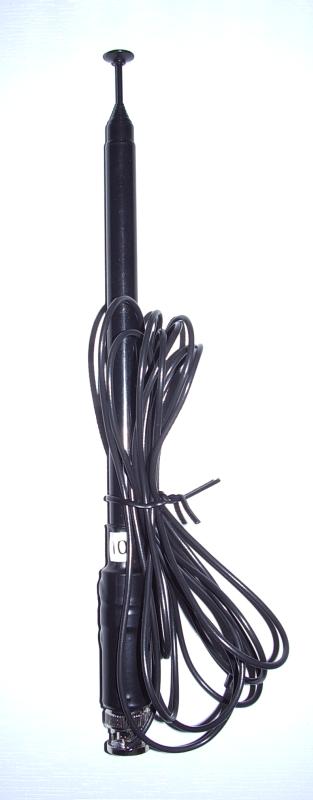 My reason for getting the Intek H-520 Plus hand-held was to try to work some Sporadic-E DX from the great outdoors. I didn’t think the supplied 18cm whip would be much good for that so I looked for the longest 10m BNC whip antenna possible. The best I could find was the AT-10 with a 4 foot telescopic whip which I believe is made by Sandpiper Antennas in Wales. It is sold by Waters and Stanton. I ordered one yesterday and it arrived in the post this morning – nice to see they can get it right sometimes.
The first thing I did with the antenna was put it on my AA-200 antenna analyzer. I was dismayed to find that the SWR on 10m was more than 10:1 and the best match was around 38MHz. I anticipated that this would be going straight back. However the instruction sheet “Getting the best out of your antenna” recommends using it with a counterpoise. I had expected to use one for best performance anyway, so I decided to try this before writing the antenna off completely.
The instruction sheet recommends a length of 6ft 5in for 10 metres, but I found that was too short as the best match was still well above 30MHz. By trial and error I eventually found a length of 7ft 6in was about right. The best SWR was still only 2:1 so I think the antenna is capable of improvement, but there is nothing else available to the best of my knowledge.
If a counterpoise is required you might think it would be a good idea for the manufacturers to provide somewhere to attach one. I tried using an alligator clip but it tended to slip off the BNC connector. In the end I managed to solder to the outer sleeve of the BNC connector using my biggest soldering iron turned up to maximum temperature so the counterpoise is now permanently attached to the antenna (until the wire breaks off, which it will probably do in the middle of a field just at the start of a massive band opening.)
Now I just need some Sporadic-E to see how far it is possible to work with a hand held radio.

Julian Moss, G4ILO, is a regular contributor to AmateurRadio.com and writes from Cumbria, England. Contact him at [email protected].
RadioSport History | CQ World Wide DX CW 1980

RadioSport is fun although the level of fun one seeks is another matter. Certainly, the sport where wireless technology meets human skill and intellect, is my favorite niche within ham radio. My passion remained even during those days in uniform or while attending graduate school. Whatever the measure of one’s station, what really counts at the end of the day, is how one shares their enthusiasm for the game.
Perhaps, after all the trophies and certificates are won, what really matters is the moment when a rookie operator gets it.
The measure of our success is best exemplified by Doug, N6DFY and his smile.
Nuts and Bolts.
I hope a frank and earnest discussion begins regarding the trajectory of RadioSport and a bold vision is developed. Afterall, this is Dayton weekend, when the movers and shakers of the game gather for pizza inside the Contesting Suite. I believe such a vision is beginning to develop out of the genesis of the World Wide Radio Operators Foundation (WWROF).
I’m not going to besiege with a list of complaints neither do I want to point a finger at anyone organization, institution, or individual. What I want is leadership, bold vision, courage, and something to believe in again.
The task before WWROF is not an easy one, in fact, why create a non-profit dedicated to improving the skills of amateur radio operators, if there was not a need?
Brockman and Cox (1981) pointed out padding in the logs, excessive dupes, sloppy copy, and operating outside one’s privileges to mention a few as problematic. However there something called honor, courage, and duty.
Please, if one is reading my blog in Dayton, take a moment and reflect about qualities rarely discussed anymore. Leadership. Honor. Courage.
I hope that in between all that is going on in Dayton that our movers and shakers take time to reflect as well. I believe WWROF is a good step forward in addition they are willing to confront the challenges ahead with leadership, vision, and courage.
73 from the shack relaxation zone.
Reference: Cox, B. K3EST, Brockman, L. N6AR (1981, October). CQ Magazine: 1980 CQ World Wide DX Contest: C.W. Results. pp. 13 – 16, 18 – 20, 22 – 27.

Scot Morrison, KA3DRR, is a regular contributor to AmateurRadio.com and writes from California, USA.
New DVAP dongle
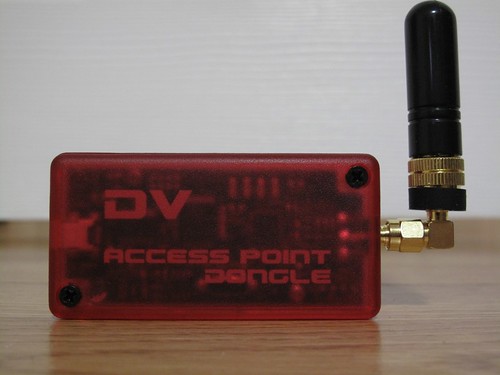
I recently acquired a DV access point (DVAP) dongle from HRO. This is a very interesting piece of D-STAR equipment. It is a 2m transceiver that is connected via a USB 2.0 port to a computer, which has to be connected to the internet. This then allows the dongle to be effectively a simplex repeater passing D-STAR signals on and off the D-STAR network. So using my IC-91AD HT I can link to either D-STAR gateway repeaters or reflectors and talk to other operators. The audio quality is very good. I have heard other operators using theirs and I have had good reports when using mine. Output power is 10mW (but can be lower) and I can link to the dongle from around the house. So I can make contacts around the World on the D-STAR network from the comfort of an armchair or whilst sitting outside on the deck.
The device is made in the USA and it is very well put together and packaged. Even the supplied USB cable was a quality molex brand cable. (Please note you must own a 2m D-STAR radio to use a DVAP, it will not convert FM to D-STAR. If you do not have a D-STAR radio consider the DV Dongle.)
Here are a few videos that talk about the DVAP dongle.
First an overview from the US National Capital Radio D-Star Association. They talk about the DVAP dongle for about the first 2 minutes then go on to talk about other equipment.

Next a detailed DVAP demonstration by Tim, G4VXE,
Finally HRO has them in stock!


Alan Steele, VA3STL, is a regular contributor to AmateurRadio.com and writes from Ottawa, Ontario. Contact him at [email protected].
A License to …
Jeff, KE9V, posted a note today about all of the bellyaching that goes on over the Hamvention venue at Hara Arena in Dayton, Ohio, also occasional home to Bill Goodman’s North American Gun and Knife Show (“Tell a buddy, bring a friend…Don’t you dare miss it!” the jingle goes). In fact, according to the Hara calendar, it appears to host almost monthly gun and knife shows. But, I digress. I’m delighted that Hara is near my in-laws’ home should I ever wish to make a last-minute appearance—yes, it’s tempting to get in the car tonight. And, I digress farther. The point of this post is to explain the pervasive grumbling, finger-pointing, and misinformation, that spews forth from a vocal minority of the amateur community.
I was sitting in 8th grade math class adrift in daydreams as the teacher reviewed yet another topic from a prior grade. Clearly, this was a widely-perceived problem, because one of my classmates persisted in talking to several others around her. Finally, the teacher became so exasperated that he asked, “Young lady, do you have a license to talk?” Of course she did not, but I chuckled noting that, as a newly-minted General class amateur radio operator, I had a license to talk. I tucked that away for future use and went back to whatever it was I was daydreaming about. And today, some 16 years later, the thought sprung into my mind as I read Jeff’s blog.
Another curious coincidence contributed to this confluence of cogitation. As I was eating my lunch, I happened across an old KK7B paper from the Proceedings of Microwave Update ‘94 entitled “Simply Getting on the Air from DC to Daylight.” It’s not a particularly technical paper. It is about the art of doing radio and it was fun to read. In the first three paragraphs, he writes,
In the not-so-distant past, the primary emphasis in amateur radio was putting a station on the air…Sometime in the ’70s the ARRL stopped calling amateur radio a technical hobby and started referring to it as a communications hobby.
Brilliant. I’d like to update that for the present,
In the not-so-distant past, the primary emphasis in amateur radio was communication via radio…Sometime in the ’00s, realizing that it had lost the communications game to telecom deregulation, mobile phones, and the Internet, the ARRL stopped calling amateur radio a communications hobby and started referring to it as an emergency service.
So, where does that leave us? Well, we have a technical license exam structure impressed upon a group of people who are enthralled with communication but use the Internet because it’s easier. No wonder anybody who reads about ham radio on the Internet thinks we’re up a creek!
I’m going to go make a CW contact or melt some solder to cheer myself up. In the end, we have a license to communicate via radio. Let’s use it.
Ethan Miller, K8GU, is a regular contributor to AmateurRadio.com and writes from Maryland, USA. Contact him at [email protected].
Fun on 10 FM
 As some of you know, I’m a bit of a sucker for hand-held radios. Whilst browsing eBay I’d often come across the Intek H-520 Plus CB hand-held and thought what a nice looking rig it was and wouldn’t it be nice if it could be converted to amateur 10m usage. A couple of days ago I stumbled across a site that gave the details of how to convert it for amateur 10m use so I decided to order one. It arrived this morning.
Never has a radio been taken apart so soon after its arrival. (Real hams don’t care about warranties!) Unfortunately, no matter how hard I tried, I couldn’t find again the site that had the modification information, but I vaguely remembered the details. Beneath the battery compartment there is a loop of wire. Snip it and push the ends apart. I’m not sure what that does. Now put the batteries back in and turn on the radio whilst depressing the Menu button. You can then select the option “Po” by pressing the down arrow button. Press Menu again, then press and hold the up arrow button until the frequencies displayed are in the 29MHz region. You now have a 10m FM / AM hand held.
Whilst I was doing this I was WSPRing on 10m and I saw some very strong traces from stations in Germany indicating that there was short-skip Sporadic-E on 10m. Were conditions such that I would actually be able to make some contacts with the new radio today?
The antenna supplied with the Intek H-520 Plus is about 15cm long so I suspect it will be less than useless for making any DX contacts. Clearly what I need in order to use this as a portable radio is some kind of long BNC 10m antenna, but at the moment I don’t have one. The H-520 comes with a “car kit” which screws to the bottom of the radio and allows you to power it from an external supply and connect an antenna with a PL-259 plug. So I hooked it up to the shack supply and the attic dipole.
I tuned around and there seemed to be things going on, so I found a clear frequency, 29.520MHz, and called CQ. After a few seconds jack PE1JRP called CQ on the same frequency. I called him and we made contact. He found my signal was up and down, as I did his, but he gave me a 53 report. He said that Leo PA3ELQ was waiting on the frequency and he then called, for my second contact. My report in this case was 57. They were both pretty impressed with my signal running – as I thought – 4W output.
I decided to check the H-520 Plus on my power meter and found that, far from putting out the advertised 4 watts, it was only radiating a whisker over 2. I took it down to the CB channels and even there it was giving barely 3W output. I also recalled that the web page that I could no longer find mentioned the need to turn up the deviation for 10 FM use.
 I managed to locate and download a service manual for the H-520 Pro and this gave a procedure for adjusting the power. I had to turn the power control pot all the way up and I still only got about 3.6W on battery power (and just about 4W when running from the car adapter.) That’s good enough, though. From the block diagram I also was able to identify the FM modulation pot and turned that up a bit, though neither of the Dutch stations had complained about my audio. In the picture above, the red circle shows the wire loop that you cut, the green circle shows the power out pot and the blue circle the modulation control.
With the radio back together I hooked it up to the dipole again and worked Oliver DH5PK, receiving a 53 report. I am quite happy with my three contacts considering that I only opened the box after lunch and the radio spent much of the time disassembled. I saw from VHFDX.info that there was a great opening on 6 metres at the same time, but making contacts with less than 4W of FM is more challenging.
What I’m hoping, of course, is that I can make some contacts like this using the H-520 Plus as a hand held radio with a whip antenna!

Julian Moss, G4ILO, is a regular contributor to AmateurRadio.com and writes from Cumbria, England. Contact him at [email protected].
Why the shack-in-a-box?
There is speculation at the moment about whether Icom will release the new IC-9100 top band to 23cm transceiver at Dayton, and what the price will be.
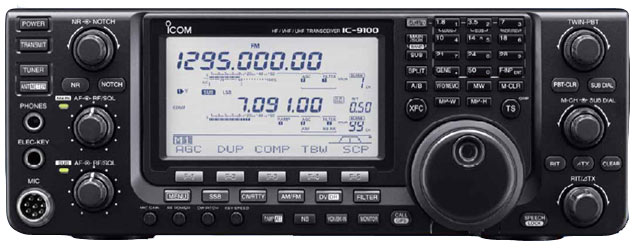 I wish someone could tell me why there is this trend towards do-everything shack-in-a-box radios instead of separate VHF/UHF rigs like the now discontinued IC-910H which I just bought? One of the reasons I switched from using a transverter to having a separate rig for VHF is that I can’t use HF and VHF at the same time. An all-in-one radio would have just the same limitation.
Just because technology makes it possible to cram everything into one box doesn’t mean that there is no longer a reason to have separate radios. If you want a new multimode radio for 2m or 70cm you have to buy an FT-817, FT-857, FT-897 or TS-2000 – which are all compromise rigs with fairly poor performance – or wait for the IC-9100. No wonder good single VHF band multimode rigs like the IC-275H are now worth their weight in gold bullion.

Julian Moss, G4ILO, is a regular contributor to AmateurRadio.com and writes from Cumbria, England. Contact him at [email protected].
Handiham World for 12 May 2010
Welcome to Handiham World!
Courage Center Development Officer Walt Seibert Passes Ham Radio Exam

Photo: Walt Seibert, left, gets congrats from Pat, WA0TDA.
Another New Ham
Congratulations to Walt Seibert, who passed his Technician licensing exam at the Handiham-affiliated Stillwater Amateur Radio Association VE session last Thursday. Walt works with me at Courage Center, and we have known each other for many years. As one of his duties in the Courage Center Development Department, Walt traveled with me one year to Dayton HAMVENTION and with the help of our colleague Tom Olson put on a “meet and greet” development event in support of the Handiham program.
So Walt is no stranger to ham radio, and when he decided to pursue his Technician Class amateur radio license, we were thrilled. There is nothing like being able to “walk the walk and talk the talk”, and if you are going to ask potential donors to support an amateur radio education program for people with disabilities, it certainly helps to have an amateur radio license yourself. I know that Walt was amazed at the size and scope of Dayton HAMVENTION. The amazing technology, the friendly folks who visited the Handiham booth, the fun and fellowship — I guess it isn’t surprising that amateur radio looked pretty good.
Of course Walt is always busy at work, helping Courage Center to earn the trust and support of those who believe in our mission to help people with disabilities. For a time he was interested in amateur radio but couldn’t take the time to pursue it because of his other professional development studies and the demands of work. However, the stars finally aligned for Walt, and he decided to earn his Technician. We helped with study materials and links to amateur radio practice exam websites. Soon Walt was reporting back to us that he was passing practice exams on a regular basis, and then every time he tried. We set up Walt with an upcoming VE session and crossed our fingers.
I am a member of the Stillwater Amateur Radio Association VE Team, so I was pleased to see that Walt showed up at our Thursday evening testing session, which meant that I would be able to personally give him the good news when he passed the test. As expected, Walt did a great job on the examination and I was able to perform one of my favorite duties as a volunteer examiner: giving a successful candidate the good news!
Congratulations to Walt, who is now waiting for his callsign to appear in the database.
Guide Dog Trawler passes away quietly

Folks, it is with much sadness that I report the passing of guide Trawler. He gave no indication of any health issues. He guided at church last Sunday, and we went to the Plymouth Senior Center yesterday, where he worked well as usual, steps and all. All was normal the rest of Monday. This morning, Tuesday, Pam found him on his sleeping mat next to our computer. He was in his normal sleep position, no sign of any trauma. Pam feels it was his heart. Trawler would have been ten years old July 4 of this year.
I would like to have my ham radio friends on the net and camp staff know of this, so could you forward the information?
Jerry Kloss, N0VOE
Editor’s note: Trawler guided Jerry, Handiham Volunteer & Student Coordinator, through years of Radio Camps and Handiham activities. A true team, they worked so well together that it was fun to watch them travel with confidence and poise. Our hearts go out to Jerry and his wife Pam in their time of loss, for losing a treasured animal and guide leaves a hole in your heart.

Pat Tice, WA0TDA, is the manager of HANDI-HAM and a regular contributor to AmateurRadio.com. Contact him at [email protected].
 Ham Radio Deluxe |
 W5SWL Electronics |
 Ham Radio Prep |
 KB3IFH QSL Cards  Hip Ham Shirts  HamRadioAuctions HamRadioAuctions Reliance Antennas Reliance Antennas Enigma Shop Enigma Shop |  morseDX  Ni4L Antennas  R&L Electronics R&L Electronics antennas.us antennas.us QRV QRV |
- Matt W1MST, Managing Editor
