 |
 Announcing HOLeS
 22 May 2010 | by
 We're still finalizing our complete feature list and rate schedule, but here are the basic options and rates so far:
Base Packages:
Basic Service $99.99/month
Deluxe Service (your own URL like www.mydomain.com): $125/month
Options:
QSL Card Printing Capability: $25/month (Lets your users print out cards)
Awards Programs: $50/month (Offer your own awards like WAS and DXCC)
RSA QSL Card Authentication: $25/month
Triple DES QSL Card Authentication: $50/month
Modern Logbook Program Uploading Capability: $75/month
DOS or CP/M Logbook Program Uploading Capability: $250/month
Logger32 Program Uploading Capability: $450/month (Support for Logger32)
Ham Blacklist Feature: $125/month (Lets you block select users)
Rare Country Shopping Cart: $200/month (Lets your users buy rare countries and you make $$$!)
HTML Frames and Notepad Support: $25/month (You can customize your site with Notepad and use frames)
Alternate Fonts: $85/month (Use fonts other than Times New Roman on your site)
As with LOTW, eQSL, and QRZ.com, all online logbook sites hosted on HOLeS will be totally incompatible with other online logbook services and will not interface with them to exchange QSL information. This includes other online logbook services hosted on HOLeS.
Later this summer we're also going to offer a ground-breaking service called Logbook Uploader of the World or LUTW. This service will manage multiple online logbook subscriptions for amateurs, giving them a one-stop-shop to upload and download their logs and QSLs. Users will pay a LUTW subscription fee, and LUTW will pay subscription fees for all the online logbooks the user wants to manage through LUTW. LUTW adds a 40% service fee per managed online logbook, but we feel this will be well worth it to manage tens or hundreds of online logbook subscriptions, potentially savings users hours of frustration uploading and downloading time and having to deal with logbook program compatibility issues.
We're proud at The K3NG Report to support the needs of amateur radio operators and to be on the forefront of technology in this great hobby. Stay tuned for more announcements!

Anthony Good, K3NG, is a regular contributor to AmateurRadio.com and writes from Pennsylvania, USA. Contact him at [email protected].
10m open to the north
Once again, WSPR is revealing the existence of consistent propagation paths every day on 10m between Iceland (TF), the Faroes (OY) and northern Norway (LA/LB) and the UK and north-west Europe when there is no Sporadic-E and no other propagation except over very short distances between closely located stations. This has occurred even during periods of zero sunspots.
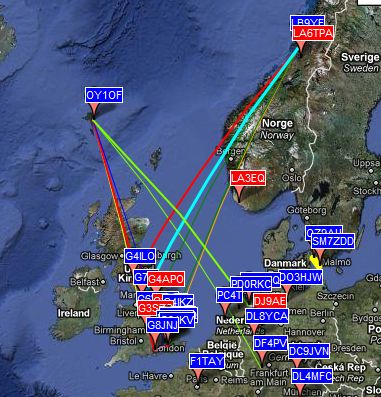 I’m guessing that because we have only in the last few weeks had a large number of WSPR monitors on 10m because of the Sporadic-E season, no-one has previously observed it. But I’m surprised at the lack of comment about it. Perhaps this is a phenomena known to everyone but me, in which case I’d welcome some enlightenment.

Julian Moss, G4ILO, is a regular contributor to AmateurRadio.com and writes from Cumbria, England. Contact him at [email protected].
QRZ.com to offer logbook
QRZ.com has just announced that it will be making available an online logbook. It will also be offering an awards program and will be organizing a contest to recognize the first person to make confirmed contacts with 100 other QRZ users.
I like QRZ.com and think this is a great idea. I don’t know whether they will be providing an API for logging programs to post entries to the log in real time but if they do then I want my program KComm to support it so I have volunteered my services as a tester.

Julian Moss, G4ILO, is a regular contributor to AmateurRadio.com and writes from Cumbria, England. Contact him at [email protected].
Ten Tec HB-1A
From John Harper AE5X’s blog I have discovered that Ten Tec will be re-branding the Chinese HB-1A QRP CW transceiver. The Ten Tec versions aren’t exactly the same – they will be selling two versions, one covering 40 and 30 metres and one covering 30 and 20 metres whereas the original covers 40, 30 and 20. This may have something to do with meeting FCC spurious emissions specifications.
 As it happens, my HB-1A is on eBay at this very moment. Not that there is anything wrong with it, just that it doesn’t do anything that my FT-817 can’t do and I’ve spent quite a lot on new radios recently so it seems right to dispose of some of the ones that aren’t being used.
But its performance wasn’t exactly spectacular. It’s a bit sad to see the company that made and discontinued the Argonaut 516 HF QRP rig and matching 526 6’n’2 metre rig offering such a basic radio as its only QRP product.
I’d love a Ten Tec 516 / 526 pair, so if anyone has one in mint condition that they’d like to sell or trade for an Elecraft K3/100 drop me an email.

Julian Moss, G4ILO, is a regular contributor to AmateurRadio.com and writes from Cumbria, England. Contact him at [email protected].
A couple of setbacks
Computers and radio really don’t mix. I was trying to connect the FT-817 to the shack computer. I plugged the USB cables into the back of the PC, then as I lifted the cables vertical to feed them behind the shelf unit I heard the noise level on 2 metres come up quite clearly. I could probably reduce the noise using clip-on ferrites but any more noise than I already have is unwelcome. I think I might give up the computer altogether and go back to paper logging!
I also proved today that it isn’t possible to work satellites with indoor antennas. Yesterday I tried receiving AO-51 with the 3/4 wave vertical I made, but I got a readable signal for only a few seconds. Today I tried the 6 element Yagi I made a few weeks ago which received signals off the Moon when used outdoors. Pointing it at the satellite from inside the shack I again heard only a few seconds of signal from the satellite. I think there is just too much attenuation at 70cm to use indoor antennas, so satellite operation is out of the question.
I could probably combine the 6-element 70cm and the Moxon 2m antenna to make a portable hand held antenna for satellite use. But whilst it would be an interesting challenge to make a satellite contact using the FT-817 and a hand held antenna out of doors I had really hoped to be able to do it from inside the shack.

Julian Moss, G4ILO, is a regular contributor to AmateurRadio.com and writes from Cumbria, England. Contact him at [email protected].
More on the TS-930S PA
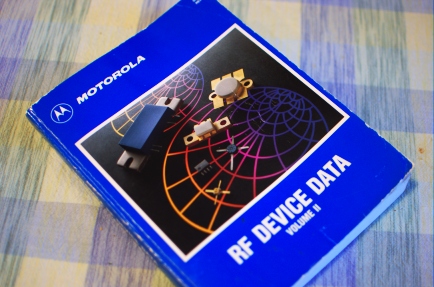
I’m not sure that I’ve shared this on the blog, but I’ve long known that the reason that my “troublesome” 930 burns up PA drivers is a low-frequency oscillation. This mechanism was also mentioned by Leeson in his comprehensive list of 930 upgrades and repairs. At first, I thought that the 28-volt power supply’s filter capacitors might be the culprit—insufficient ripple-suppression. After all, the oscillation sounds like it has a 60-Hz component (I’ve never tried to measure this because I’m concerned about blowing up more transistors). I finally completed the capacitor replacement last night, realigned the power supply voltage and PA bias levels…and the oscillation is still there, just as I increase the drive past the point where I get 50 watts out.
There is a good Helge Granberg article in the September/October 1980 issue of RF Design titled “Good RF Construction Practices and Techniques.” I would like to get a copy of the original article because Motorola, in their infinite wisdom, reprinted the article as AR164 but neglected to include the list of references. Granberg devotes an entire section of the article to instabilities, a full of half of that section to low-frequency instabilities. This is the area I will focus on first:
Causes for the low frequency instability are usually inadequate collector DC feed bypassing or an extremely poor ground in that area. Two or three RF chokes together with various values of bypass capacitors from 1000 pF to several uF may be required in the DC line to stabilize the circuit. (See examples in Reference 1.)
Ah, Reference 1, where (who) art thou?
If I ever get to the bottom of this problem, there should be a useful body of work and notes to prevent this from happening repeatedly to others.
Ethan Miller, K8GU, is a regular contributor to AmateurRadio.com and writes from Maryland, USA. Contact him at [email protected].
WebProp update update
I received a response from the web host support desk about the problem that is causing the WebProp update scripts to fail to access the WWV solar data. The reply was:
There is nothing we can do to fix this it’s a configuration error on their end with their dns. This is occurring because of invalid dnssec configurations at noaa.gov. We will not bypass the dnssec configurations implemented within .gov. The only way to have this corrected is by the dns administrators at noaa.gov signing their zones.
20-May-2010 15:26:00.099 validating @0x827fff000: swpc.noaa.gov SOA: got insecure response; parent indicates it should be secure
20-May-2010 15:26:00.116 validating @0x80284f000: swpc.noaa.gov SOA: got insecure response; parent indicates it should be secure
20-May-2010 15:26:00.159 validating @0xadb055000: swpc.noaa.gov SOA: got insecure response; parent indicates it should be secure
20-May-2010 15:26:00.204 validating @0xad9af8000: www.swpc.noaa.gov A: bad cache hit (www.swpc.noaa.gov/DS)
This is way over my head, but I think they are saying this is due to a problem at NOAA’s end not mine.
I will give it a couple more days, but if the problem doesn’t go away then I will have to remove WebProp. I know this will be a pain for those who have included it in their websites but there is nothing I can do about it.

Julian Moss, G4ILO, is a regular contributor to AmateurRadio.com and writes from Cumbria, England. Contact him at [email protected].
 Ham Radio Deluxe |
 W5SWL Electronics |
 Ham Radio Prep |
 KB3IFH QSL Cards  Hip Ham Shirts  HamRadioAuctions HamRadioAuctions Reliance Antennas Reliance Antennas Enigma Shop Enigma Shop |  morseDX  Ni4L Antennas  R&L Electronics R&L Electronics antennas.us antennas.us QRV QRV |
- Matt W1MST, Managing Editor
