 |
 Fun on 10m
 23 May 2010 | by
 Another glorious day and Olga and I took a picnic lunch up to Watch Hill. We go there not because it is a SOTA summit but because it is near home, a nice walk, not a steep climb (so Olga is happy to come with me) and one of the easiest operating sites for me to reach when I want to get away from all the electronic QRN I’m plagued with at home. Unfortunately there isn’t a picnic table up there and I haven’t yet found a way to support the MP-1 antenna on a bare hilltop. Using a right-angled PL-259 adapter and a 259 to 3/8 adapter on the back of the FT-817 only works if you have a level surface to put the radio on and no breeze. So despite taking them with me I wasn’t able to get any use out of them. No doubt a photo tripod would do the job but that is too much ironmongery for me.
I did also take the Intek H-520 Plus and a couple of BNC mounted whip antennas but although there clearly was propagation on 10m I didn’t manage to work anything. I did hear something puzzling though. After one call on 29.600 I heard what I’m sure was a native English speaking voice announced something on the lines that this was the EA????? repeater. Unfortunately I’m getting increasingly slow witted these days so I don’t remember the exact announcement nor the full call and I didn’t hear it again. 29.600 is supposed to be the 10m FM calling frequency and not a repeater output so what could it possibly have been?
Back home later in the afternoon and VHFDX.net showed that there was a big Sporadic-E opening on 6m and even 2m in Eastern Europe. I decided to try 10m which seems to be the neglected band and managed to make several contacts including a new country for me, OD5NH in Beirut, Lebanon.

Julian Moss, G4ILO, is a regular contributor to AmateurRadio.com and writes from Cumbria, England. Contact him at [email protected].
2010 Field Day
The Beach Boys Amateur Radio Club went to work on Saturday morning and rested five hours later after prepping antenna systems. I was tired and a few aches reminded me that taking care of myself is really important. Our team enjoyed its morning and afternoon beneath the solar disc with the blue Pacific over our shoulders. The day was ideal for tackling Field Day logistics and preparation.
We are passionately committed to our project goals such as ham radio fun, operating outdoors, learning, and deploying a competitive signal from our location. The Beach Boys Amateur Radio Club is an informal group letting our enthusiasm for the hobby drive our organizational goals.
Tower.
Our antenna systems arrived to include a 30 foot tower, a tri-bander, a vertical, a VHF quad, and a flat top dipole. The biggest challenge inside the project is the tower. We brainstormed safety principles and focused on the tower base plate. It required 3 foot steel stakes with clips and washers. The team concurred that a stake system in addition to proper guying will maximize our safety.
Our next goal is a practice run at deploying and guying the tower with the tri-bander attached to the rotor mast while keeping safety in mind at all times. Additionally, keeping the rules out in front of us, the entire system is dissembled prior to Field Day operation.
Flat Top Dipole.
Ham radio fun picked up momentum after a pair of operators slung rope into a pair of trees for the flat top dipole. Theoretically, launching rope into tree branches as easy on paper as it seems, is not a straight forward process. It was work and required a few attempts before achieving success. The moment was sweet when we fired up a TS440S on 40m lower sideband and logged a Nevada along with a California station.
The buzz around the work party, “What was the signal report?”
Vertical.
Another team of operators deployed our vertical antenna system for operational testing on the low bands. It’s intentionally positioned at the furthest end of our site to thwart cross band interference. There is nothing more discouraging when stations begin interfering with each other. It is the fast track to frustration.
Counterpoise is everything for a vertical. Pundits may say otherwise, however, I advocate wire beneath one’s vertical. We have the benefit of a large metal-like cage near the feed point surrounding this antenna as an added bonus. The antenna analyzer data suggested reasonable standing wave ratio although I’m learning how-to calculate efficiency.
Additionally, we will deploy a rudiment counterpoise system of quarter wavelength radials or near quarter wavelength given our on-going debate. This system will be above ground but not equal to the height of the feed point.
Conclusion.
The Beach Boys Amateur Radio Club party benefited all those in attendance. We tested two out of three antenna systems, assembled the tower with rotor, improved base plate security, and ended the day exhausted. Everyone enjoyed working outdoors, getting their hands dirty, and learning about antennas in preparation for this year’s Field Day.
73 from the shack relaxation zone.

Scot Morrison, KA3DRR, is a regular contributor to AmateurRadio.com and writes from California, USA.
ICQ Podcast Series Three Episode Eleven (23 May 2010) – Travelling to Ireland
Series Three Episode Eleven of the ICQ Amateur / Ham Radio Podcast. News Stories include:
- 70.005 MHz WE9XFT beacon operational
- Trip to Mozambique
- Support for South Orkney DXpedition
- Collapsible fabric yagi antenna
- Amateur Services Spectrum Requirements
- Wouxon.US show Chinese HT at Hamvention
- New regulations for Cayman Islands
- Proposed 5MHz changes in USA
- Australia - Options for 403–520 MHz
- Extended 5 MHz experiment
- 70 MHz beacon upgraded to PSK31
- RSGB respond to Ofcom 433 MHz plans
- ZS10 Soccer World Cup Prefix
- GB7HD D-Star Repeater
- 12 year-old operator shines in contest
Your feedback, upcoming events and Martin (M1MRB) tells us about travelling and operating in Ireland.
Colin Butler, M6BOY, is the host of the ICQ Podcast, a weekly radio show about Amateur Radio. Contact him at [email protected].
Announcing HOLeS
We're still finalizing our complete feature list and rate schedule, but here are the basic options and rates so far:
Base Packages:
Basic Service $99.99/month
Deluxe Service (your own URL like www.mydomain.com): $125/month
Options:
QSL Card Printing Capability: $25/month (Lets your users print out cards)
Awards Programs: $50/month (Offer your own awards like WAS and DXCC)
RSA QSL Card Authentication: $25/month
Triple DES QSL Card Authentication: $50/month
Modern Logbook Program Uploading Capability: $75/month
DOS or CP/M Logbook Program Uploading Capability: $250/month
Logger32 Program Uploading Capability: $450/month (Support for Logger32)
Ham Blacklist Feature: $125/month (Lets you block select users)
Rare Country Shopping Cart: $200/month (Lets your users buy rare countries and you make $$$!)
HTML Frames and Notepad Support: $25/month (You can customize your site with Notepad and use frames)
Alternate Fonts: $85/month (Use fonts other than Times New Roman on your site)
As with LOTW, eQSL, and QRZ.com, all online logbook sites hosted on HOLeS will be totally incompatible with other online logbook services and will not interface with them to exchange QSL information. This includes other online logbook services hosted on HOLeS.
Later this summer we're also going to offer a ground-breaking service called Logbook Uploader of the World or LUTW. This service will manage multiple online logbook subscriptions for amateurs, giving them a one-stop-shop to upload and download their logs and QSLs. Users will pay a LUTW subscription fee, and LUTW will pay subscription fees for all the online logbooks the user wants to manage through LUTW. LUTW adds a 40% service fee per managed online logbook, but we feel this will be well worth it to manage tens or hundreds of online logbook subscriptions, potentially savings users hours of frustration uploading and downloading time and having to deal with logbook program compatibility issues.
We're proud at The K3NG Report to support the needs of amateur radio operators and to be on the forefront of technology in this great hobby. Stay tuned for more announcements!

Anthony Good, K3NG, is a regular contributor to AmateurRadio.com and writes from Pennsylvania, USA. Contact him at [email protected].
10m open to the north
Once again, WSPR is revealing the existence of consistent propagation paths every day on 10m between Iceland (TF), the Faroes (OY) and northern Norway (LA/LB) and the UK and north-west Europe when there is no Sporadic-E and no other propagation except over very short distances between closely located stations. This has occurred even during periods of zero sunspots.
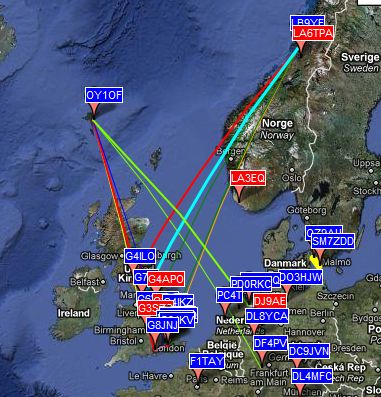 I’m guessing that because we have only in the last few weeks had a large number of WSPR monitors on 10m because of the Sporadic-E season, no-one has previously observed it. But I’m surprised at the lack of comment about it. Perhaps this is a phenomena known to everyone but me, in which case I’d welcome some enlightenment.

Julian Moss, G4ILO, is a regular contributor to AmateurRadio.com and writes from Cumbria, England. Contact him at [email protected].
QRZ.com to offer logbook
QRZ.com has just announced that it will be making available an online logbook. It will also be offering an awards program and will be organizing a contest to recognize the first person to make confirmed contacts with 100 other QRZ users.
I like QRZ.com and think this is a great idea. I don’t know whether they will be providing an API for logging programs to post entries to the log in real time but if they do then I want my program KComm to support it so I have volunteered my services as a tester.

Julian Moss, G4ILO, is a regular contributor to AmateurRadio.com and writes from Cumbria, England. Contact him at [email protected].
Ten Tec HB-1A
From John Harper AE5X’s blog I have discovered that Ten Tec will be re-branding the Chinese HB-1A QRP CW transceiver. The Ten Tec versions aren’t exactly the same – they will be selling two versions, one covering 40 and 30 metres and one covering 30 and 20 metres whereas the original covers 40, 30 and 20. This may have something to do with meeting FCC spurious emissions specifications.
 As it happens, my HB-1A is on eBay at this very moment. Not that there is anything wrong with it, just that it doesn’t do anything that my FT-817 can’t do and I’ve spent quite a lot on new radios recently so it seems right to dispose of some of the ones that aren’t being used.
But its performance wasn’t exactly spectacular. It’s a bit sad to see the company that made and discontinued the Argonaut 516 HF QRP rig and matching 526 6’n’2 metre rig offering such a basic radio as its only QRP product.
I’d love a Ten Tec 516 / 526 pair, so if anyone has one in mint condition that they’d like to sell or trade for an Elecraft K3/100 drop me an email.

Julian Moss, G4ILO, is a regular contributor to AmateurRadio.com and writes from Cumbria, England. Contact him at [email protected].
 Ham Radio Deluxe |
 W5SWL Electronics |
 Ham Radio Prep |
 KB3IFH QSL Cards  Hip Ham Shirts  HamRadioAuctions HamRadioAuctions Reliance Antennas Reliance Antennas Enigma Shop Enigma Shop |  morseDX  Ni4L Antennas  R&L Electronics R&L Electronics antennas.us antennas.us QRV QRV |
- Matt W1MST, Managing Editor
