 |
 Handiham World for 2 June 2010
 2 June 2010 | by
 Welcome to Handiham World!
June is here, and that means Field Day planning

As you know, we have been at Handiham radio camp last week, and because the camp session ended just as the long Memorial Day holiday weekend began, today is our first day back for routine office duties. We hope you had a pleasant and thoughtful Memorial Day weekend and were able to set some time aside to remember those who have gone before us, serving to protect our freedom.
Memorial Day seems to be the unofficial start to the summer season here in North America. Yes, I know that the official beginning of the season begins later this month at the summer solstice on June 21. In fact, in the Northern Hemisphere, summer solstice begins on Jun 21 2010 at 7:28 AM EDT. Nonetheless, nothing flips the switch to summer quite as well as a long holiday weekend, and once people get into the mood of summer, they tend to forget about spending time with indoor activities and look to the great outdoors for fun in the sun.
That doesn’t mean that ham radio will not be an important part of the summer. To the contrary, June is an excellent month for ham radio. Amateur Radio Field Day is coming up on the first full weekend in June, as it always does. ARRL Field Day is June 26-27, 2010. If you have never operated during a Field Day, you are in for a pleasant surprise: Field Day is the largest on-the-air operating event in Amateur Radio. Combining elements of a contest with setting up portable stations is a brilliant strategy. Field Day provides an opportunity to practice setting up for emergency situations, learning new and better operating skills, participating in a competitive event as a group or as an individual operator, really learning how your equipment works, and — in the case of a radio club Field Day event — being able to socialize with your friends and just have a lot of fun sharing this operating event. Some radio clubs have a family picnic to make sure that spouses and children can share in the fun. Others are in it for the contest and run stations day and night, focusing on that all-important point count.
If you are a person with a disability, you can participate in Field Day, but you may have to do just a little advance planning to make sure that you are able to operate effectively and safely, either as an individual or in a group. Here are some things to consider:
Field Day has many different options. You can operate from your home station without setting up any portable antennas and portable radios. You do not need to operate using power from a generator or batteries. In fact, you can operate your existing station just as you always do and still participate and have a great deal of fun on Field Day. The object of the exercise is to work as many stations as possible on any amateur radio band except 60, 30, 17, and 12 m. If your disability requires that you stick close to home, you may want to simply participate using your own station.
You don’t have to operate during the entire Field Day exercise. Even if you participate for a couple of hours, you can have fun and gain experience. So, even if your disability makes it inconvenient to be away from home for long periods of time, you will be welcome at most radio club Field Day sites during the time it is practical for you to be part of the group effort.
Check out the Field Day site in advance for accessibility, especially if you are using a wheelchair or electric scooter to get around. Some sites are truly rugged and not accessible. Others may be the ultimate in accessibility, with wheelchair ramps and accessible restrooms. Since several radio clubs in your area may be participating in Field Day, now is the time to start shopping around for an accessible site. Don’t be afraid to call the contact person listed on the club website and discuss accessibility. It is better to find out in advance what is and what is not available.
Sometimes special needs can be accommodated at the operating positions of a club Field Day site. For example, if it is known in advance that a blind operator will be participating, a radio or radios equipped with voice frequency output might be made available. Again, this is something that needs to be planned in advance, so now is the time to speak up.
If you are a ham radio operator with a disability, I certainly hope that you are part of a local radio club already. But if you aren’t, a club Field Day is sometimes the perfect opportunity to meet club members and find out if a particular club will meet your needs. Don’t forget that as a club member you will be expected to participate and take on some club duties as well.
Sometimes we concentrate on accessible radios and wheelchair ramps when we think about Field Day, forgetting that it will be necessary to take care of life’s normal requirements. Since the contest goes on for at least 24 hours, if you expect to stay at the Field Day site for long periods of time or even for the entire length of the contest, you will have to consider whether the restrooms are accessible, if the food and beverages meet your dietary needs, whether it will be possible for you to stay on your medication schedule if you must take medicine on a daily basis, and what kind of shelter is available on site in the event of inclement weather.
If you stay overnight, you will need to determine where you will sleep and how you will stay warm since it can get quite cool in the night and early morning. Generally speaking, if you are comfortable with camping and already do so on a regular basis, you will have no problem managing a Field Day where the crew is “roughing it”. On the other hand, if you would rather fill out 100 tax forms than go camping, you should look for a club that has its Field Day indoors with lots of amenities. Either one will be a great experience, but you have to be sure you pick the right one for you!
Field Day rules change a bit from year to year as new ideas take shape and technology changes. If you have never been to a Field Day or if you have been away from Field Day for a number of years, take some time to check out the ARRL website and find out more about this excellent operating event.
My radio club, the Handiham-affiliated Stillwater Amateur Radio Association, is holding its Field Day indoors in a completely accessible modern city park building. SARA goes the extra mile to serve Handiham members and is an ARRL Special Service Club.
I hope to hear you on the air during Field Day 2010.
Patrick Tice, Handiham Manager
[email protected]

Pat Tice, WA0TDA, is the manager of HANDI-HAM and a regular contributor to AmateurRadio.com. Contact him at [email protected].
Dead mic
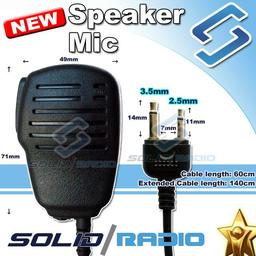 When using a hand held radio with a long whip antenna for more gain I often prefer to use a speaker mic so I can hold the radio in a steady, upright position. I have a speaker mic for the Kenwood TH-F7E (which fits the old TH-205E as well) and I have one for the Motorola GP300. But needless to say neither of them fit the Intek H-520 Plus 10m rig because the wiring and pin spacing is different. The official Intek speaker mic is rather expensive so I looked on eBay and found a speaker mic for “Alinco Icom Standard 2-pin” with the correct pin spacing for less than £7 including postage from Hong Kong.
When it arrived I decided to check what the audio sounded like by listening on the K3 while I made a call. The mic keyed the radio up but there was no audio. To make troubleshooting easier I swapped the antenna for a dummy load and audio was then heard!
I then tried a variety of different antennas and power levels and was soon pulling my hair out. I would hear audio with the dummy load connected and none as soon as I switched to an antenna. Eventually I tried the very short antenna supplied with the H-520 on the lowest power setting, 0.1W and I heard audio. It was looking very much as if the presence of radiated RF was somehow interfering with the audio. But the amount of RF required to cause the problem must be small as 0.1W on any of the larger antennas resulted in no audio from the speaker mic.
I didn’t know whether the RF was causing a problem with the microphone or the radio. I tried clamp-on ferrites at both the mic end of the cable and the plug end but neither made any difference so I was none the wiser. This particular made-in-China speaker mic is held together with screws that require a nonstandard five pointed key to undo so I couldn’t look inside to see if it used screened cable. I decided to give up on that speaker mic and do what I could have done in the first place if I hadn’t thought spending seven quid would be an easier solution.
In my junk box was the business end of another cheap Chinese speaker mic from which the cable had been ‘borrowed.’ I noticed in the past that the curly cables used for these speaker mics are often not screened. I happened to have a length of stereo audio cable with each channel separately screened. I wired this up to the spare speaker mic and attached suitable 2.5mm and 3.5mm jack plugs to the other end. When I tested it I now had transmit audio even on high power with the 4 foot telescopic whip!
At this time I don’t really know whether the mic I bought was at fault because I don’t have another radio that uses the same size plug spacing to test it with. Given that I have been less than impressed with other aspects of the H-520’s performance I wouldn’t be surprised if it wasn’t the radio that has inadequate filtering for RF picked up on the speaker mic cable.

Julian Moss, G4ILO, is a regular contributor to AmateurRadio.com and writes from Cumbria, England. Contact him at [email protected].
Change of emphasis?
 I have never owned a Ten-Tec transceiver (although I once built and used one of its transverter kits) but I always thought that the thing the company’s products were most renowned for was their good support for CW operation and excellent QSK. So I was surprised to visit the Ten-Tec website a few days ago and see beneath the logo the slogan “The SSB Company.” Obviously CW isn’t seen as so important these days.
In the last couple of years Ten-Tec has dropped its kit range, its QRP Argonaut transceivers and most recently has been in the news for announcing that it will be rebranding the Chinese-made HB-1A QRP CW transceiver as a Ten-Tec product. I suppose someone somewhere has decided that this makes commercial sense but it doesn’t seem to me like the way to hold on to a reputation as an innovative indigenous American manufacturer of quality radio products for the discerning amateur.

Julian Moss, G4ILO, is a regular contributor to AmateurRadio.com and writes from Cumbria, England. Contact him at [email protected].
Can APRS count for contacts?
Colin, 2E0XSD, raised an interesting question this afternoon in the Wainwrights On The Air forum when he asked what the rules were regarding making contacts using APRS. I confess that I hadn’t thought about it and haven’t come to a conclusion at the moment.
 For those who think that APRS is merely a way of using ham radio to transmit position reports that can be received and tracked I should explain that it is a lot more than that. One of its best features, if one that is not all that widely used, is the ability to send text messages to other APRS users. For example, if you see someone’s position on the map and would like to contact them on the radio you could send them a message to ask whether they are on the air and what frequency and mode they are using.
You could use APRS text messages to exchange exactly the same kind of information with another station that you might exchange in a normal digimode contact – signal report, name, QTH, locator and so on. This could arguably constitute a valid contact. But most of the time APRS users are not in direct radio contact with one another so the messages may be passed with the aid of digipeaters: stations that receive an APRS packet and rebroadcast it. Even more common these days is the use of internet gateways (IGates) that route messages between APRS stations via the internet. There are also an increasing number of APRS users who use mobile devices and the cellular network to send and receive APRS. So I have come to regard APRS as a kind of hybrid system that is not purely amateur radio and I do not regard conversations held using APRS messaging as radio contacts in the sense that I would log them, QSL them or use them to qualify for an operating award.
But that’s just me. If two people exchange APRS messages over RF with no digipeaters or IGates involved, is there any reason that this should not count as a contact?
I must confess to having mixed feelings about APRS. When I first found out about it I thought it was an extremely useful system and I still do. My wife Olga worries when I go walking in the hills on my own and likes being able to see where I am at any moment on a map on her computer. If I don’t return she will know my last position and could send someone to look for me. And it is a useful way to alert WOTA summit chasers to the fact that you are approaching a summit that you are going to activate. But I quickly became disappointed when I discovered that this functionality could not be achieved if you relied solely on amateur bands RF.
Then I discovered Lynn KJ4ERJ’s program APRSISCE which can run on a data enabled mobile phone and connect to the internet-based APRS infrastructure and I was able to get the kind of usage I envisaged from it. (In this part of the world even the cellular data coverage isn’t 100% but it is still a big improvement.) But although I now use the mobile client whenever I am on some radio related outdoor activity, I found that using an internet connected client destroyed the radio interest because I could now communicate using APRS with anyone, anywhere with the same kind of reliability as sending an SMS or an email.
APRS is too useful to hobble it by insisting on using only amateur bands RF as the transmission medium. Because of that I don’t feel it can be used to make contacts or QSOs in the sense that is generally accepted within the hobby and I’m not convinced that it would be right to make an exception for message exchanges that are “direct.” But I’d be interested in other people’s opinions on the matter.

Julian Moss, G4ILO, is a regular contributor to AmateurRadio.com and writes from Cumbria, England. Contact him at [email protected].
Antique Wireless Association Journal – On-Line
 I recently featured some material available from the Antique Wireless Association and had to go a little deeper.
They have a wealth of information available on their site with some of their journal’s online articles. Great articles on vacuum tubes and such – but much, much more.
 I found a great little article called “Working With Crystal Control: A ‘Part 15′ Broadcast Band Transmitter “, the transmitter setup on the left. Really neat article (I think I must….want to build one of these)……… The image on the left is from that article – not to difficult to build and learn!!!
As I understand it, you can purchase a CD with back copies of this magazine. I just might look into that. Kinda sounds like the enjoyment I get when I receive that little journal from the G-QRP club – SPRAT. When that hits my mailbox, I know it’s getting stuffed in my backpack for enjoyment down the road.
One important thing to keep in mind with the AWA Archives is how well they not only demonstrate radio history, but how you can recreate it and learn from it. What a better way is there for a budding QRPer to learn where he’s going, but get a hands on demo from where other hams have been?
Below are only a few examples of the neat articles you’ll find on the AWA website:
Key and Telegraph by John Casale, W2NI
President Taft’s Telegraph Key
Building a 1929 Style Hartley Transmitter by Scott M. Freeberg, WA9WFA
Need a transmitter for our 1929 QSO Party? Build it in one week-end!
Breadboarding by Richard A. Parks
More Adventures With Transistors
The Vacuum Tube by Ludwell A. Sibley
Tube Bases and the Asbestos Hustle
Restoration of Shellac Finishes on Older Radios by Lane Upton
Don’t Strip That Old Finish–Save it Instead!
A nostalgia trip for the old-timer; an eye-opener for the newbie.
The Beginnings of Radio Central by Ralph Williams with Marshall Etter, Bob McGraw and Chris Bacon
Pupin and Armstrong lay an egg–An Antique Radio Gazette reprint.
A Solid-State Filter Choke or Field Coil Replacement
Go ahead and check them out at:
http://www.antiquewireless.org
http://www.antiquewireless.org/otb/archive.htm – a direct link to the journal archives
Jonathan Hardy, KB1KIX, is a regular contributor to AmateurRadio.com and writes from Connecticut, USA. Contact him at [email protected].
Great Cockup
In British English, a “cockup” is rude slang for a mistake, usually implying carelessness. Great Cockup is the name of a rather undistinguished grassy Wainwright summit near the northern edge of the English Lake District. I don’t think there is any connection between the slang meaning and the name of the hill. But whilst my decision to go for a walk up Great Cockup on Bank Holiday Monday wasn’t a mistake, from a radio point of view it wasn’t a success either.
 I parked the car near Overwater and set off on quiet lanes and then a grassy track on the western side of the fell with great views over Bassenthwaite Lake.
 The summit was reached after about an hour of walking. Despite being the end of May a cold north westerly breeze was very much in evidence on the summit. By descending a few feet it was possible to get away from the breeze, but as soon as it dropped clouds of black insects appeared and covered everything. It was necessary to brave the full force of the wind in order to eat the lunch Olga had prepared without an accompaniment of fresh insects. Despite this one managed to find its way inside the Intek H-520 – it was still walking around the inside of the display window this morning!
Lunch over, I got the radios out. I had taken the Intek H-520 hoping to make some DX contacts on 10 metres, but despite making numerous calls on the 10m FM calling frequency, 29.600MHz, I had no takers. There was obviously some enhanced propagation as I heard a French station and also some activity on a repeater on 29.660MHz.
I heard a French station call CQ on 29.600 and when I replied to him he said “UK stations, please QSY to 29.205MHz.” I was unable to oblige because a) my radio only tunes exact 10kHz multiples and b) when I did try to transmit anywhere near there the radio cut out due to the SWR being too high on that frequency. I’m afraid the H-520’s intolerance to even moderate SWR renders it almost unfit for purpose and if I hadn’t modified it to work on the 10m band I would probably consider returning it under warranty. As it is, probably the only option is to reset the power control to limit the power to 2W on the “4.0W” setting. As noted previously, when received the radio delivered less than 3.0W even on the UK CB band and I now suspect this was done deliberately by the manufacturer to try to mitigate this problem, knowing that the majority of CB users would be none the wiser.
While listening for the French station I heard what sounded like an APRS packet on 29.210MHz. I don’t know if that is a recognized APRS frequency but it would be interesting to monitor that frequency with a decoder to see what is being transmitted.
 I tried the Motorola GP300 on 2m with the 5/8 telescopic antenna but was unable to raise any contacts on that band either. I did hear some activity on the channel set up for GB3EV but which I suspect may be the GB3BT repeater on the north east coast which is on the same frequency.
Back home I heard and worked Colin 2E0XSD/P who was on Ling Fell (behind the ‘hump’ on the left of the middle photograph) using the H-520 inside the shack with the 4ft. whip antenna. On 2m I worked Derek 2E0MIX/P who was up on Scafell Pike, England’s highest mountain. So had I gone out a bit later I would probably have made not just a couple of contacts, but a couple of summit to summits. Never mind. It was a pleasant walk and now I have the excuse to go again another time.

Julian Moss, G4ILO, is a regular contributor to AmateurRadio.com and writes from Cumbria, England. Contact him at [email protected].
Interview With Bryce, KB1LQC And Brent, KB1LQD Of RITARC | Part 2 Of 2
Their vision is bold and their commentary on the state of ham radio is noteworthy. We are, in their words, at a crossroad; one that is deciding the direction of our hobby into the middle of this century and beyond.
Who else but KB1LQC and KB1LQD, young men at the beginning of their careers, could deliver a message to those capable of creating required change?
What kind of ham radio related activities is RITARC involved in these days?
The RIT Amateur Radio Club is one of those clubs I feel is taking a different approach to the hobby. As I stated earlier, there is a difference between the traditional outlook on the hobby and the demands of the current generation of students in high school and college. K2GXT is very much into utilizing amateur radio for various technical aspects, not just operating.
The club has been promoting various uses to advance technology rather than simply operating HF or other bands. As a group we are also very good at promoting amateur radio along with our club to the student body as well as RIT administration. For the last two years straight we’ve won the RIT Clubs Showcase “Best in Show” award which pitches 10 clubs against each other to present themselves to RIT administrators who then vote for their favorite and most innovative club.
We know how to make our presence, effectively get our point across, and deliver a memorable presentation.
For example, we recently redesigned and constructed a 12 foot long RC blimp from scratch which utilizes ATV video on-board. Just search YouTube for some of the videos uploaded this past May! Brent is designing an optical communications system for long distance light transmission. So far he has obtained about 1/4 mile from his efforts. This may not be amateur radio but many techniques learned from the hobby have been utilized.
We just obtained the ability to design, etch, and construct our on PC boards right in our clubroom. Finally, this summer I hope to design a simple Software Defined Radio much like the softrock kit while here at RIT. Both the light receiver and SDR have the potential to become a K2GXT kit for promotional purposes.
We may be veering off from most college clubs but we are seeing a huge amount of interest from the student body. Next year may be a defining moment for the clubs’ membership. Today’s students just don’t seem to be impressed with long distance QSO’s or repeater contacts, at least initially.
Many of my peers might not truly realize that a cell phone is simply a radio. We are becoming quite an abstract society with the technology granted to us. Brent and I have found that by introducing the hobby through alternative methods such as projects and other technological advancements with amateur radio, we are able to grab the interest of younger people.
Tradition will never die, once in the hobby they are exposed to the numerous traditions of DXing, QSL cards, etc. I am excited to see where the RIT Amateur Radio Club is able to go with this next year.
What mode of operation is trending within the club?
RIT keeps most of us busy enough with its academic rigor combined with the quarter system (10 week courses, very fast paced) that we don’t get to operate nearly as much as Brent or I would enjoy seeing. The club did do a lot of operating during this past Fall (2009) and focused mainly on 20 meter SSB and PSK31. Many new club members did a fine job and were interested but unfortunately everyone got hit pretty hard winter quarter with school commitments, it’s a problem many organizations at RIT deal with, the quarter system has obtained a love-hate relationship.
This summer Brent and I are redesigning the clubroom which is located underground in the academic tunnel system to be much more operation friendly. It was setup a few years ago bye people with great intentions but not too much HF operating experience. We hope to make it really inviting to sit down and grab some DX!
What about third year varsity oarsmen for the NCAA Division 3 crew team?
First off, Brent and I no longer row for RIT. Brent obtained a rather bad injury in the beginning of his Varsity year (2nd year) and I had to leave this past year about halfway through my third year rowing due to academics. Rowing is one of those sports that few truly understand. It’s an intense commitment and being proactive, I decided it was better to leave the team than to let my grades suffer; I was going to bed at 4:00am and getting up at 5:30am several nights a week.
Very few people knew that the rowing season goes six days a week and from four to six hours a day from early September through late May. Rowing has been “grandfathered” into the NCAA so it follows the US Rowing regulations as opposed to NCAA regulations; simply meaning that we practice full speed all year.
I have learned a lot about pushing myself both mentally and physically from being on the team as well as how to manage my time. I thought I was busy in high school!
To put it in perspective, I’m not where near the normal height of a rower, most mistook Brent and I for coxswains! Perseverance, mental toughness, and having the ability to deal with a large amount of self-induced lactic acid pain allowed me to row for RIT. Since I am shorter than most rowers I had to push harder just to obtain the same speed as my peers who had more leverage on the oars.
A good analogy for what it’s like to row a 2 Km race would be to put 90 or so pounds on a leg press machine and do 225 leg presses in six or seven minutes without stopping. Crew will be one of those adventures in college that I will miss!
What are your goals after graduation?
Both of us are toying with the idea of Graduate school. Ironically or not, both of us are deeply interested in analog electrical engineering. We both have an interest in further studies involving the analog/mixed signal design field. If not, both of us are obviously RF geeks and want to do something with radio communications.
I have also found an interest in UAV’s (unmanned aerial vehicles) and similar areas so maybe I’ll be able to find a job that blends the two together! Too bad NASA cancelled the constellation program… HIHI.
Where do you see ham radio in the year 2020?
This is a big one. I honestly can’t say for sure but I will say that the hobby is at a crossroads. I feel that many radio amateurs are committed to keeping traditional views of amateur radio the main course of the hobby. This includes things such as DXing, QSL cards, SSB, CW, etc.
Honestly, I don’t see the hobby grabbing the attention of a large majority of the coming generations if it stays on that course. Yes, we have small niches involved in building satellites, software defined radios, and other very technical areas but overall the hobby is very much focused on the same goals it was in the 1950’s and 1960’s.
I’d like to see the hobby as a whole take a step back, look at what the 15-25 year old generation is more responsive to, and go from there.
It is apparent now that mobile communications has been integrated with personal computers which have been further integrated with the Internet. The key word for today’s generations is “integration”, building a 40 meter CW rig may be neat but in the overall picture we have more people who could potentially be involved in amateur radio who are interested in much larger integrations of technology. As radio amateurs we have a critical advantage, spectrum. Use it or loose it as they say.
The engineering field itself is seeing declining interest, why can’t we become the “De-facto” hobby for students interested in engineering? Not just electrical engineers either. Aerospace, mechanical, software, and other engineering disciplines all have the ability to integrate one form or another of amateur radio into their projects. So what if it’s not DXing. Maybe they will become interested in that too!
When amateur radio first started in the early 1900’s think about what it was then. Radio technology was still in its infancy. A brunt of the hobby was involved in experimenting with technology for almost half a century; if you wanted to be on the forefront of communications technology then you got your amateur radio license.
Studying the early years of amateur radio has shown me that around the time-frame following World War II our current traditions were created. Think about it, radio technology allowed for easier communications around the world with surplus equipment. We must move on!
I personally feel we need to look back into our roots of experimenting and try to use the radio spectrum available to us for more technologically advanced applications. This should grab the interest of many high school and college aged people with an interest in technology.
I’ll end this with an analogy. Don’t try to sell a car to someone who isn’t interested in purchasing a car, it’s much more effective to sell a car to someone who is interested in buying one in the first place. Now tell me where amateur radio can improve its promotional campaigns?
73 from shack relaxation zone.

Scot Morrison, KA3DRR, is a regular contributor to AmateurRadio.com and writes from California, USA.
 Ham Radio Deluxe |
 W5SWL Electronics |
 Ham Radio Prep |
 KB3IFH QSL Cards  Hip Ham Shirts  HamRadioAuctions HamRadioAuctions Reliance Antennas Reliance Antennas Enigma Shop Enigma Shop |  morseDX  Ni4L Antennas  R&L Electronics R&L Electronics antennas.us antennas.us QRV QRV |
- Matt W1MST, Managing Editor
