 |
 An interesting Es day
 19 June 2010 | by
 There’s been plenty of VHF Es buzzing around here today. It started off, literally with a buzz on 50MHz as I was driving down to the Post Office in the next village this morning. I heard some TV buzz on 50MHz, almost certainly out of Eastern Europe. A few stations started coming through including YU1EXY, the Belgrade University club station.
After that, I had plenty of things to do and didn’t get to the rig again until around 1530z. There seemed to be a contest going on 50MHz. I worked LZ9W (KN12) and YT2F(KN03) as well as an EA6.
There were some reports of 144MHz Es too. At one stage, I could hear DLs working Es that I couldn’t hear any trace of. At 1735 though, I heard LZ2ZY (KN10) briefly. He was working into Belgium at the time and I didn’t hear him work any Gs. G4MKF, not too far from me, worked a station that I couldn’t hear at all, but the opening seemed pretty fleeting. Though it was a shame not to work LZ2ZY, it was great to hear him!

Tim Kirby, G4VXE, is a regular contributor to AmateurRadio.com and writes from Oxfordshire, England. Contact him at [email protected].
Polar Bear Summer Picnic Event Jun 2010
My favorite QRP group is the Polar Bear QRP gang! We have a good time and enjoy outdoors activities and trying to connect with one another at least once a month with some kind of activity. To escape some of the heat, I got an early start on the day. I wanted to try out a new mini-bac antenna configuration and knew it would take some time to get it up into the trees. BOY WAS THAT AN UNDERSTATEMENT! It was 110 ft doublet with a 40 ft feedline that was setup as a ladder line. Not an easy one to get up single-handed. Thanks to some tall trees, was able to get it up about 40-45 feet in the pine trees. It loaded great on 40m, but was disappointing on 20m so I ended up setting up my W3EDP in an L from my 20 ft Jackite pole to a nearby cedar tree at about 35 feet. The sun chased me into the treeline where I settled in to chase bears.

Abandoned mini-back doublet feedline hangs in foreground
My xyl Connie took a picture that shows the mini-back feedline hanging in the breeze after I shifted positions and setup the W3EDP in the shade. Grrrrr!

Osprey perched right above my head…cell phone picture
Was able to work a couple of the Polar Bears, Mike W3MC in MD and Guy N7UN up in the mountains on a trail(?) in NJ. I heard VA2SG but he was at ESP level briefly then faded away. I did hear a few others working him though. WA8REI was working Guy but I could not hear him at all and ended up tail ending their QSO to connect with N7UN.
Got to work a few others through the QSB and poor signal strength on 20m including Pastor Les, K4NK in SC, KE5SBZ, Ed in TX, N1FJ in MA, and Phil W3HZZ in Atlanta so it was a nice way to spend a few hours outdoors in the heat.
Connie brought me a picnic lunch and we enjoyed the osprey and bald eagle show as they fished Lake Fredrica.

Had to drink extra coffee to copy speedy W3MC's signal

This is the life… outdoors and ham radio…making QSO's…PTL!
Kelly McClelland, K4UPG, is a regular contributor to AmateurRadio.com and writes from Florida, USA. Contact him at [email protected].
RadioSport History | Chatting Up With N6AA
 I enjoyed our hamfest in Santa Maria, California this morning and my opportunity to chat up with Richard Norton, N6AA.
We talked about what it takes to move to the next level and he shared a few stories about his 9Y4VT operation as well. The key to successful RadioSport, according to N6AA, is operate as much as possible, guest operate where possible, and call CQ alot even if one is low power, low profile.
Richard mentioned both the art and science of the game will surely follow as one pursues a Box score. I wanted to listen for hours however his duties were first given the hamfest, perhaps, next time N6AA will continue recounting his adventures to 40 zones stretching across the globe.
73 from the shack relaxation zone.
P.S. I purchased a Palomar R-X Noise Bridge and a 2009 ARRL Periodicals CD-ROM with QST, QEX, and the National Contest Journal.

Scot Morrison, KA3DRR, is a regular contributor to AmateurRadio.com and writes from California, USA.
Unsquelched
I did a quick lash-up of the UHF FM transmitter module I received a few days ago which I was planning to use in a low-power Echolink node, mainly just to see if it worked. It did, but I discovered a small snag. The audio output isn’t squelched.
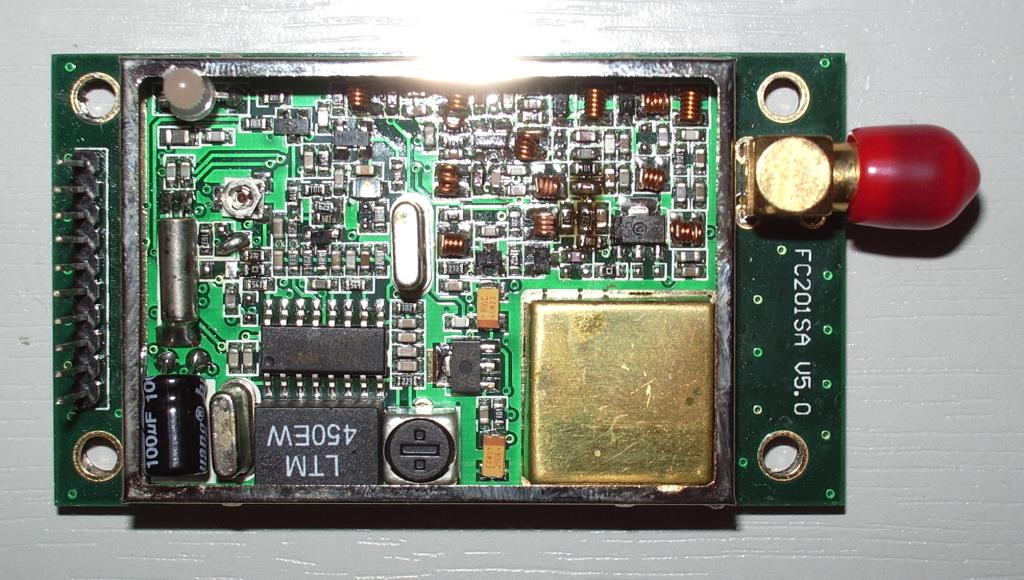 The Echolink software requires either normal squelched FM audio or a carrier operated squelch signal on one of the serial port control lines. As neither of those is provided I guess I am going to need to generate a squelch signal derived from noise. But as I am not knowledgeable enough about electronics to design my own circuit I am going to have to find one first. This appears easier said than done, though there seem to be a surprising number of patents on the subject.
It isn’t an urgent problem as I’m not in any hurry to build this project. I’ll probably have more enthusiasm for it once the gloomy autumn weather starts.

Julian Moss, G4ILO, is a regular contributor to AmateurRadio.com and writes from Cumbria, England. Contact him at [email protected].
Making a mistake, rapidly
Someone commented in the eHam ratings for my blog that I spent too much time complaining about retailers. I’m sorry about that, I only tell it how it is, but it appears that no-one in this country is capable of doing their job properly. Perhaps the government’s policy of sending 50% of people to university means that most people are over-qualified for the job they do and are too bored by it to actually think about what they were doing.
Phase 2 of my shack renovation was completed earlier this week. It should have been finished a couple of weeks ago. Olga designed and ordered a system of wall units including shelves, cupboards and a bureau with a door that drops down to form a working surface. This bureau is to be my workbench – now I can start something and when I have done enough for one day I can just close the door on it so everything stays looking tidy.
The consignment arrived consisting of all 11 boxes as marked on the shipping labels. However as we started to assemble it we found that a few bits, including the entire bureau, were missing. On contacting the retailer they were sure that 12 boxes had been sent, but the bureau was never discovered and they had to order a new one from Sweden – hence the delay.
My workbench is now separate from my operating area so I can no longer use the Diamond power supply that powers my radios to power my projects. So I needed a variable power supply for the workbench. Yesterday I was pleased to win in an eBay auction a refurbished variable power supply from Rapid Electronics for about half what a new one would have cost. The courier delivered a large parcel this morning which was labelled with my address, but when I opened it I found four retractable mains cable extensions that had been ordered by Workington Sixth Form College, together with their invoice. So now I have to wait in while Rapid arranges for its courier to collect the mains extensions. Whether I will ever see the power supply, or whether it will just vanish like our original bureau, remains to be seen.
I’m sure some readers must be thinking “take a chill pill, mistakes happen.” But mistakes seem to happen rather too often, if you ask me. If you were in the mail order business, wouldn’t you put systems in place to ensure mistakes like this don’t happen, because they annoy your customers and cost money to rectify? Rapid Electronics “operates a Quality Management System to BS EN ISO 9001:2008.” What a load of spherical objects that is.
While on the subject of retailers, last week I sent an email to a company that advertises notebook PCs with Linux installed, asking for a quote for a system for my business. I have not received a reply. Why does that not surprise me?

Julian Moss, G4ILO, is a regular contributor to AmateurRadio.com and writes from Cumbria, England. Contact him at [email protected].
The Montreal Doppler
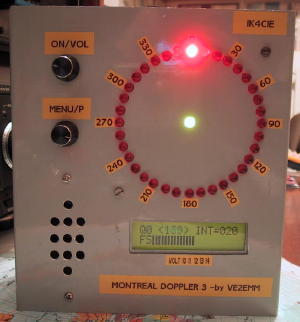 So, here I was at Dayton a few weeks ago and decided to check out the fox hunting/amateur radio direction finding (ARDF) forum. I forgot who did the forum, but it was actually very well done. One of the projects I learned about was “The Montreal Doppler”. This is a really neat project designed by Jacques Brodeur, VE2EMM.
I saw many neat attenuators, offset attenuators….. but this….. well…. it has LEDS! Pretty lights…. OK, I digress. Working with a bunch of these LED’s is pretty kewl and looks sweet. This is a project that is well documented on the web and I’ll provide links below.
The biggest question I had was, where do I get the microcontrollers and firmware. Not only was I able to acquire the PICS (microcontrollers), but I was able to get PC boards and the LCD for a very reasonable price from FAR Circuits! I know I picked up the last one he had at Dayton, but he may be able to do more (they cost $45.00). Check out the FAR circuits website at http://www.farcircuits.net/
A little about this project from VE2EMM’s website, list of features:
– 36 LEDs display; center LED when green = good signal, when red = no signal , the direction is frozen to the last good signal.
– Uses 3 PICs; a PIC16F628A for the display, a PIC18F4520 as the main processor and a PIC12F675 as a frequency divider.
– Filters; a Max 267, the best bandpass filter that I have ever seen, followed by the Roanoke switch cap filter for very narrow band width (+/- 0.5Hz).
– My DopplerII integrating and phase detection software in the main PIC.
– LM386 for monitoring the audio independently from the doppler.
– Simpler menu selection, turning a selection pot and a pushing a DO switch.
– It will switch 4 antennas with a + or – going signal, 4 antennas differential, 8 antennas with a + or – going signal.
– Pushing the DO PB sends the direction to APRS. The protocol is: <cr><lf>%359/Q<cr><lf>. The Q (0<8) is the quality of the signal just before the
extraction of the phase information.
– GPS information goes through the doppler, it will be instantly interrupted when the doppler sends a DF to APRS on a PC.
– Faster main processor, PIC18F4520. **** NEW **** June 06
The model I saw really intrigued me and there are a few really well done websites devoted to this project (it has quite the cult following).
The original site is at:
http://www.qsl.net/ve2emm/pic-projects/doppler3/doppler3-e.html
Here is another page on Jacques site that has some examples from other builders:
http://www.qsl.net/ve2emm/pic-projects/doppler3/md3_photos/dopler%203%20pictures.html
KA7OEI has a neat page with a bunch of information on this project:
He has a lot of information about an alternate firmware that looks like the image below:
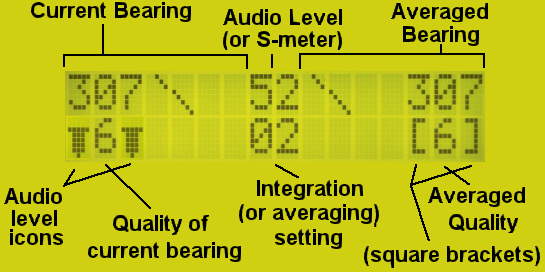
The alternate firmware page is at:
http://ka7oei.com/emm2_mont2a.html
If you have any more information on this project, resources or anything of the sort, please comment below.
Jonathan Hardy, KB1KIX, is a regular contributor to AmateurRadio.com and writes from Connecticut, USA. Contact him at [email protected].
One Foot in the Grave
This blog is meant to be about my hobby, amateur radio. Occasionally I have given in to the temptation to blog about some other event that has affected me, or let off steam about some topic that has annoyed me. But as I discovered a few months ago when a couple of the American ham radio blogs I read decided to vent about Obama, health care and other issues that Americans care deeply about, it can be very disconcerting to encounter far off-topic subject matter in a specialist blog, especially if the opinions expressed are ones with which you profoundly disagree. So in recent months I have tried to resist the temptation of controversial posts.
Sometimes I still get the urge to write about these topics, though. So to satisfy that urge I have started a new blog. Its title is One Foot in the Grave; the subtitle is Ramblings of a real-life Victor Meldrew. British readers who have seen the BBC comedy series of the same name will know what to expect from this. Readers from other parts of the world will have to see for themselves, though perhaps much of what I will be writing about won’t be of much interest to them anyway since it is going to be mostly about the trials and tribulations of life in the UK.
Nevertheless I hope that a few of you may find it worth following One Foot in the Grave and even telling other people about it.

Julian Moss, G4ILO, is a regular contributor to AmateurRadio.com and writes from Cumbria, England. Contact him at [email protected].
 Ham Radio Deluxe |
 W5SWL Electronics |
 Ham Radio Prep |
 KB3IFH QSL Cards  Hip Ham Shirts  HamRadioAuctions HamRadioAuctions Reliance Antennas Reliance Antennas Enigma Shop Enigma Shop |  morseDX  Ni4L Antennas  R&L Electronics R&L Electronics antennas.us antennas.us QRV QRV |
- Matt W1MST, Managing Editor
