 |
 ICQ Podcast Series Three Episode Fourteen (04 July 2010) – Going Mobile
 4 July 2010 | by
 Series Three Episode Fourteen of the ICQ Amateur / Ham Radio Podcast. News Stories include:
- Radio Hams travel to space station
- May RAE - callsigns not yet available
- Ham radio satellite SO-67 back on air!
- UK Amateur Radio Licences - 31st May 2010
- New UK Amateur Foundation licence syllabus
- Oman on 50 MHz
- Ham Radio - 2010 National Scout Jamboree
- Thai hams on 50 MHz for contest
- Stealth antenna for 500 kHz
- Ham radio called-out for campsite flood
- Slow Scan TV from the edge of space
- Kid's Ham Radio tower must come down
- 30-months for hoax mayday calls
- BBC to Investigate Radio/TV Interference
- D-STAR illegal in France
- Power line tech could crash aircraft
Your feedback, upcoming events and Martin (M1MRB) discusses Mobile Installations
Colin Butler, M6BOY, is the host of the ICQ Podcast, a weekly radio show about Amateur Radio. Contact him at [email protected].
2010 Field Day Beach Boys Amateur Radio Club Photographs
 Beach Boys Amateur Radio Club | 2 Alpha | Santa Barbara.
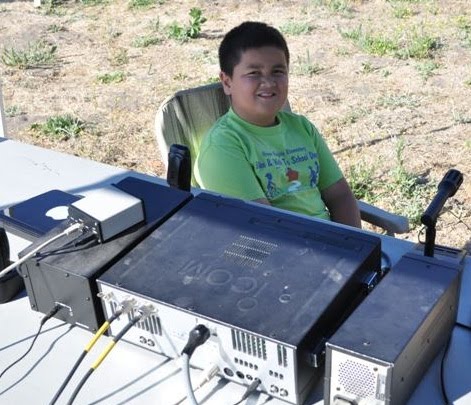 Emerito, N6ETO’s son Vinnie taking a tour of the ionosphere despite closed out conditions.
 Phil, KK6PE working on the laptop prior to official start while Brian and Frank troubleshoot our rotor control box.
 Phil, KK6PE is downloading N1MM Logger for use over the weekend. The club operated from the dialogue box while inputting mode, frequency, and callsign.
 Fred, KI6QDH and John, KG6RFW logging Saturday afternoon 20m contacts.
 Fred, KI6QDH in the pilot’s chair and a box provided screen shading otherwise it was impossible to see one’s input.
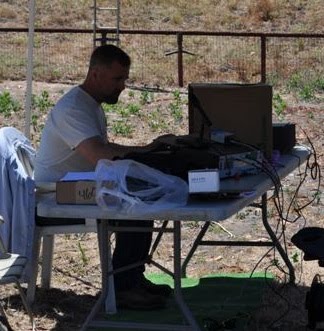 Operating our low band station. I’ve never forgotten field day in Western Pennsylvania as a novice. The low bands were always hot and fun!
 Phil, KK6PE, Ricky, and John, KG6RFW manning our high band station through Saturday evening. Ricky totally dug high frequency operations.
 Saturday night pumps on the low bands and I’m having a blast working both short and long skip. The evening cooled off significantly enough to warrant a North Face sleeping bag and skull cap.
 Ernie, AE6ZE who hosted our first ever field day event in the pilot’s chair on Sunday morning.
 Riding a few hours sleep and back in the chair on 40m early Sunday morning.
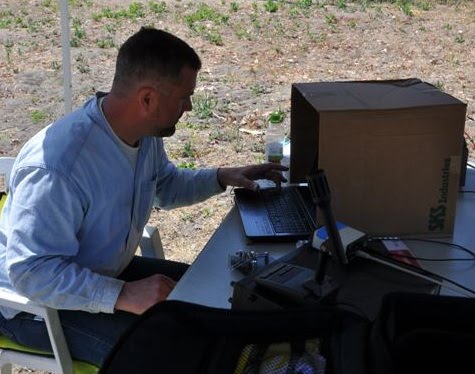 Activity shifted on Sunday as many operators went into the log as 1 Deltas and I imagine it will be an on-going, persistent trend in the forthcoming years.
 KI6QDH and KI6UYB logging contacts either on 15 or 10m because 20m was not as productive as the team had hoped for through the weekend.
 Kord, KI6UYB hitting his groove on the high bands mid-Sunday morning.
 John, KG6RFW summed up our weekend beneath the warmth of Cycle 24 during the final hours of field day.
 73 from the Beach Boys Amateur Radio Club and stay tuned for our next adventure!

Scot Morrison, KA3DRR, is a regular contributor to AmateurRadio.com and writes from California, USA.
VHF NFD washout
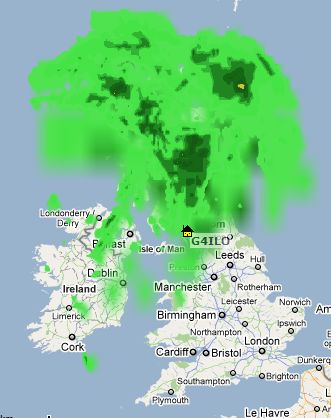 Conditions could hardly have been worse for the RSGB’s VHF Field Day contest this weekend. Yesterday I worked a few southern Scottish portables on 2m and 6m, plus the Lincoln Radio Club station G5FZ/P on 2m, and that was that. There did not appear to be a shred of Sporadic-E on either 2m or 6m, according to DX Sherlock. 6m was so quiet my K3 S-meter wasn’t even moving.
Today when I turned on the radio I tuned both 2m and 6m without hearing a single signal. The map on the right probably shows why. We awoke to heavy rain and gale force winds, and I immediately thought of those poor guys on hilltop sites with their guyed poles supporting their beam antennas. If the wind didn’t force them to take the antennas down I dare say the rain and the poor propagation made them decide they might just as well give up.
This has been a really disappointing year for me too, VHF-wise. After working Spain and Portugal on 2m on two separate occasions last year – the last being exactly one year ago – I improved my antenna by 3dB and my output power by 6dB in the hope of doing better during this year’s season. But I have worked nothing and as far as I know the sporadic-E this year has hardly been heard this far north. DX Sherlock showed that a couple of well-sited northerly stations managed to make a few contacts a few weeks ago and I fleetingly heard a station from Romania complete a contact and call CQ at that time, but that was that.
Something is becoming clear to me that I never realized when I lived in the south, which is that just a couple of degrees of latitude can make a huge difference to the amount of Sporadic-E you get. The season isn’t over now but it must be on the wane and I’m soon going to be away from the radio for a couple of weeks, so it’s looking as if 2010 is going to pass for me without any 2m Sporadic-E DX.

Julian Moss, G4ILO, is a regular contributor to AmateurRadio.com and writes from Cumbria, England. Contact him at [email protected].
2010 Field Day | Beach Boys Amateur Radio Club
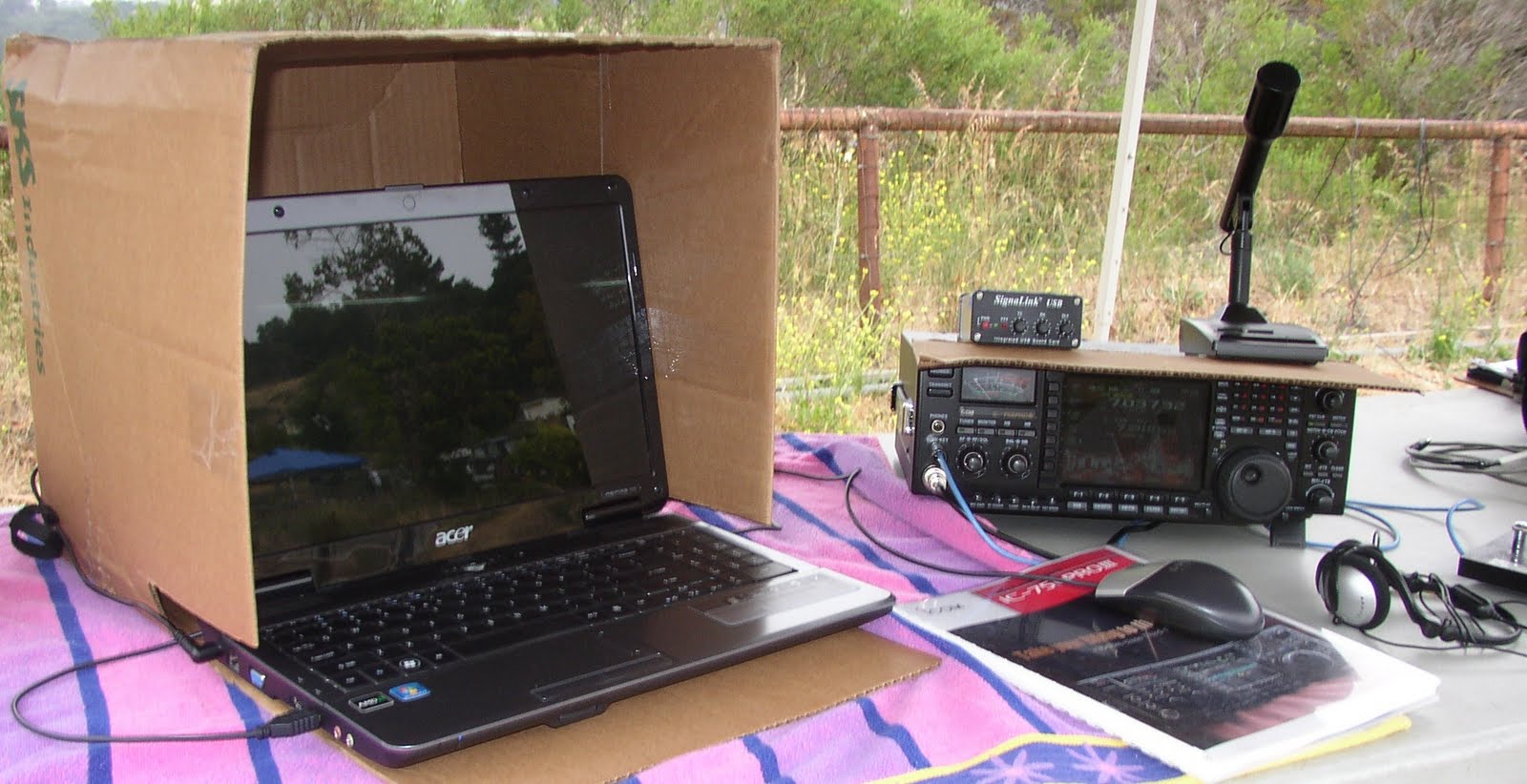 Was it a week ago when ham radio operators across the nation gathered together for a weekend of emergency wireless communications and socializing?
Gratitude.
I want to thank Ernie, AE6ZV for his magnificent effort as the Beach Boys Amateur Radio Club successfully executed its first ever field day. He magnified the definition of ham radio spirit while Honda generators hummed, Morse code sang into the starry night, and operators shouted into microphones.
Many thanks to Emerito, N6ETO, Fred, KI6QDH, John, KG6RFW, and Kord, KI6UYB for their inspiration, hard work, and dedication to the Beach Boys Amateur Radio Club mission — ham radio is a lot of fun!
I believe our club is reinvigorating ham radio in our local area as participants chatted up the excitement of logging their first ever HF contacts, the flush of our accomplishment, and their passion for a wonderful hobby. Our local 2m repeater will never be the same after last weekend.
Reward Is In The Effort.
We are a band of like minded with varying degrees of expertise. Our antenna systems for the weekend included an elevated Butternut HF9V with 5 quarter wave radials on the low bands (40 & 80m), a 3 element tribander at 35 feet (10, 15, and 20m), a G5RV (80m LSB), and a 40m dipole.
Propagation really depressed conditions on the high bands with a Sunday morning sporadic-e exception. Literally, 20m was gridlocked and 100 watts was not sufficient enough to conquer both conditions and signal jam when 15 and 10m are virtually shut down however; Beach Boys Amateur Radio Club logged over 200 contacts on the high bands.
A job well done for Kord, KI6UYB who logged his first ever HF contact!
Low Bands Play On.
The low bands performed beyond expectation and we were more than pleased with the performance of the elevated vertical with counterpoise. The concentration of 6 land stations on 40m had an enormous positive impact on our log statistics. Their signals ranged from barely above receiver noise floor to an astounding 20dB on the s-meter.
Forty meters made up the difference for our low power operation especially when 20m was gridlocked.
Fred, KI6QDH fired up our G5RV on 80m LSB beneath a sky ablaze with full moon light and thin, wispy tendrils of fog. His effort spiked our overall total while I logged Morse code contacts on the same band. I enjoyed listening to him as contact after contact went into the log. On the other hand, we are in need of an 80m operator who is a night owl because my brain stopped processing Morse code around 1 o’clock in the morning.
The Beach Boys Amateur Radio Club logged over 500 contacts on the low bands.
Locally Reinvigorating Ham Radio.
Our preparations paid dividends especially in terms of having a lot of ham radio fun. We had lots of visitors throughout Saturday afternoon and, hopefully, our band of passionate operators inspired individuals to look again at ham radio in addition high frequency (HF) operating.
We were wiped out when the buzzer concluded our first ever field day operation. Our team effort scored over 700 contacts in the log and we are targeting over 1,000 for next year.
Next Project?
The Beach Boys Amateur Radio Club is looking at its next project, perhaps, UHF/VHF operations near the beach with our beams pointed north/south toward San Francisco and Los Angeles. There are digital modes yet to be conquered and lots of space on HF for ham radio fun. Six meters is all the rage in the area trending Hawaiian print shirt popular along the central coast of California.
Stay tuned for the next adventure and 73 from the shack relaxation zone.
P.S. Working on my radial system this afternoon, antenna lab gets a 6m beam, and I renewed my ARRL membership.

Scot Morrison, KA3DRR, is a regular contributor to AmateurRadio.com and writes from California, USA.
D-Star’s hidden blacklist
The QRZ.com thread resulting from the news about the French petition to have D-Star made legal has not degenerated into the usual flame war. This afternoon it produced this interesting post by Gavin, G0LGB whe makes some observations that are quite jaw-dropping.
Gavin claims that “Repeater groups are being persuaded by financial incentives, free or drastically reduced equipment, fast-track applications via RSGB/Ofcom, to convert their under used repeaters to D-Star.” The logic of how converting an under used repeater to use a little-used digital mode will increase traffic escapes me. More likely it has to do with starting to establish a network by the back door in the hope of encouraging more users, after which the busy repeaters will come under pressure to change too. We are having D-Star forced upon us whether we want it or not!
The other worrying claim Gavin makes is that the repeater keeper has the ability to ban users, not just from the repeater but from the D-Star network as a whole. This would be fine if it was simply used to ban miscreants – though why someone would pay £500 for a radio just to swear or play music is also a mystery – but apparently people have been banned just for voicing opinions unpopular with the repeater owners (somewhat reminiscent of my own experience with the ROS digital mode!) This is possible because the system is digital – all packets of audio or data originating from you are stamped with your call so the network knows who you are and where you are (or at least which repeater you are in range of.)
I think that, regardless of the merits or otherwise of using digital voice on the VHF bands, D-Star is not the way to go. It vests too much power in the hands of one manufacturer, Icom, and in individual repeater owners. It’s just unacceptable to have a situation that could result in you being barred from your hobby just because a repeater owner disagrees with your views. I suspect that the people who find APRS too much like Big Brother won’t like this either.

Julian Moss, G4ILO, is a regular contributor to AmateurRadio.com and writes from Cumbria, England. Contact him at [email protected].
SMA Failure
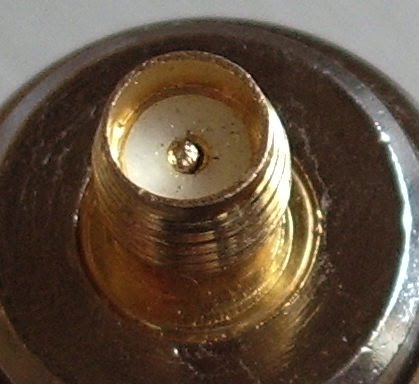 I’d heard about the famous fragility of the SMA connectors used on modern hand-helds but today I got bitten by it. I was using my RigExpert antenna analyzer to check the resonance of the stock antenna supplied with the VX-8GR (which I found to be rather broad) and thought I would check the antenna supplied with the Kenwood TH-F7E for comparison. That was sharper, but the SWR was high – the best match was at 160MHz. As I was unscrewing the antenna from the SMA to BNC adapter I heard a snap. When the antenna came off I saw that the centre pin was still in the socket of the adapter. Damn!
These SMA sockets are not meant for constant swapping of antennas. The centre pin is thin and fragile, and to make things worse the pin rotates with the antenna as you screw or unscrew it, subjecting it to a twisting action that must eventually cause metal failure. All it takes is for the female to be a bit tight, if you’ll pardon the expression, and the result could be castration of the antenna.
So I’ve had it with SMA connectors. I bought two BNC to SMA adapters several months ago and the only reason I was still using the SMA antennas is that I don’t have any short BNC antennas suitable for using with the radio on my belt. But now one of those adapters will go on the VX-8GR permanently.
What’s most upsetting about this is that I’ve spoilt my TH-F7E which I was planning to sell, as the original antenna is now useless. So now I’ll have to buy a new Kenwood antenna before I can sell the radio (£24 from W&S, eek!)

Julian Moss, G4ILO, is a regular contributor to AmateurRadio.com and writes from Cumbria, England. Contact him at [email protected].
Is APRS Broken?
As I wrote yesterday, I have been experimenting with APRS on the HF bands (30 metres.) This morning I spotted a couple of mobile stations beaconing position reports, or more likely I was receiving the digipeated copies of them. I can see that position reporting on HF could be useful if you want to be tracked and are out of range of any VHF digipeaters or gateways, but HF stations with their much larger capture area and four times slower data rate really couldn’t sustain many fast-moving mobiles sending position updates every minute or so.
APRS is meant to be more than just a system for capturing position reports using radio and I find the facility to exchange messages with ham friends and know that they received them (even if they aren’t immediately able to respond) to be very useful. It isn’t a substitute for conventional digital contacts, it’s an additional way of communicating. However, unlike on VHF where you probably know the people whose calls you see on your screen, on HF there is no way of knowing whether someone wants to chat, or even if a particular station is attended. Unless the intention is to chat direct by radio, using HF seems to me to be an inefficient way of reaching the APRS-IS internet backbone. So apart from giving someone in the middle of nowhere an extra chance that their packets will be received – which would be a rather boring use of an expensive HF radio – I’m still unsure of the value to me personally of running an HF APRS station. The technology is interesting but the practical use eludes me.
Despite this I was still keen to try APRS over HF. As I didn’t know whom to contact I decided to send a greeting to Lynn, KJ4ERJ, currently holidaying in Spain, who I knew (from checking aprs.fi) was online at that moment. I disconnected my APRSIS32 client from the internet so I would know that if my message was received, it would have been picked up on the radio.
The message went out on 30m, and was repeated several times as no acknowledgements were received by my station. In the meantime I decided to send a second greeting message to Colin, 2E0XSD. No acks were received for that message either. Eventually I checked aprs.fi and sure enough my messages had made it to APRS-IS through various gateways in Switzerland and France. They had even made it to their destinations and Lynn and Colin had both sent replies. But I never received their replies over the radio, either.
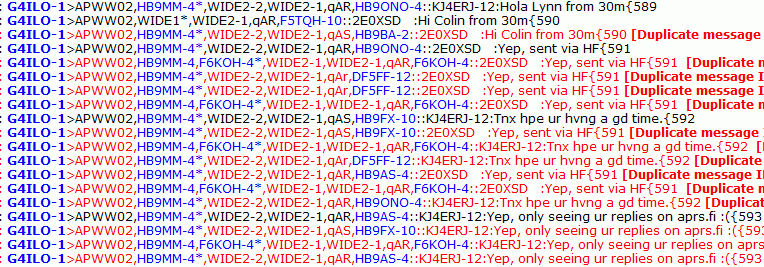 The screengrab shows a section of the raw messages list from aprs.fi which includes the paths of my messages as they were received on the internet. It appears that nearly all were received and digipeated by HB9MM-4. I’m not sure if that station also gated my messages to the internet.
The way I understand APRS to work, any messages sent to me (and any acknowledgements of messages sent by me) should be relayed back to me over RF by any stations that have heard me on RF. The acknowledgements and replies from Lynn and Colin were on APRS-IS and could be received by the HF stations that were hearing me. But they were not transmitted. I was receiving a strong signal from HB9MM-4 so it is very unlikely that the packets were sent and none of them were decoded.
What’s the use of a system for messaging if it can’t be relied on to work as intended? It seems to me that APRS is broken and is really only useful for collecting position reports where the traffic is all one way – to the internet.

Julian Moss, G4ILO, is a regular contributor to AmateurRadio.com and writes from Cumbria, England. Contact him at [email protected].
 Ham Radio Deluxe |
 W5SWL Electronics |
 Ham Radio Prep |
 KB3IFH QSL Cards  Hip Ham Shirts  HamRadioAuctions HamRadioAuctions Reliance Antennas Reliance Antennas Enigma Shop Enigma Shop |  morseDX  Ni4L Antennas  R&L Electronics R&L Electronics antennas.us antennas.us QRV QRV |
- Matt W1MST, Managing Editor
