 |
 No comment
 6 July 2010 | by
 I think something must be broken in Blogger. Two people posted comments today, one each to the two postings I made. I know this because I received an emailed copy of the comments. Neither of the comments are showing up in the blog. In the Blogger dashboard, one of the posts shows “1 comment” but when I click on that link I can’t see it.
So, Paul and S.o.a.l., don’t be offended. I didn’t delete your comments.

Julian Moss, G4ILO, is a regular contributor to AmateurRadio.com and writes from Cumbria, England. Contact him at [email protected].
70MHz: UAE permission granted / interesting openings
I just took a look at the excellent 70MHz website.
United Arab Emirates have granted permission for 70MHz activity, as a secondary service. 70.000 to 70.500 may be used, with 100W.
In the Chatterbox section, David, G4ASR reports activity yesterday from CU4/DL3GCS and D44TD.
Four metres gets ever more interesting!

Tim Kirby, G4VXE, is a regular contributor to AmateurRadio.com and writes from Oxfordshire, England. Contact him at [email protected].
I don’t belieeeve it!
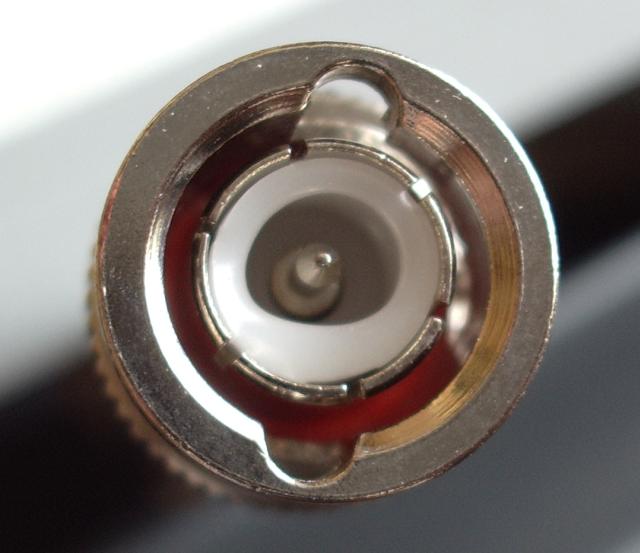 No, this isn’t a post that was meant to go in my other blog One Foot in the Grave. But I just cannot believe the amount of bad luck I have ordering radio goods from suppliers.
A few months ago I wrote about what a difference it made to the effectiveness of helical “rubber duck” VHF antennas if they were tuned precisely to 145MHz and I described how I had tried to lower the resonant frequency of some helical antennas I already had that were too high in frequency.
A few days ago I discovered that Waters and Stanton sell a tunable VHF rubber duck with BNC socket that can be trimmed to frequency by the user. As I have decided to switch completely to BNC antennas on my hand helds I needed another so I decided to order one.
It came this morning, but when I tried to fit it to the BNC adapter on my antenna analyzer in order to start trimming it, it wouldn’t go. When I examined the BNC closely I saw that the insulation had melted and deformed, presumably during the process of applying heat shrink tubing. So it is completely useless! You would have thought an “ISO 9001 Registered Firm” would have heard of quality control, wouldn’t you?
I have written Waters and Stanton a snotty email containing a copy of the photograph asking if they would send me a replacement. Since I have no desire to incur additional expense sending the faulty one back I have also asked how they will reimburse me for the postage.

Julian Moss, G4ILO, is a regular contributor to AmateurRadio.com and writes from Cumbria, England. Contact him at [email protected].
Save Analogue FM
 Practical Wireless editor Rob Mannion G3XFD has been writing to radio clubs urging members to support a campaign to save analogue radio. However, the radio he wants to save is not ham radio but broadcast FM radio, which has been threatened with closure in the UK forcing users to switch over to the “new” Digital Audio Broadcast (DAB) system.
The much vaunted DAB was supposed to re-invigorate the UK’s radio industry, provide a raft of new and interesting IP based services to audiences, permit the launch of new national, regional and local radio stations and generate new marketing revenue for radio stations. However, DAB is almost dead on its feet, as users have been reluctant to buy expensive new radios which in many cases offer poorer reception and fewer stations than they can get on FM. If this reminds you of something more amateur radio related you can probably guess where I am going with this.
D-Star was supposed to re-invigorate VHF radio usage, deliver a raft of new, interesting IP based services like text messaging, DPRS and file transfer to users, permit international, national, regional and local contacts and generate new revenue for Icom. However it is struggling to gain acceptance as people have been reluctant to buy expensive new radios that will provide access to fewer repeaters and fewer local contacts than they can get on FM and have been underwhelmed by the new features offered. Nevertheless the creeping D-Starization of the VHF and UHF bands continues, with the regulatory authorities now apparently refusing to allow new analogue repeater proposals whilst fast tracking D-Star applications through the system.
It does not seem to me to be beyond the bounds of possibility for the powers that be to decide at some point that there will be a ham radio digital switchover, that all analogue repeaters should be switched off and sections of the bands previously authorized for analogue FM use will be allocated to digital.
Perhaps we amateurs need our own campaign to Save Analogue Radio before it is too late. If you oppose the D-Starization of the amateur VHF and UHF bands, feel free to use the “No D-Star” logo on your website, your forum avatar and anywhere else that people might see it.

Julian Moss, G4ILO, is a regular contributor to AmateurRadio.com and writes from Cumbria, England. Contact him at [email protected].
K2DBK/VP9
As I mentioned previously, Ed, VP9GE helped me to get a license to operate from Bermuda (VP9) for my vacation last week. Since this was all pretty last minute, the exact plans to get on the air were pretty much non-existent, but Ed suggested that I contact him on the repeater when I got down to Bermuda and work out the details that way. I decided to bring along my Icom W32a HT (a full-featured 5w transceiver) as well as my little Icom Q7a HT, which is very small, runs off two AA batteries, but only puts out 500mw (1/2 w). I haven’t used the W32a much recently, and although I’ve tried to keep the batteries (I have 2 battery packs, one stop and one an extended capacity version) topped off, I think they may have simply reached the end of their life and don’t seem to hold a charge very well. Still, I figured that I might be able to get enough power out of them to make contact with Ed.
I didn’t mention previously that we were taking a cruise to Bermuda, and because of the location of the ship (we were docked in “Dockyard” it was very difficult to reliably hit the repeater. The first day there, we decided to take the high-speed ferry to Hamilton (the capital city) and I took the small Q7a with me, hoping that there would be good-enough coverage there. As it turns out, that did work out quite well, and I was able to contact Ed via the repeater, using my K2DBK/VP9 callsign. Ed is constantly running around (he runs some guest apartments on the island) and had a number of runs to the airport and meetings over the next couple of days, but we agreed to try to contact each other again at around noon the next day.
Unfortunately, I wasn’t able to get in to the repeater the next day, as we were doing some sightseeing in St. Georges, and apparently the repeater doesn’t have good enough coverage there to pick up my little 1/2 watt signal. I didn’t know it at the time, but I was close enough that I could have worked Ed simplex, but I never tried.
So although I did manage to operate at least once as K2DBK/VP9, I wasn’t able to get on HF or 6 meters. Still, it was fun doing that, and if I ever get back to Bermuda, I’ll try to plan a bit more in advance and hopefully get on the lower bands.

David Kozinn, K2DBK, is a regular contributor to AmateurRadio.com and writes from New Jersey, USA. Contact him at [email protected].
IC-290H dial frequency offset
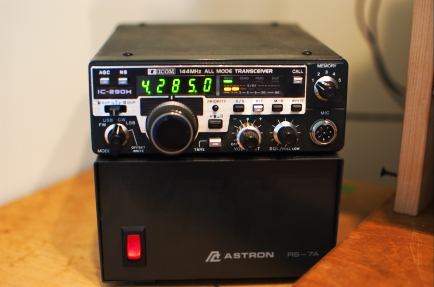
Some time back, I had the good fortune to stumble across a broken IC-290H at an attractive price. The IC-290H is a synthesized mid-1980s 25-watt 2-meter all-mode transceiver. Since I had been contemplating a radio to use as the IF to my W1GHZ transverters for 903 through 3456 (yeah, still need to build/integrate all of these), I jumped. The problem was described as an offset of some tens of kHz between the dial frequency and the actual transmit and receive frequencies. Since the IC-290 lacks a user community like the TS-600 and TS-700 (my other 2-meter all-mode radio), I went to Google and then posted a quick inquiry on the Stanford VHF e-mail list to see if this was a common problem. Google produced nothing and the VHF list produced the usual “get the Service Manual” response. Since I already had the Service Manual thanks to the previous owner, I was set.
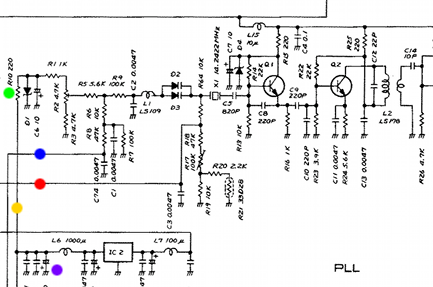
The synthesizer (“PLL”) in the IC-290H has at its heart a VCXO (shown above). The control voltage biases varactor diodes D2 and D3 in a tank circuit with crystal X1 operated between the series and parallel resonant frequencies (as a very high-Q inductor). Contributions to the control voltage come from the microprocessor (red dot), the receive incremental tuning (RIT, blue dot), and an overall bias of -9 V derived from 5 V using DC-DC converter IC2.
In the “PLL Adjustments” section of the Service Manual, the VCXO adjustments are outlined, checking the synthesizer output with a frequency counter. I noted that as I changed rotated the VFO encoder on the front of the radio and the digits changed on the display, the output frequency of the synthesizer changed accordingly. Similarly, the RIT caused the frequency to shift. Neither of these things were surprising since I could tune in different stations before. In USB mode at 145.998.5 MHz, the synthesizer should output at 134.250.0 MHz. I read it at 134.230.21 MHz, clearly the source of the almost 20-kHz offset. I nudged potentiometer R2 (against the vehement warnings of the Service Manual) and the output didn’t change. For good measure, I swept R2 over its entire extent with no change.
R2, it seems, controls amount of the available -9 V bias applied to the varactors. I checked the -9 volts line. Zero. Who stole the bias from the cookie jar? The 5 V line was sagging down to 4.23 V.
I removed IC2, which is in a metal can that resembles an overgrown Mini-Circuits mixer and has only “DP-1″ stamped on the cover in black ink. For kicks, I drove this little guy with 5 volts into no load and got well over -100 V out. Did this punk destroy other parts in my synthesizer? I put this question to Dad, who happened to be here over the weekend. He suggested that it might require a load to produce a regulated output. Good thinking. Nothing on the synthesizer board appeared to be charred. So, my theory was unlikely and I proceeded.
Without IC2, the 5 V line bounced up to 4.95 V. And, the output side (connected to L6) showed a DC short to ground. If you trace the circuit from the output of IC2 to one of the legs of R2, nothing should show a DC short. I looked for bridged solder traces. None. Taking the divide an conquer approach, I removed R10 (green dot), to isolate the entire RF portion of the circuit. Still shorted. So, this left the following three suspects: two 0.1 uF ceramic disk capacitors and a 10 V, 100 uF electrolytic. Since electrolytic capacitors, especially older ones, have a bad reputation for causing problems, I interrogated it first (C20, purple dot). Bingo.
The only 100 uF capactor I had on hand that even came close to fitting was a 50 V unit from a previous repair. I squeezed it in—it’s the big brown one against the edge of the case in the center of the photo below. Note IC2 “DP-1″ in the lower right corner.
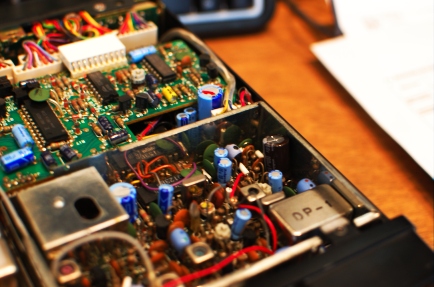
So, I plugged the radio into a power supply and antenna. And, low and behold…it was about back on frequency. So, I completed the synthesizer and RIT adjustments in the Service Manual and put it back together. It actually receives WA1ZMS/B on 145.285.0, which, Doppler notwithstanding, is GPS-locked at 145.285.000… Stay tuned for the low-drive transverter IF modification in the next few months once I start building them again.
Ethan Miller, K8GU, is a regular contributor to AmateurRadio.com and writes from Maryland, USA. Contact him at [email protected].
NEScaf Filter Saves the Day
As one of the many antenna restricted condo owners of America, I cannot operate as often as I’d like. The hassle of putting up and taking down temporary antennas wastes time, isn’t always practical and generally spoils the fun for us.
Great that we have some holidays and time off as it allows a bit more opportunity to get on the air. The MI QRP group hosted a 4th of July Sprint and although the hour was late (7-11PM EDT) since I did not have to go to work Monday, I took advantage of the chance to work a few of my fellow QRP ops.
Rain and lightning welcomed my efforts to set up an antenna. So I forsook my normal setup and settled for a twinlead 44 foot doublet hung from my 20 foot Jackite pole which was bungee cord strapped to a ladder in the back yard of our condo. The antenna ran north south so much less than ideal, but at least I could get on the air.

Freshly Built NEScaf saved my bacon!
The day was saved by my freshly built NEScaf filter. As one of the lucky ones, I recently received the latest edition of this great kit provided by the NE QRP bunch. It enabled me to listen to cw despite the high QRN and background hash from neighbor’s TV’s, computers and air conditioners. What a joy it is to actually hear stations through the noise. This is a must have accessory for the condo based QRP op! I am still learning to use it well, but am mega-impressed with the capabilities it offers. With this audio filter, I could null out the QRN and peak the CW signals making for much more relaxed and enjoyable copy. The extra audio boost helps my little Sierra audio too. Keep watching for the next round of kits!
Kelly McClelland, K4UPG, is a regular contributor to AmateurRadio.com and writes from Florida, USA. Contact him at [email protected].
 Ham Radio Deluxe |
 W5SWL Electronics |
 Ham Radio Prep |
 KB3IFH QSL Cards  Hip Ham Shirts  HamRadioAuctions HamRadioAuctions Reliance Antennas Reliance Antennas Enigma Shop Enigma Shop |  morseDX  Ni4L Antennas  R&L Electronics R&L Electronics antennas.us antennas.us QRV QRV |
- Matt W1MST, Managing Editor
