 |
 Foxhunt gear – offset attenuators
 8 July 2010 | by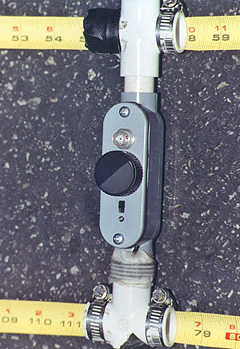
I attended a great fox hunting presentation at Dayton this year, hence a few posts on the topic.
I had some posts in the past about tape measure beam antennas. Really neat antennas and they have multiple purpose use (they are GREAT for hitting distant repeaters when you orient them vertically!). Much like the picture on the right (courtesy of Joe Moell K0OV) they are more useful for fox hunting when you add the active attenuator to your setup. FYI, Joe is the co-author of the great book “TRANSMITTER HUNTING, Radio Direction Finding Simplified” available where most ham books are sold. His website has more information on the book at http://www.homingin.com/THRDFSinfo.html and he contributes to CQ and CQ VHF.
So….. just what is an offset attenuator? Joe explains it on his “Homing in” site as:
An RF attenuator is a device that goes between antenna and receiver to reduce the signal strength down to within the range that the receiver S-meter can handle. Without one, you may think you’re close to the fox when you’re still far away. You won’t be able to get close enough to a camouflaged hidden T to identify it. The amount of attenuation should be adjustable so that you can add just a little when your S-meter first pins, up to a lot as you get within a few feet. Special ARDF receivers used by champion foxhunters have electronic attenuation built in, but ordinary handi-talkies don’t. Adding it would require major micro-surgery in the HT.
His attenuator page is:
http://www.homingin.com/joek0ov/offatten.html
I recommend his site in general, many great projects:
On his attenuator page, he has full schematics to make an offset attenuator.
But wait…… there’s more!
Further on his page, you see one made in a sweet Pomona box.  I like this box and thought it was a bit pricey at first, until I did the math and figured out the cost/time to do it myself. These boxes are shielded with the connector of your choosing (BNC/SMA/259, etc).
They generally cost around $25 or so and are shielded! Great to have. When you add the cost of connectors and such, it isn’t really so expensive after all.
I really advise using such a case or a metal case in general, makes things work out much smoother in the end. More information on this box at: http://www.pomonaelectronics.com/index.php?i=prodsub&parent=BOX&cat=BONCONN&getDetails=
But wait….. there’s even more!
 Marvin Johnston KE6HTS is now offering a “semi-kit” for this attenuator on his website. I’ve seen this kit when I was at Dayton this year and encouraged a friend to pick it up and build. I may end up running a buildathon here in CT on these attenuators.
The price is really not bad at $22.00. You can purchase them built for a few dollars more.
Information on the kits and pre-built models are at:
http://www.west.net/~marvin/k0ov.htm
And yep……. there’s even more (again!).
If you would like to “roll your own” from parts you may have on your bench, but don’t want to make a circuit board, you can get one from……. you guessed it…… Far circuits. I picked one up and am going this route myself.
There are a few boards/projects on the Far circuits website at:
There are a ton of great resources out there on the web, these will really get you going right from the start. Fox hunting is a really fun and useful part of our hobby and one that doesn’t cost a ton of money to get started in. If there are no active fox hunts in your area – start ‘em! There are plenty of options as far as transmitters and such and really doesn’t cost a club much money to get started.
Jonathan Hardy, KB1KIX, is a regular contributor to AmateurRadio.com and writes from Connecticut, USA. Contact him at [email protected].
Spud Gun/Antenna Launchers
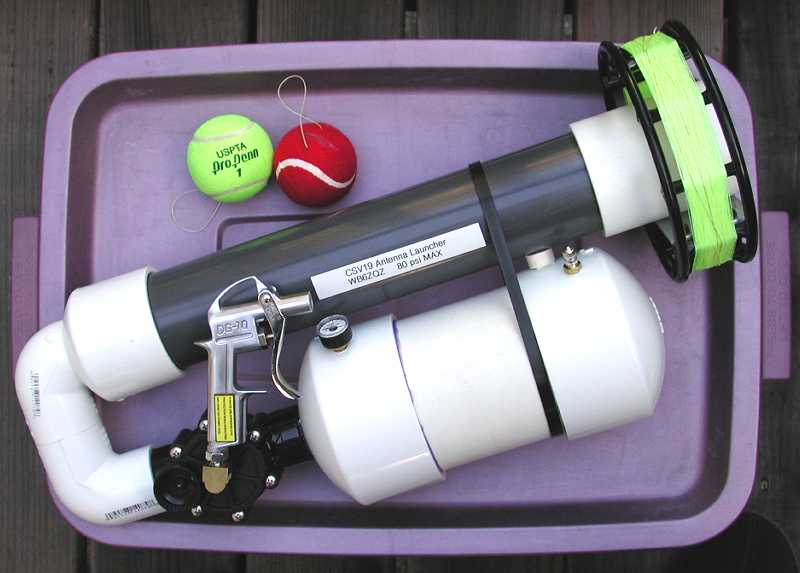 Spud guns or “potato cannon’s” have been around for a long time. For some reason, I’m shocked that more hams don’t use them for putting up wires. QST did an article awhile back on the topic getting people started, but not a lot of activity since (at least from what I’ve found online and locally).
The setup on the right here is the CSV19, instructions (and kits available) are on their website at:
http://www.antennalaunchers.com/csv19/csv19asm.html
There is a ton of information on the web. Unfortunately, a lot of what used to be freely available ended up not being so anymore since people decided to make businesses out of sites that used to give the information away – BAD WEBSITE! BAD!
Anywhooo……
There is still some other interesting sites with plenty of information. On that end, I send you to Philip Mayfield. He has a site with full details on various methods, air displacement, etc. on his site at:
http://www.sigmazone.com/TennisCannon_FullFactorial.htm
I’ve limited this to pneumatic cannons for a reason, the combustible versions are VERY simple. I just don’t like the mess they leave behind (though they are fun). Combustion mortars are fun too……. but I digress…..
There is a FANTASTIC video with step by step instructions courtesy of Patrick Norton (of ZDTV fame, then on various shows on the Digg networks). He did a video on Systm (now canceled program) that is still freely available online – SWEET!
The video below is also available as a downloadable file:
If you want to download the show, or read show notes, visit them at:
http://revision3.com/systm/tennis
If you know of any other resources available online, please post in the comments.
Jonathan Hardy, KB1KIX, is a regular contributor to AmateurRadio.com and writes from Connecticut, USA. Contact him at [email protected].
The Mechanical Universe and Beyond – Annenberg project
 First off…. sorry for the delay in posting (never took three weeks off before). As the Amateur Radio Emergency Service District Emergency Coordinator, we had a TON of public service events and I had a couple of public speaking engagements (radio related), soooo…………. But I plan on posting several posts to make up for the shortfall – there is just too much interesting stuff for amateur radio ops on the web!
Which brings me to the Annenberg Project and their series “The Mechanical Universe and Beyond”. Really great series and I’m thinking about purchasing on DVD for some of my classes – there’s a ton of information here that will indeed pertain to hams.
The course description reads:
This series helps teachers demystify physics by showing students what it looks like. Field trips to hot-air balloon events, symphony concerts, bicycle shops, and other locales make complex concepts more accessible. Inventive computer graphics illustrate abstract concepts such as time, force, and capacitance, while historical reenactments of the studies of Newton, Leibniz, Maxwell, and others trace the evolution of theories.
But, in the middle of the course are some good videos for new hams (and those that want to reinforce some of the theory in radio physics):
14. Potential Energy
Potential energy provides a powerful model for understanding why the world has worked the same way since the beginning of time.15. Conservation of Momentum
What keeps the universe ticking away until the end of time?16. Harmonic Motion
The music and mathematics of periodic motion.17. Resonance
Why a swaying bridge collapses with a high wind, and why a wine glass shatters with a higher octave.18. Waves
With an analysis of simple harmonic motion and a stroke of genius, Newton extended mechanics to the propagation of sound.28. Static Electricity
Eighteenth-century electricians knew how to spark the interest of an audience with the principles of static electricity.29. The Electric Field
Faraday’s vision of lines of constant force in space laid the foundation for the modern force field theory.30. Potential and Capacitance
Franklin proposes a successful theory of the Leyden jar and invents the parallel plate capacitor.31. Voltage, Energy, and Force
When is electricity dangerous or benign, spectacular or useful?32. The Electric Battery
Volta invents the electric battery using the internal properties of different metals.33. Electric Circuits
The work of Wheatstone, Ohm, and Kirchhoff leads to the design and analysis of how current flows.34. Magnetism
Gilbert discovered that the earth behaves like a giant magnet. Modern scientists have learned even more.35. The Magnetic Field
The law of Biot and Sarvart, the force between electric currents, and Ampère’s law.
There’s more, but this will give you an idea of the valuable resource. The video clips are viewable online (though rather small). I haven’t inquired yet as to the cost of the course on DVD.
Available at:
http://www.learner.org/resources/series42.html?pop=yes&pid=587#
Post update:
I have found the link for the cost of the series – $450. YIKES!
http://www.learner.org/catalog/series42.html
Jonathan Hardy, KB1KIX, is a regular contributor to AmateurRadio.com and writes from Connecticut, USA. Contact him at [email protected].
Being taken for an idiot
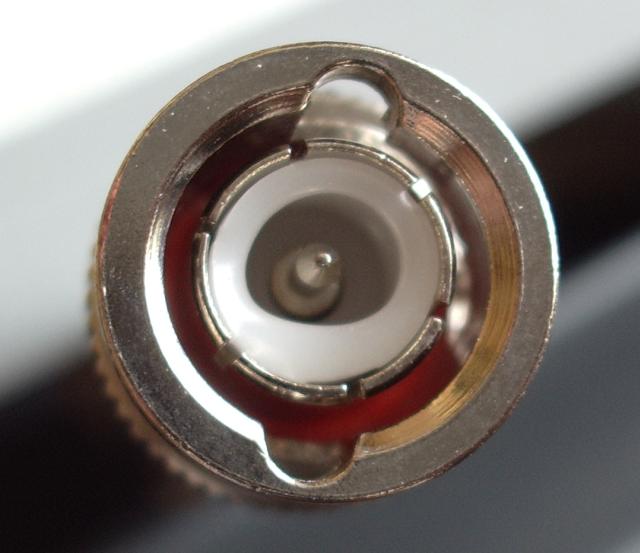 I just received a phone call from the service department at Waters and Stanton who had just received the faulty helical antenna I returned to them.
I was asked: “What frequency did you use it on? It looks as if it as been used to transmit at high power on the wrong frequency.”
Do they imagine that it would be possible to overheat an antenna in such a way as to melt the connector without having any effect on the antenna itself, leaving the connector impossible to attach to a socket? You would think perhaps the fact that the antenna was untrimmed and the top cap not placed in position would give the game away that I hadn’t even used it.
In fairness, they did then agree that it must have been a manufacturing fault and they would send a replacement. But I was left feeling that I had been taken for an idiot. They didn’t even have the grace to apologize to me for the inconvenience of receiving a faulty product.

Julian Moss, G4ILO, is a regular contributor to AmateurRadio.com and writes from Cumbria, England. Contact him at [email protected].
ARRL Derangement Syndrome
Several of the lines in this animation are paraphrased from actual web forum postings. Any resemblances to radio amateurs alive or deceased is strictly intentional.

Anthony Good, K3NG, is a regular contributor to AmateurRadio.com and writes from Pennsylvania, USA. Contact him at [email protected].
Handiham World for 07 July 2010
Welcome to Handiham World!
A volunteer summer
Will Tice, KC0LJL, does some soldering.

Handiham volunteer Will Tice, KC0LJL, helped out at Camp Courage by soldering some PL-259’s to random wire receiving antennas. Will learned to solder when he took an electronics class in high school. Now that he is heading into his senior year at university, he helps us with other jobs as well, including computer-related stuff.
“Look at these nice, shiny solder joints”, he says.
And speaking of volunteers, Bob Garwood, W0BV, has a first draft of the Summer Handiham World print edition ready. Bob is an experienced newsletter editor, and knows how to cut my sometimes too-long articles down to size. Look for the print edition (with a giving envelope) to show up later this summer.
Handiham volunteers Lyle Koehler, K0LR, and Eliot Ricciardelli, KE0N, will be working with me on the W0ZSW Remote Base HF station. We expected to work on the project soon after radio camp, and several important pieces of the project are now in place. We have completed our office move and have configured the office and ham shack space at Camp Courage. We have drilled holes through the concrete walls for feedlines, and our antenna team of Dave Glas, W0OXB, and John Harvard, KC0UHY, have installed an excellent 300 foot center-fed dipole fed with 450 Ohm open wire line and a current balun. The parts were donated by the Stillwater Amateur Radio Association, and a tuner was donated by Eliot, KE0N.
We are so grateful for the time and talent that all of our volunteers share with us. Thank you!
For Handiham World, I’m…
Patrick Tice
[email protected]

Pat Tice, WA0TDA, is the manager of HANDI-HAM and a regular contributor to AmateurRadio.com. Contact him at [email protected].
Handiham World for 07 July 2010
Welcome to Handiham World!
A volunteer summer
Will Tice, KC0LJL, does some soldering.
Handiham volunteer Will Tice, KC0LJL, helped out at Camp Courage by soldering some PL-259’s to random wire receiving antennas. Will learned to solder when he took an electronics class in high school. Now that he is heading into his senior year at university, he helps us with other jobs as well, including computer-related stuff.
“Look at these nice, shiny solder joints”, he says.
And speaking of volunteers, Bob Garwood, W0BV, has a first draft of the Summer Handiham World print edition ready. Bob is an experienced newsletter editor, and knows how to cut my sometimes too-long articles down to size. Look for the print edition (with a giving envelope) to show up later this summer.
Handiham volunteers Lyle Koehler, K0LR, and Eliot Ricciardelli, KE0N, will be working with me on the W0ZSW Remote Base HF station. We expected to work on the project soon after radio camp, and several important pieces of the project are now in place. We have completed our office move and have configured the office and ham shack space at Camp Courage. We have drilled holes through the concrete walls for feedlines, and our antenna team of Dave Glas, W0OXB, and John Harvard, KC0UHY, have installed an excellent 300 foot center-fed dipole fed with 450 Ohm open wire line and a current balun. The parts were donated by the Stillwater Amateur Radio Association, and a tuner was donated by Eliot, KE0N.
We are so grateful for the time and talent that all of our volunteers share with us. Thank you!
For Handiham World, I’m…
Patrick Tice
[email protected]
Pat Tice, WA0TDA, is the manager of HANDI-HAM and a regular contributor to AmateurRadio.com. Contact him at [email protected].
 Ham Radio Deluxe |
 W5SWL Electronics |
 Ham Radio Prep |
 KB3IFH QSL Cards  Hip Ham Shirts  HamRadioAuctions HamRadioAuctions Reliance Antennas Reliance Antennas Enigma Shop Enigma Shop |  morseDX  Ni4L Antennas  R&L Electronics R&L Electronics antennas.us antennas.us QRV QRV |
- Matt W1MST, Managing Editor
