 |
 So that’s what it sounds like
 20 August 2010 | by
 While most of you reading this are hams, I have a number of readers who aren’t and who probably haven’t heard what things sound like on the radio. There are also some hams who aren’t active on the HF bands for any number of reasons who might not have had an opportunity to listen to DX. DX, meaning “distance”, is what hams use to refer to a “far away” contact. The definition of “DX” varies, but in this case I’m talking about a contact with a ham in a foreign country. What I’d like to do is present a short (42 second) clip of a DX station and explain what’s being heard.
First, I’ll note that what you’ll hear is typical of a DX station making brief contacts. There’s not a lot of chat back and forth, but the goal here is to make as many contacts as possible. Second, I picked this clip (recorded earlier today) because the station I was listening to happened to have an exceptionally strong signal and conditions were very good. (For those of you interested, the DX station was using a 2KW amplifier into a 6 element cubical quad. My station is an Icom 756 Pro II with a G5RV antenna up about 10 m in the backyard. I worked him a few minutes before this recording was made.)
With that said, here’s the link to the audio file that I’ll be describing: http://k2dbk.com/rl3a.mp3 (you may need to right-click and save that to your computer, or you may just be able to click on it to play, depending on how your computer is set up.)
I’ll give a start time in seconds for each description to help you follow along, here’s what you’re hearing:
:00 – “Q R Zed stateside, Radio LimaThree Alpha” – QRZ (hams pronounce the letter “Z” like “Zed” because it’s so similar to other letters like C, etc.) is a sort of shorthand for “Who is calling me?”. He uses the term “stateside” because he’s just interested in making contacts with stations in the United States (though often that really includes Canada and Mexico as well.) Radio Lima Three Alpha are the radio phonetics for the callsign RL3A, who is the DX station that I referred to earlier. I’ll explain more about him later, but what’s happening here is that he’s saying “This is RL3A and I’m ready for another contact”.
:03 – At this point various stations are giving their callsigns phonetically (kind of like kids raising their hands in class and saying “pick me, pick me!”). Because of the way radio propagation works, you can’t hear everyone calling him, but you can hear Whiskey Alpha Eight Lima Oscar Whiskey (WA8LOW) along with what sounds like a bunch of other people calling all at once. (In fact, that’s exactly what’s happening).
:07 – “Victor Echo United, what’s the prefix?” Although we heard WA8LOW, RL3A has heard part of a callsign that ends in VUE and he’s asking for the beginning of it.
:10 – First a bit of just noise, then “Roger, roger, Victor Echo Three Victor Echo United fifty-nine, QSL?” The noise (most of which I’ve edited out) is where VE3VEU is giving his complete callsign to RL3A. The reason you can’t hear VE3VEU is because of propagation. That’s a station in Canada and his signal is probably passing right over me, but was mostly likely very strong as heard by RL3A. RL3A acknowledges that he’s heard the complete callsign and gives him a standard signal report, 59. The report is given using the RST (Readability, Signal, Tone) system, but in many cases a simple 59 report is used where the exact value of the report isn’t important. QSL is a shorthand way of saying “Did you get the information that I sent you?”
:16 – More noise while VE3VUE is talking, then at about :21 “Seventy Three Bill, good luck Q R Zed Radio Lima Three Alpha” Seventy-Three (73) is another ham radio “code” which means “best regards” and is a common way to say “so long” at the end of a contact. If you’ve been keeping track, you’ve figured out that the next part is RL3A asking “who wants to be next?”
:25 – More stations calling, then “Whiskey Delta Eight Japan Papa something fifty-nine, over”. This is pretty much the same as the previous contact, but in this case RL3A sent the 59 signal report right away. He’s got most of WD8JP’s call but thinks he might be missing a letter. “Over”, as you might expect, just means that he’s telling the other station to go ahead and talk.
:34 – I cut quite a bit of the noise out here since it was rather long, and then we hear “QSL John, I am Dima, Delta Italy Mike Alpha and the QTH Moscow. Thank you John for the QSO 73 good luck”. In this case, RL3A is using QSL to acknowledge that he has heard the information sent (it can be used either as a question, as in the clip started at :10, or as an answer). Obviously the WD8 station operator has said his name is John (and it turns out that the complete station call was in fact WD8JP, that’s why RL3A didn’t respond with the full callsign again, since he had received it correctly the first time), and RL3A’s name is Dima, which he spells phonetically. You have probably guessed that QTH is a shorthand for “location”, and Dima is located in Moscow. He then closes out the contact with the usual “so long” and after that (though not recorded), he repeated the “loop” of working stations.
I hope you’ve found this informative, if a bit lengthy. If for some reason you have a problem downloading the MP3 file (it’s a bit over 500k bytes in size), please let me know and I’ll help you out.

David Kozinn, K2DBK, is a regular contributor to AmateurRadio.com and writes from New Jersey, USA. Contact him at [email protected].
The ingenious circuits of Sir Douglas Hall
 As a confessed web junkie (how else can you do a site like this) and a ham…… I find many sites that show circuits from decades gone by that are every bit as relevant today as they were when they were originally created.
Then…… there comes a time when you can look at a mere snippet of someones overall body of work and get an interesting glimpse into one of those rare “beautiful minds”. Such is the case with Sir Douglas Hall.
He started publishing articles nearly two decades after he started tinkering with electronics. This site has copies of his published works from the early forties to…… here’s the crazy thing….. the new millennium!!!
I can’t even begin to go over the normal lists like I do for many articles here, but there are tons of articles from various methods of volume control, multiple crystal receivers, portable radio kits (transmitters and receivers), tons of theory….. the list goes on.
I think I need to cache a copy of this page for my next trip so I have plenty of neat stuff to read while traveling, truly neat stuff.
To find these ingenious circuits, go to:
http://www.spontaflex.free-online.co.uk/
**** Update ****
Thanx to Geoff for commenting and letting me know that there are not only updates, but MORE great circuits on the radioconstructors site at:
http://www.radioconstructors.info/
Jonathan Hardy, KB1KIX, is a regular contributor to AmateurRadio.com and writes from Connecticut, USA. Contact him at [email protected].
Too many radios
If your better half complains that you have too much radio equipment, just show her this article.

Julian Moss, G4ILO, is a regular contributor to AmateurRadio.com and writes from Cumbria, England. Contact him at [email protected].
Avoidable Acronym
You’ve all seen it: a new or prospective radio amateur joins a web forum and posts: “I’m looking for advice on how to get started in HAM radio.” HAM is not an acronym. What do they think it stands for? I consulted the Acronym Finder and could find nothing remotely relevant.
Having been in computing for more years than I care to remember, I know that the avoidable acronym is not a new invention. The one that really used to bug me is HELP, as in “Software includes full online HELP.” For goodness sake! Help is a word, not an acronym. I don’t think it was meant as a cry for assistance: HEEELLLPPP!!!! though I have come across a few programs where that would be appropriate.
Another example is FAX. Again, I can’t think of three words it could be an acronym for. It’s short for facsimile, so it’s just fax.
And ham is short for amateur, so capitalization is not required. There are many suggestions as to why amateur radio became known as ham radio. No-one really knows. Some say it has the same origins as “ham actor”, though that’s a pejorative term for an actor who overacts and generally isn’t very good. Others suggest it comes from British English. Cockneys (working class Londoners) drop the leading H from words like “hurry” or “have”, so they would often insert it in front of words where it doesn’t belong when trying to “speak posh.” Hence “amateur” would become “hamateur” and then “ham”.
Who knows? But whatever the origin, ham certainly isn’t an acronym.

Julian Moss, G4ILO, is a regular contributor to AmateurRadio.com and writes from Cumbria, England. Contact him at [email protected].
Contest Season Preparations
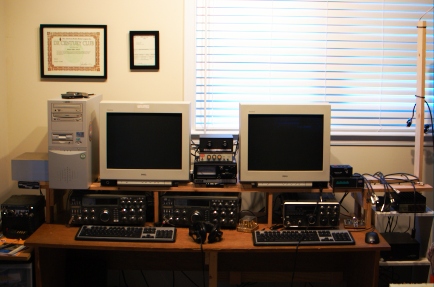
The dog days of summer are here and the contester’s mind begins to drift toward…contest season, of course. What preparations need to be made? Here at K8GU/3, there are a couple of hardware goals I have to get ready:
- Finish building K9AY loop. I have this scheduled for this weekend. I want to at least be able to use it on 80 meters in the CW Sprint on 11 (12) September. This needs one or more W3LPL filters to prevent blowing up my IK4AUY preamp or the RX radio when I’m doing SO2R. I’m going to implement 80 meters on the left radio to begin with.
- Finish building the 50-MHz transverter in time for ARRL VHF on 11-12 September. I’ll be happy with 3-4 watts from this—just enough to move a couple of locals (e.g., W3ZZ or K1RZ) for easy points/mults.
And, as far as mental preparation, I’m operating the weekly NS Ladder.
Ethan Miller, K8GU, is a regular contributor to AmateurRadio.com and writes from Maryland, USA. Contact him at [email protected].
NS Ladder (20 August 2010)
I used to be an ardent participant in the NCCC Sprint Ladder competition when I lived in the Central time zone. Now that I’m back in the Eastern time zone, 10:30 pm local is a little late for me. But, W9RE conned me into doing it. After some fits and starts last night (including using the NAQP module for TR instead of the Sprint module, which caused me to QLF my first two serial numbers), I had a good time. Here are the numbers:
NCCC Sprint Ladder - Aug 20

 Call: K8GU
 Operator(s): K8GU
 Station: K8GU

 Class: Single Op LP
 QTH: MD
 Operating Time (hrs): 0.5
 Radios: SO2R

 Summary:
 Band  QSOs  Mults
 -------------------
 160:
 80:   9      7
 40:   8      7
 20:  12      9
 15:
 10:
 -------------------
 Total:  29     23  Total Score = 667

 Club: Potomac Valley Radio Club
So, I have some work to do. I was getting up into the 40s of QSOs when I left off two years ago. More sprints!
Ethan Miller, K8GU, is a regular contributor to AmateurRadio.com and writes from Maryland, USA. Contact him at [email protected].
Cannot Get Enough QRP Portable
Now into the third week of my sabbatical, I am surprised how much I want to get out and operate my QRP portable gear. Guess I have deprived myself over the years of being a confirmed workaholic and avoiding time off, vacations, and time for my favorite hobby.

Grrrrr! The Polar Bears Are On The Loose!
This should be a good weekend for QRP portable. The Polar Bear QRP Group will be out for another Polar Bear Summer Picnic Event and Polar Bears from Spain to the West Coast of the US will be out looking for BSO’s. Grrrrr! I am PB #173 and we’re over 200 members now. With the new Twitter and APRS connections to QRPSPOTS.COM which also point to the excellent spotting site of K3UK with a section for FISTS/QRP Ops to spot and sked one another, there are plenty of ways to use technology to help find each other. Add in a few other contests and state QSO parties, and there should be some buzzing going on this weekend. Makes me wonder when the FOBB results will be announced! Buzzzz Buzzzzz
I’ll be out and if all goes well I will be field testing a new C Pole antenna based on the suggestion I received from Neil W0LVZ. I added some switchable capacitance to my BLT+ and have rewound the main toroid to see if I can push the range a bit more with it so will have a delta loop and probably my W3EDP in the air too. I love playing with antennas and am still amazed when the ones I build actually make contacts!
Give a listen for me on the QRP watering holes on 40m, 30m and 20m Saturday morning. I’ll be self spotting on QRPSPOTS and the K3UK sites to make it easier for you to find me. Let me know how my newest antenna is workin’.
72,
Kelly K4UPG
PB #173
Kelly McClelland, K4UPG, is a regular contributor to AmateurRadio.com and writes from Florida, USA. Contact him at [email protected].
 Ham Radio Deluxe |
 W5SWL Electronics |
 Ham Radio Prep |
 KB3IFH QSL Cards  Hip Ham Shirts  HamRadioAuctions HamRadioAuctions Reliance Antennas Reliance Antennas Enigma Shop Enigma Shop |  morseDX  Ni4L Antennas  R&L Electronics R&L Electronics antennas.us antennas.us QRV QRV |
- Matt W1MST, Managing Editor
