 |
 K9AY loops
 30 August 2010 | by
 When I lived on my parents’ farm in Ohio, I used to install Beverages. That was back when copper was cheap and I bought 500-ft rolls of #14 THHN for $10 each. N8ET gave me some ferrite toroids (of unknown mix, probably 77) and I added some parts from RadioShack to build some killer listening antennas. The best setup was three unterminated (bi-directional) ones that covered the compass. When I lived in Minneapolis, I went to W0AIH to operate the low bands. And, when I lived in Urbana, IL, I didn’t operate 160 and didn’t need the low-noise receiving antennas—or I went to NO9Z. Now, I live in the suburban wasteland between Washington and Baltimore. It was time to do something about the receiving situation.
Armed with my (autographed, no less) copy of ON4UN’s Low-Band DXing, I began thinking of what options I had. A small RX 4-square developed by K9UWA, W8JI, and others was appealing. But, it’s too large to fit comfortably on my lot. I considered a pair of short verticals with a phasing box (a project that has been in my queue longer than any—since 2003). But, I ended up settling on the K9AY “loops” because they are small and portable, having an integral ground radial and a single ground rod.
When I lived in Urbana, I had considered doing a set of K9AYs. So, I had purchased the parts to build a nice balanced preamp based on a QEX article by IK4AUY (this design is actually based on an even older Ulrich Rohde design). Note that the version of this preamp presented in ON4UN’s Low Band DXing, 4th edition, is wrong—if you see IK4AUY’s web site you shouldn’t miss it. Several months ago, I had assembled one on a perfboard (and tested it—so I thought). When I tried the preamp again over the weekend, it didn’t amplify the signals on the antenna side. The 2N5109 transistors are heat-sinked and so should get warm to the touch during operation. They did not. This suggested that they weren’t even being biased properly. So, armed with a DMM and the schematic, I started following the Vcc line. Megaoops. I failed to connect the collectors to Vcc. That fixed the problem and the preamp worked like a charm.
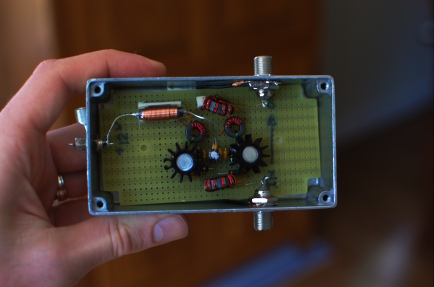
I built the classic K9AY crossed loops at 90 degrees for four-direction switching. Here’s my switchbox (built using 48-volt relays scavenged from the AT&T Long Lines system in the post “Resume of a Master Dumpster Diver“).
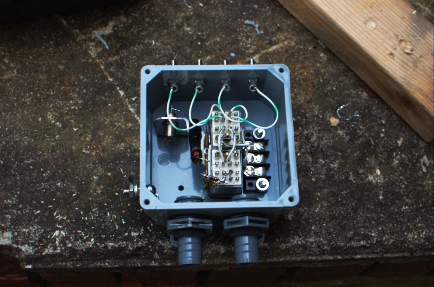
This box may have layout problems. If you’re an expert on K9AY loops, please weigh-in. The terminal strip at right is for the control wiring. I had originally planned to run Siamese RG-6 (scavenged from a DBS installation initiated by some lying, theiving, lazy, pot-head, good-for-nothing duplex neighbors we had in Urbana—they also discontinued our shared “free” Cable) so the loops could be independently switched and shared between two transceivers. But, when I suggested this idea to K9AY, he told me that the loops couple strongly with each other unless the unused loop was left floating. (If this idea actually did work, you could use two transformers on each loop, one in place of the termination, like a reversible Beverage…hmmm…for maximum flexibility.) Instead, I built the regular control box, with a scrap of CAT5 cable as the control cable.
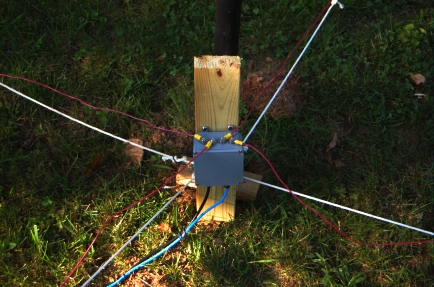
And, zoomed out…
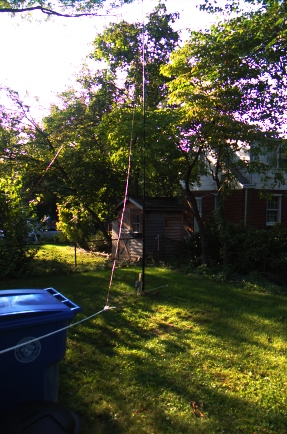
The loops are 80% of full size due to the amount of space (and wire) I had available. I terminated them with a 330-ohm resistor, although I’m having a hard time getting a null. Unfortunately, this is one of the best sites in my yard, yet it has a rusty metal fence (i.e., lots of little diodes on a big antenna) on two sides, a 30-ft mast and my 80-meter vertical on the other two sides. So, it’s not entirely unexpected that I’m not getting a null. I suspect that the neighbor would let me install it in his back yard, but I don’t want his landscape guys to hit the cables. This may become an option.
After conferring with N3OX, I tried putting a 500-ohm potentiometer on the termination point. But, that didn’t seem to help. I probably should bring a receiver out to the antenna when I do this…shouldn’t have sold that FT-817. I checked the potentiometer with my antenna analyzer and it looked pretty reactive. So, that could have been part of the problem. For now, I have the 330-ohm resistor in there and get 10ish dB F/B when I’m lucky…
Ethan Miller, K8GU, is a regular contributor to AmateurRadio.com and writes from Maryland, USA. Contact him at [email protected].
Ohio QSO Party 2010
Ohio is my home state (hence the W8 callsign) and I thought I’d get on to work a few old friends. I was surprised and pleased to work former co-worker WB8JAY although I’ve changed callsigns since we worked together and I don’t think he recognized me. We had friends over for dinner, so I only got two and a half hours in.
The big bummer of the Qhio QSO Party is the RTTY contest. It seems like there’s a lot of bad blood between RTTY and CW ops. I think a lot of it comes from the fact that they can’t (as a CW op, I consider RTTY ops to be functionally-illiterate at CW because they’d be using CW if they weren’t) copy each other’s signals and therefore treat each other as just another interfering signal. One man’s signal is another man’s noise, as we like to say in the remote sensing business.
Anyhow, it was a good time and helped me identify some problems with the K9AY loops setup…
                    Ohio QSO Party

Call: K8GU
Operator(s): K8GU
Station: K8GU

Class: Single Op LP
QTH: MD
Operating Time (hrs): 2.5
Radios: SO2R

Summary:
 Band  CW Qs  Ph Qs
--------------------
   80:   24      4
   40:   42     12
   20:
   15:
   10:
--------------------
Total:   66     16  CW Mults = 38  Ph Mults = 11  Total Score = 7,252

Club: Potomac Valley Radio Club
Ethan Miller, K8GU, is a regular contributor to AmateurRadio.com and writes from Maryland, USA. Contact him at [email protected].
GB7ML 2m D-STAR node: great coverage
I noticed a D-STAR buzz on 145.6375 the other day when I was testing an analog set and a quick ‘Google’ showed that the GB7ML 2m D-STAR node was now operational from Tring. The coverage map at ukrepeater.net looks really impressive and showed potential hand-held coverage around our village here.

Sure enough, when I took the IC-E92 along the footpath this morning, I could just about get into GB7ML!
This should prove a great D-STAR resource for increasing activity around the Home Counties and beyond.

Tim Kirby, G4VXE, is a regular contributor to AmateurRadio.com and writes from Oxfordshire, England. Contact him at [email protected].
Screenshots and copyright
Yesterday I received a comment in the site guestbook from Murray Greenman, ZL1BPU, which says: “While I appreciate your ad-hoc publicity for ZL2AFP CMSK, it would have been much better if you had asked permission to use my screen-shot on your blog site! While web pictures and text are widely plagiarized, that doesn’t make it right to do so. Copyright still applies and the image is still mine.” I have removed the image and inserted a comment directing the reader to this posting in its place.
Since I am on holiday at the moment and did not intend making any blog postings I will leave it to readers of the blog to lead the discussion on this issue. But I would just like to say that part of my career has been made publicizing software. I have always found software authors to be glad of the publicity and have never, until today, received a complaint about using their own images to this end. It is not always possible to take your own screenshots. In this case, I was unable to try the software on the air because of its insistence on using the default soundcard and I thought that it was more interesting to readers to see the live screenshot made by ZL1BPU than a blank one made by me.
As to the question of whether I should have asked permission first, I wonder if ZL1BPU understands what blogging is about? Part of the motivation for writing about some new development in a blog is to be one of the first, and if you have got to write an email asking permission and wait for a reply then it’s likely that others will pip you to the post. It’s not like writing an article, which may take several days to prepare and where time is not of the essence. Blogging is a bit like tweeting, but more verbose.
Finally I would argue that a screenshot is not an original work of art. I’m not depriving anyone of earned revenue by using it. Anyone can install the software and obtain one that is pretty similar. So why make an issue out of copying someone’s screenshot, particularly when the purpose of doing so is to give publicity to the software not to use it with any adverse intent?
I shall certainly think twice about giving publicity to any more new ham radio programs in my blog in future. Perhaps all of you bloggers who happily copy people’s QSL cards and shack photos to illustrate your stories about contacts should pause for thought as well. Ought this not to count as “reasonable use” – the clause in copyright laws that allows you to quote part of an article when referring to it?

Julian Moss, G4ILO, is a regular contributor to AmateurRadio.com and writes from Cumbria, England. Contact him at [email protected].
Spiderbeam, USA
 Congratulations from the low power, low profile shack to Scott Robbins, W4PA who acquired SpiderBeam, USA according to a recent email from the company. Scott also owns Vibroplex as well. One might say there is something fascinating going on in Knoxville, Tennessee and a ham radio entrepreneur is leading the way.
I want to send all the best success to Scott, W4PA as he leads the way into ham radio’s future.
73 from the shack relaxation zone.

Scot Morrison, KA3DRR, is a regular contributor to AmateurRadio.com and writes from California, USA.
ICQ Podcast Series Three Episode Eighteen – RSGB President (29 August 2010)
Series Three Episode Seventeen of the ICQ Amateur / Ham Radio Podcast. News Stories include:
- Hams exempt from RFI ordinance
- Donated spy radio
- Intern builds amateur radio station
- LED technology interference
- Aviation fears over powerline
- Interference investigation
- Radio hams support Pakistan floods
- YL team for Sumburgh Head lighthouse
- Nature Conservation Association needs Hams
- New version of MMSSTV released
- Changes at BARTG 2010
- National Hamfest Award 2010
- Amateur Radio Gets People Talking
- NZ ATV forced digital
- India's hams get 6 metres
Your feedback, upcoming events and David Wilson (M0OBW) joins us to discuss the hobby and his involvement with the RSGB
Colin Butler, M6BOY, is the host of the ICQ Podcast, a weekly radio show about Amateur Radio. Contact him at [email protected].
Broadcaster Praises Amateur Radio, Decries CB

 Ham Radio Deluxe |
 W5SWL Electronics |
 Ham Radio Prep |
 KB3IFH QSL Cards  Hip Ham Shirts  HamRadioAuctions HamRadioAuctions Reliance Antennas Reliance Antennas Enigma Shop Enigma Shop |  morseDX  Ni4L Antennas  R&L Electronics R&L Electronics antennas.us antennas.us QRV QRV |
- Matt W1MST, Managing Editor
