 |
 Becoming an Android
 10 September 2010 | by
A few days ago I came across a forum thread discussing ham radio applications for smartphones in which someone claimed that they were using an HTC Touch Pro (the phone I have) dual booting into Windows Mobile and Google Android. I was interested, but imagined that achieving it would require the ability to follow exactly a lengthy sequence of obscure commands with a high probability of turning the phone into a brick. However I was unable to resist looking into it further and discovered that it should be easier than that. It should be simply a matter of extracting an image of the HTC Android port on to an SD card, copying a configuration file that matches your model of phone into the root folder and then running a program (under Windows Mobile) that reboots the phone into Android. Unfortunately I don’t have an SD card of the type used by the Touch Pro so I haven’t been able to try it yet.
I originally bought a smartphone running Windows Mobile specifically because it would run Lynn KJ4ERJ’s APRSISCE, which is undoubtedly the best APRS client on any smartphone by several hundred miles. However, for me that is really about the only good reason for using that platform. I don’t need the ability to sync with Outlook or use Pocket Office as I don’t use any Microsoft applications on my PCs, and I find Windows Mobile to be too much like Windows itself – complicated to use – and not enough like a phone – easy to make phone calls and text messages. Plus, the fact that running APRSISCE all the time drains the battery in a couple of hours leaving you without a working phone has been a big disincentive to using it in the way I originally envisaged.
Whilst Windows Mobile 6.x is an undoubtedly powerful platform, as you can tell from the range of full-featured applications (not just “apps”) available for it, it is also a dead end. I was surprised to find that Windows Mobile currently has just 5% of the market. Microsoft is hoping to reclaim some of its market share with the upcoming Windows Mobile 7. Personally I think it’s too late and Microsoft has missed the boat on this one. I think Microsoft has an over-inflated opinion of the Windows “brand”. People use Windows on PCs because they don’t have much of an alternative, not because they think it’s great. Smartphone users have lots of choices. People love Google because they are always giving us stuff for free, while Microsoft always makes you pay (and then keeps checking your receipt afterwards). So I think Windows Mobile 7 is doomed even if Microsoft hadn’t decided to make it incompatible with earlier versions so that it won’t run any legacy applications – including APRSISCE.
I really wished in the end I had bought an Android phone. Now this dual boot trick will allow me to try the Google OS out and see whether it is really is as good as the hype. More when I receive the SD card I ordered and am able to try it.
(Update: Just checked the status of my order placed on Wednesday with option for first class next day delivery and it is still shown as Pending. Grr! Clearly it wasn’t a good idea to order from MyMemory.)

Julian Moss, G4ILO, is a regular contributor to AmateurRadio.com and writes from Cumbria, England. Contact him at [email protected].
September 2010 Prize Drawing
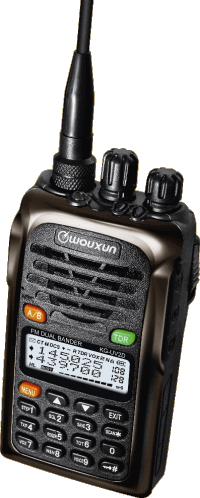
We are very pleased to announce the winner of a
Wouxun Dual-Band HT
from Wouxun.us!
Thanks to Ed at Wouxun.us for sponsoring this month’s drawing.
We had over 750 entries!
We’re giving away another great prize in October.
Stay tuned and get ready to enter.
OK, on to what you’ve all been waiting for!
The winner of our September 2010 prize giveaway is…
Matt Thomas, W1MST, is the managing editor of AmateurRadio.com. Contact him at [email protected].
Duh: Learning Curve #3–Coke Choke Works!
Had a great time setting up the C Pole antenna in a tree suspended configuration. My good friend and cohort, Jim Diggs, K4AHO came by with his AIM 4170 Antenna Analyzer and we were ready to tune the antenna and get a feel for it.
LESSON: A good analyzer makes tuning an antenna fast, simple and accurate! The AIM 4170 gave us a TON of info (most of it going over my head) and let us see how the C Pole was doing in several areas. Take a look at this output! (Click on the image for a larger version)

K4UPG C Pole Scan Results
LESSON: I followed Niel’s directions, but did not have a small plastic coffee container so used a Quart Coke bottle instead. So I call it a Coke Choke and it seems to work well. Here’s a photo to show it off!

Coke Choke Ready for Duty
I think this one is a keeper. Goes up easily, hears well and loads nicely too. I made a few brief contacts and called it a day, but look forward to more C Pole action in the days ahead.
72,
Kelly K4UPG PB #173
p.s. Don’t forget to vote in the Ideal Ham Radio QTH poll on the blog!
Kelly McClelland, K4UPG, is a regular contributor to AmateurRadio.com and writes from Florida, USA. Contact him at [email protected].
Sivan’s Wonder Loop
It’s always good to hear when something one does or writes inspires somebody else to try it and they are pleased with the outcome. Sivan, 4X6IZ, made a version of my portable Wonder Loop and found that “it works as advertised.” He has put some information and pictures of it and another loop he made on a website. His idea of using polyethylene coated aluminium pipe to make a fixed frequency loop and tuning capacitor is particularly interesting if you always operate close to a particular frequency such as for QRP CW, PSK31 etc. If I had space in my attic for another magnetic loop I could dedicate for HF APRS use I would definitely make one of these.
I’m sure you’ll find it worth reading about Sivan’s magnetic loop antennas.

Julian Moss, G4ILO, is a regular contributor to AmateurRadio.com and writes from Cumbria, England. Contact him at [email protected].
Internet killed the radio star
Reading through the Southgate ARC blog this morning, I came across this interesting post from Geoff Emery, VK4ZPP.
It was funny, because this very morning, JackFM were playing the Buggles track, ‘Video killed the Radio star’ from 1979 (we hear the playback and it seems so long ago). And I was thinking, we probably really did think that video WOULD kill radio. But here I am, 31 years later (gulp), listening to more broadcast radio than I have in years – and seeing a really vibrant and varied radio scene (though as an industry it’s fair to say that it has its’ own challenges). And of course, “internet broadcasting” has become part of radio, as we would have called it in 1979.
So it’ll be interesting to see whether the predictions of doom for amateur radio ring true. My guess and earnest wish is that as a hobby, it will evolve. It may(will) not evolve to everyone’s satisfaction and how many times have we heard the phrase “but it’s not amateur radio” muttered?
The truth is that the hobby MUST evolve to survive. It cannot survive as it was, for all sorts of reasons. That doesn’t invalidate the pleasure that people gain from taking part in the facets of amateur radio that have existed “for ever” – not at all.
Geoff’s choice of title made me think about about the parallels with the music broadcasting world. The need and desire to broadcast will not go away – only the methods will change. And so, I suspect will it be with amateur radio – the underlying principles will remain, but the methods will evolve.
And the other thing is that moaning and complaining about it won’t stop “progress” either. Just get on with enjoying what you do – engaging with other people and showing them what a great hobby this is; past, present and future.
I’m Tim Kirby, G4VXE and that’s what I think, how about you?

Tim Kirby, G4VXE, is a regular contributor to AmateurRadio.com and writes from Oxfordshire, England. Contact him at [email protected].
Tuesday night on VHF/UHF
Driving home last night, I was talking to Andy, G0UWS (who incidentally is now on Twitter) who was telling me and Richard, G4ERP that he was planning to be out on the 144MHZ UK Activity Contest that evening.
After we’d eaten and I’d attended to the dishwasher, I popped upstairs and had a quick listen to 144MHz SSB. Sure enough I managed to work Andy who was a great signal, along with a number of local stations. Conditions didn’t seem that great. I came back to the rig a little later on, around 21z when the GB3VHF beacon seemed a lot louder than it had been earlier.
I was able to work a few more people in the East and South East – it’s always good to work into the Suffolk/Norfolk area as well as some of the Cray Valley guys like M0RCV and G0VJG/P to the south-east of London.
Richard, GD8EXI was an intriguing signal. I could barely hear him beaming direct path, but his signal peaked up to the south-east! I didn’t bother to call him, but I strongly suspect I would have been able to work him.
Around that time, I noticed that the PI7CIS beacon was coming through nicely on 2m, so I went over to 70cms to listen for it there. Sure enough it was somewhat above average, though not startling. I tried a couple of CW CQ calls on 432.200 beaming towards the Netherlands, but no luck on this occasion.
All in all, an interesting evening. And thanks to Andy, G0UWS, for without the ‘prompt’ during our earlier FM QSO, I might not have checked the bands.

Tim Kirby, G4VXE, is a regular contributor to AmateurRadio.com and writes from Oxfordshire, England. Contact him at [email protected].
You should be ashamed of yourself
The title of this entry is a phrase that I recall hearing numerous times, probably from a grandparent, when I was growing up. It was usually in response to me doing something that I shouldn’t have done, and it was a form of punishment that relied on my own sense of guilt for doing something that I knew was wrong.
As adults, we learn about things as we go through life, and part of what we learn is to distinguish between things that are right and things that are wrong. We also learn that life is complex, and that sometimes the distinction between right and wrong isn’t very clear. The philosophical implications of that ambiguity are beyond me and something better left to the professionals (such as my uncle and cousin, both of whom have chaired the philosophy department at a major university). However, there are some fairly well-defined things that we all agree are wrong. One thing that we all know is wrong is cheating. Cheating can be defined as “Acting dishonestly or unfairly in order to gain an advantage, especially in a game or examination”.
Recently, the sponsors of the CQ World Wide DX contests have begun to do something that should have been done long ago. They are publicly identifying and punishing those who cheat in their contests. A recent article on the Radio-Sport blog discusses how a number of well-known contesters have been either disqualified or moved into different categories because they were caught cheating. In a very few cases, the operators involved accidentally broke the rules, but it appears now that the majority of them knew what they were doing was wrong, and didn’t expect to get caught. In the past, when such things happened, they weren’t well-publicized, and often the only way anyone ever found out was by noticing that a well-known station was missing from the final results. Even then, the contest sponsor would not comment on the reason for the disqualification. It just “happened”.
From the information published in the Radio-Sport blog, it would appear that most amateurs are pleased with CQ’s new policy of naming and publicly punishing the offenders. I am certainly among them, and I’d like to congratulate CQ for this new policy. Just like in “real life”, if you cheat and get caught, you will have to suffer the consequences. CQ has done a good job of shaming those involved in cheating, which I think is warranted. In ham radio contests, we aren’t competing for multi-million dollar prizes, we’re competing for the right to be proud of our accomplishments. If you cheat, removing that pride is pretty much all that can be done.
I would like to encourage the ARRL and other contest sponsors to follow CQ’s lead. The technology exists today to catch cheaters, and it should be used wherever possible to do so. Quietly disqualifying someone is a disservice and an insult to the vast majority of operators who contest honestly and with integrity.

David Kozinn, K2DBK, is a regular contributor to AmateurRadio.com and writes from New Jersey, USA. Contact him at [email protected].
 Ham Radio Deluxe |
 W5SWL Electronics |
 Ham Radio Prep |
 KB3IFH QSL Cards  Hip Ham Shirts  HamRadioAuctions HamRadioAuctions Reliance Antennas Reliance Antennas Enigma Shop Enigma Shop |  morseDX  Ni4L Antennas  R&L Electronics R&L Electronics antennas.us antennas.us QRV QRV |
- Matt W1MST, Managing Editor
