 |
 ICQ Podcast Series Three Episode Nineteen – Rediscover Listening (12 September 2010)
 12 September 2010 | by
 Series Three Episode Nineteen of the ICQ Amateur / Ham Radio Podcast. News Stories include:
- Return of SumbandilaSat SO-67
- Amateur station seeks new home
- EAP Multi-band 2010
- New Lancashire RAYNET group
- Try amateur radio direction finding
- Bicycle tour needs more radio hams
- A very bright weekend for lighthouses
- RSGB Convention deep space lecture
- Open Source Digital Voice Codec
- Morse and Music
- Vuvuzela Morse Code
- Milestone for WIA Centenary Award
- New D-STAR repeater installed in ARRL lab
Your feedback, upcoming events, Hints, Tips and Tricks and Martin (M1MRB)discusses rediscovering listening.
Colin Butler, M6BOY, is the host of the ICQ Podcast, a weekly radio show about Amateur Radio. Contact him at [email protected].
Best 73 To N4EMG
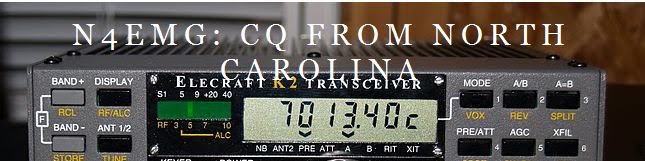 I want to thank Ed, N4EMG who helped bring ham radio blogging to the Internet and for sharing his personal journal as well. There is a season for everything. I’m experiencing that change when the leaves begin morphing while the deep slumber of winter is soon to arrive. I met a friend through the spirit of ham radio blogging and will miss Ed’s contribution.
Ed, please leave your blog, your contribution is part of ham radio’s history. Who knows what one year will bring or for that matter five years from now? We are among the early new media pioneers and now it is reaching ubiquity within our community.
Or, perhaps now is a good time for a vacation from the blog, gather new material without having to journal about what was learned. I’m having fun writing out traditional QSL cards and watching the mailbox. Finally, I’m getting after my basic awards like DXCC, WAS, and WAC as well. Likewise, I’m confirming counties and building up my grid square count. Today, KI6QDH and I worked on his 3-element tri-bander with its new 40 meter add on kit. What a hoot!
There is a season for everything and best 73 to Ed, N4EMG from the shack relaxation zone.

Scot Morrison, KA3DRR, is a regular contributor to AmateurRadio.com and writes from California, USA.
Hard drive failing
Two months ago I got a new Dell Inspiron laptop to use for my work. I have been very pleased with the computer which is quite fast and has a good keyboard and a very nice screen. However this afternoon I switched it on to do a bit of work and was typing away when the hard drive started making a noise like a cat with indigestion – which anyone who has ever done tech support will recognize as the sound of a hard drive attempting to read a bad sector.
Windows froze, there was no way out but to long-press the power switch, losing the work I had been doing. On start-up, Windows insisted on doing a disk check and printed up a lot of messages that appeared to be to do with errors on the hard drive. Eventually I was able to restart, Windows booted up and it seems to be working normally again. But my confidence in the system’s reliability has taken a blow. In my experience hard drives don’t malfunction once and then run perfectly for ever after. But there’s no sign of any fault now, so I have little option but to wait until the next time it starts making funny noises. 🙁

Julian Moss, G4ILO, is a regular contributor to AmateurRadio.com and writes from Cumbria, England. Contact him at [email protected].
Japan on 15m
This morning I worked Kei, JI1BBN, on 15m PSK31 using 50W to the MFJ magnetic loop in the attic.
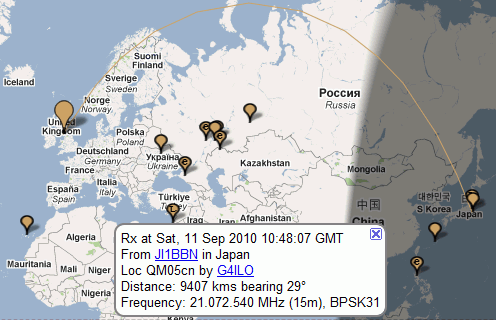
I heard several other DX stations on both the loop and the dipole, including DU3MEL in the Philippines whom I last worked in 2003, also on 15m. That was also the last time I worked Japan. Then I would only have been using QRP with my Elecraft K3, and the antenna would have been a horizontal loop of wire round the perimeter of the attic, with a 4:1 balun at the centre of one side, tuned using the K2 internal ATU.
What’s that about stealth antennas not working?

Julian Moss, G4ILO, is a regular contributor to AmateurRadio.com and writes from Cumbria, England. Contact him at [email protected].
The completed Warbler

Finished Warbler in box
A few weeks ago I finished the box to mount the Warbler. The connectors are all soldered directly to the pcb board so the alignment of holes had to be done carefully. When doing such layout and drilling I am always grateful of the ‘O’level in metalwork that I finished back in high school thirty years ago now. (As a sidenote I am currently reading ‘Shop Class as Soulcraft’ by Matthew Crawford which covers the recent decline of school shop classes).
The box is aluminium (showing my British origin with the spelling) and made by Hammond. To give it a nice finish I spray painted it with a couple of coats of Rustoleum Universal hammered spray paint and it came out rather well.

The painted surface showing the 'hammered' finish.
The box size is 4.5″×3.5″ so it makes quite a nice compact unit.
I need to look at the final output power of my Warbler as I think it is a little low, but it is performing well and I have made 80m PSK31 contacts out in Wisconsin, Illinois and North Carolina. As previously reported I have also used the Warbler for an Olivia contact. A great kit and I am looking forward to using it over the Winter when 80m conditions should be better than they are now. Unfortunately, it looks like Small Wonder Labs have dropped it from their current product line.


Alan Steele, VA3STL, is a regular contributor to AmateurRadio.com and writes from Ottawa, Ontario. Contact him at [email protected].
SatGates needed
The International Space Station has had its packet BBS / digipeater active for the last few days on 145.825MHz. Noel G4PEW asked me in a short APRS chat last night if I had tried listening to it. It had been a long time since I tried bouncing anything off the ISS as I got fed up with checking if the station was operational and finding that it wasn’t, so I decided to give it a go to break the monotony of nothing much happening terrestrially.
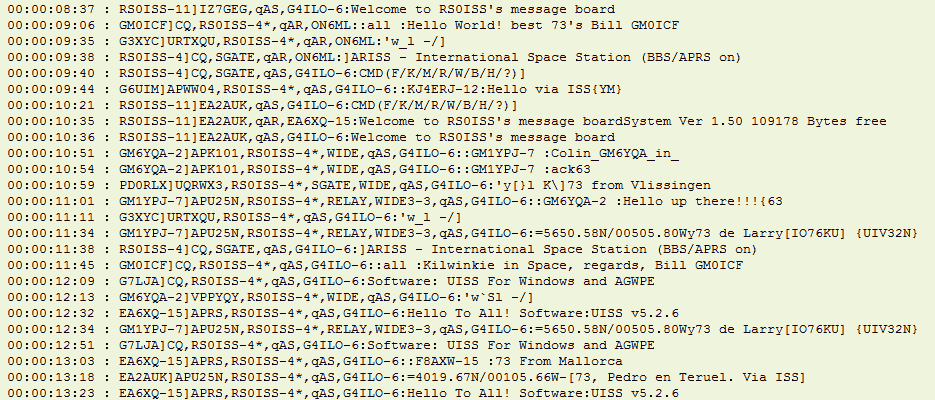
There was a good pass this afternoon and I received ten stations. I even received my own digipeated beacon and a copy of my reply to GM0ICF’s message to ALL. Unfortunately my own transmissions didn’t show up on the map and list of stations that worked through the ISS at ariss.net as it appears that I was the only station gating the signals from the space station to the internet, as the list above shows (you’ll need to click on it to enlarge it enough to be readable.)
I was using APRSIS32 to send the beacons and messages and I guess that it didn’t gate my digipeated packets as having been received via the ISS because it had already sent them to the internet direct at the time I sent them.
I’m surprised that none of the other stations sending signals up to the space station were gating them during the receive periods. We aren’t talking about important communications here, just seeing if it can be done, but it would be nice to have the proof of it afterwards. Come on, chaps, play the game and get your gateways working!

Julian Moss, G4ILO, is a regular contributor to AmateurRadio.com and writes from Cumbria, England. Contact him at [email protected].
Welcome to readers of AmateurRadio.com
I was really pleased last night to hear from Matt Thomas, W1MST who is the Editor at AmateurRadio.com. Matt was kind enough to say that he’d been reading this blog for a while and that he would like to syndicate the posts onto his site.
Naturally, I’m delighted – thank you Matt for your kindness and confidence and I hope that readers will find my posts of interest.
Funnily enough, yesterday, I produced a word cloud based on the last six months of my posts on this site, which gives you an idea of where the emphasis lies at the moment. That’s not to say, of course, that it won’t veer off to somethng very different – as it tends to follow whatever I’m interested in amateur radio wise at the time.


Tim Kirby, G4VXE, is a regular contributor to AmateurRadio.com and writes from Oxfordshire, England. Contact him at [email protected].
 Ham Radio Deluxe |
 W5SWL Electronics |
 Ham Radio Prep |
 KB3IFH QSL Cards  Hip Ham Shirts  HamRadioAuctions HamRadioAuctions Reliance Antennas Reliance Antennas Enigma Shop Enigma Shop |  morseDX  Ni4L Antennas  R&L Electronics R&L Electronics antennas.us antennas.us QRV QRV |
- Matt W1MST, Managing Editor
