 |
 One worked, one confirmed
 5 October 2010 | by
 Yesterday I worked Kouichi, JI1FGX/DU9 operating from Mindanao Islands in the Philippines. I’d worked a DU back in 2002 but unfortunately have been unable to get a confirmation from him. His US manager hasn’t received logs from him in years, and as a result can’t confirm my contact. Kouichi was the first DU contact since then, and I was very happy to discover that he has an active manager in Japan, so my chances of getting a confirmation from him are excellent.
Along the same lines, today I received a QSL card back from the 3C9B DXpedition to Equatorial Guinea that I’d worked in June of this year. That confirms my 295th country in mixed mode and 218th confirmed on CW. (I see that I have about 35 countries on CW that I haven’t confirmed yet, I guess I’d better start getting some cards sent out.)
My numbers will change in about a week when the reorganization of the Netherlands Antilles results in a probable deletion of 2 entities and the addition of 4 or 5, but I’m very happy to be so close to 300.

David Kozinn, K2DBK, is a regular contributor to AmateurRadio.com and writes from New Jersey, USA. Contact him at [email protected].
One thing leads to another
Yesterday I began assembling the Foxtrak-M APRS tracker kit. After installing all the resistors I began adding the capacitors and found that I only been given 4 0.1uF capacitors instead of the 5 needed. I noticed that this was actually a mistake in the packing list, which stated 4 of these parts, so I turned to the computer to send an email to Dinesh so he could correct the mistake in future kits.
Whilst I was logged in to my Google account I checked the blogs I am following and read an interesting entry from PE4BAS about trying PSKMail. I noticed he had a gadget in the right hand column that said he was on the air around 18.100MHz (that’s cool, I must try to set up something like that in KComm.) From the frequency I guessed Bas was on PSK31 so I switched on the K3 to see if I could spot him. I couldn’t, but I did see some DX including a Japanese station.
This was on my 80/40/20/15/10/6m dipole, which my K3 ATU managed to tune to a 1.0:1 match. I decided to see how well I could hear the DX on the magnetic loop so I shut down the K2 which was running HF APRS and groped around the back to disconnect the loop, plug it into the K3 and tune it up on 17m. What a difference resonance makes! The DX signals were noticeably stronger on the magnetic loop than the dipole, stronger enough to surely make a difference given that signal strengths were marginal in any case.
Using 40W to the attic mounted magnetic loop I worked FG5LA (Guadeloupe) and then, after several tries and witnessing some of the kind of bad mannered operating that makes me think it might be best to stay off the radio at weekends, JI1FGX/DU9. KComm said this was not a valid call, so after the contact I fired up the Lazarus development system and had another attempt at rewriting KComm’s callsign validation routine. KComm still thinks the contact is with Japan not the Philippines so that is something I still have to look at.
I could of course have tried to work these DX stations using the K2 and 5W but I doubt if I would have been successful. This made me think that it would be handy if there was an easier way to switch the magnetic loop between the K2 and the K3 than groping round the back of the rigs and unscrewing the plugs. In my junk box I had one of those die-cast coaxial switches that are intended to switch one radio between two antennas. In theory I could use it to switch one antenna between two radios, but would there be sufficient isolation on the disconnected port that I wouldn’t blow up the K2’s front end while running 100W from the K3?
To find out I connected the antenna switch between the K3 and the magnetic loop controller and connected my QRP wattmeter to the other input. While transmitting a 40W carrier I observed no movement at all on the QRP wattmeter on its 1W FSD scale so I think the isolation between the two ports is good enough. I got the drill and fixed the switch to the wall so I can now change the magnetic loop between the K2 and the K3 at the turn of a switch.
And that was Sunday’s ham radio activity in the G4ILO shack!

Julian Moss, G4ILO, is a regular contributor to AmateurRadio.com and writes from Cumbria, England. Contact him at [email protected].
History of Communications – Electronics in the US Navy
 I’ve posted a lot of articles here about the history of radio – most of them weren’t even from the US. Here is the complete web listing for “History of Communications – Electronics in the US Navy”. Originally prepared in 1963, it covers a large base of history from the civil war and good focus between the two world wars.
Though this is a military publication, you will find some of the roots of radio and electronics with Faraday, Hertz, etc. This publication is rather readable, even if you aren’t a ham or a “tech junkie”. I have an interest in military history and gave segments for a friend to read, he had no issues with the technical content and found it interesting (as he served in the Navy as well).
It is a rather long read, but I didn’t find a pdf of it anywhere. If you know of a PDF version of this book, please comment below. I’d much rather read this out and about than sitting in front of the computer.
Note: 10.20.2010
I don’t know what happened to the link, but here is a working one:
http://earlyradiohistory.us/1963hw.htm
Jonathan Hardy, KB1KIX, is a regular contributor to AmateurRadio.com and writes from Connecticut, USA. Contact him at [email protected].
qsl.net gone phishing?
OpenDNS is a free domain name server (DNS). Most of you will know what that is, but for those who don’t, a DNS is a server that converts web addresses like blog.g4ilo.com into numeric IP addresses like 123.234.345 so the web browser can find the right web site. Most people use the DNS provided by their internet service provider (ISP) and don’t think twice about it. However, the DNS provided by many ISPs is slow and unreliable. It was because of that that I started searching for a free alternative and discovered OpenDNS.
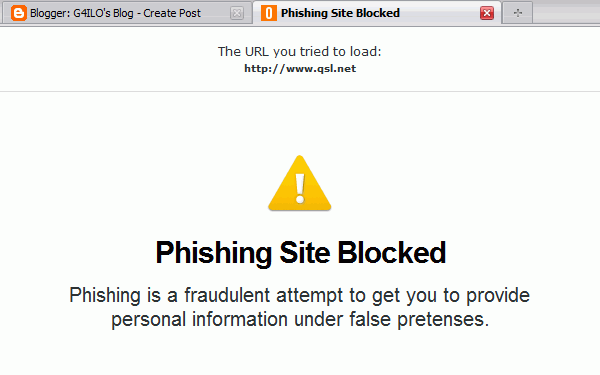
An added benefit of OpenDNS is that it provides content filtering. This can be a useful safeguard if you have children who use the computer as it can prevent them accessing various dubious sites. It can also protect you from visiting phishing sites – websites that pretend to be the login pages of various online banks or email services so they can steal your passwords. It does this by converting the addresses of known phishing sites to the IP address of a warning page instead. The web is a pretty dangerous place these days and any extra level of protection is a good thing as far as I am concerned.
However, this afternoon I tried to access a ham radio site at qsl.net, and was informed that this was a phishing site and had been blocked. In fact the whole of qsl.net has been blocked to users of OpenDNS. I have contacted them using the link provided to tell them that qsl.net is a free web host for ham radio hobby sites. I’m assuming, of course, that qsl.net hasn’t been blocked because it is hosting malware.

Julian Moss, G4ILO, is a regular contributor to AmateurRadio.com and writes from Cumbria, England. Contact him at [email protected].
QRPSPOTS.COM and IHAB Do it Again!
Wow! Great way to bring together a lot of ham radio ops on a Saturday using all sorts of technology! Way to go! QRPSPOTS.COM is normally used by QRP ops to spot each other when we are out operating portable or to alert others of band openings. It was ALIVE with reports and updates from all over the USA and even a few DX ops adding input too! In addition, several QRP reflectors were buzzing with updates and info. What a great community effort this turned out! Congrats to all and thanks to QRP ARCI for helping get the word out.

Iowa High Altitude Balloon Project
One of the 4 States QRP bunch, Terry WA0ITP, provided the 20m beacon again and has some great info on his informative website.
But for me, the coolest thing was listening in on the streaming webcast of VE3EN and his wonderful IC-7700. Sure wish I had thought of recording a bit or doing a screenshot to share here. But what a treat to listen in and hear the beacon’s signal right up until touchdown. Thanks Kevin for a fun way to eavesdrop on this event since the lawn mowing crew took over my condo’s yard and didn’t allow me to put an antenna out today. There is a ton of info and creative website construction on Kevin’s website and it is worth spending some time looking at the solar cycle data.
Congrats to the team for a successful event today and for bringing so many hams together for a good learning experience and something out of the ordinary. Well done W0OTM, well done indeed!
Kelly McClelland, K4UPG, is a regular contributor to AmateurRadio.com and writes from Florida, USA. Contact him at [email protected].
Stealth Antennas
 Today sees the publication of a new RSGB book by Steve Nichols, “Stealth Antennas.” I haven’t seen the book myself, but I was asked by Steve to contribute a description of my own stealth antenna farm as one of the practical examples. It remains to be seen whether this entitles me to receive a free copy. 😉 It isn’t even in the RSGB Bookshop yet, but hopefully it soon will be.
I think this is an important book which addresses an issue that I believe many new radio amateurs (and many not so new, such as myself) find themselves faced with, that of what to do when circumstances prevent the erection of the kind of antennas so many experts say you need. I hope the book helps to dispel the impression created by many that in order to enjoy the hobby one needs a beam mounted on a huge tower, or at least a full size dipole up high and in the clear. It would be nice if you could have one of these, but it certainly isn’t the end of the world if you can’t.

Julian Moss, G4ILO, is a regular contributor to AmateurRadio.com and writes from Cumbria, England. Contact him at [email protected].
Duh: Learning Curve #6 What’s a ham to do?
Here’s my dilemma:
I am a rookie homebrewer. My kit experience is good, but I have struggled to build direct from schematics. Part of it is my lack of ability to conceptualize the physical layout and part of my challenge is lack of building experience and mentoring.

What should I use?
Several of my antenna tuner projects seem to have a TON of hand capacitance effect. They are built in plastic cases, some from the Shack and some from the local surplus shops and hamfests. Most commercial tuners are built in metal cases and I wonder if that would eliminate the sensitivity to the tuning hand?
I have a couple metal enclosures I can use and a great ham friend sent me some thin copper with adhesive tape on the back. I am thinking of slapping some copper tape inside the plastic cases and see how it works.
So, I am putting it to the vote:
Note: There is a poll embedded within this post, please visit the site to participate in this post’s poll.
And for the record, the vote in the poll for best ham radio QTH in the US was won by West Virgina. Here is the top 5:
- West Virginia (17%, 11 Votes)
- Kansas (14%, 9 Votes)
- Texas (8%, 5 Votes)
- Hawaii (6%, 4 Votes)
- New Hampshire (5%, 3 Votes)
Thanks and 72,
Kelly K4UPG
Kelly McClelland, K4UPG, is a regular contributor to AmateurRadio.com and writes from Florida, USA. Contact him at [email protected].
 Ham Radio Deluxe |
 W5SWL Electronics |
 Ham Radio Prep |
 KB3IFH QSL Cards  Hip Ham Shirts  HamRadioAuctions HamRadioAuctions Reliance Antennas Reliance Antennas Enigma Shop Enigma Shop |  morseDX  Ni4L Antennas  R&L Electronics R&L Electronics antennas.us antennas.us QRV QRV |
- Matt W1MST, Managing Editor
