 |
 All roads leading to Software Defined Radio (SDR)
 18 October 2010 | by
 Before I tell you about the weekend and SDR – I want to do a shameless plug. My lovely wife, Julie is very talented in many dimensions. She’s just set up an online shop on ETSY where you can see some of the beautiful craft items that she makes and perhaps buy them too! Do have a look there – with Christmas coming up, you might find a nice gift for someone special.
Anyway. Back to Software Defined Radio. It’s funny how sometimes you can’t escape a particular topic! On Saturday, the latest Practical Wireless dropped through the door. Naturally I checked the VHF column had come out ok (it had, thanks Rob and the team!) and then started to look through the other examples. I was particularly interested in the review of the FlexRadio 1500 QRP SDR transceiver by Phil, G3XBZ.
What a fascinating looking little box that you plug an aerial and a morse key into, connect the USB to your computer and control the rig and all the filtering from within the computer. Phil had obviously had a good time with the rig and had made some nice CW and SSB QSOs with it. Ideal too, I should think for data modes. Very tempting. I don’t need another rig or anything like that. But if I did….
The next ‘nudge’ towards SDR came from an interesting posting via the Southgate club’s blog about the AMSAT-UK FuncubeDongle. This is a dongle, which takes antenna input via an SMA adapter and plugs into your USB port. It forms a VHF/UHF/SHF receiver, obviously aimed at the satellite market which operates between around 64 to 1700MHz. You can use it with any of the current raft of SDR control programs and thus decode all sorts of modes.
Interestingly, there will be two versions of the dongle – a basic one aimed at the educational/schools market – to allow them to listen / decode transmissions from the Funcube satellite and a ‘Pro’ one with a little more flexibility. The feature set of the basic and Pro models isn’t entirely clear at the moment. This looks a brilliant project. Pricing for the ‘Pro’ model looks to be around £100. A 64-1700MHz receiver for £100. That sounds worth keeping an eye on, doesn’t it!
See the FuncubeDongle site here. But before you do, go and see Julie’s ETSY shop and tell her I sent you 🙂

Tim Kirby, G4VXE, is a regular contributor to AmateurRadio.com and writes from Oxfordshire, England. Contact him at [email protected].
Keyboard Trays, QRP Rig, and SoftRocks
Time, as they say, has been of the essence of late. So, when I do have time to play radio, I rarely have a chance to write about it. Here are some photos of my latest tinkerings.
Keyboard Trays
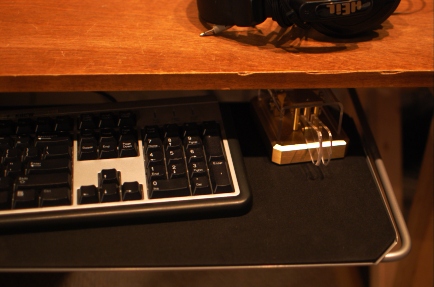
Sarah has always talked about using a keyboard tray at work as a part of an ergonomic workstation. Until recently, my work invovled enough variety of computer and non-computer time that I did not think about it. But, after coming home from work with stiff shoulders and wrists, I decided something should be done. While I was at it, I upgraded the HF and VHF/SDR operating positions at K8GU with pull-out trays, as well. These were $10 each at IKEA and pretty easy to install, although I told Sarah that I was grateful that she didn’t witness my contortions to hold them up with my knees while driving the first screws.
Liberating my inner QRPer
Back in high school, I built a Small Wonder Labs SW-40 that I had seen in a QST article. It lived in a variety of enclosures, but spent the last decade in the ugly PC board half-enclosure that looked like a redneck pickup truck at right. I decided to put it into a proper enclosure, being the diecast box at left.
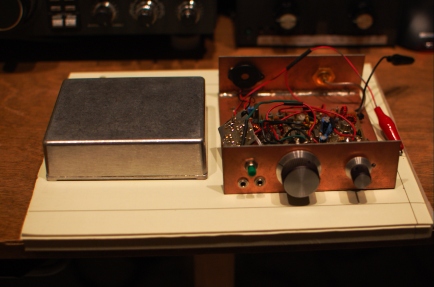
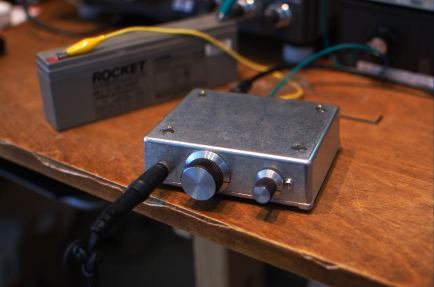
Despite the fact that I made the radio impossible (no room for front panel controls) to assemble the first time I drilled the board mounting holes, I’m pleased with the result. Four dabs of gray epoxy cover the errant holes. I probably could sand and polish those now. The power connector is a pair of Anderson Power Poles.
VHF Softrock and Enclosures
Readers of the blog have seen the screen capture from my new Softrock Ensemble II VHF. Tony does not advertise these on his site because they are not 100% supported with documentation yet. Robby, WB5RVZ has done a great service to the community by preparing step-by-step instructions for most of the SoftRock series. I’m not a step-by-step kind of guy, so I just used his photos showing the locations of the 0.1 uF and 0.01 uF chip capacitors and built the rest my way: mount all chip caps, all SMT ICs, all through-hole ICs and sockets, all through-hole resistors and diodes, all through-hole capacitors, all inductors, and all connectors. It worked right away.
I also have two v6.0 SoftRocks that I built a few years ago while I was in grad school. One of these (for 160) has been a bare board all these years and the other (for 40 and 80) has been living in an ugly little RadioShack black plastic project box. I decided to upgrade them to diecast boxes with external power connectors (also PowerPoles—I’m slowly switching the station over) and a switch for 40 and 80 meters. Here’s the happy family of little radios…
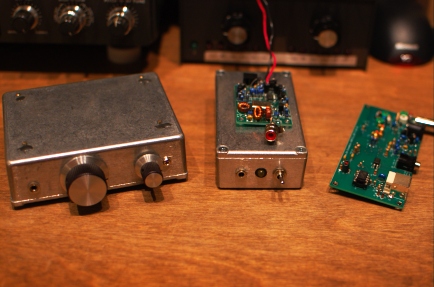
The 160-meter SR v6.0 is on top of the diecast box holding the SR v6.0 40/80. The Ensemble II VHF is on the right. It’s unfortunately too long for either size diecast box. I don’t like the commercially-available box for it. So, we’ll have to see…
Ethan Miller, K8GU, is a regular contributor to AmateurRadio.com and writes from Maryland, USA. Contact him at [email protected].
Bureau Cards
If you have come to the site checking to see if I am still alive because you have not received a QSL card via the bureau system, you have come to the right place. I finally mailed about four years worth of CE/K8GU, KP4/K8GU, PJ2/K8GU, and K8GU bureau cards out this week. (Yes, it was a nice-sized pile, but not as big as it could have been.) There are a few recent requests that have not been filled because I ran out of CE/ and KP4/ cards. I will get some more soon.
Ethan Miller, K8GU, is a regular contributor to AmateurRadio.com and writes from Maryland, USA. Contact him at [email protected].
On the air!
My QRSS beacon is now on the air, running 50mW into my MFJ magnetic loop in the attic. It is showing up very well right now on the grabber of PA0TAB.

I also saw it less strongly on the grabber of I2NDT, but I forgot to grab the image before it faded into QSB.

Reception reports will be most welcome to:

Julian Moss, G4ILO, is a regular contributor to AmateurRadio.com and writes from Cumbria, England. Contact him at [email protected].
Giving Out Points Again!
Nice weather and an open schedule allowed for some radio time this weekend. The QRP ARCI Fall QSO Party made some buzz so I loaded up the gear and headed out by the lake. I put up an 88ft doublet in an inverted vee. I shoot a line over a tree limb at about 40ft and use that for the center and have two 17ft Crappie Poles that I use for end supports. That allows me to reorient the antenna to suit the conditions.

Ground Mount Closeup
One of the things I threw together is a simple mount for the crappie poles. I use a 2ft piece of PVC with a couple bolts inserted at right angles to one another at the base to keep the pole from going all the way through to the ground. The PVC is attached to a 3ft piece of aluminum angle iron that with 3 stainless steel hose clamps.

Crappie Pole End Supports
The poles are pretty limber and take a bit of a bend but do a good job of handling the 24 gauge teflon wire I use. As you can see in the pictures, the mounts do the job and don’t cost as much as commercial counterparts.
So it was a good day and I made a few contacts, enjoyed the outdoors and had a nice picnic lunch with my XYL down by the lake between QSO’s. The bands were pretty decent and I gave points to 20 of the more serious contestants out there.
72,
Kelly K4UPG PB #173
p.s. The Polar Bears will be out and on the air next weekend. Give a listen, hear?
Kelly McClelland, K4UPG, is a regular contributor to AmateurRadio.com and writes from Florida, USA. Contact him at [email protected].
Benoît Mandelbrot 1924-2010

Benoît Mandelbrot (courtesy of Rama via Wikimedia Commons)
It was sad to read late last night that Benoît Mandelbrot had just died. He was an outstanding mathematician and the individual that coined the term ‘fractal’. Obituaries can be found at the New York Times and the BBC.

A closer look into a Mandelbrot set. (Courtesy of Dr. Wolfgang Beyer and reproduced from Wikimedia Commons).
Beside the fractal he is perhaps most famous for the Mandlebrot Set (see an image above), which of course has fractal geometry. As a grad student, in the late ’80s and early ’90s, myself and a few others would run our computers in our spare time to generate Mandlebrot sets and we would zoom in and explore different regions. This was outside our main research work but these images were so beautiful it was fun to explore the set by mathematically zooming in to different regions. Professionally I still work in nonlinear science and I was sad to hear of the passing of Mandlebrot. His legacy to our understanding of the natural world and nonlinear science is considerable. Here is a clip of a BBC documentary that explains some of what he helped us understand.
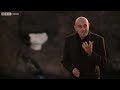
Here is the man himself talking earlier this year at a TED talk.

If you are wondering if there is a connection to amateur radio. Well besides a better understanding of our natural world, Mandelbrot’s work gave us fractal antennas.

Fractal antenna (from a patent via Wikimedia Commons)


Alan Steele, VA3STL, is a regular contributor to AmateurRadio.com and writes from Ottawa, Ontario. Contact him at [email protected].
QRSS reception report

QRSS reception by ON5SL in Belgium
I received a reception report today via the KnightsQRSS e-mail list. Pierre, ON5SL, received my QRSS signal last night in Belgium along with the signals from WB3ANQ and W4HBK, as shown above. My signal is running QRSS3, that is a 3 second dit, and is the bottom trace.
My set-up was the homebrew transmitter putting out 160mW into the homebrew Z-match and an 88′ doublet (again homebrew). Helping match the short coax feed to the outside of the house to the doublet’s ladderline is an Elecraft BL2 balun.
Thanks goes to Pierre for the reception report. This is not the first time he has sent reception report, he sent me one in April and also one in March 2009. I am sure I speak for all who run such beacons that we all welcome and appreciate reception reports of our signals.


Alan Steele, VA3STL, is a regular contributor to AmateurRadio.com and writes from Ottawa, Ontario. Contact him at [email protected].
 Ham Radio Deluxe |
 W5SWL Electronics |
 Ham Radio Prep |
 KB3IFH QSL Cards  Hip Ham Shirts  HamRadioAuctions HamRadioAuctions Reliance Antennas Reliance Antennas Enigma Shop Enigma Shop |  morseDX  Ni4L Antennas  R&L Electronics R&L Electronics antennas.us antennas.us QRV QRV |
- Matt W1MST, Managing Editor
