 |
 VHF Tropo forecasting using William Hepburn’s tropo pages
 4 November 2010 | by
 About a week or so, I got an e-mail from Matty, MD0MAN drawing my attention to some propagation forecasting websites. One that I hadn’t come across before, though somewhere at the back of my mind, I think I’ve heard it mentioned, is William Hepburn’s Tropospheric Ducting Forecast site.
The site allows you to select the area of the globe that you’re in – so in my case, I selected the North West Europe page but if you’re in North America, this is your map
But how well does it work? After Matty’s e-mail, I looked at the maps for the UK and NW Europe last weekend and could see that there would be a chance of some tropo to the South West towards the end of this week, from Thursday onwards.
Driving to the station this morning, with one VFO going on 145.650, there was another repeater just breaking the squelch – something not normally audible. Purely a guess, but I’ll bet it was the GB3TR repeater, to the South West of me, in Torbay.
An interesting site – I’m looking forward to keeping an eye on it. Thanks to William for some fascinating data and to Matty, MD0MAN for the tip-off.

Tim Kirby, G4VXE, is a regular contributor to AmateurRadio.com and writes from Oxfordshire, England. Contact him at [email protected].
What Would You Do?
Your crazy great uncle Thadeus died last week. He was an eccentric old coot who liked his amateur radio a lot, so much that his wife Mildred left him forty years ago and he’s been holed up in his hamshack ever since. Everyone thought old uncle Thad was broke, but in his will he revealed a Swiss bank account with $60 million left to you, the only other ham in the entire family. But there’s a catch. You have to spend $10 million of it on revitalizing amateur radio in order to get the other $50 million. What do you spend it on? (Yes, I know, this is like a Richard Pryor movie…)


KComm updated
Today I released a new version of my logging and data communications program for Elecraft transceivers, KComm, on my website. The program is developed in Lazarus / Free Pascal and is released under the GPL.
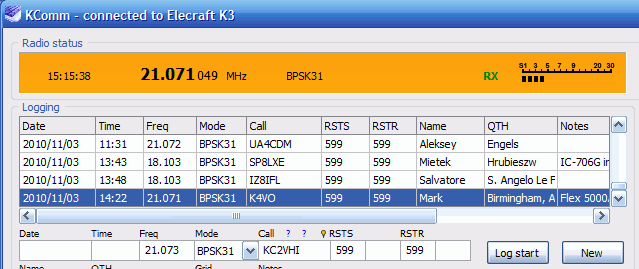
Apart from numerous bug fixes and small improvements I have made in the months since the last release, the new version 1.9 allows the receive and transmit sound devices to be selected separately. This is something that is becoming increasingly necessary, though users will have to play “guess the device number” as I don’t know how to find out the names of the sound devices in Free Pascal in order to display them in a list box. The program also supports the K3 “TB” command which allows it to get the text decoded by the K3 DSP in CW, PSK or RTTY modes and display it on the screen just the same as if you were using a sound card program.
Although I have given up developing ham radio programs in general, I am continuing to update and maintain KComm as it is the only one of my programs that I continue to use regularly. However this will be the last version for which I will be able to provide a compiled Linux binary. The screen of the old Linux laptop that I used to compile it has almost failed so I will not in future have a computer on which I can do this.

Julian Moss, G4ILO, is a regular contributor to AmateurRadio.com and writes from Cumbria, England. Contact him at [email protected].
Handiham World for 03 November 2010
Welcome to Handiham World!
In this edition:
Still waiting for frequencies!
Plain text frequency chart updated
Split Rock on the air event
Dip in the pool
Operating skills: How to use beacons
November events released
Live ham radio broadcast from w5kub.com starts this morning!
Remote base progress report
Video feed of Mars Rover being outfitted
Phone number for this podcast – call & listen if you don’t have access to a computer.
This week at HQ
No feedback as to frequency for new 75 meter net

Hello, anyone out there? I’m still waiting for your feedback on frequencies you have listened on during the continuing search for a place to park our new 75 meter net. If you could get back to me with your suggestions for a clear frequency anywhere in the Extra, Advanced, or General portions of the band, I would really appreciate it. Our first choice would be a clear General frequency if possible, but if one is not available in the evening, which is when we will have the net, then we will go with an Advanced or Extra frequency. The 75 meter band DX window will not be used. It is 3.790-3.800 MHz. The AM calling frequency of 3.885 MHz is also reserved as is the SSTV frequency 3.845 MHz.
Please e-mail me this week with your frequency and time suggestions, frequency reports, and other suggestions about the net.
73,
Patrick Tice, WA0TDA
Handiham Manager
[email protected]

Pat Tice, WA0TDA, is the manager of HANDI-HAM and a regular contributor to AmateurRadio.com. Contact him at [email protected].
Episode #052 Live Rescheduled
Due to extenuating circumstances, we will have to move the recording of Episode #050 to November 16th at 8:15pm CST. We hope to see everyone then.
73 de The LHS Guys
Russ Woodman, K5TUX, co-hosts the Linux in the Ham Shack podcast which is available for download in both MP3 and OGG audio format. Contact him at [email protected].
Being prepared
We Brits and our friends across the Atlantic may share a common language but sometimes it seems as if we live on different planets. One of the most obvious examples of this is that Americans sometimes seem to act as if Armageddon could happen at any minute, something that doesn’t seem to cause much lost sleep over here.
Perhaps I’m jumping to the wrong conclusion based on the higher emphasis given in the USA to the use of ham radio for emergency communications. Read some issues of QST these days and you might think that “emcomms” is what amateur radio is really all about. Many American hams maintain “go kits” – portable radio stations that they keep charged up and ready to go the moment they are needed. Over here we have something called Raynet, but I get the distinct impression that it is a bunch of people who would like to use ham radio to help in an emergency rather than a volunteer emergency service on the lines of, say, Mountain Rescue that has a clearly defined purpose and meets a genuine need.
In his latest blog “Smoke Curls” Jeff, KE9V recently posed the question of whether a portable QRP HF station was really useful in the context of emergency preparedness. Most of the replies seem to illustrate the extent to which the thought of a major disaster is never far away from the American consciousness. My comment that the only benefit I could see in having battery powered HF ready to use was so I could take advantage of the noise-free bands while the power is out – which in fact I did during the outage that occurred during the local floods a year ago – probably seemed rather flippant, though that wasn’t the intention.
My opinion is that emergency communications is a job for the experts and the last thing they need is a bunch of amateurs trying to help but more than likely getting in the way. The Cockermouth floods were the nearest I have ever come to being directly affected by a disaster and it never even entered my head that as a radio amateur I might be able to help. As for needing HF or any other kind of ham radio for personal emergency communications I still feel the likelihood of something happening in which my radio gear might end up being my only means of getting in contact with anyone I needed to is so remote that I’d cross that bridge if I ever came to it.
I would never assemble a “go kit”. And if I did, I know for sure that I would forget to charge the batteries or raid it for parts I needed for something else so it would never work in the unlikely event it was needed.
Is there a cultural difference between us and Americans in this regard, or is it just me?

Julian Moss, G4ILO, is a regular contributor to AmateurRadio.com and writes from Cumbria, England. Contact him at [email protected].
Not the CQWW SSB weekend…or shouting Elephant at contest stations!
Over the years, I’ve developed an aversion to having anything to do with major HF SSB contests unless I’ve got at least a beam antenna. Of course, you don’t *need* a beam antenna and you *can* make contacts and good ones at that, with a dipole or vertical and perhaps 100w or less. The trouble is that each contact seems to go something like this
DX Station: QRZ Contest
Me (enthusiastically): Golf Four Victor Xray Echo
DX Station: QRZ the X-RAY
Me: Golf Four Victor Xray Echo
DX Station: Gee Four Vee Ex I you’re five nine twenty eight.
Me (starting to lose enthusiasm for this): No, it’s Golf Four Victor Xray Echo, Golf Four Victor Xray Echo, OK?
DX Station: QSL, Golf Four Victor Xray India you’re five nine twenty eight. What’s my report?
Me (thinking why did I bother….): No, the last letter is Echo, Echo Echo. Like Espana, Ecuador, Elephant (actually, I’ve never used Elephant as a phonetic, but I might now I’ve thought of it)… QSL
DX Station: QSL – Golf Four Victor Xray Echo – you’re five nine twenty eight OK?
Me: Roger roger (Thinking thank heavens for that…) you’re five nine one four. OK?
Disclaimer: I’m not singling out zone 28 stations! I was just listening to one last night. They’re super operators with great ears…
So, you can see that each contact, even with a semi decent setup is a bit of a trial of patience and I have learned it’s not good for my blood pressure. I’m quite happy to accept that I could put up a bigger antenna (but then it works ok most of the time for CW and data contacts) and that perhaps my voice isn’t that clear (well, sorry, I’m stuck with that).
It’s not that I don’t like contests – I love hearing the activity generated, and I love hearing DX coming through from all parts of the globe. I’m inclined to think, though that there is now so much interference and general aggro that anyone with a normal suburban station is unlikely to have a great time in the major SSB events (CW and data are usually better options).
Anyway, that’s a long way of telling you that I didn’t have any contest QSOs over the weekend. Still, I did have a listen on 7MHz last night about 2100z and very interesting it was too. In between the very loud Europeans there was some great DX from the Far and Middle East. JA3YGP (from memory) and 9K2HN were doing great business and good signals on the vertical and there was an Indonesian station coming through too..
Having switched the HF rig on, I listened around a little more. The 5MHz channels were quiet, though I did hear some Spanish fishermen on 5398khz! Listened on 27.555MHz too – someone told me recently that this is a CB frequency that shows activity even when the 28MHz amateur band is quiet. Not much doing there, though I heard some meteor bursts!
It was nice to listen on HF again though. I realise that I have missed playing HF recently, although not shouting Elephant at contest stations!

Tim Kirby, G4VXE, is a regular contributor to AmateurRadio.com and writes from Oxfordshire, England. Contact him at [email protected].
 Ham Radio Deluxe |
 W5SWL Electronics |
 Ham Radio Prep |
 KB3IFH QSL Cards  Hip Ham Shirts  HamRadioAuctions HamRadioAuctions Reliance Antennas Reliance Antennas Enigma Shop Enigma Shop |  morseDX  Ni4L Antennas  R&L Electronics R&L Electronics antennas.us antennas.us QRV QRV |
- Matt W1MST, Managing Editor
