 |
 Spot on
 5 November 2010 | by
 Having an interest in weak signal narrow band modes, not to mention APRS which requires you to park your receiver on a specific frequency, I have always wished that the frequency readout on my radios could be relied upon. The QRSS band, for example, is only 100Hz wide. If your dial reading is out by that much, you’ll miss it completely.
Many people try to calibrate their transceivers using WWV but that is not often a very good signal over here, and what with all the other carriers around 10MHz – many of them locally generated – you can never be sure that you have tuned to the right signal. I have wanted an accurate frequency reference for some time so a couple of weeks ago, following a comment by QRSS enthusiast Steve G0XAR, I ordered an Efratom LPRO-101 rubidium frequency standard on eBay. It arrived in about a week.
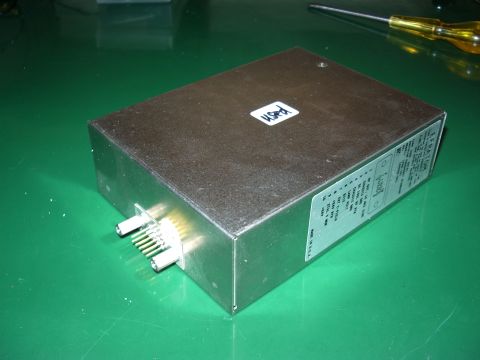
The unit I bought cost about £50 and came with a plug for the 10-pin connector and a 24V switched-mode power supply. These second hand units are widely available. New, they cost over $1,000 even in quantity. They are used in cellular base stations and are manufactured to have a maintenance-free life of ten years. To ensure reliable service the cellphone network providers take the equipment out of service before the ten years is up after which it is presumably shipped to China for reclamation. The used units should have several years of life in them, especially in occasional amateur use.
Rubidium frequency standards work by locking a crystal oscillator to the very precise frequency at which the amount of light from a rubidium lamp dips due to a phenomenon known as the hyperfine transition. A synthesizer locked to a reference oscillator is swept through this frequency until the dip is detected. The LPRO-101 includes an oven for the reference crystal, circuits to detect the dip and lock the oscillator, an output that tells you when the unit is locked, and the frequency reference output at 10MHz. The connector also provides signals that can tell you the state of health of the rubidium lamp. Once that fails you may as well scrap the unit because it can only be replaced by the manufacturer at a cost far in excess of what you paid for it.
To use the LPRO-101 you could simply attach a 24V supply and connect a cable to the 10MHz output. However, it’s useful to have a circuit that shows you when the unit is locked on frequency. I used one shown in an article by KA7OEI built up on a piece of Veroboard, which uses a dual-colour LED to light red when the reference oscillator is unlocked and green when it is locked. You can see the circuit board inside the partially assembled case.
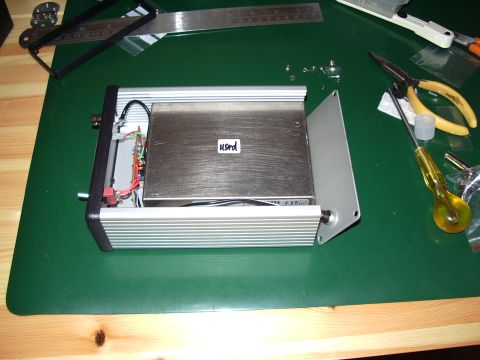
The voltage regulator and crystal oven inside the LPRO-101 generate a lot of heat so the unit is intended to be mounted on a heat sink. I purchased a Hammond extruded aluminium case to use for the project, which should provide reasonable heat sinking for the module.
One thing I learned from researching on the internet is that the LPRO-101 will run cooler when operated from its minimum recommended supply of 19V. This just so happens to be the output voltage of the power supply for an old Toshiba laptop whose screen failed so I decided to use that instead of the 24V supply that was sent by the seller.
The other thing I learned is that the rubidium lamps wear out with time. When they are made, the manufacturer ensures that they contain sufficient rubidium to achieve the stated maintenance free life of ten years, so the expected life in continuous use would be ten years less the use it has already had.
If I ran the unit all the time my rig is on – for example as an external frequency reference for a transceiver – then it is going to fail sooner or later. If I only use it for frequency calibration purposes, switching it on only when needed, then it will probably outlast me. The TCXO in my K3 is pretty stable so I should be able to obtain adequate accuracy for my purposes by manually calibrating the master oscillator using the rubidium standard and repeating this as often as necessary. How often that turns out to be, we’ll see.
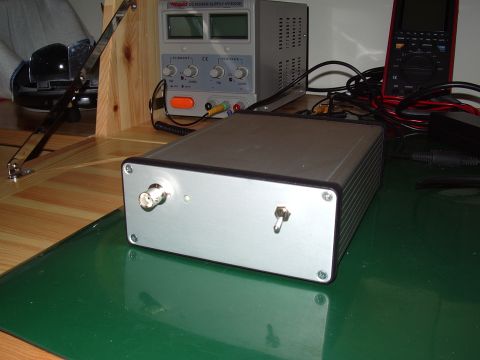
Here is the finished unit. Annoyingly, I messed up the front panel of the rather expensive Hammond case. Originally I had intended to use an SMA socket for the output but I didn’t get the holes for its two mounting screws in the right place and after filing to fit it looked unsightly. So I fitted a BNC socket instead which is what I should have done in the first place. Unfortunately you can see the two holes for the SMA mounting screws either side of the BNC socket. So my frequency standard doesn’t look quite as professional as this one built by DL2MDQ. Oh well, it’s only a piece of test equipment!

Julian Moss, G4ILO, is a regular contributor to AmateurRadio.com and writes from Cumbria, England. Contact him at [email protected].
What I hear on VHF/UHF from the car
Over the last few days, I’ve been using the scan feature on the FT8900 a bit more from the car. I’m scanning particular channels, rather than the whole of the band, but it’s interesting to see what coverage I’m getting. I’ll probably add more channels to scan when I identify likely targets of semi-distant stations to listen for.
I thought it might be fun to try and put together a Google Map of what I heard this morning – I’ve colour coded the different bands.
View Heard by G4VXE this morning in a larger map
As you can see, GB3CF up in Leicestershire is probably the most distant station heard this morning. It fights it out on 145.600 with GB3WR. But I didn’t hear WR this morning and GB3CF was clearly audible just around Abingdon for a few hundred yards.

Tim Kirby, G4VXE, is a regular contributor to AmateurRadio.com and writes from Oxfordshire, England. Contact him at [email protected].
VOACAP Online
I don’t know how long it has been around but I only discovered this online propagation prediction tool using the VOACAP prediction engine today.
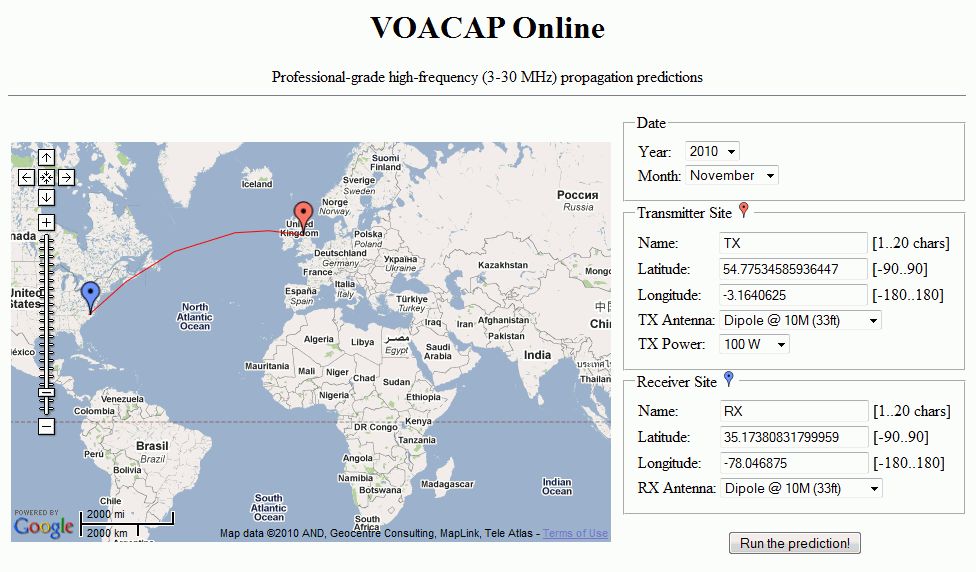
It’s very easy to use, and produces a nice chart showing the best times and frequencies to use to make a contact with a particular region. Of course, the predictions are based on the average expected propagation for the month, it won’t tell you what the bands are like today, which is why it is better not to waste your time on tools like this and turn on the radio.

Julian Moss, G4ILO, is a regular contributor to AmateurRadio.com and writes from Cumbria, England. Contact him at [email protected].
VHF Tropo forecasting using William Hepburn’s tropo pages
About a week or so, I got an e-mail from Matty, MD0MAN drawing my attention to some propagation forecasting websites. One that I hadn’t come across before, though somewhere at the back of my mind, I think I’ve heard it mentioned, is William Hepburn’s Tropospheric Ducting Forecast site.
The site allows you to select the area of the globe that you’re in – so in my case, I selected the North West Europe page but if you’re in North America, this is your map
But how well does it work? After Matty’s e-mail, I looked at the maps for the UK and NW Europe last weekend and could see that there would be a chance of some tropo to the South West towards the end of this week, from Thursday onwards.
Driving to the station this morning, with one VFO going on 145.650, there was another repeater just breaking the squelch – something not normally audible. Purely a guess, but I’ll bet it was the GB3TR repeater, to the South West of me, in Torbay.
An interesting site – I’m looking forward to keeping an eye on it. Thanks to William for some fascinating data and to Matty, MD0MAN for the tip-off.

Tim Kirby, G4VXE, is a regular contributor to AmateurRadio.com and writes from Oxfordshire, England. Contact him at [email protected].
What Would You Do?
Your crazy great uncle Thadeus died last week. He was an eccentric old coot who liked his amateur radio a lot, so much that his wife Mildred left him forty years ago and he’s been holed up in his hamshack ever since. Everyone thought old uncle Thad was broke, but in his will he revealed a Swiss bank account with $60 million left to you, the only other ham in the entire family. But there’s a catch. You have to spend $10 million of it on revitalizing amateur radio in order to get the other $50 million. What do you spend it on? (Yes, I know, this is like a Richard Pryor movie…)


KComm updated
Today I released a new version of my logging and data communications program for Elecraft transceivers, KComm, on my website. The program is developed in Lazarus / Free Pascal and is released under the GPL.
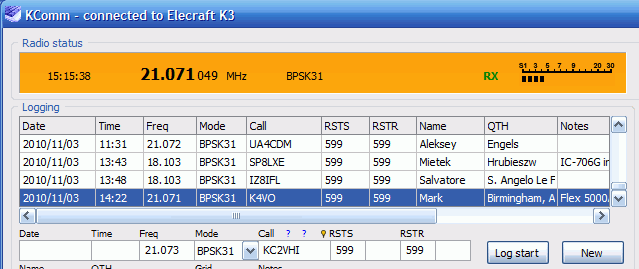
Apart from numerous bug fixes and small improvements I have made in the months since the last release, the new version 1.9 allows the receive and transmit sound devices to be selected separately. This is something that is becoming increasingly necessary, though users will have to play “guess the device number” as I don’t know how to find out the names of the sound devices in Free Pascal in order to display them in a list box. The program also supports the K3 “TB” command which allows it to get the text decoded by the K3 DSP in CW, PSK or RTTY modes and display it on the screen just the same as if you were using a sound card program.
Although I have given up developing ham radio programs in general, I am continuing to update and maintain KComm as it is the only one of my programs that I continue to use regularly. However this will be the last version for which I will be able to provide a compiled Linux binary. The screen of the old Linux laptop that I used to compile it has almost failed so I will not in future have a computer on which I can do this.

Julian Moss, G4ILO, is a regular contributor to AmateurRadio.com and writes from Cumbria, England. Contact him at [email protected].
Handiham World for 03 November 2010
Welcome to Handiham World!
In this edition:
Still waiting for frequencies!
Plain text frequency chart updated
Split Rock on the air event
Dip in the pool
Operating skills: How to use beacons
November events released
Live ham radio broadcast from w5kub.com starts this morning!
Remote base progress report
Video feed of Mars Rover being outfitted
Phone number for this podcast – call & listen if you don’t have access to a computer.
This week at HQ
No feedback as to frequency for new 75 meter net

Hello, anyone out there? I’m still waiting for your feedback on frequencies you have listened on during the continuing search for a place to park our new 75 meter net. If you could get back to me with your suggestions for a clear frequency anywhere in the Extra, Advanced, or General portions of the band, I would really appreciate it. Our first choice would be a clear General frequency if possible, but if one is not available in the evening, which is when we will have the net, then we will go with an Advanced or Extra frequency. The 75 meter band DX window will not be used. It is 3.790-3.800 MHz. The AM calling frequency of 3.885 MHz is also reserved as is the SSTV frequency 3.845 MHz.
Please e-mail me this week with your frequency and time suggestions, frequency reports, and other suggestions about the net.
73,
Patrick Tice, WA0TDA
Handiham Manager
[email protected]

Pat Tice, WA0TDA, is the manager of HANDI-HAM and a regular contributor to AmateurRadio.com. Contact him at [email protected].
 Ham Radio Deluxe |
 W5SWL Electronics |
 Ham Radio Prep |
 KB3IFH QSL Cards  Hip Ham Shirts  HamRadioAuctions HamRadioAuctions Reliance Antennas Reliance Antennas Enigma Shop Enigma Shop |  morseDX  Ni4L Antennas  R&L Electronics R&L Electronics antennas.us antennas.us QRV QRV |
- Matt W1MST, Managing Editor
