 |
 In contrast
 22 November 2010 | by
 In contrast to my giving up the frequency for a DX station while in the middle of a “run” during a contest (as I recently mentioned), I heard a particularly bad bit of operating on last Sunday while trying to work Bob, VP8LP in the Falkland Islands. I’ve worked Bob before on several bands but needed a contact from him on 15m. He had an excellent signal and was steadily working stations, the vast majority of which were good operators, standing by when Bob was working another station and not responding when Bob wasn’t calling them. (Please see my post about The DX Code of Conduct if you haven’t already.) There was, unfortunately, one exception to the “good guys” on the frequency.
As Bob was steadily working the pile, a ham started calling K7NRA on the frequency. After he did this once or twice, assuming that perhaps he was unaware that there was another station on the frequency, I responded to him and said that the frequency was in use and gave my callsign. (The other ham was using his callsign, or what I presume was his, though I neglected to note it. While normally I don’t like to “pick on” people in a public forum, what was going on was heard by dozens of other hams, and if I could remember what it was, I’d post it here.) The other ham said “Well, there’s supposed to be a special event for K7NRA on this frequency and I’m going to call him, this is his announced frequency”.
It was pretty clear that the guy calling wasn’t hearing K7NRA, and aside from that fact that he refused to stop interfering with an active frequency, his general technique was awful. He was calling “blind” (meaning he didn’t hear the other station), and kept calling “CQ CQ CQ CQ CQ CQ K7NRA”, which doesn’t actually make a lot of sense. CQ generally means “calling all stations”, thus saying “CQ K7NRA” means “calling all stations with a callsign of K7NRA”; by definition there will only be one. There are exceptions to using a “directed CQ”, such as when calling “CQ DX” (looking for any DX station) or “CQ NJ” (looking for a station in New Jersey), but proper procedure when calling a particular station is to simply call the station. If I were to call that station, I’d say “K7NRA this is K2DBK” or, if K7NRA was listening for other stations, I would likely just give my callsign only.
Several other stations responded to the caller (some more politely, and some, unfortunately much less so), and he refused to move, insisting that he had “as much right to the frequency as anyone”. Unless he had an emergency (which clearly was not the case), what he said was not true. The FCC rules governing the amateur radio service state that nobody can “own” a particular frequency (including by “publishing” use of a particular frequency at a particular time), and further, if any frequency is in use, with the exception of use in an emergency, nobody is required to relinquish the frequency for another station. Thus, the caller was not only wrong, but he was violating the rule that says “No amateur operator shall willfully or maliciously interfere with or cause interference to any radio communication or signal.”
The guy would not give up, and continued to attempt to call K7NRA repeatedly. The worst of it was when one station was speaking with Bob, and was showing ham radio to a young Boy Scout for the first time. All the others stations on the frequency patiently stood by while Bob spoke with the youngster, all except the guy calling K7NRA, who simply wouldn’t stop. Several hams were telling him (in language that probably violated another part of the FCC rules) exactly what they thought of him, to no avail. While this was happening, it occurred to me what a terrible impression this was making on the young Scout. Is this how we want to entice others into our hobby?
After the contact with the scout was over, Bob, who could hear the guy calling the K7 station, finally said “The station calling CQ, this is VP8LP, please go ahead”. That did the trick, the station stopped calling. Bob called several more times with no response, and finally said “well, I guess I’ve figured out how to shut him up!” and went back to working the pileup.
I would like to say that Bob’s comment had a permanent effect, but unfortunately that was not the case. The caller kept coming back, Bob would respond to the “gentleman calling CQ”, which would usually shut him up for a while, and so on. This went on for a while, with the occasional argument back and forth between the guy calling K7 and others on the frequency, until finally propagation changed enough that he was no longer heard on the frequency.
After this was over, I did a little research to see what “special event” he was talking about, since an initial check of the spot clusters didn’t show any activity for K7NRA. After a little digging I discovered that in fact the Yavapai Amateur Radio Club was, in fact, doing a special event to celebrate the “birthday” of the NRA, as described on their website. The frequency occupied by VP8LP was also one of the frequencies advertised (21.355mHz), but what our caller failed to notice was that the event was scheduled for the 17th of November, not the 14th of November, when this all occurred. This caller was not only wrong from a legal and ethical standpoint, he managed to get a lot of people annoyed at him by trying to work an activity that wasn’t even happening. As they say, you can’t outlaw stupidity.

David Kozinn, K2DBK, is a regular contributor to AmateurRadio.com and writes from New Jersey, USA. Contact him at [email protected].
ICQ Podcast Series Three Episode Twenty-Four – TenTec 1330 Completed
Series Three Episode Twenty-Four of the ICQ Amateur / Ham Radio Podcast. News Stories include:
- UK Space Agency starts CubeSat pilot programme
- World DX Club introduces e-membership
- Wi-Fi partners with mains networking tech
- UK Dreamer's Band first transmission (8.760kHz)
- Indy Officers under fire for radio chatter
- ARRL President makes final QSO WIA Centenary station
- Creation of a high-performance diode could change modern electronics
- Ofcom to automatically renew Short Contest Callsigns
- Caribbean DXpedition head back to St. Lucia
- WW2 activities of Radio Amateur G5HF
- Understanding LF and HF Propagation
- RAIBC amateur radio audio course discs
- Paper Aeroplane Released Into Space on 70cm
- Help the National Radio Centre
- Five Towns Repeater Group puts GB3WY on the air
- FM interference to amateur radio satellites
Your feedback, upcoming events and Martin (M1MRB) completes the TenTec1330.
Colin Butler, M6BOY, is the host of the ICQ Podcast, a weekly radio show about Amateur Radio. Contact him at [email protected].
ICQ Podcast Series Three Episode Twenty-Four – TenTec 1330 Completed
Series Three Episode Twenty-Four of the ICQ Amateur / Ham Radio Podcast. News Stories include:
- UK Space Agency starts CubeSat pilot programme
- World DX Club introduces e-membership
- Wi-Fi partners with mains networking tech
- UK Dreamer's Band first transmission (8.760kHz)
- Indy Officers under fire for radio chatter
- ARRL President makes final QSO WIA Centenary station
- Creation of a high-performance diode could change modern electronics
- Ofcom to automatically renew Short Contest Callsigns
- Caribbean DXpedition head back to St. Lucia
- WW2 activities of Radio Amateur G5HF
- Understanding LF and HF Propagation
- RAIBC amateur radio audio course discs
- Paper Aeroplane Released Into Space on 70cm
- Help the National Radio Centre
- Five Towns Repeater Group puts GB3WY on the air
- FM interference to amateur radio satellites
Your feedback, upcoming events and Martin (M1MRB) completes the TenTec1330.
Colin Butler, M6BOY, is the host of the ICQ Podcast, a weekly radio show about Amateur Radio. Contact him at [email protected].
Ottawa D-Star Symposium

The Ottawa Amateur Radio Digital Group are organizing the first Ottawa D-Star Symposium at Carleton University on Saturday 27th Nov. 2010. The will be a number of speakers and the the focus will be on some of the current developments such as the Freestar network, hotspots, DV and DVAP dongles and the D-RATs software. We are lucky to have Eric Meth, VE3EI, from Icom Canada as well as one speaker Andrew, M0GRU, who will be linking in from the UK.
The current talk plan is:
- Welcome and Introductions – VA3STL and VE3CVG
- D-STAR Past, Present, Future – VE3EI
- The VA3ODG System – VE3CVG – where we are and issues
- DVAPs, Dongles and HotSpots – M0GRU
- Break (5 min)
- The Spaghetti Bowl – FreeStar, USTrust, NI-STAR, ircDDB, G4ULF – VE3CVG, VA3OMP,others
- Lunch Break (30min)
- ID1 and High Speed Data – VA3YH
- D-RATs -VA3STL
- Break (5 min)
- About YMCA
- About Almonte VA3AAR
- Existing Projects
- Project Opportunities
- Where do we go from here?
Space is limited but if you are in the Ottawa area and would like to attend then please contact me.


Alan Steele, VA3STL, is a regular contributor to AmateurRadio.com and writes from Ottawa, Ontario. Contact him at [email protected].
WOTA day
What a day it has been for activity in the Lake District fells! Although the day isn’t over the light is beginning to fade as I write this and I’m guessing there won’t be any more activations today. But a quick count of the spots on the Wainwrights On The Air website shows there have been a total of 22 different fells activated by 6 different people which is probably a Wainwrights record.

At times the spots were coming so thick and fast that there was a danger of missing someone because you spent too long calling another station. And the fell-top stations had a hard job finding a clear frequency. Many had to QSY two or three times from their original chosen frequency because they landed on top of someone else’s contact. Perhaps we need to consider moving to 70cm for WOTA?
I myself made 16 contacts and added 7 new summits to my chaser total. I wish I could have been out on the fells myself to gain a bit of elevation and work some of the more distant ones. But this has still been my most productive day of WOTA chasing. Thanks to Phil G4OBK, Geoff GM4WHA, Phil M0AYB, Richard G1JTD and Colin G4UXH for the contacts. Visit Phil G4OBK’s Wainwrights blog where he will no doubt be posting an account of today’s activity with pictures shortly.

Julian Moss, G4ILO, is a regular contributor to AmateurRadio.com and writes from Cumbria, England. Contact him at [email protected].
W1GHZ 1296 MHz RX working!
I spent about two hours last night assembling the W1GHZ 1296RSU and 1152LO boards from his paper “Multiband Microwave Transverters for the Rover—Simple and Cheap.” Once again, I trekked over to W3APL beacon site at lunch and put the pair through their paces on RX with the IC-290H as the IF radio. It worked! Here’s a clip:
One of the interesting things about the 1296-MHz beacon is that it’s FSK, not CW. You’ll notice this after about 15 seconds when it starts sending its callsign. The higher pitch tone is “keyed” and the lower is “unkeyed.” Brian, ND3F, was at the beacon site with us last week to check out a problem (turned out to be a dead power supply fan). He told us that it’s common for microwave beacons to operate in FSK mode so you always have a carrier to tune across (and swing your antenna across). Who knew?!
Anyhow, it’s time to start building the other trappings, including enclosures, sequencers, filters, PAs, and T/R switches! Apart from the PA parts and some connectors, the other components are on-hand and ready.
Ethan Miller, K8GU, is a regular contributor to AmateurRadio.com and writes from Maryland, USA. Contact him at [email protected].
A little RF goes a long way
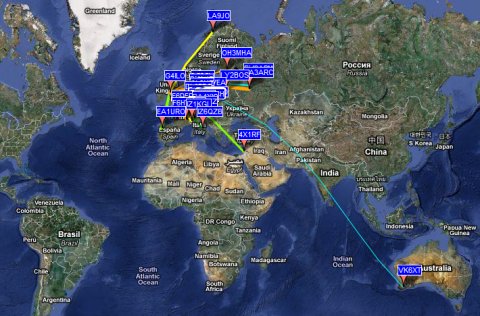
In this case, 5W of WSPR on 40m to a bent attic dipole. Not, perhaps, as impressive as M0XPD’s results with 50mW on 30m. But it’s still nice to be heard on the other side of the planet.

Julian Moss, G4ILO, is a regular contributor to AmateurRadio.com and writes from Cumbria, England. Contact him at [email protected].
 Ham Radio Deluxe |
 W5SWL Electronics |
 Ham Radio Prep |
 KB3IFH QSL Cards  Hip Ham Shirts  HamRadioAuctions HamRadioAuctions Reliance Antennas Reliance Antennas Enigma Shop Enigma Shop |  morseDX  Ni4L Antennas  R&L Electronics R&L Electronics antennas.us antennas.us QRV QRV |
- Matt W1MST, Managing Editor
